In June, while working from New York, I had the chance to speak with many people around Wall Street.
I learned a lot. And I was reminded of an old business-school truth: if you want to build companies, you have to understand how money flows.
More people are becoming rich. More wealth is changing hands. And the next generation of capital will not behave exactly like the last one.
Private bankers will feel it first. But founders and investors should pay attention too. More capital does not automatically mean easier fundraising. It means new allocators, new habits, new expectations — and more noise.
Pic. The money still likes New York. The owners are changing.(source)
Before the money changes hands, there is a simpler fact: there is more of it.
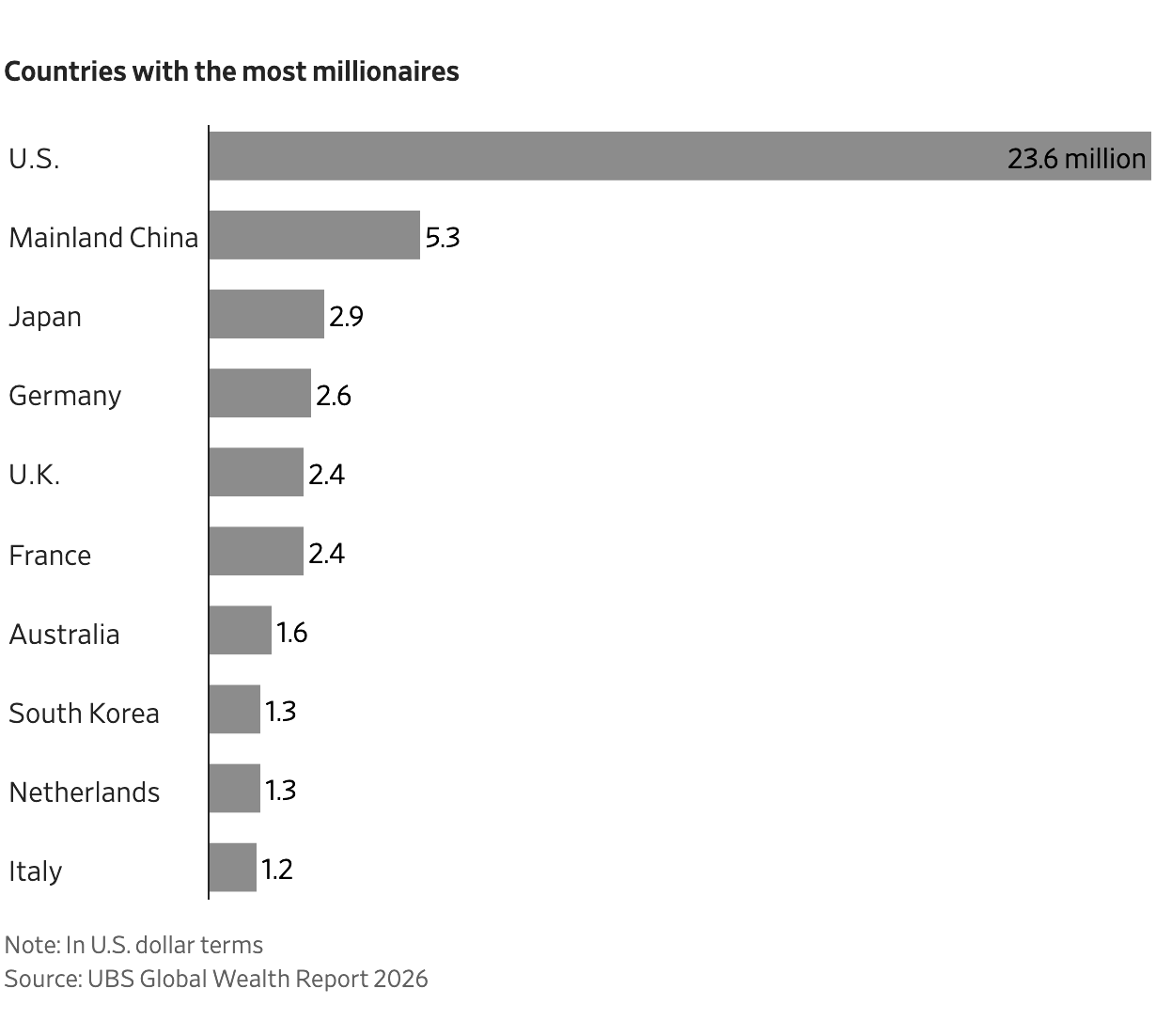
UBS reported that nearly one million people became US-dollar millionaires worldwide in 2025. The United States alone added more than 440,000 new millionaires, or more than 1,200 per day. That is the number behind the WSJ headline, and it matters because it shows that the story is not only about inheritance. New wealth is still being created at scale. 1
The US is still the main factory for new millionaires. Family offices tend to follow the smell of fresh capital. (source)
That wealth is not coming evenly from wages. It is heavily linked to financial assets, company ownership, public markets, private markets, and technology. In the US, the WSJ notes that financial assets such as stocks and bonds make up a large share of gross wealth, which helps explain why strong markets create new rich people quickly. This is also why AI matters here. If AI drives another wave of company formation, market gains, IPOs, secondary sales, and founder liquidity, it will not only change technology. It will create new allocators of capital.2
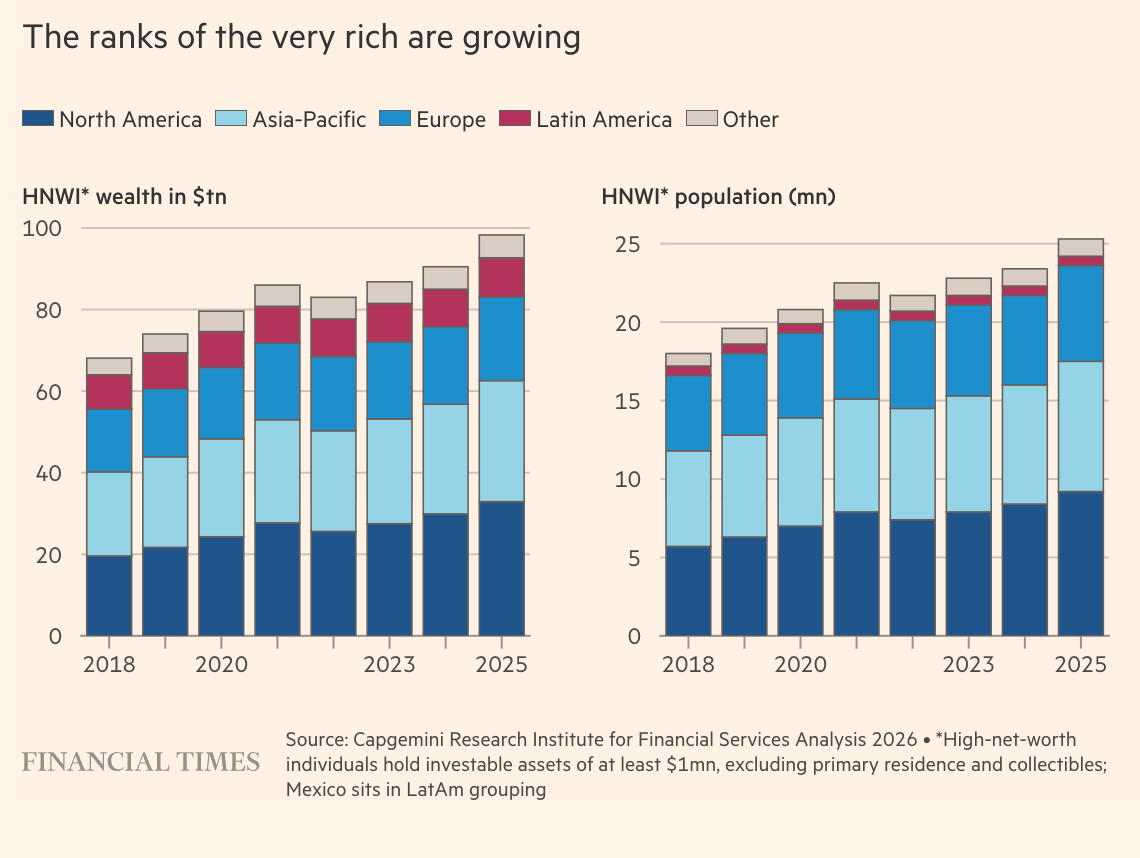
This is the first money-flow shift: the investable wealth base is expanding. More founders will exit. More employees will receive liquid stock. More operators will become angels. More family offices will be created. More people will sit between “successful professional” and “institutional investor” and ask the same question: where should my capital go now?
More millionaires. More private capital looking for a job. (source)
That is the backdrop for the wealth transfer. The next decades are not only about old money moving down the family tree. They are also about new money being created by technology, markets, and private-company value. The important story is the combination: more private capital, more people controlling it, and a younger generation with different habits deciding what to do with it.
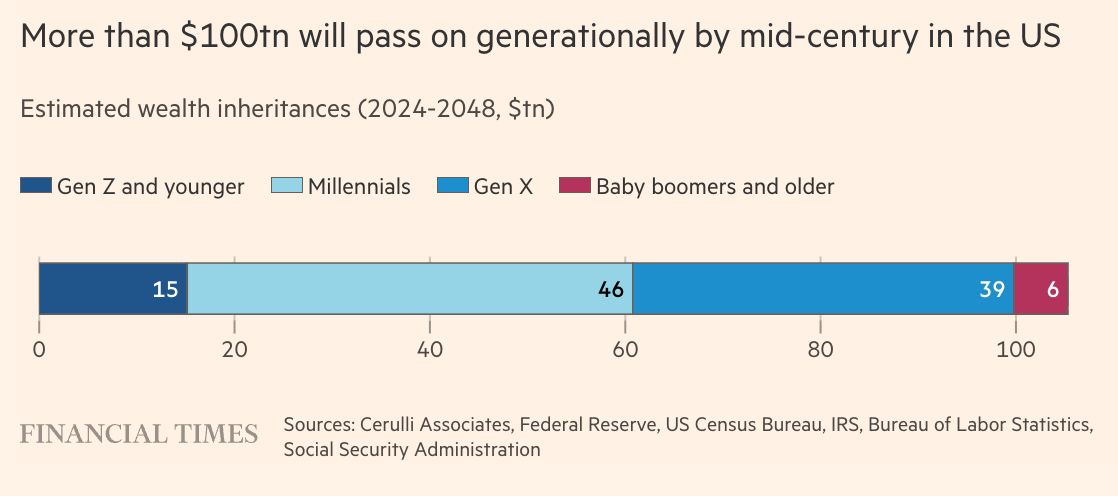
The headline number is large enough to feel abstract. Cerulli projects that $124 trillion in wealth will transfer in the US through 2048. Around $105 trillion is expected to go to heirs, and around $18 trillion to charity. This is the number behind the “great wealth transfer” story.3
But the size of the transfer is not the most interesting part. The more important question is who will control the capital, how they will think about it, and which institutions they will still trust once the money moves. Wealth does not only move across bank accounts. It moves across habits, risk preferences, interfaces, loyalties, and beliefs.
Pic. Inheritance is not a family story. It is a capital-allocation event. (source)
The simple version says: old people die, young people inherit, banks lose, crypto wins. Too simple. A lot of this wealth will first move to spouses. Some will move to Gen X before it reaches millennials or Gen Z. Some will stay inside family structures, foundations, trusts, companies, and private arrangements. The FT article makes the same point: the transfer is already disturbing wealth management, but it is not a clean handover from one generation to another.4
The better reading is this: a large part of private capital is entering a new decision cycle. The people influencing it, inheriting it, advising on it, and reallocating it will not behave exactly like the people who built it. That is enough to matter for founders, funds, banks, family offices, and everyone who depends on private capital formation.
Pic. The children did not inherit the asset allocation memo. (source)
Private banking was built on long relationships. The banker knew the founder. The founder trusted the banker. The family office knew the lawyer, the tax structure, the operating company, the awkward sibling, and the family lunch dynamics. In old wealth, that kind of continuity was part of the product.
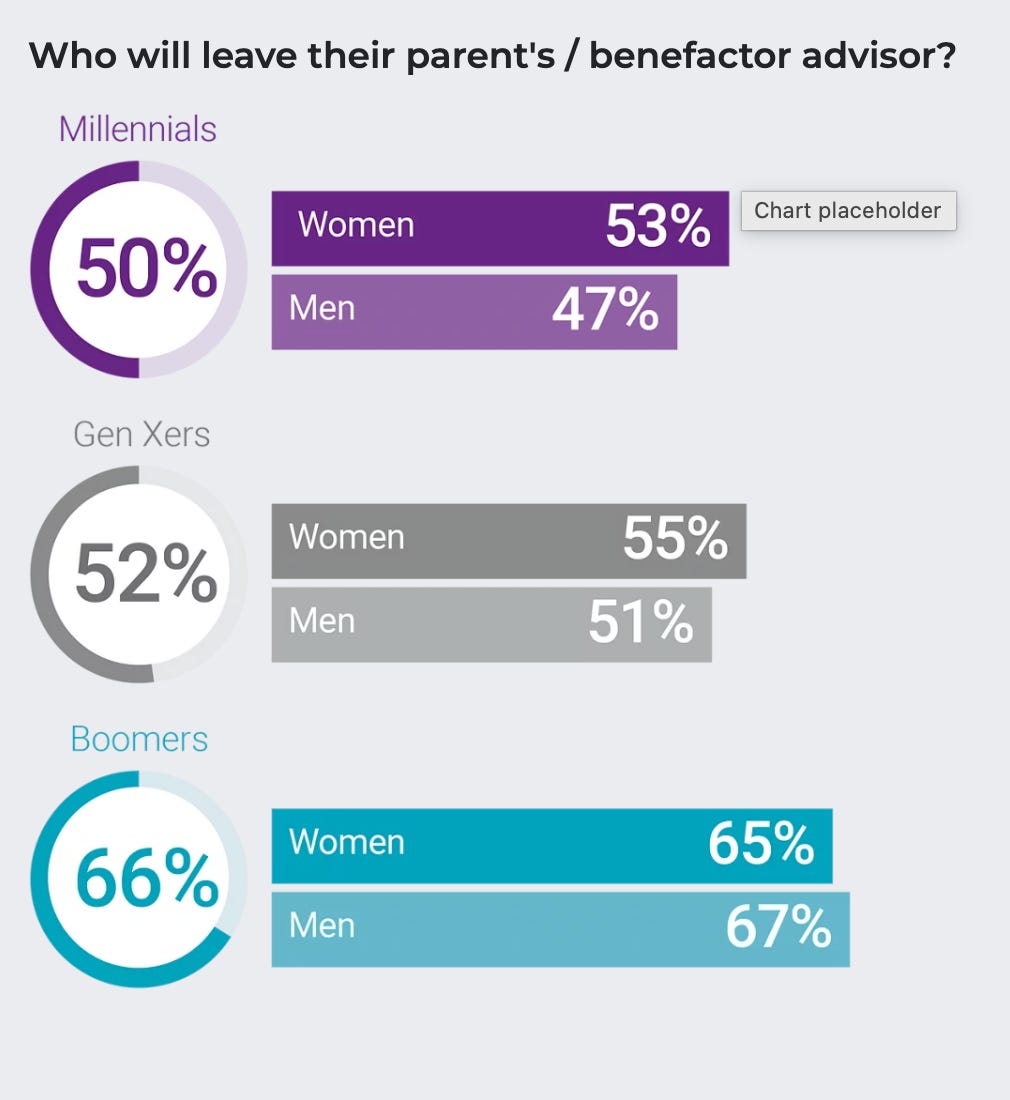
That model still has value. But inherited loyalty is weaker than the industry wants to believe. Natixis reported that 55% of next-generation heirs plan to leave their benefactor’s adviser. That does not mean advice is dead. It means the next holder of the assets wants to choose the relationship, not simply inherit it.5
Pic. The assets may stay for a while. The loyalty already left.
This is the quiet problem for traditional wealth managers. Their old client may still love the institution. The heir may only see an expensive login, a slow process, and a person who speaks the language of their parents. The account may stay for a while, especially if the structures are complex. But emotional ownership is different from legal ownership.
The assets may stay for a while. The loyalty already left. (source)
That is why the FT piece matters beyond wealth management. It shows a broader trust reset. The next generation may still want advice, but it wants advice wrapped in access, speed, transparency, and relevance. The old relationship is no longer the moat. At best, it is the starting point.
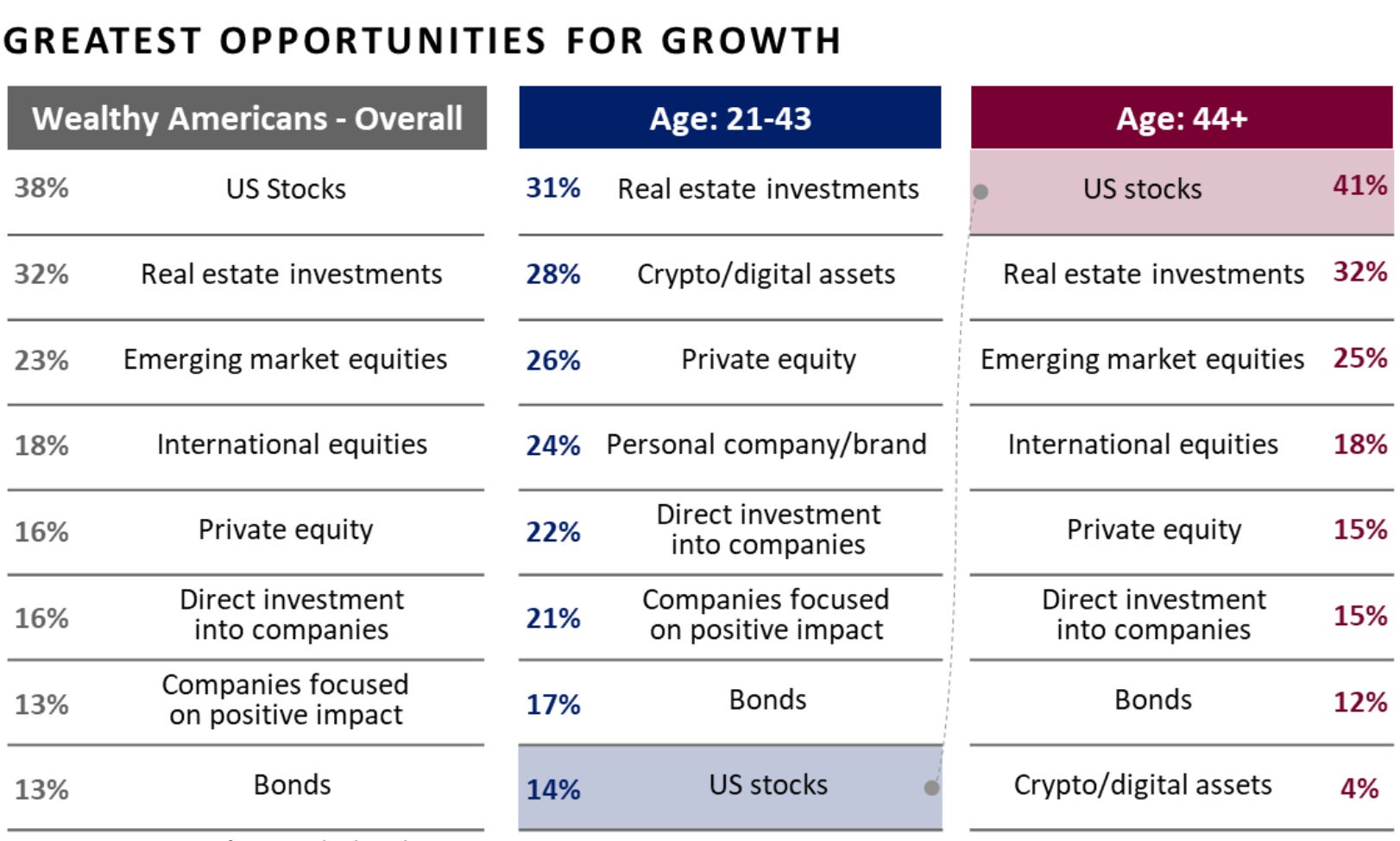
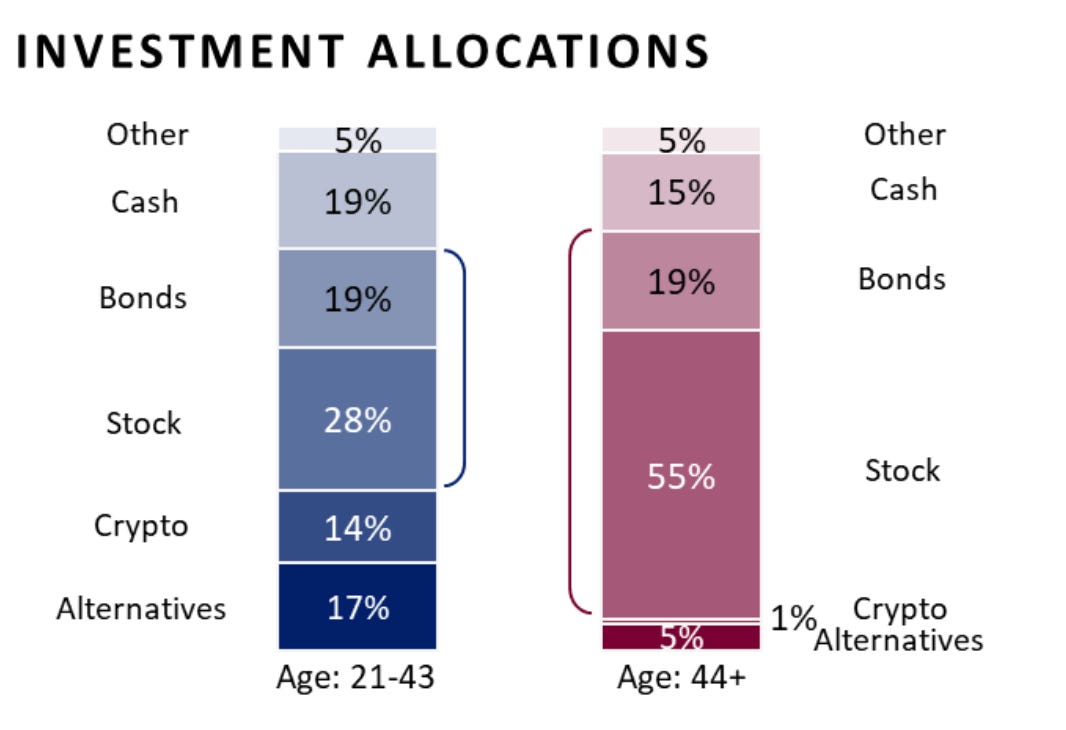
Bank of America’s 2024 study of wealthy Americans shows the split clearly. Among wealthy investors aged 21 to 43, the highest-ranked growth opportunities included real estate, crypto / digital assets, private equity, personal company or brand, and direct investment into companies. US stocks and bonds ranked much lower for that younger group.6
Pic. Real estate, crypto, private equity, direct deals. Apparently bonds were not invited to the party. (source)
This should not be romanticised. Younger investors are not automatically better investors. Private markets are harder to price. Crypto is volatile. Direct investing can turn confidence into very expensive education. A generation that grew up with startup legends and platform access can also confuse access with judgment.
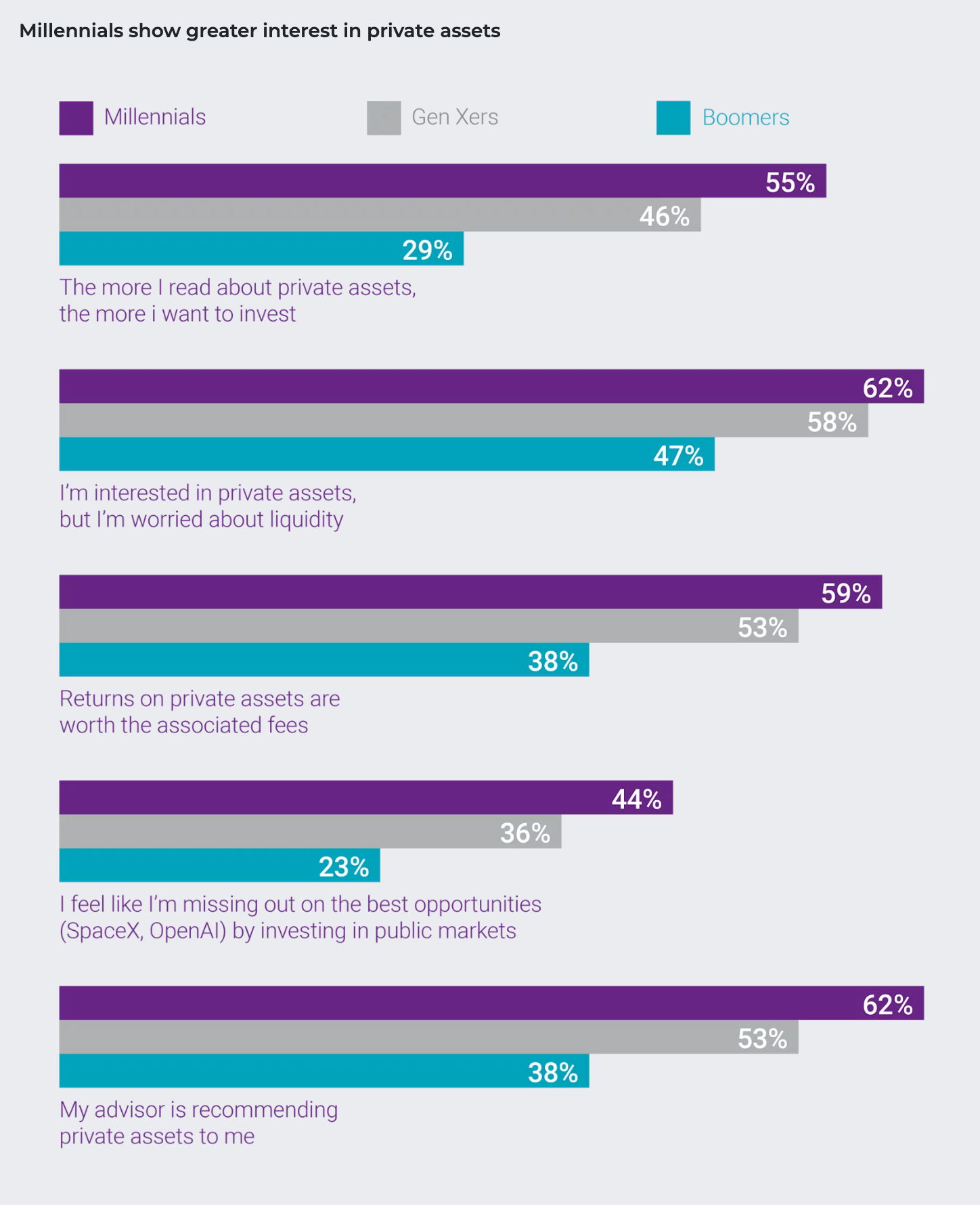
Still, the direction matters. Younger wealthy investors grew up watching private companies become cultural assets long before they became public assets. SpaceX, Stripe, OpenAI, Databricks, Anthropic, Revolut and similar companies shaped the imagination of capital before most people could buy them in the public market. So the question changes. It is less “Which listed fund should I buy?” and more “How do I get access before everyone else?”
Pic. Same wealth class. Different portfolio religion. (source)
That shift is uncomfortable for traditional advisers. A classic portfolio discussion starts with allocation, risk, liquidity, and time horizon. The next-generation discussion often starts with proximity: access to private companies, founders, networks, co-investments, AI winners, crypto infrastructure, and venture-like upside. Some of that is rational. Some of it is FOMO wearing a Patagonia vest.
The large institutions have noticed. Morgan Stanley completed its acquisition of EquityZen in January 2026, bringing a private-share platform into its broader wealth ecosystem. Charles Schwab completed its acquisition of Forge Global in March 2026, giving eligible investors access to pre-IPO companies through direct private share purchases and funds.78
Everyone wants the next SpaceX. Preferably before the sign goes up in Times Square. (source)
The same pattern is visible in crypto. JPMorgan and Coinbase announced a partnership that will let Chase customers link bank accounts to Coinbase wallets. Morgan Stanley Wealth Management and Galaxy Digital announced a referral capability around spot crypto exchange-traded products. These are not random product features. They are signs that traditional finance is trying to absorb behaviour it did not originally own.910
The strategic move is clear. Banks and wealth managers are trying to move from “we advise you” to “we give you access.” Access to private shares. Access to crypto rails. Access to alternative assets. Access to founder networks. Access to the next generation before it walks out the door.
The risk is also clear. If a young heir already distrusts the family bank, the bank’s new private-market or crypto product may not be enough. The institution may offer the right asset but still feel like the wrong channel. That is the uncomfortable part: the product can modernise faster than the trust.
Founders should care because capital is becoming more fragmented. The next generation of private money will not only sit inside old family offices, endowments, and institutional venture funds. It will also sit with heirs, operators, exited founders, crypto-native investors, angel syndicates, private-market platforms, and smaller family offices trying to behave more directly.
B O X
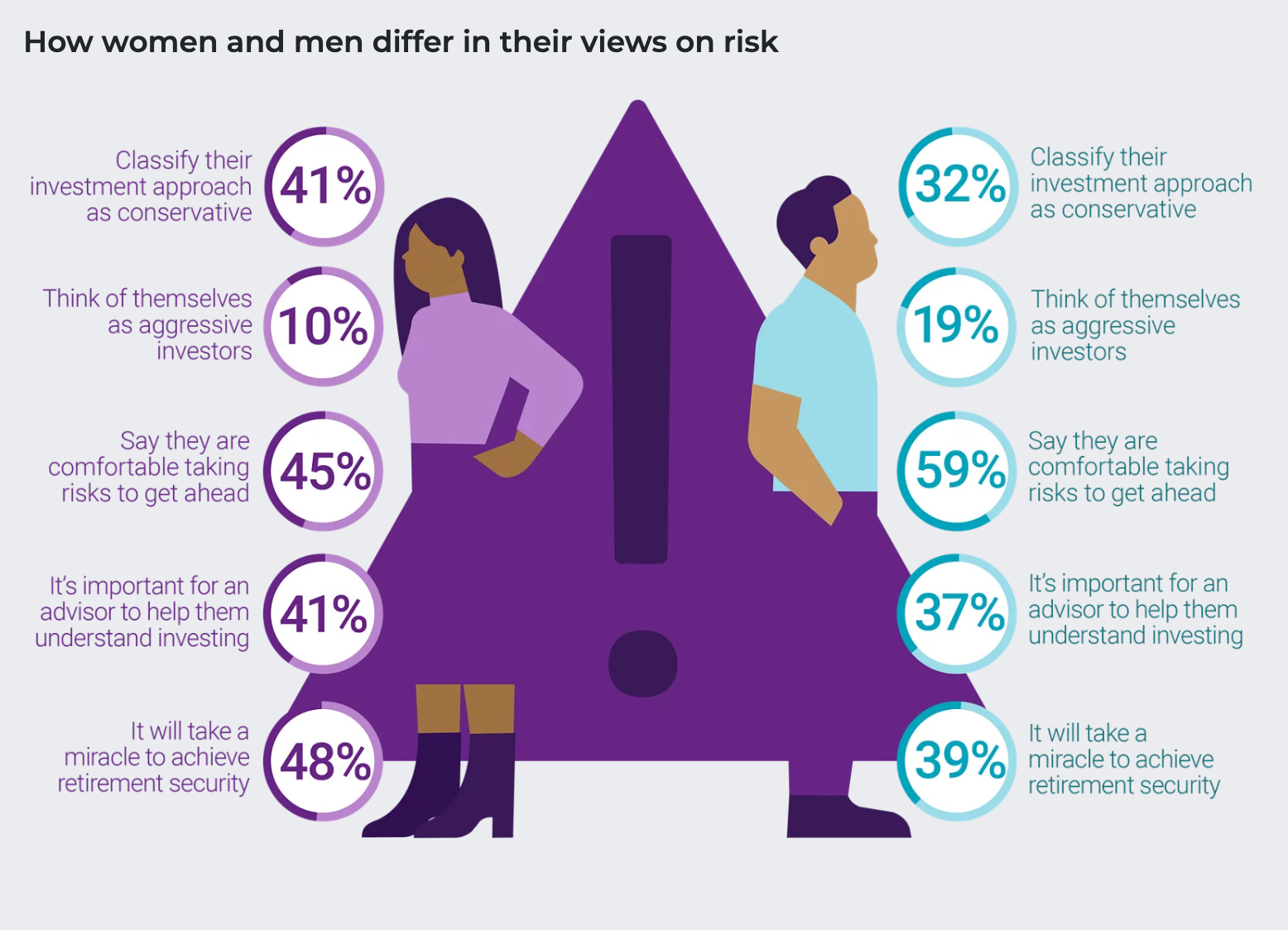
More private capital means more opportunity — but only for people who understand risk, ownership, dilution, timing, and conviction. Female founders and allocators should not wait to be invited into the capital conversation. Learn the game early. Play it seriously.
Pic. Risk is personal. Access is not the same as conviction. (source)
However, more capital does not automatically mean better capital. More access does not automatically mean better judgment. Early-stage investing is still hard because the asset is not yet obvious. At pre-seed, there is often no clean revenue curve, no finished team, no institutional signal, and no consensus. There is only a team, a market shift, a product wedge, and a lot of work ahead.
That is where the role of early-stage venture changes. The fund is not just a wrapper around access. It becomes a filter, a translator, and sometimes a production partner. Good early-stage funds help decide which founders deserve attention before the market agrees. They help turn a raw company into something later capital can understand.
For founders, this raises the bar on communication. “AI platform for enterprise productivity” is not enough. Capital that has more access also has more noise. The clearer founder will beat the louder founder. The founder who can explain what is changing, why now, why this team, and why this wedge has a better chance of being remembered.
For funds, the same rule applies. A thesis must be simple enough to repeat and specific enough to matter. If an LP cannot explain the fund after one conversation, they cannot underwrite it, discuss it internally, or move toward commitment. In a market with more private wealth and more private-market access, vague positioning becomes expensive.
This is the money-flow point for venture. The next generation of wealth wants access to the next generation of company creation. But access alone is not the product. The product is judgment: which founders, which markets, which timing, and which work turns an early idea into a company worth financing.
Money is changing hands. Culture already did.
Future’s “Radio” feels right for this piece: fast, synthetic, restless, platform-native. Not legacy wealth. Not marble lobby music. More like capital with notifications turned on.
As you know: Money does not make you happy. But it does improve your options.
StudioAlpha Capital is a Delaware-structured pre-seed venture fund backing AI-native B2B software startups at day zero. Legal counsel: Cooley LLP. Fund administration: AngelList.

![The Financial District of Lower Manhattan, including Wall Street, is the world's principal fintech and financial center.[1][2]](https://substackcdn.com/image/fetch/$s_!z84_!,f_auto,q_auto:good,fl_progressive:steep/https%3A%2F%2Fsubstack-post-media.s3.amazonaws.com%2Fpublic%2Fimages%2Fde505538-91e9-4de2-b721-7bc343030acb_3840x2498.jpeg "The Financial District of Lower Manhattan, including Wall Street, is the world's principal fintech and financial center.[1][2]")




Comments
Nothing yet. Say the first thing.
Sign in to join the conversation.