
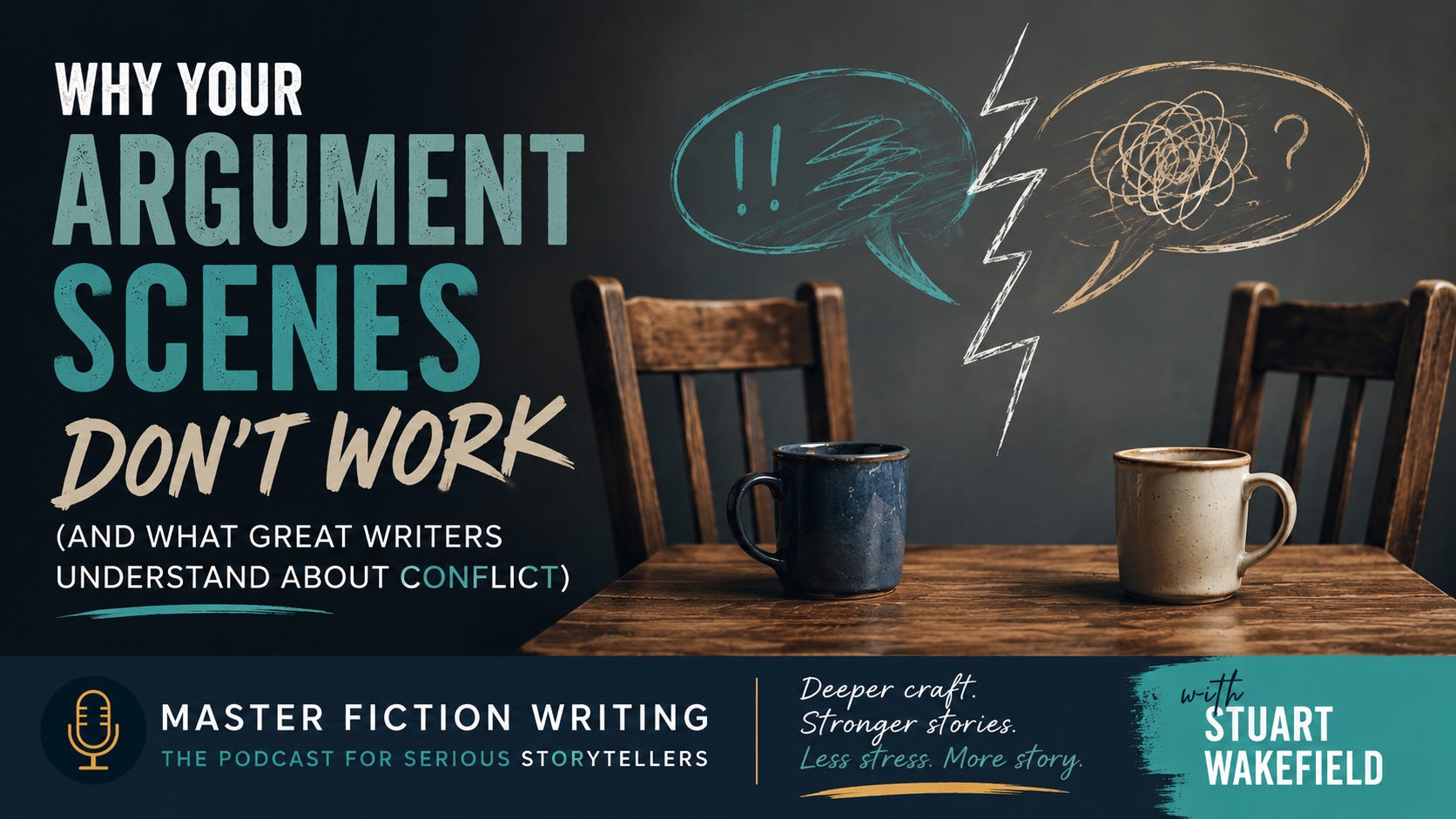
I read a lot of manuscripts as a book coach, and there’s one problem that turns up surprisingly often. Two characters are supposedly having a blazing row, yet somehow it feels… polite.
Everyone gets to explain themselves. Every point is answered with another perfectly reasonable point. By the end of the scene, the reader has an excellent understanding of the novel’s themes and absolutely no sense that two human beings have just collided.
It’s strange, really, because none of us argues like that.
Think about the last genuinely difficult conversation you had. Chances are you weren’t delivering beautifully structured speeches. You were probably trying to protect yourself. Perhaps you changed the subject because you weren’t ready to answer the real question. Perhaps you said something you regretted five seconds later. Perhaps you realised halfway through that you weren’t actually upset about what you thought you were upset about.
Real arguments are gloriously untidy.
That’s why they make such powerful scenes in fiction.
One of the biggest shifts in my own thinking came when I stopped seeing arguments as conversations and started seeing them as attempts to change another human being.
That sounds obvious when you say it out loud, but it’s astonishing how often we forget it when we write.
If two characters simply disagree, you’ve got a conversation.
If one character desperately needs the other to forgive them, stay with them, leave them, tell the truth, abandon a plan or admit they’ve been wrong, you’ve got drama.
The difference isn’t the topic.
It’s the objective.
Once you begin looking at arguments through that lens, lots of other things start making sense. Characters rarely argue about the thing they’re actually arguing about. A row about moving house is often really about security. A disagreement over money turns out to be about trust. Two siblings arguing over who gets Mum’s dining table are usually discussing something far older than furniture.
Readers understand this instinctively.
Even if they can’t explain why a scene works, they can feel when the emotional battle is happening somewhere beneath the words.
That’s one reason I think writers sometimes become too concerned with dialogue itself. We polish the lines, search for clever comebacks and worry about making everyone sound distinctive. Those things matter, of course, but they’re not usually what keeps a reader glued to the page.
They’re watching the emotional movement.
Who’s gaining ground?
Who’s retreating?
Who’s just revealed something they didn’t mean to?
Who’s quietly realised they’re losing?
That’s the story.
One idea I return to again and again is that every scene should leave something different from how it began. Argument scenes are no exception. If two characters have exactly the same relationship after a blazing confrontation as they did before it, there’s a good chance the scene hasn’t earned its place.
The best arguments don’t simply exchange opinions.
They alter trust.
They shift power.
They expose fear.
Sometimes they close a door that can never be reopened.
That’s why they’re so satisfying to write when they work well. You’re not simply filling pages with dialogue. You’re changing the shape of the story.
I’ve devoted the latest episode of Master Fiction Writing to this subject because I think it’s one of those areas where a small shift in perspective can transform an entire manuscript.
Instead of asking, “What are my characters arguing about?”, try asking, “Who is trying to change whom?”
It’s a surprisingly different question.
And it usually leads to a much more interesting answer.
The latest in-depth episode of this subject is on the Master Fiction Writing podcast, available now wherever you listen to podcasts. I’d love to know whether this changes the way you think about argument scenes or whether you’ve spotted any fictional rows that get it spectacularly right.
Comments
Nothing yet. Say the first thing.
Sign in to join the conversation.