
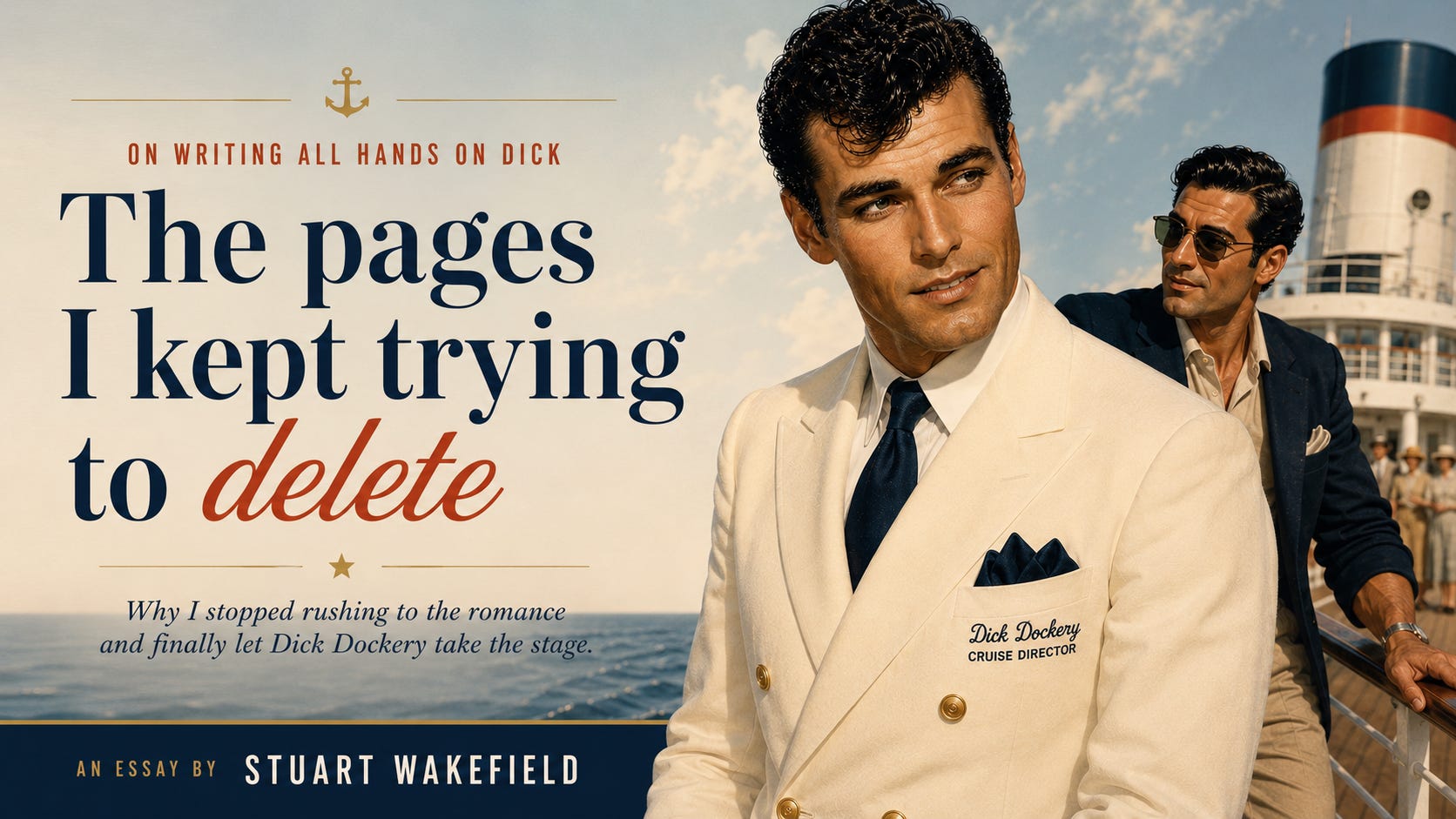
Today, All Hands on Dick is published.
That’s a sentence I’ve imagined writing for a while now, although I hadn’t expected the emotion attached to it. Relief, certainly. Excitement. Gratitude. What I hadn’t anticipated was curiosity. Publication has a habit of making you look backwards. You stop asking whether the book works and start wondering why it took so long to become the book you wanted to write.
For me, that question led straight back to the opening chapter.
I rewrote it more times than I can count. I moved scenes around, experimented with different starting points and, at one stage, became convinced that the novel simply began too late. Like many writers, I’d absorbed the familiar advice about avoiding throat-clearing and getting to the story as quickly as possible. My romantic interest, Van Valentine, is the catalyst for everything that follows. He arrives aboard the S.S. Celestial, meets cruise director Dick Dockery, and quietly alters the course of Dick’s life. If that’s where the story truly begins, why not begin there?
It seemed such a sensible question that I stopped questioning it.
Instead, I kept trimming away everything that came before Van’s arrival. Every draft edged him a little closer to the first page. Every draft became a little more efficient. Every draft also became a little less alive.
I don’t think I recognised the problem until I stopped looking at the chapter as a writer and started looking at it as a book coach.
Over the years I’ve written almost a hundred of editorial letters. If there’s one question that appears more often than any other, it’s probably this:
Why should the reader care about this person?
It’s an irritating question because writers almost always answer a different one. We explain who the protagonist is, what they want, and what happened to them before the novel began. Sometimes we explain the entire plot.
Those answers have their place, but they aren’t usually what creates attachment. Affection isn’t built out of information. It’s built out of experience. Readers decide whether they care about a character by spending time in their company.
The embarrassing part of this story is that I knew all of that already.
I simply wasn’t applying it to my own manuscript.
When I finally stopped trying to hurry towards the romance, I found myself watching Dick go to work instead.
Before Van appears, Dick welcomes passengers aboard, reunites Mrs Bellamy with her missing hat, settles a dispute over dining tables, comforts a gentleman who has managed to become seasick while still tied to the dock, and untangles a cabin mix-up that threatens to become a social catastrophe. None of these moments changes the direction of the plot. All of them reveal something about the man at its centre.
One exchange in particular made me realise I was finally writing the novel I’d wanted to write all along.
“Mr Dockery,” she says, “there is a gentleman in my cabin.”
Dick’s smile does not move. “Is he expected?”
“Certainly not.”
“Then he is lost. Confidence may also be involved, although only the first condition responds well to a steward.”
The laugh matters, of course. This is a comedy of manners, after all. Yet the joke, however gentle, isn’t really doing the heavy lifting.
What interested me when I looked at the scene again was Dick’s instinctive response to another person’s distress. He doesn’t dismiss it. He doesn’t mock it. He absorbs it, lowers its temperature, and hands it back in a form that feels manageable. Humour is simply the tool he happens to use.
The same thing happens a few pages later, after he’s resolved the misunderstanding.
“My position depends on making everything sound almost harmless.”
I smiled when I reread that line recently because I realised I’d underestimated it. At the time, I thought it was simply a neat piece of dialogue. Looking back, I think it may be the novel’s quiet thesis.
Dick’s professional role is to make everyone else’s problems seem smaller than they really are. Passengers arrive carrying anxieties, embarrassments, disappointments and secrets. He smooths them over before anyone else notices. If a marriage is wobbling, a passenger is frightened, or someone has wandered into the wrong cabin with a shaving brush, Dick restores order with such practised grace that the crisis almost disappears.
It’s a wonderful skill to possess professionally, and it’s a considerably more complicated way to live.
By the time Van finally steps aboard the Celestial, I no longer wanted readers to think, Ah, here’s the love interest.
I wanted them to think, I hope this doesn’t hurt Dick.
That isn’t a structural difference. It’s an emotional one.
Van’s first conversation with Dick is playful from the outset.
“Does the voyage promise to be lively?” Van asks.
“The New York-to-Bermuda crossing is famed for relaxation.”
“That sounds like something printed on a brochure after a lawyer has stripped away the truth.”
A few lines later, Dick offers what has become one of my favourite exchanges in the chapter.
“We endeavour to provide sun, dancing, excellent food, and the illusion that passengers have left their troubles ashore.”
“And have they?”
“Never. But they pack them all the same.”
The line lands because we’ve already watched Dick carrying everyone else’s troubles for the best part of a chapter. Had Van boarded twenty pages earlier, the dialogue would have been exactly the same. The scene would even have been recognisably the same scene, but I don’t think it would have meant the same thing.
Publishing a novel after years of coaching other writers has been a quietly humbling experience. I haven’t discovered that the advice I give clients is wrong. If anything, I’ve discovered how painfully right it is. The difficulty has never been understanding the principles. The difficulty lies in recognising the moment your own manuscript is asking you to trust them.
Writing and coaching have turned out to be much less separate than I’d imagined. Every editorial letter has sharpened my eye for my own work, and every chapter I’ve wrestled into shape has made me more sympathetic when a client says, “I know what I should do. I just can’t persuade myself to do it.”
I understand that sentence rather better than I used to.
To mark publication day, I’m sharing the opening chapter below.
When you read it, don’t worry too much about where the plot begins. Instead, spend a little time watching Dick do his job. Watch how he talks to people. Watch what he notices. Watch the problems he chooses to solve before anyone asks him to. By the time Van Valentine walks up the gangway, you’ll know whether I finally learned the lesson I’d been teaching everyone else for years.
Here we go!
Everyone needs Dick.
Some need Dick on the gangway. Some need Dick below deck. Some require Dick in their cabins immediately, though in most cases the matter proves to involve luggage or a husband who has wandered into D Deck when he belongs, regrettably, in E. By eleven o’clock that morning, Dick Dockery has been summoned by a widow, pursued by two sisters, cornered by a man with a damp collar, and asked whether he might personally inspect a berth whose bed is “not as firm as advertised.”
He can, of course. Dick can do almost anything if asked nicely.
This is particularly true on the embarkation deck of the S.S. Celestial at ten minutes past eleven on a cloudless New York morning, with the city behind them full of theatre marquees, taxi horns, television aerials, and headlines nobody had paid first-class fares to think about, when the entire civilised world appears to have misplaced its ticket, quarrelled with its travelling companion, overdressed for the weather, underprepared for the crossing, and arrived under the impression that a single young man in a pristine white jacket can personally restore order to creation.
Fortunately, Dick is already doing his best.
He moves through the confusion as if choreographed by a very expensive dance director with a private grudge against anything other than the foxtrot and a deep suspicion of this new cha-cha nonsense. Sunlight finds him at once, because sunlight, like most people, knows quality when it sees it. It glints on his dark hair, catches the white line of his smile, and turns the brass buttons of his jacket into tiny declarations of competence. His shoes are immaculate, his collar crisp. His expression suggests a man who has never once been surprised by disaster. Disappointed in its timing, yes, but never surprised. A passenger list is tucked under his arm.
“Welcome aboard, madam. Mind the step. Your cabin is on B Deck, starboard side. Yes, that is the sea. No, it doesn’t usually come indoors. Not unless specially invited.”
A steward hurries towards him, pink with urgency. “Mr Dockery, Mrs Bellamy’s hat has gone missing.”
“Mrs Bellamy’s hat,” says Dick, without slowing, “is on Mr Bellamy’s head.”
The steward blinks. “Sir?”
Dick inclines his chin towards the second gangway, where a stout gentleman in a grey suit is standing beneath an enormous violet creation with silk cherries trembling over one eye. Mr Bellamy, owing either to matrimonial obedience or complete spiritual defeat, appears not to have noticed.
“Retrieve it gently,” Dick says. “Over-decoration above the neck rather suits him.”
The steward darts away towards Mr Bellamy. Mrs Bellamy, a compact woman in navy silk, is also advancing on her husband with the moral force of a harbour bell. Dick continues forward, already smiling at a tall, narrow woman in dove-grey silk whose expression suggests she has discovered an offence against civilisation and intends to have it tried at The Hague.
“I am not sitting at Table Twelve,” the woman announces. “Table Twelve is beside a pillar.”
“The pillar is one of our most discreet passengers, Mrs Crewe,” says Dick. “It has never repeated a confidence, even after brandy.”
“I requested a view.”
“And you shall have one.” Dick takes a notebook from his pocket, turns it over with the flourish of a conjurer, and writes something neat and decisive in pencil. “Table Six. Near the windows. Excellent light, favourable angle, and no pillar except Mr Crewe after his second brandy.”
Mrs Crewe gives him the look reserved for men who are being forgiven against better judgement. “You are very quick, Mr Dockery.”
“One has to be, madam. On a ship this size, delay can be fatal. Especially when ladies are not properly seated.”
From behind him comes a faint moan. Dramatic moans are already plentiful on the Celestial, but this one is damp and tremulous, issued by a thin gentleman clinging to the rail with tragic intensity.
Dick turns, smile softening by exactly three degrees. “Mr Phipps, isn’t it?”
The man opens one eye. “I fear I am a poor sailor.”
“We haven’t sailed yet.”
“That is what alarms me.”
Dick takes his elbow with professional tenderness. There are ways of touching a passenger which say support, not lawsuit, and Dick knows all of them. “The trick is to look at the horizon.”
“We are facing Manhattan.”
“Then look at Manhattan as though it is the horizon. Much the same principle, more architecture.” He signals to a passing deck steward. “Dry toast and ginger ale. Perhaps the chair with arms. Mr Phipps is conducting preliminary research.”
“Am I dying?” Mr Phipps whispers.
“Not before luncheon. It would ruin the seating plan, and I should hate to have you go down before the soup.”
By the time Mr Phipps has been installed beneath a rug despite the heat, Dick is intercepted by a flustered woman in a travelling suit the colour of chilled champagne. She clutches a cabin key in one hand and a glove in the other, although the glove, judging by her expression, has somehow become evidence in a case of maritime indecency.
“Mr Dockery,” she says, “there is a gentleman in my cabin.”
Dick’s smile does not move. “Is he expected?”
“Certainly not.”
“Then he is lost. Confidence may also be involved, although only the first condition responds well to a steward.”
“He was unpacking.”
“That does suggest confidence.” Dick takes the cabin key from her, reads the number, and looks at the passenger list tucked beneath his arm. “Ah. A transposed digit. Your cabin is B38. The gentleman is meant to be in B83.”
“Then why was his shaving brush in my washstand?”
“Because, madam, numbers are treacherous things, and gentlemen in transit are rarely at their best before luncheon.” He hands the key back with such grave assurance that the invasion of her cabin becomes less a scandal than an administrative hiccup. “I’ll have a steward redirect him immediately. Your belongings will be entirely undisturbed.”
“My nightdress was on the bed.”
“Then we shall all be thankful he was still at the shaving-brush stage.”
The woman’s mouth twitches despite her best efforts. “You make it sound almost harmless.”
“My position depends on making everything sound almost harmless. Especially when a gentleman has entered the wrong cabin with his brush in hand.”
He sends her off with a steward and the quiet knowledge that B-83 will require an apology, followed by a firm explanation of nautical numeracy.
He is almost at the top of the gangway when Mrs Honoria Primm plants herself before him like a figurehead with opinions. She is a magnificent construction of burgundy silk, lorgnettes, pearls, and social appetite. The ship, being made of steel, is in no danger of sinking beneath her scrutiny, but several weaker men have already listed.
“Mr Dockery,” she says, “I require clarification.”
“Most of us do, Mrs Primm. Some, like the gentleman over there, merely disguise it with a fabulous hat.”
She accepts this as tribute. “The captain.”
“Yes?”
“Is he married, widowed, or persuadable?”
Only Dick’s eyes move. Around him, the embarkation deck continues its grand overture of whistles, ropes, gulls, footsteps, floral arrangements, and human need. Inside him, where less poised men keep panic, a small clerk adds Mrs Primm to the list of items requiring delicate handling.
“The captain,” Dick says, “is devoted to the Celestial.”
“How dull. Is she devoted back?”
“Passionately. Though she can be demanding in wet weather and has been known to creak when handled roughly.”
Mrs Primm looks towards the bridge, where the object of her maritime inquiry has just appeared. Captain Everard Blaine is silver-haired, square-jawed, and dressed in white so severe it implies both naval authority and excellent soap. He descends three steps, observes the deck’s population of anxious passengers, spots Dick, and experiences the visible relief of a man discovering that civilisation has already hired staff.
“Dockery,” he says.
“Captain.”
“Everything under control?”
This is a foolish question, but captains are permitted a few. It helps keep them away from passengers.
“Perfectly,” says Dick, as Mrs Crewe begins arguing with her husband from a distance, and Mr Phipps groans into his ginger ale.
“Good man.” Captain Blaine turns his smile upon Mrs Primm with the polished warmth of command that has disappointed many women by being non-transferable. “Madam.”
“Captain,” says Mrs Primm, lowering her lashes with the grave sensuality of a bank vault opening.
Captain Blaine, sensing a possible ambush of the female persuasion, retreats at once into authority. “Dockery will see to your comfort.”
“How very generous of him,” says Mrs Primm.
“How very necessary,” murmurs Dick.
The captain has already gone. This, too, is leadership.
Across the deck, Bunny Marlowe passes through the crowd as if she has been poured, cool and glittering, from a cocktail shaker. As the Celestial’s social hostess, she is paid to make introductions and smooth ruffled feathers. She also makes it her business to know exactly why, for her own pleasure, said feathers have been ruffled. She would be dangerous in the right glass. Her gloves are white. Her mouth suggests she has heard every line before. She pauses beside Dick just long enough to measure the general human temperature.
“Promising,” Bunny says.
“For what?”
“Disaster. There’s already a gentleman under a rug who wants his mother.”
“He is seasick.”
“We’re still tied to the pier.”
“He is also ambitious.”
Bunny’s eyes move over the passenger list tucked under Dick’s arm. “Any divorcees? Or men travelling alone with too many silk scarves?”
“This is a respectable voyage,” Dick says, the corner of his mouth twitching.
“My dear Dick, we both know that respectability is merely scandal before it has unpacked.”
“Then let us hope the luggage is delayed.”
“Never,” she says with a wry laugh. “Half the fun is seeing what people bring aboard.”
She slips away before he can answer, already smiling at someone else with the expression of a woman placing a bet. Dick watches her go with affection and caution. Bunny is one of those women who can read a room so accurately that even the empty ones become nervous in her presence.
A shadow falls at his side. A practical shadow, edged in terrycloth.
Tony Two-Towels stands beside him with, as one might guess, two snowy towels folded over one forearm and the expression of a man who has seen everything twice, too. He is broad through the shoulders, quiet in the feet, and blessed with the sort of face that could fold a secret as neatly as linen. Nobody knows whether Tony acquired the nickname because he always carries two towels, or whether he carries two towels because the nickname got there first. Ships are full of such mysteries that are usually better left unanswered.
“Tony,” says Dick, glancing at the towels, “why are you carrying towels before we’ve even left harbour?”
Tony looks out across the deck, where Mrs Bellamy is reclaiming her hat from her husband with the tenderness of a woman removing a jellyfish from a pier. “Optimism, sir.”
Dick considers this. “One towel would be optimism.”
“One towel would be confidence, sir. Two allows for human nature.”
“Do we expect human nature before luncheon?”
“Human nature rarely waits for a posted schedule, sir.”
There are days when Dick suspects Tony knows more about the passengers than the passengers, and possibly the Almighty. He says little and moves quietly. He appears at moments when fabric, discretion, and silence are required. These are, on a liner to Bermuda, the three great pillars of peace.
“Keep them handy,” Dick says.
“I intended to, sir.”
Dick reads through the passenger list. Names march before him in tidy columns of widows, businessmen, secret drinkers, public bores, private romantics, and at least one man who has already asked whether Bermuda has excursions “of a personal nature.” Dick’s pencil travels down the page, tapping lightly as he measures the voyage ahead in potential emergencies rather than nautical miles. Mrs Primm will require flattering containment. Mr Phipps must be kept facing whichever direction appears least nautical. B38 and B83 must be prised apart.
Then his pencil stops.
Van Valentine.
The name sits there in ink with outrageous confidence. Dick has seen it before, usually in gossip columns written by men who pretend to disapprove of nightlife while describing it with lavish attention.
Van Valentine of the Valentine Rooms. Van Valentine of the Blue Lantern, where imported liquor appears without visible effort and certain private doors open only for men who know how to ask in private.
The Blue Lantern survived a visit from the vice squad that spring and emerged with its licence and most of its clientele intact. This suggested innocence to nobody and excellent management to everyone. One columnist has taken to printing initials instead of names, thereby ensuring that every respectable household in Manhattan reads him twice. There are policemen who speak of Van without enough evidence, husbands who speak of him too fondly after brandy, and certain gentlemen who do not speak of him at all.
To Dick, this is less glamorous than operational. A passenger who arrives trailing gossip, police interest, and nervous denials can turn a holiday voyage into a headline before the band has unpacked.
Dick tells himself he is professionally noting a passenger of possible importance. Possible incident would be less elegant, though perhaps more accurate.
He is still looking at the name when the final cluster of passengers comes aboard. The deck alters by a fraction, although not everyone appears to have noticed. Mrs Primm continues aiming herself at the bridge. Mr Phipps continues negotiating with toast. Elsewhere, the gentleman in B-83 is about to discover that the sea is not the only thing capable of making a man lose his bearings. Dick feels it, the way a good cruise director feels a dropped tray before it hits the floor.
Van Valentine boards as if the gangway has been waiting for him personally and all will forgive him for being late. He is tall, dark-haired, beautifully dressed, and carrying so little luggage that one must assume either a life of admirable simplicity or a man with other people to worry about socks. His suit is summer-weight charcoal and his shirt blindingly white. Even his tie is an act of quiet insolence. A pair of sunglasses rests in his breast pocket rather than on his face.
He pauses at the top of the gangway and looks over the deck. Assessing. Some men enter a room hoping to be noticed. Van Valentine enters knowing notice has arrived before him, which is always more restful for the man and more dangerous for everybody else.
Dick looks at him for half a second too long.
Van catches him.
Near the rail, a thin man in a straw hat lowers his newspaper by an inch. His eyes move from Van to Dick and back again with the neat economy of a man filing something away. Perhaps he is merely interested in tailoring. Dick has learned not to build a career on perhaps.
It is nothing. Merely a glance meeting a glance across sun, brass, salt, steam, and the excited shriek of a gull with no sense of occasion. But some glances arrive wearing evening dress. This one removes its gloves and makes itself comfortable.
Dick looks elsewhere at once with the smooth precision of a man selecting a canapé from a tray. His spine straightens, and his smile returns to regulation brilliance. His pencil resumes motion over the passenger list, although he has no idea what name it is currently underlining. Inside, some private and inconvenient part of him, long accustomed to being locked in a well-appointed cupboard, sits up and listens.
“Mr Valentine,” he says, when Van reaches him. “Welcome aboard the S.S. Celestial.”
Van’s eyes flick to Dick’s name badge. “Mr Dockery.” His voice is warm, low, and amused at the edges. “You know my name.”
“I know all our passengers’ names.”
“How democratic of you.”
“How essential.”
“And do you always receive gentlemen personally?”
“When they come aboard at the last possible moment, yes.”
“How fortunate. I should hate to be mishandled at the gangway.”
Van offers his ticket. Dick takes it. Their fingers do not touch. Dick calls this professionalism before the less charitable part of him can object. Van’s gaze rests on him with a leisure that makes haste feel vulgar. “Am I late?” Van asks.
“Nearly.”
Van looks past him to the deck, where Tony is silently handing one of his towels to a small child who has managed, before departure, to cover herself in lemonade. “Does the voyage promise to be lively?”
“The New York-to-Bermuda crossing is famed for relaxation.”
“That sounds like something printed on a brochure after a lawyer has stripped away the truth.”
Despite himself, Dick smiles. A real one, smaller than his official smile. “We endeavour to provide sun, dancing, excellent food, and the illusion that passengers have left their troubles ashore.”
“And have they?”
“Never. But they pack them all the same.”
“Then I shall try not to overburden your staff.”
“Our staff are trained for heavy handling.”
“So I see.”
Van laughs with such genuine pleasure that Dick feels it without invitation. Dick has handled hysterical mothers, fainting bridesmaids, misplaced jewels, illegal pets, and a senator who once lost his trousers between breakfast and shuffleboard. He is not a man undone by a laugh.
Still, there it is.
Mrs Primm chooses this moment to reappear, as women of singular appetite often do. “Mr Dockery, I have decided I shall require a tour of the bridge.”
“The bridge is restricted, Mrs Primm.”
“I am not.”
“No one would dare suggest it.”
Van’s eyes flicker. Dick can feel him enjoying the exchange. Van’s attention puts a fresh shine on every answer Dick gives. He can almost see himself reflected in the performance.
Mrs Primm turns her lorgnettes upon Van. “And who is this?”
“Mr Valentine,” says Dick. “A passenger.”
“My dear boy, on a ship everyone is a passenger. The question is whether one is interesting.”
Van bows slightly. “I live in hope, Mrs—?”
“Primm. Honoria Primm.”
“Then I shall strive not to disappoint you.”
“You will fail eventually. Men do.”
“With luck,” Van says, “I may last until dinner.”
“With luck,” Mrs Primm replies, “someone will.”
With that, she sails away, proving that some vessels require no engine. Van watches her go, smiling.
Dick glances towards Mr Phipps, who is now being encouraged by Tony to sip ginger ale from the correct end of the glass. Bunny is near the rail, charming a matron while clearly identifying three future arguments and one probable elopement. The captain is safely above, where he looks handsome and delegates well. The Celestial hums beneath them all, eager for the open water, stocked with champagne and enough polished mahogany to suggest that nothing can be truly serious if it occurs near a decent cocktail cabinet.
“Yes,” Dick says. “That is rather the arrangement.”
Van returns his attention to him. It notices the white jacket, the perfect smile, the brisk pencil, the man arranged like a solution. Then, somehow, it looks for the seam.
“Mr Dockery,” Van says, “I believe I’m in your hands.”
“Everyone is, Mr Valentine,” Dick replies. He realises a second too late what he has said.
Van’s smile deepens by a scandalous fraction. Dick’s remains fixed and flawless.
Doomed.
Behind them, the ship’s horn gives a long, magnificent blast as the Celestial prepares to leave New York, carrying two hundred and eleven passengers and Dick Dockery’s composure, which has just felt the faintest tug from the tide.
No posts
Comments
Nothing yet. Say the first thing.
Sign in to join the conversation.