
Last time I introduced a student — a Black woman, first generation, performing excellence while holding herself together. I talked about how trauma in the classroom flows in every direction, how unacknowledged grief can harden educators into punitiveness, and how the quiet student is the one most at risk of being missed entirely.
Today I want to go deeper. Because understanding what trauma does to growth requires more than naming the experience. It requires understanding where the experience comes from, and why the frameworks we have built to address it keep stopping short.
What follows draws on data and history specific to Black and Brown students, because that is where the record is clearest and the stakes are highest. But the mechanism underneath it; how trust breaks, and how it can be rebuilt, is not exclusive to any one single group of students or educators, it is applicable to nearly every student who enters a classroom.
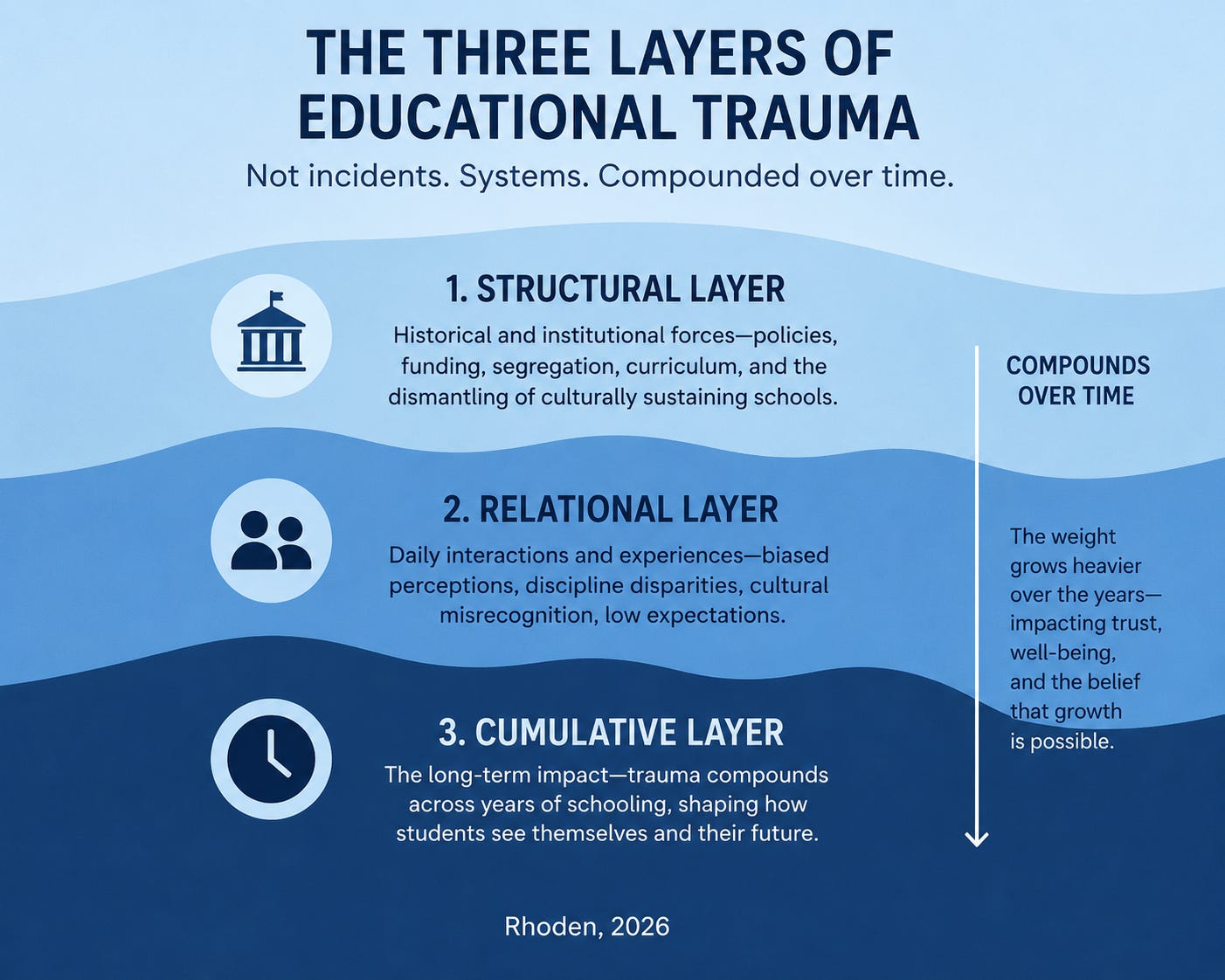
Trauma in education is not a single thing. It is structural, relational, and cumulative.
The structural layer is historical. For Black and Brown students, educational trauma predates any contemporary framework. It emerged through policies that dismantled Black educational institutions, displaced Black educators, and replaced culturally sustaining environments with systems that defined White norms as educational neutrality. The consequence was not only unequal opportunity but institutional distrust passed across generations.
The relational layer is what students experience daily. Research by Okonofua and Eberhardt (2015) shows that teachers are more likely to escalate disciplinary responses to Black students after a first infraction, reading the same behavior as part of a pattern of trouble rather than as an isolated incident the way they would for White students. What this means in practice is that a student’s survival strategies mainly withdrawal, humor, skepticism, or anger, are routinely misread as defiance or inability. The student who is protecting themself from a teacher who, in that moment, functions as the institution and has already decided who they are gets labeled as the problem.
The institution’s fixed mindset about them predates anything they have ever believed about themselves.
The cumulative layer is what happens when structural and relational trauma compound across years of schooling. By the time students reach my college classroom, particularly my students who have failed a course, who are navigating academic probation, who have been told in a hundred institutional ways that they are behind, many of them have not failed to grow. Rather, they have been exhausted by growing in systems that did not foster or support that growth. This is where growth mindset alone becomes incomplete or problematic.
Growth is never simply an individual cognitive belief. It is a relational belief that emerges from culture, history, and trust. Growth mindset asks students to believe they can develop their intelligence through challenge and persistence. That is true and worth teaching. Growth mindset also assumes students believe the institution will recognize their effort fairly. For many students, particularly those whose identities have repeatedly been treated as deficits, that assumption has never been true.
But students do not develop that belief in isolation. They develop it through relationships and institutions that either affirm or undermine the possibility of their growth. Every interaction with teachers, every policy, every experience of belonging or exclusion communicates whether growth is genuinely available to them. Growth, then, is not merely an internal mindset. It is a cultural experience shaped by trust.
You cannot ask a student to embrace challenge when the institution has spent years telling them that they are the challenge. You cannot ask a student to persist through failure when the failure was structurally produced, when their school was underfunded, teachers undertrained, behavior chronically misread and surveilled, and their potential chronically underseen and devalued. Post-traumatic growth; the psychological phenomenon of finding meaning and strength through adversity, does not emerge from adversity alone. It emerges from the meaning made within relationships that hold steady when the ground shifts.
That is the piece many of the dominant frameworks have left out. Growth is relational. Healing is relational. And the relational condition, or binding agent, that makes both possible is Cultural Trust.
Cultural Trust is what happens when a student believes that the institution sees them, that the educator in the front of the room is working with them rather than against them, that their cultural identity is not something to be managed or minimized but affirmed and sustained. It is the infrastructure of safety without which no mindset intervention, no trauma-informed practice, no belonging initiative alone can do what it claims to do.
Without Cultural Trust, trauma-informed practice becomes a technique applied to people who have no reason to trust the person applying it. Without Cultural Trust, growth mindset becomes an instruction delivered to someone who has not yet been given reason to believe growth is possible. Without Cultural Trust, healing-centered education is a philosophy that never reaches the student who needs it most because they have spent all their energy pretending and performing fine when they are not.
I have watched Cultural Trust work. In doing this research over the past few years, I have examined and analyzed more than 360 reflective artifacts (journals and final papers) from students learning to reinterpret their failure not as proof of deficiency but as a disruption they can make meaning from. What I’ve consistently found, in reading and cross-referencing this work, is that the curriculum alone does not explain the shift. It happens because of the quality of the relationship. When students experience a classroom where their full humanity is received without judgment, where vulnerability is met with curiosity rather than correction, where the educator’s own struggles are not hidden behind a performance of authority, and students are allowed to be themselves, something opens. Not always dramatically. But durably.
That is Cultural Trust in practice. And it is available to every educator willing to do the institutional and personal work of building it, including the work of acknowledging their own trauma alongside their students’.
I’ve grounded this piece in the experience of Black and Brown students because that is where the historical record and the research are most explicit about how trust gets broken. But the student who brings only the parts of themselves the room has already agreed to recognize, and leaves the rest at the door, is not confined to any one particular or singular identity. So is every educator carrying grief the institution never asked about. Cultural Trust is not a program for one identity group. It is the condition every classroom needs and most were never built to provide.
Trauma does not always stop growth. Too often, growth happens in spite of the institution, not because of it, sustained by relationships that held when the system did not. But it does not have to stay that way. Growth is far more likely when students trust that they are seen, valued, and supported by the institution itself.
That is the work of Cultural Trust.
No posts
Comments
Nothing yet. Say the first thing.
Sign in to join the conversation.