
A few years ago, in a rare moment of being outside, I was at one of my favorite venues near my house when a young woman walked up and asked if I was Dr. Rhoden. I confirmed. She smiled and told me she was in one of my classes when I taught Culture and Schooling and that at the time, she didn’t understand why I focused on well, culture and schooling, but totally gets it now. She also revealed the most important thing any educator wants to hear, that she is a better teacher because of what she learned. She thanked me and went back over with her friends.
I smiled thinking of how hard that class, those sections were and I reflected on what she said at the end for a minute.
Because here is the thing. I am not entirely sure she wasn’t the same student who once stood in front of the class and told the entire room, with complete sincerity, that she didn’t have a culture.
Maybe. Maybe not. But it would be a perfect story if she was.
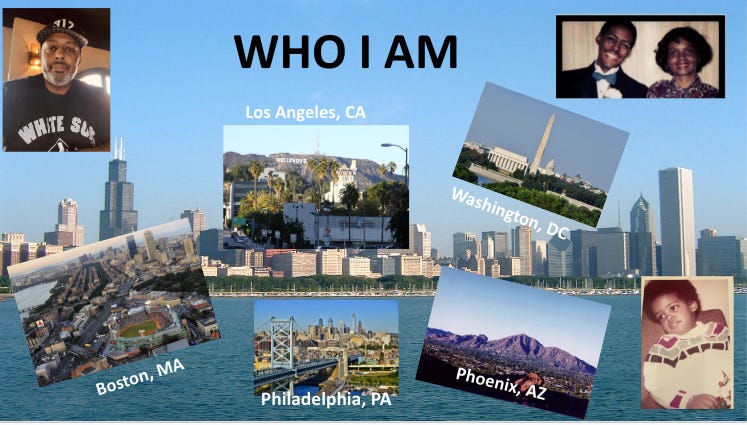
Let me set the scene. Early in the semester, as an icebreaker activity, students completed a digital story, a brief presentation identifying something unique or noteworthy about their cultural background (see above picture as an example of mine). The assignment was designed to do exactly what it sounds like: get students to locate themselves culturally before we spent a semester examining how culture, and all of its uncomfortable components, shapes everything that happens in a classroom.
A young White woman from San Diego raised her hand and said she didn’t know what to present. I asked why. She said, plainly, that she didn’t have a culture. I asked her to say more about how she was defining culture. She thought about it and said something like, other than what she was (Rhoden, 2019).
She wasn’t being difficult. She wasn’t trying to be provocative. She genuinely meant it. And that genuine bewilderment was the whole lesson.
The majority of the dominant culture in this country doesn’t present itself as having culture. It presents itself as normal. As just the way things are, completely ignoring the process of assimilating into the social construct called Whiteness. To them, everyone else has a culture, meaning something particular, something marked, something different from the assumed baseline. The student from San Diego had been so thoroughly centered by every institution she had ever moved through, her schools, her curriculum, her community, her textbooks, her sense of what a classroom looks and feels like, that she had never once been asked to see any of it as a cultural choice. It was simply reality. Even in a city that borders another country.
This is not a criticism of her. It is a description of what society and institutions do when they center one culture so completely that it becomes invisible, even to the people it belongs to.
And here is why it matters enormously for teaching. If you do not know you have a culture, you cannot know how you are centering it. Every curricular choice you make, every norm you establish in your classroom, every definition of what good student behavior looks like, every assumption about what counts as knowledge, all of it will reflect your unexamined cultural positioning. And the students who do not share that positioning will feel it immediately, even when they cannot name it. That feeling that this space, classroom or elsewhere, was not built for me, is the opposite of Cultural Trust.
But to be honest, over the course of my teaching career, I am not always the light in the room. Sometimes I am the one who lets the room go dark.
In that same course, we were discussing a case that Human Rights Watch had documented about a teacher in Brazil facing harassment and the threat of termination for teaching LGBTQ issues in her classroom. It was exactly the kind of case the course was designed to examine. What does institutional power do to teachers who tell the truth? What does it cost to hold the space?
The discussion got away from me. Many in the cohort were pre-service teachers preparing for K-5 classrooms and couldn’t see the connection between this “adult” topic and the children they were about to teach. The sentiment in the room was essentially: why do we need to know this to teach young children? The discussion drifted in that direction and I let it go further than I should have. In some moments I may have even appeared to cosign what was being said. I was trying to hold the room, to keep everyone engaged, to not shut down the dialogue entirely. What I was actually doing was abandoning someone in it.
When I circled back to the room after the conversation had gone sideways, that was the point I tried to make. It does not matter what you personally think about any social issue. What matters is how you respond when that issue walks into your classroom, and it will. A five year old with two moms does not pause at the door because her teacher is uncomfortable. An eight year old navigating gender identity does not disappear because the curriculum pretends he doesn’t exist. The classroom you are preparing for will not look like the classroom you grew up in. It may not even look like the one you are sitting in right now.
That was the vision they couldn’t stretch to. Not because they were bad people, but because every institution they had moved through in their own K-12 experience, their teacher preparation program, the rooms and other professors where they learned what a classroom was supposed to look like had all shown them the same picture. And they had never been asked to question it.
I looked over and saw one of the few men in the cohort, a young gay man, visibly upset. Crying quietly. He had been watching me let the room turn against people like him and I had not stopped it.
I shut the conversation down. I tried to find him after class and apologize quietly. It was too late. Whatever Cultural Trust I had built with him and his friends was gone. And the students who were already skeptical of the course had seen me flinch. I never got any of them back.
I carry that mistake, that pain with me whenever I enter a class, but especially when I see potentially vulnerable students of any identity present. It is one of the reasons I wear a rainbow bangle now, a rubber bracelet, a small thing, a silent signal that I am an ally without requiring anyone to ask. It is not absolution. It is a reminder that Cultural Trust is not a status you achieve. It is a practice you have to show up for every single day, including the days when the room is hard and it would be easier to let it go.
You cannot build Cultural Trust and then abandon it when it costs you something. The student who needed me to hold that space did not stop needing it because I found the moment inconvenient.
The content of that course made some people uncomfortable. It was designed to. Asking pre-service teachers to examine their own cultural assumptions, their relationship to power in the classroom, and the ways institutional norms privilege some students and marginalize others is not a comfortable conversation. It was not universally welcomed. And the professional consequences of teaching it that way were real for me. I will just say, with this course being the only course in the scope and sequence for these pre-service teachers, that the content that eventually made that young woman a better teacher cost me something. The timing was better for her than it was for me.
But the encounter reminded me why the work matters regardless of what it costs.
The student who said she had no culture eventually became a teacher. And somewhere between that classroom and the evening she found me years later, something landed. Not because I was a particularly gifted instructor. But because someone created a condition, however imperfectly, however controversially, where she was asked to see herself as a cultural being rather than as the neutral default. Where her assumptions were named rather than assumed. Where the invisible was made visible.
That is what Cultural Trust requires of institutions, not just of students. It requires educators who are willing to examine their own cultural positioning before they walk into a room and center it without knowing they are doing so. It requires curricula that treat culture as something everyone has, not something that belongs to the other. And it requires institutions that understand discomfort in the service of growth is not the same thing as harm. It demands that discomfort be supported rather than frowned upon or seen as not student centered. Because it is the epitome of being student centered, it centers where students need to be, not just where they are now.
You cannot build Cultural Trust across a cultural gap you do not know exists. The first step is seeing the gap. The second is being willing to stand in it long enough to do something about it.
The student from San Diego eventually saw it. She became a better teacher because of it. That is the whole point.
Rhoden, S. (2019). Walls and bridges: Teaching culture and diversity to pre-service teachers. In P. Bolton, C. L. Smith, & L. Bebout (Eds.), Teaching with tension: Race, resistance, and reality in the classroom (pp. 69–85). Northwestern University Press.
No posts
Comments
Nothing yet. Say the first thing.
Sign in to join the conversation.