
Hello Everybody!
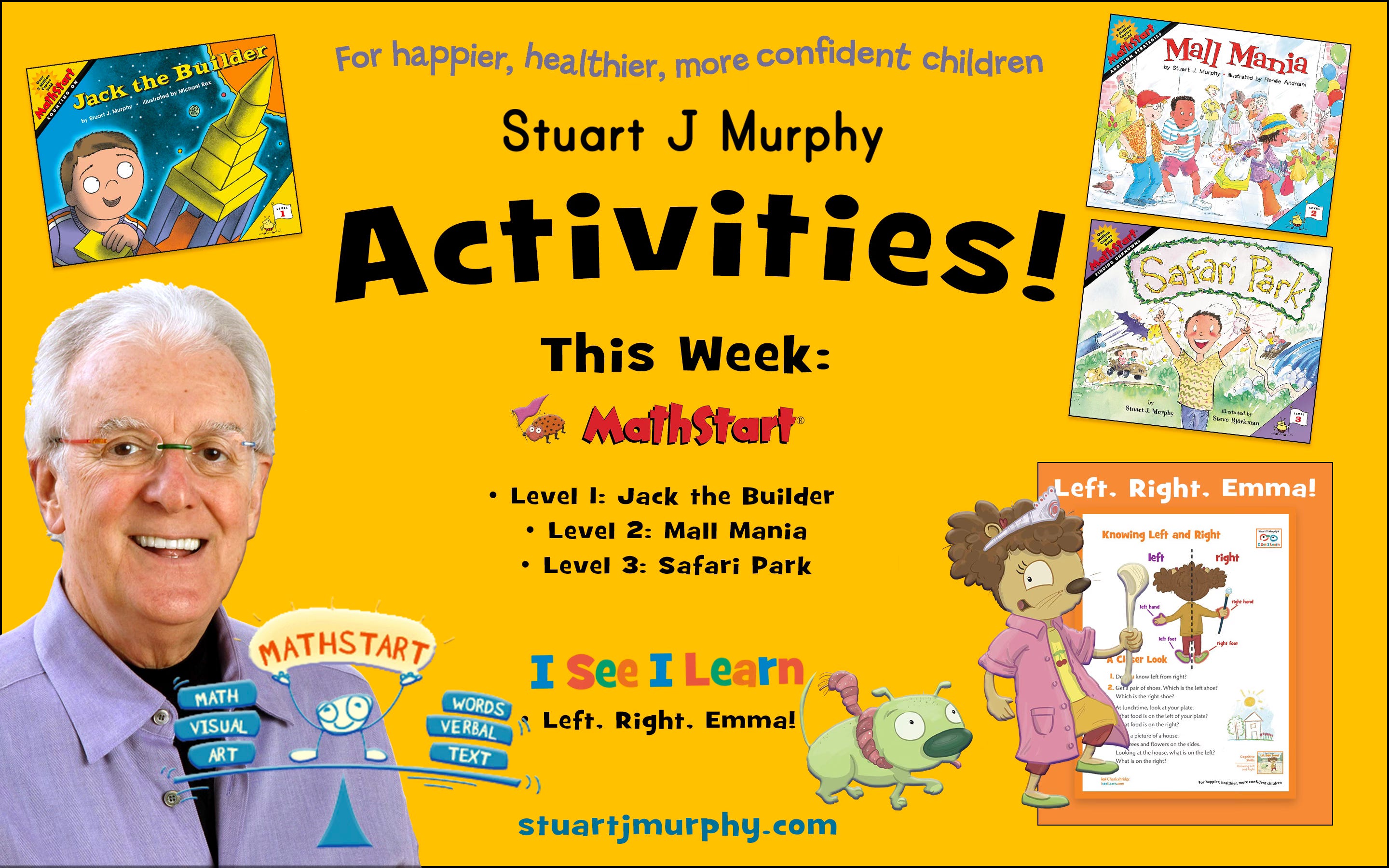
Blocks are the best! Everybody likes to play with blocks! I especially like blocks that come in different shapes. So does Jack from my MathStart Level 1 story, Jack the Builder (counting on). Jack (who happens to be named after my grandson) has a terrific imagination, too. With three (3) blocks he can make the most amazing hot dog stand ever. With twelve (12) blocks he can make the tallest building in the world. And with seventeen (17) blocks, he can make a spaceship!
What do you build with your blocks? How many blocks do you use to build it?
This week’s other featured MathStart books are:
Mall Mania Addition Strategies. Let’s go shopping!
Safari Park Solving for Unknowns. Pre-Algebra is fun! Especially at Safari Park!
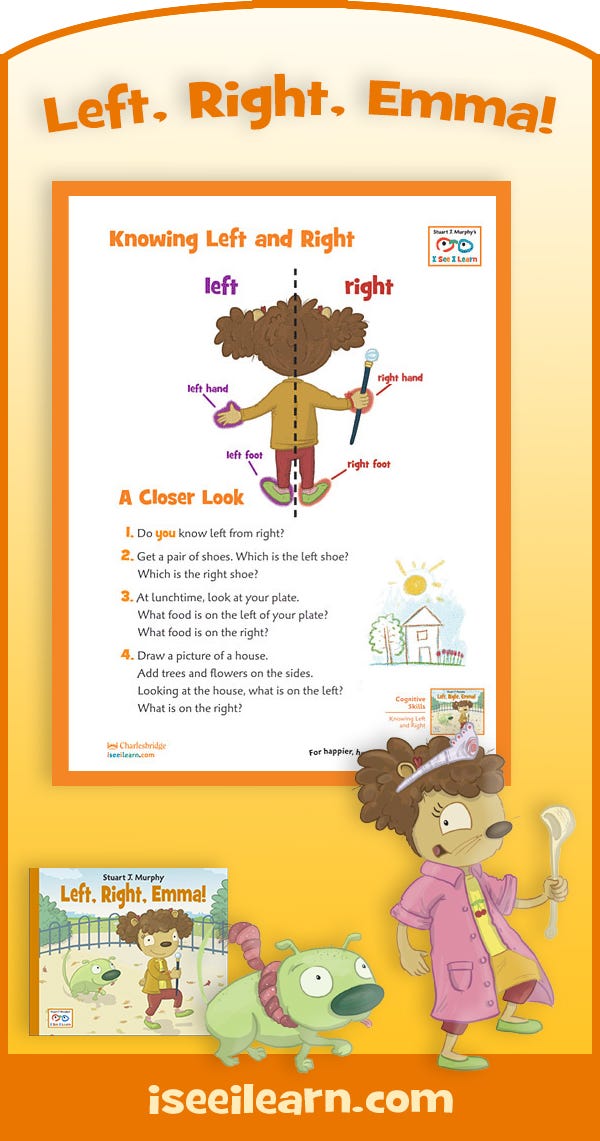
This week’s featured I See I Learn story is Left, Right, Emma! (knowing left and right). Emma loves to march around her house with her green dog, Pickle. When Miss Cathy asked her to lead the parade for Grandparents’ Day at Ready, Set, Pre-K, she was so excited! But she knew she had to practice marching left and right because the entire band would follow her lead.
Understanding basic directions allows young children to follow instructions, give others directions, and develop a strong spatial sense.
Scroll down for a FREE pdf poster!
Your friend, busy building all sorts of things with blocks, planning a trip to the mall, followed by a trip to Safari Park, and planning to go to Emma’s parade,
Stuart

Mathstart is a series of 63 storybooks organized into three levels for Pre-K through Grade 4. Each story teaches a different mathematical skill.
You can buy individual books, sets by level, or a complete library! Here is list of where to find MathStart books!
• Level 1, Pre-K/ Kindergarten:
Jack the Builder (counting on)
Jack has the best blocks ever. They come in all shapes (square, rectangle, cylinders, cones) and colors. In Jack’s imagination, an arrangement of just two blocks is a robot. Add one more block and presto! It’s a hot dog stand at the circus. Add two more blocks for a total of five for a ferry boat. And so it goes, counting on more and more blocks, all the way to the super-duper, ready-for-lift-off rocket ship. Blast off! All the blocks fall down and it’s time for Jack to start over again.
Counting on is a strategy to help young children understand how to solve addition problems.
• Level 2, Kindergarten / Grade 1:
Mall Mania (addition strategies)
It’s “Mall Mania” Day at the Parkside Mall. To celebrate, the 100th shopper to enter the mall will win all kinds of cool gifts. Jonathon, Nicole, Gabby and Steven—members of the Wilson Elementary chess club—are adding up the number of shoppers to come through each of the mall’s four doors, sharing the data via walkie-talkie. Club captain Heather and advisor Mr. Grant are coordinating efforts. “How many shoppers so far?” asks Heather. Nicole counts 7, Gabby 4, Steve 3, and Jonathon 2: That’s 7 + 4 + 3 + 2. Nicole adds the numbers one by one: first, 7 + 4 = 11; next, 11 + 3 = 14; and then, 14 + 2 = 16. Who ends up the lucky 100th shopper? Let’s just say it’s someone who never expected to be counted at all!
Addition strategies are important skills for adding more than two numbers.
• Level 3, Grades 2 - 4:
Safari Park (solving for unknowns)
Grandpa’s taking all the grandkids to the neatest amusement park ever: Safari Park. All the Jungle King rides cost 4 tickets. Rhino Rides are just two tickets. Monkey Games and Tiger Treats are a bargain at one ticket each. But a ride on the “spectacular, amazing, heart-pounding Terrible Tarantula” costs six tickets! Each of the kids has 20 tickets and has to figure out the best combination to have the most fun. Which would you choose?
An essential part of early algebraic thinking is understanding a “number sentence” with a missing element (8 + ? = 20), and the process for figuring out the unknown.
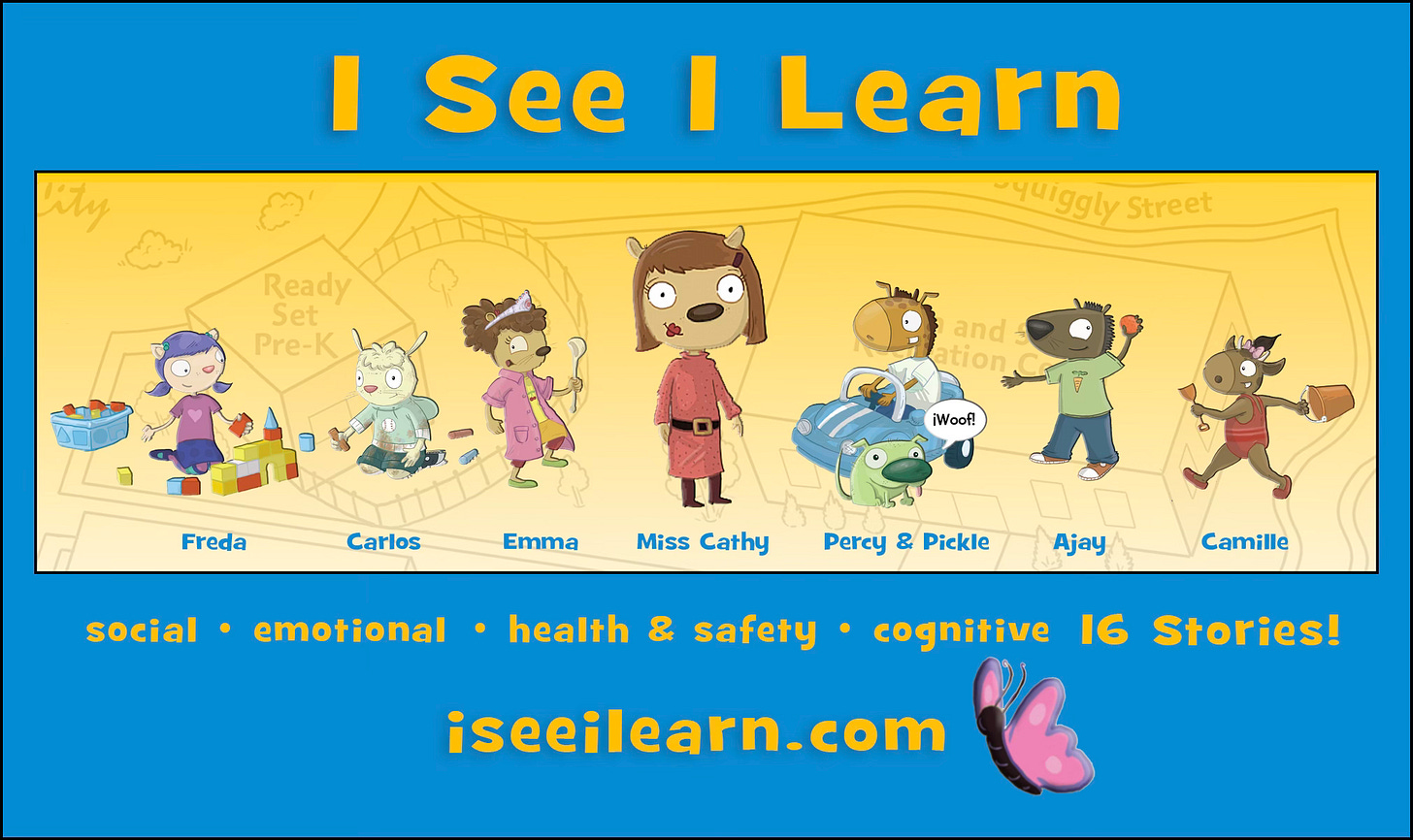
I See I Learn is a series of 16 stories that follow the adventures of the children in Miss Cathy’s class at Ready, Set Pre-K in See-and-Learn City (see map).
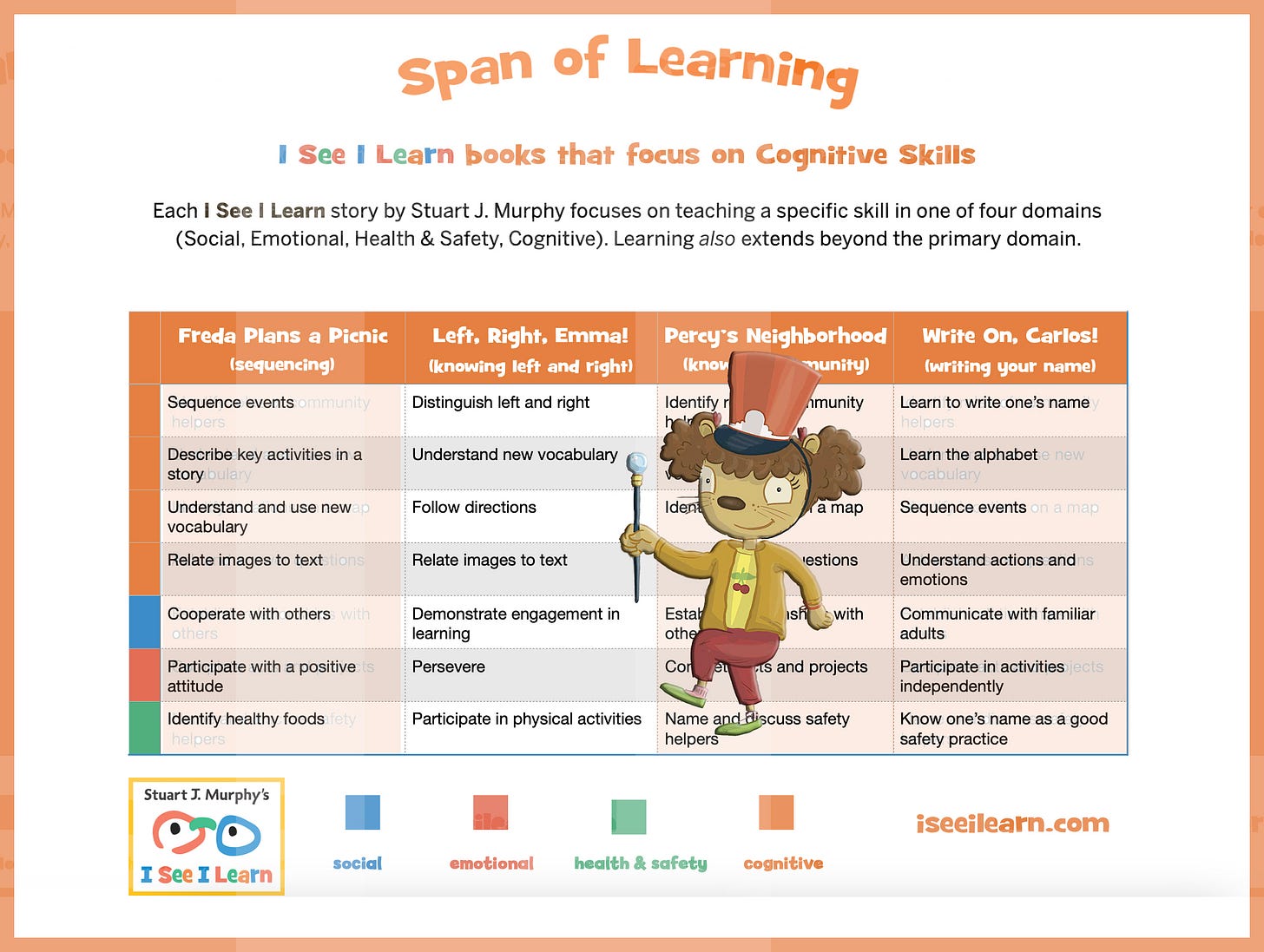
Each story focuses on a different social, emotional, health & safety and cognitive skill important for success in school and in life. For Pre-K / Kindergarten.
Left, Right, Emma! (knowing left and right)
Emma loves to march around her house. She is excited to lead a march at school. But how will Emma know when to turn left and when to turn right?
Understanding basic directions allows young children to follow instructions, give others directions, and develop strong spatial sense.
Let’s go! Left! Right!
11 x 17
Do you have a story or a question? Please send me an email!
Comments
Nothing yet. Say the first thing.
Sign in to join the conversation.