

Somewhere along the path of a project, we all hit the same roadblock: we do not know what to do next.
Sometimes the idea is still too vague. Sometimes the direction is unclear. Sometimes the work has grown too complicated, or the project has stalled somewhere between intention and completion.
Over the years, I’ve built a toolkit of ten frameworks that help me move creative projects forward, from the first spark of an idea through defining it, shaping it, getting it done, and learning from what happened afterward.
I use these tools across very different kinds of work: personal projects, brand building, product design, business strategy, team leadership, large corporate initiatives, and community work. I’ve seen them help business owners, corporate leaders, designers, musicians, writers, filmmakers, photographers, and other creatives bring structure to ideas that might otherwise stay vague, stall out, or stretch on indefinitely.
Some of these tools will already be familiar. Some may be new. One of them, Self\Community\World, is my own framework. I’ve used many of them for years, including on million-dollar and billion-dollar projects involving large teams, multiple countries, tight schedules, and fixed budgets. I’ve also used them to shape my own creative identity, make personal decisions, and figure out what to do when the path ahead was not clear.
I trust them because they work at very different scales. They are rigorous enough for complex organizations and practical enough for one person trying to make something real.
I do not use every tool for every project. Each one is useful on its own, and different projects call for different combinations. But there is also a clear flow between them. Together, they help define the work, give it shape, test it, move it toward completion, and reflect on what should happen next.
I think of them as four connected phases: identity and direction, design and validation, execution and delivery, and reflection and learning.
This is where I start when a project, brand, role, or idea does not yet have a clear center. I use Venn diagrams\Ikigai, my Self\Community\World framework, and mind mapping to identify what the work is, what it stands for, who it serves, and where it fits.
I have used these tools to define my own creative identity, clarify the purpose of community projects, and help large brands make sense of sprawling categories and product lines. At Columbia Sportswear, that meant helping define new categories across different countries while keeping them connected to the larger brand. At The North Face, it meant taking hundreds of outerwear styles and giving them structure, identity, and a clear pathway forward.
These tools help reveal the core of the work before too much energy is spent building around something that is still undefined.
Once the core is clear, the next step is giving the idea shape and making it understandable to other people. I use SWOT analysis, mood\vision\intention boards, and smoke tests to communicate direction, align teams, and test whether an idea has enough relevance and energy to move forward.
This phase matters when you are presenting a new direction, selling an idea internally, guiding teams downstream, or creating something for an audience. A strong concept is not enough if no one else can see it, understand it, or respond to it.
The smoke test is especially important because it creates a feedback loop before too much time or money is committed. It asks the idea to meet reality before the full project is built.
This is where the work has to move from intention into action. I use SMART goals, ABC prioritization, and Gantt charts to set clear outcomes, decide what matters most, manage overlapping layers of work, and keep projects from drifting.
I have used ABC prioritization almost every day for years. I began creating Gantt-style charts before I knew what they were called because I needed a way to see how work across teams, countries, timelines, and dependencies fit together.
These tools are essential for large corporate projects, but they are just as useful for a musician making a record, a filmmaker managing production, a founder launching a business, or anyone trying to finish and ship a creative project without losing control of the scope.
The final phase is about stopping long enough to understand what happened. I use the 4Ls retrospective: what I liked, lacked, learned, and longed for.
This is the part of the process that is easiest to skip. It requires feedback, honesty, and a willingness to look at what worked, what did not, and what needs to change next time.
The 4Ls framework is newer in my own practice, but it fills an important gap. It helps turn experience into something useful rather than simply moving on and repeating the same patterns.
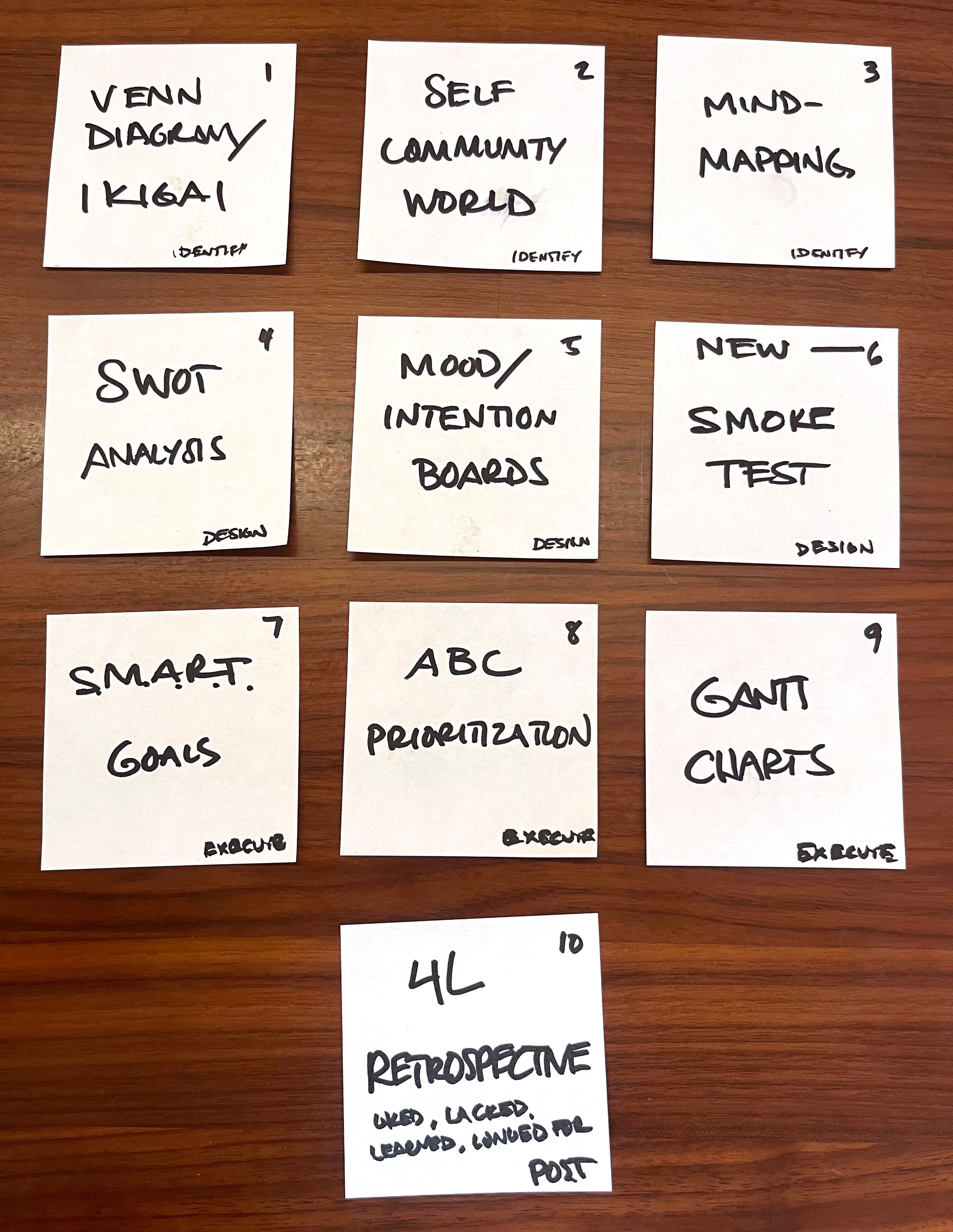
Each of these tools can stand on its own. You may need only one to clarify a decision, shape an idea, or get a project moving again. But they also belong to a larger flow.
Together, they can help you find the center of the work, give it form, test it against reality, move it toward completion, and learn from what happens once it is out in the world.
That is the part I am most interested in now: not just the tools themselves, but the way they speak to one another. The way one question leads to the next. The way a project changes when identity, design, execution, and reflection are treated as parts of the same creative life.
Over the next few weeks, I will be opening up each phase and sharing how I use these frameworks in practice as a set of reliable ways to find your bearings.
Because sometimes the hardest part of the work is not having the idea.
It is knowing what to do next.
Comments
Nothing yet. Say the first thing.
Sign in to join the conversation.