
If you've ever felt overwhelmed by the explosion of AI tools in journalism—ChatGPT, Claude, Gemini, Perplexity, and countless others—you're not alone. Which tool fits your specific needs? How do you use them responsibly? Where do you even begin?
These are the kinds of questions I keep hearing from journalists and newsroom leaders, which is why I created the LLM Journalism Tool Advisor.
As associate director of operations at the Center for Cooperative Media, I've watched newsrooms struggle to make sense of AI's potential while maintaining their journalistic integrity. This free web app is my attempt to bridge that gap—think of it as having an experienced colleague who's already done all the research sitting beside you, ready to offer specific recommendations based on exactly what you're trying to accomplish.
I designed the tool around one core principle: simplicity.
Rather than overwhelming you with endless options, it starts with one straightforward question: "What journalism task are you working on today?"
From there, an interactive decision tree guides you through a series of questions that narrow down your exact needs. Whether you're analyzing massive datasets, preparing for a crucial interview, crafting engaging newsletters, or trying to make complex policy documents digestible, my advisor provides tailored recommendations complete with specific tools, sample prompts, and actionable tips.
For instance, if you're drowning in documents for an investigative piece, the advisor might recommend Claude for its superior document analysis capabilities. Need to create data visualizations on deadline? It'll point you toward Claude 4 Opus with Artifacts or Gemini 2.5 Pro with Canvas, complete with example prompts you can adapt immediately.
What I'm most proud of isn't just the recommendations—it's the wealth of real-world case studies I've collected showing how newsrooms are already transforming their workflows with AI:
The Jersey Bee uses ChatGPT integrated with Airtable and Zapier to produce daily curated newsletters for 12 communities with a tiny staff
The Economist leveraged AI to extract and structure 15 years of MPs' financial disclosures—a task that would have been prohibitively time-consuming using traditional methods
The Baltimore Times employs AI for everything from editorial assistance to creating immersive AR experiences, despite limited resources
The Marshall Project uses ChatGPT to simplify bureaucratic text and perform textual analysis, freeing journalists for deeper reporting
As Paris Brown from the Baltimore Times said, "AI is the assistant I prayed for. We train it on our mission and values to ensure alignment."
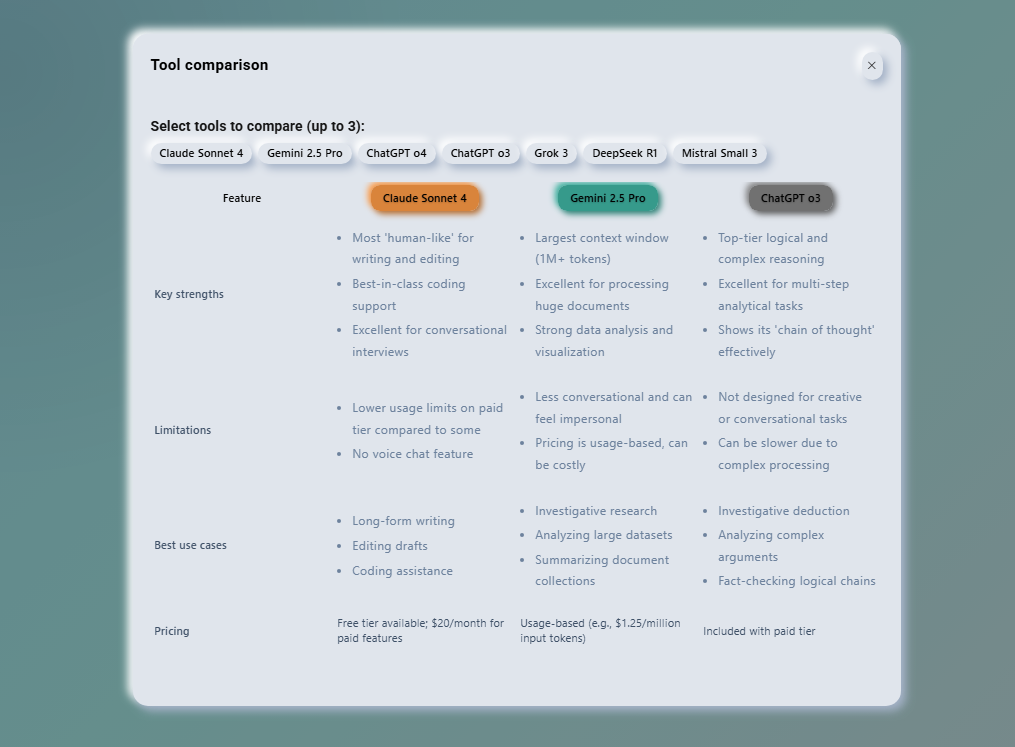
The tool includes feature that lets you select up to three AI tools and see them compared side-by-side across key criteria: strengths, limitations, best use cases, and pricing. This objective assessment helps you make informed decisions without the marketing hype.
Beyond just recommending tools, I wanted to provide in-depth guidance on responsible use. You'll find effective prompting techniques, fact-checking protocols, and ethical considerations specifically tailored for journalism, not generic AI advice.
The advisor covers as many journalistic needs as I could think of:
Breaking news research with real-time information
Document analysis for investigative reporting
Data visualization and analysis
Interview preparation and question generation
Content editing and headline optimization
Multimedia production assistance
Audience engagement and accessibility
Sometimes you don't know what you don't know. So I added a random workflow feature that introduces unexpected applications, like using AI to create audio versions of stories for accessibility or automating repetitive newsletter tasks.

I know journalists work under constant deadlines, so I designed the interface to respect your time. A visual progress bar shows exactly where you are in the decision process.
You can go back a step, restart entirely, or—if you already know what you need—jump directly to specific workflows via the dropdown menu. Dark mode is there for those late-night deadline pushes, and the responsive design means you can access it from anywhere.
This is perhaps what matters most to me: the LLM Journalism Tool Advisor doesn't treat AI as a magic solution.
Throughout every recommendation runs a consistent thread that reflects my own philosophy: AI should augment human journalism — not replace it.
The tool emphasizes maintaining editorial oversight, verifying AI-generated content, and being transparent with audiences. As one featured case study notes: "The best and most obvious use cases for AI tools are the ones where the bots are helping with the boring and tedious stuff so the journalists can spend more time actually serving their communities."
AI tools are already reshaping journalism, whether we're ready or not. The question isn't whether to use them, but how to use them effectively and ethically. I wanted to bridge the gap between the cutting-edge potential of AI and the day-to-day reality of newsroom work.
This isn't about replacing the irreplaceable—your news judgment, source relationships, and understanding of your community. It's about reclaiming time from tedious tasks so you can focus on what matters: serving your audience with quality journalism.
I invite you to explore how AI can enhance your journalism while maintaining your professional standards. Click here to try the tool for yourself.
Start with whatever's on your plate today. Whether you're an AI novice or already experimenting with these tools, I hope you'll find practical guidance tailored to your needs.
If you have questions or want to share how you're using the tool, I'd love to hear from you. You can find me on Twitter or Bluesky, or you can send me an email at amditisj@montclair.edu and I’ll do my best to respond when I can.
Joe Amditis is the assistant director of operations at the Center for Cooperative Media at Montclair State University. Contact him at amditisj@montclair.edu or on Twitter at @jsamditis.
About the Center for Cooperative Media: The Center is a primarily grant-funded program of the School of Communication and Media at Montclair State University. Its mission is to grow and strengthen local journalism and support an informed society in New Jersey and beyond. The Center is supported with funding from Montclair State University, Robert Wood Johnson Foundation, Geraldine R. Dodge Foundation, Democracy Fund, the New Jersey Civic Information Consortium, the Independence Public Media Foundation, Rita Allen Foundation, Inasmuch Foundation and John S. and James L. Knight Foundation. For more information, visit centerforcooperativemedia.org.
Comments
Nothing yet. Say the first thing.
Sign in to join the conversation.