
I’ve met African Americans who also want to know.
This is a story I’m just beginning to tell. It’s a disorienting story. A surprising, heartbreaking, shape-shifting story involving plantations, slavery, shame, and my own name: Mariah Burton Nelson.
When I was growing up in Pennsylvania and Arizona, I had no idea our family had deep roots in Sussex County, Delaware, where I now live. Only later, when I started vacationing in Rehoboth Beach, did Mom say, “I used to vacation there as a child.”
“Why?” I asked. She had grown up in New Jersey, about two hours north.
“We had family there,” she said.
Family? I had noticed familiar landmarks: Burton Island, Burton Pond, Burton Road, Burton Street, Burton Village. Such designations are so ubiquitous in this small seaside community that they’re unmissable. I had wondered why I was seeing my own name everywhere, but it’s not an unusual name, and I had not connected the dots.
“Could we be related to those Burtons?” I asked Mom, whose maiden name was Burton.
“Yes,” she said. “William Burton emigrated from Shropshire, England in the 17th century and had 9 sons. They all stayed in the area.”
I have since discovered hundreds of Burton gravestones in 25 local cemeteries.
But I was taken aback when reading a letter from my great-uncle to my grandfather that mentions the “Delaware Burtons, from whom there came quite a multitude, black and white.”
Wait. Black and white? What did this mean? I had to take a deep breath. Then a deep dive into historic wills, probates, tax assessments, census data, so-called “slave schedules.” Having never heard the word slavery mentioned in connection to our family, I needed to confirm the facts for myself.
Among many other artifacts, I have discovered a brick house built in 1717, the plantation “Big House” un-ironically known as The White House. It’s still standing and apparently inhabited by distant cousins. My mother, who has since died, had told me that this was her vacation spot in the 1930s.

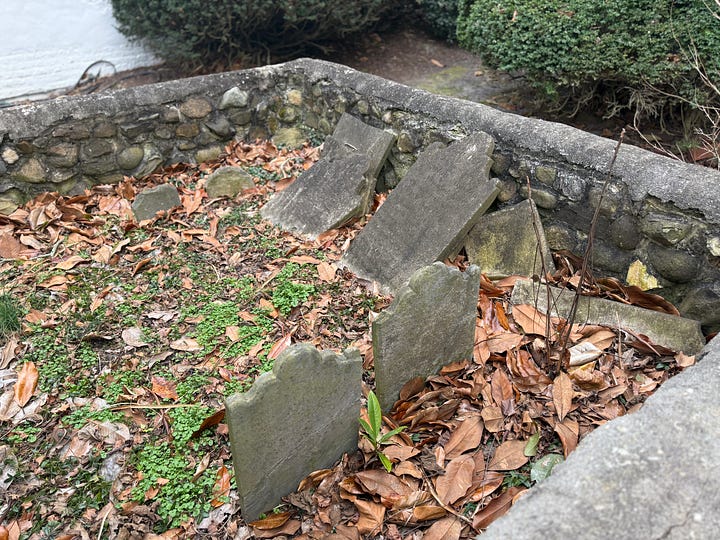
I have found old maps depicting more than a dozen other Burton plantations throughout the county. I have learned that one 1850 map depicts the entire area as Burtonville.
And on a massive spreadsheet, I have so far documented 480 people enslaved by 215 Burtons over a 200-year span.
Milly. Cato. Cesar. Moses. Sambo. Clary and Hester and their infants. One seven-year-old noted as “lame.” One 70-year-old: “worn out.” Almost no one freed.
Four escaped via the Underground Railroad: Hansel, Handy, Perry, Spencer.
Here’s the advertisement my second cousin, Isaiah Burton, ran in the 1796 Philadelphia Gazette when Spencer ran away - or “self-liberated,” the more accepted term these days:
FORTY DOLLARS REWARD.
[About $1,000 in today’s dollars]
RAN AWAY from the subscriber in Long Neck Indian River, Sussex county Delaware State, on Friday evening the 12th day of August, 1796, a NEGRO MAN, named Spencer, about 5 feet eight or nine inches high, a yellow complexion, freckled about the nose, grey eyes, light frizled hair, had on when he went away a blue cloth coat, yellow nankeen jacket and trowsers, sarred hat. Whoever secures the said negro slave and gives information thereof to the said master, so that he may have him again, shall receive the above reward, and all reasonable charges paid by
ISAIAH BURTON.
I’ve met African Americans who also want to know. But information about their ancestors is harder to unearth.
I’ve joined a group called Coming to the Table:
“Working together to create a just and truthful society that acknowledges and seeks to heal from the racial wounds of the past, from slavery and the many forms of racism it spawned.”
The descendants of enslaved people I’ve met there, and historians, librarians, and archivists I’ve met during my research, encourage me keep going.
I hope to publish my work with the Journal of Slavery and Data Preservation, which offers a searchable database at Enslaved.org.
I also created a legacy fund through the Delaware Community Foundation.
I want to be helpful. I’m just getting started.
Know someone who would be interested? Thanks for sharing.
I read a version of this essay at Rehoboth Beach Writers Guild program called Art in the A.M. on June 8, 2026.
Mariah Burton Nelson is the author of hundreds of articles and seven nonfiction books, including The Stronger Women Get, The More Men Love Football.
As always, I welcome your thoughts.
Comments
Nothing yet. Say the first thing.
Sign in to join the conversation.