
New here? Start with Johann Gottfried Seume Stroll to Syracuse project.
This post is best read on the Substack website.
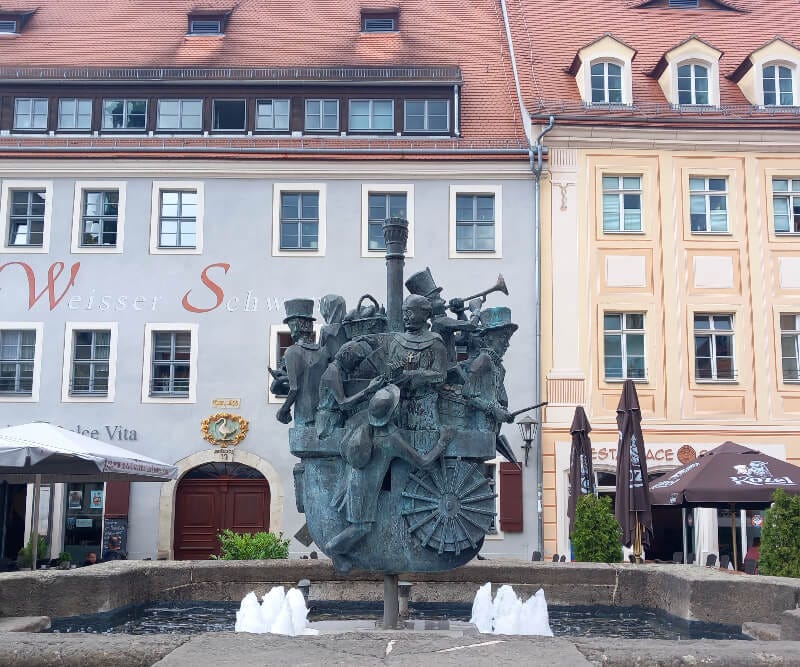
Pirna stands on the River Elbe, about 25 kilometres south-east of Dresden. It is often described as the gateway to Saxon Switzerland, where the river valley gives way to sandstone uplands near the Bohemian border.
In Pirna we spent an hour with Herr Siegfried, whom you know as the author of Siama and Galmory, and who, with several acquaintances, accompanied us to the border.
- Seume
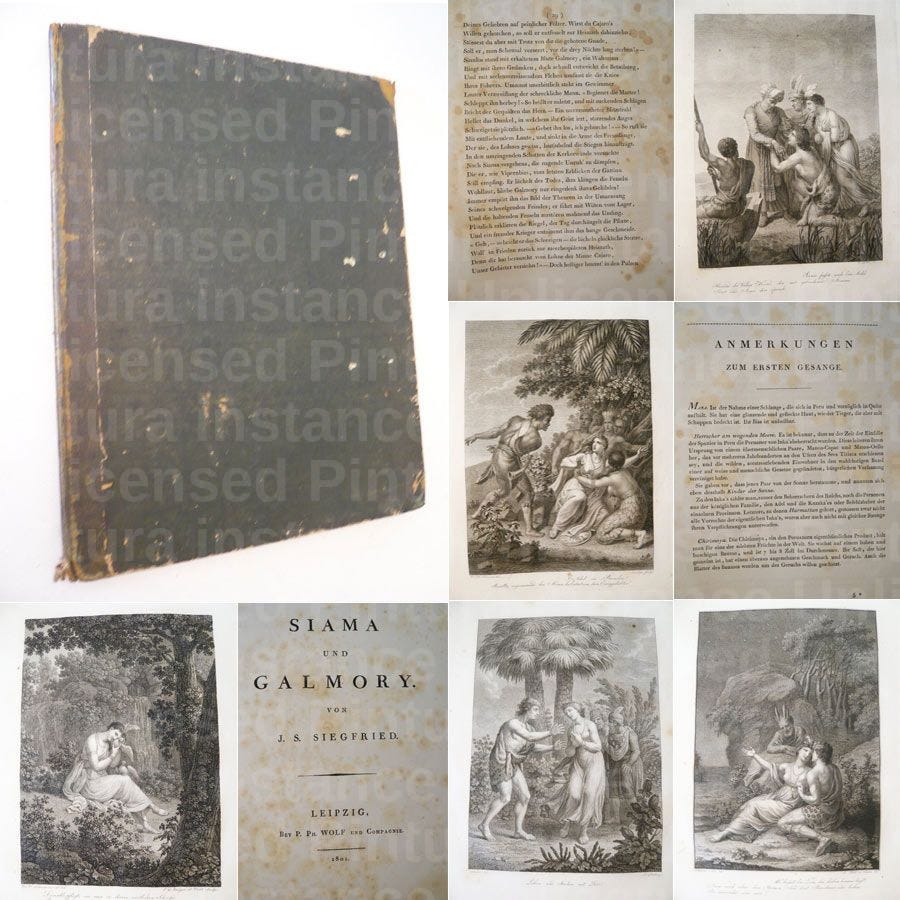
Seume stopped briefly in Pirna to visit the novelist Johann Samuel Siegfried, a minor writer, now almost completely forgotten. I scoured the internet for information about the man but there is next to nothing to be found, except on a page selling antiquarian books with images of the woodcut illustrations from his novel Siama und Galmory (1801).
Thanks to the Italian painter Bernardo Bellotto we have a fair idea of how Pirna looked when Seume arrived in 1801.
Born in Venice in 1722, Bellotto was the nephew and pupil of the celebrated painter Giovanni Antonio Canal, more commonly known as Canaletto.
In 1746 Bellotto was employed at the Dresden court of Frederick Augustus II, Elector of Saxony and King of Poland.
Bellotto painted a series of views of Pirna with Sonnenstein Castle often rising above the streets and river. He died in Warsaw in 1780.

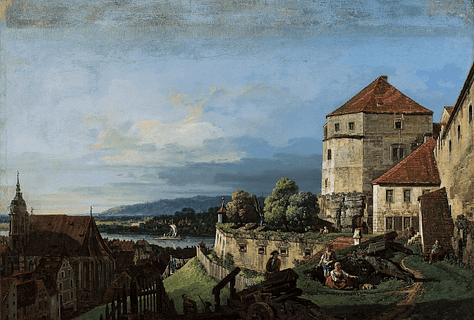
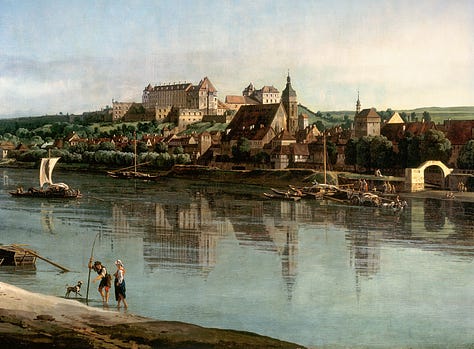
The Pirna Market Square painting (first on the left) has a dark 20th century history attached to it:
In June 1938, facing financial distress due to racial persecution by the Nazi regime, German Jewish businessman Dr. Max J. Emden sold three Bellotto paintings, including The Marketplace at Pirna, to Karl Haberstock, Hitler’s art dealer.
A plane to Berlin, a bus to Dresden, a train to Pirna.
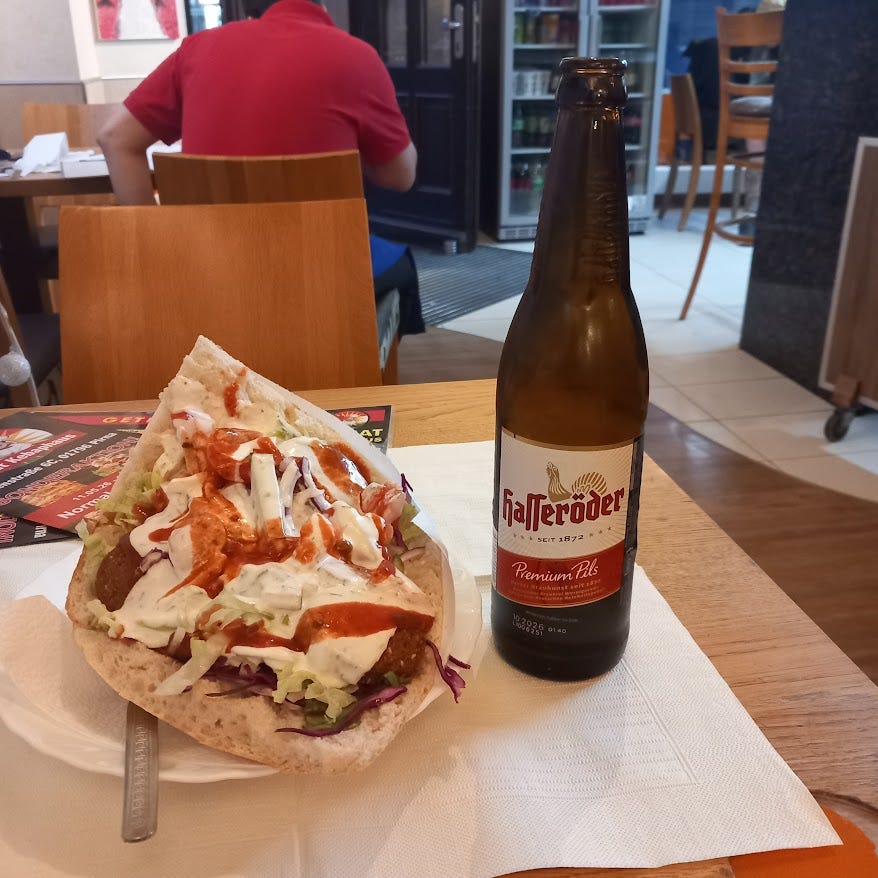
I arrived in the evening after travelling for 14 hours. Tired, hungry and thirsty, the walk into town takes me past the Rojhat Kebap Haus where I stopped for a falafel and beer. I left feeling full and content.
Pirna was quiet, attractive, and tidy, its streets lined with old buildings. I stopped to watch the Elbe flowing towards Dresden.
The fifth-longest river in Europe, the Elbe runs like a ribbon through the first two stages of the Stroll to Syracuse. At Grimma I had followed the Mulde, a left tributary, I joined the Elbe at Meissen and Dresden, and on entering Prague will follow another left tributary, the Vltava.
The Airbnb was a little odd but it was clean and cosy. I had an early night.
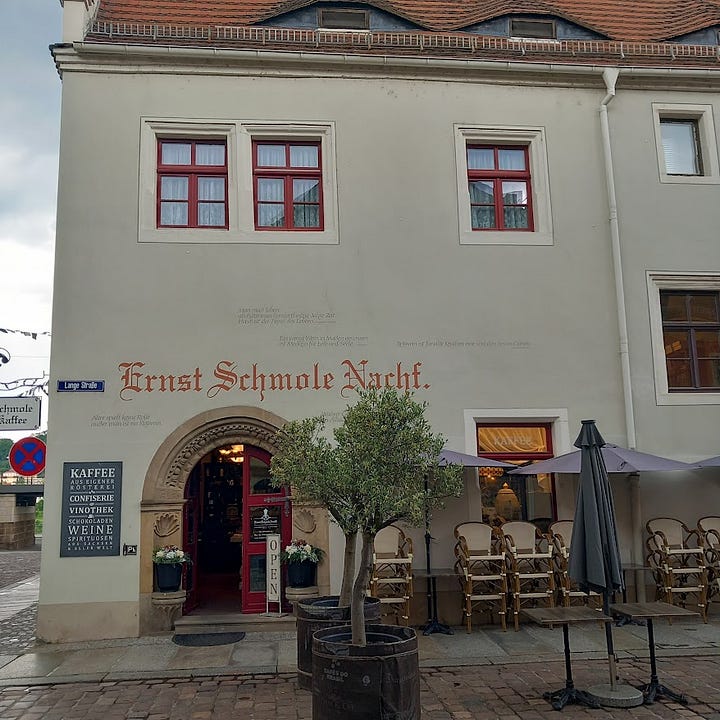
The next morning I was out and about just before 9 am, the skies were largely clear with clusters of clouds on the horizon. I made my way to Ernst Schmole Nachf, a Pirna coffee house since 1880.

After my coffee I took a ferry across the Elbe to follow the Saxon Wine Trail along the edge of the valley overlooking the river.

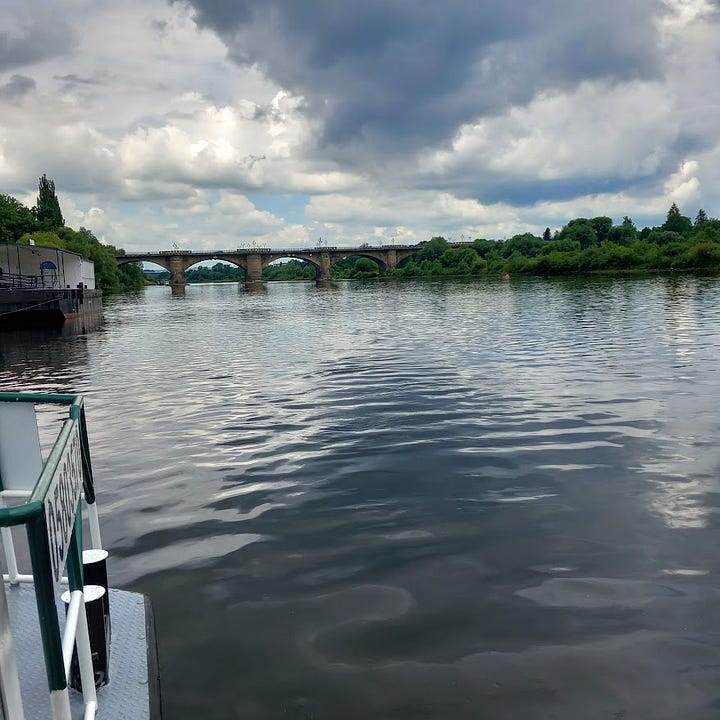


I was hoping to find a vineyard, bar or restaurant where I could stop for a local white wine but alas not one of the venues I passed was open. Still, the walk was enjoyable, especially the river views.
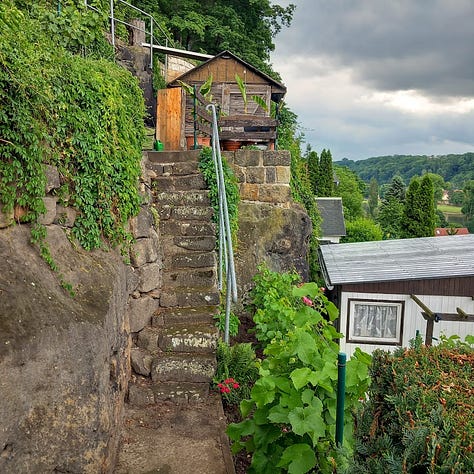
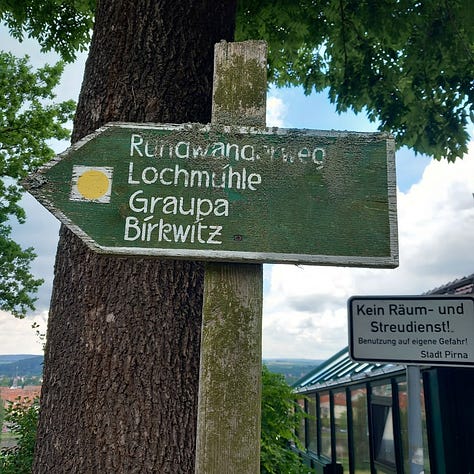

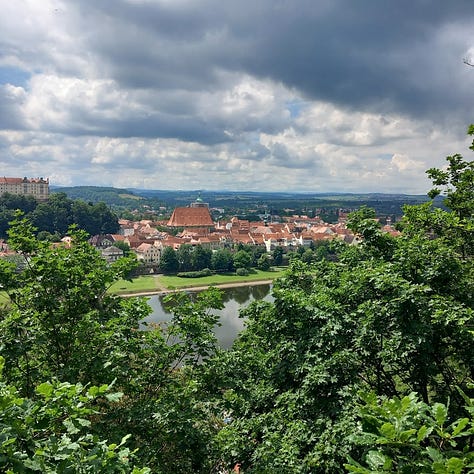
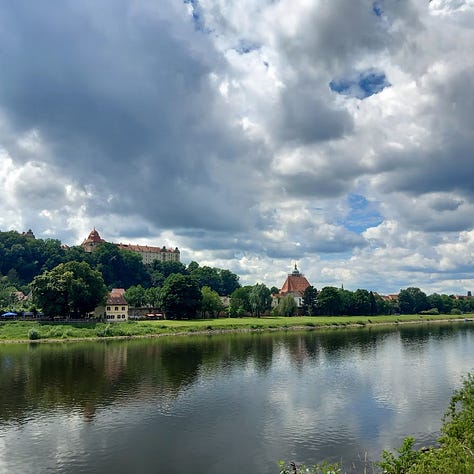
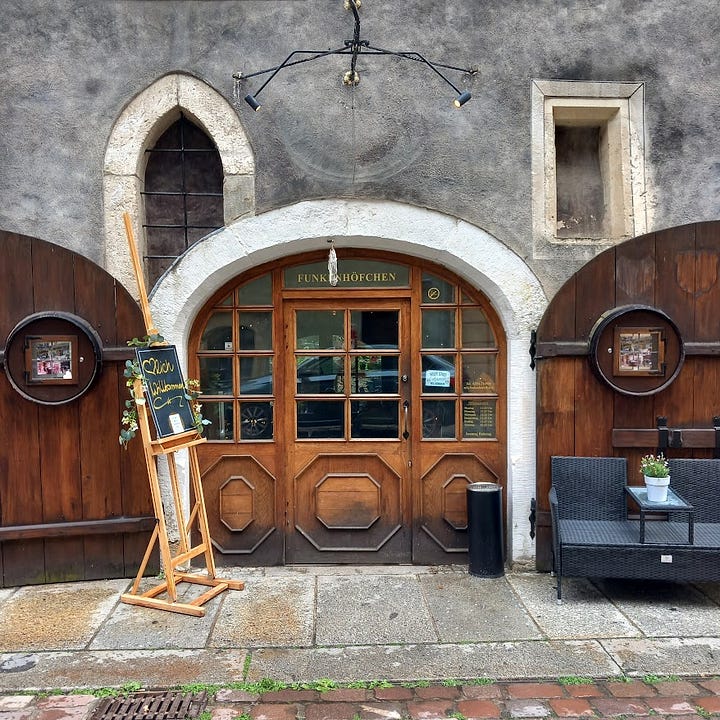
I caught the ferry back to the other side of the river and settled on the Funkenhöfchen restaurant for lunch.
My lunch at the Funkenhöfchen was exceedingly enjoyable. Everything about the restaurant was up to scratch, nearing perfection: the friendly welcome; the vaulted interior; the sleeping dog by the cashier’s desk; the Hirschbraten (roast venison with red cabbage and homemade bread dumplings); the local Saxon white wine; and an espresso, all at a reasonable price.
All of this added up to make it probably my favourite meal of the Stroll so far.

After the meal I retired to my Airbnb for a well-earned rest.
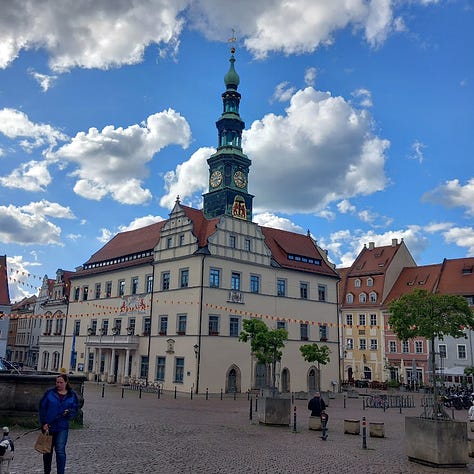
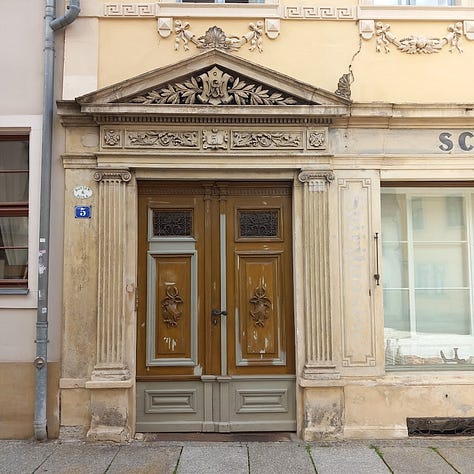
In the afternoon I toured the town, enjoying the handsome main square and Renaissance Rathaus.

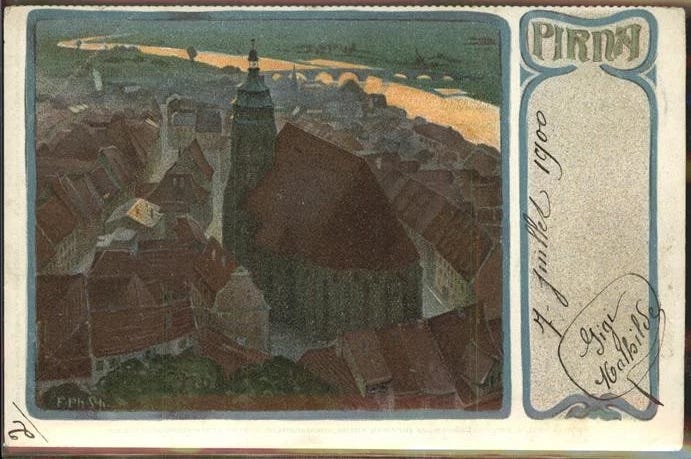
I had been hoping for a look at the 15th century Marienkirche but it was closed and dressed in scaffolding, thus the postcard below from 1900 will have to suffice.
I dropped in to the tourist information office for a postcard and then set off to climb the hill to Sonnenstein Castle (1460), which from 1811 to 1945 housed a mental hospital.
The castle has a sinister 20th century history:
Approximately 15,000 people were murdered at the Nazi killing center in Sonnenstein between 1940 and 1941. They were predominantly mentally ill and intellectually disabled, and later also prisoners from concentration camps.
This extermination facility, not least because of the number of its victims, is one of the worst sites of Nazi crimes in Saxony. The Sonnenstein killing center also served as a personnel, organizational, and technical training ground for the Holocaust.
Since 1970, the building has housed disabled people and in June 1991, the Sonnenstein Memorial Foundation was established on the site.
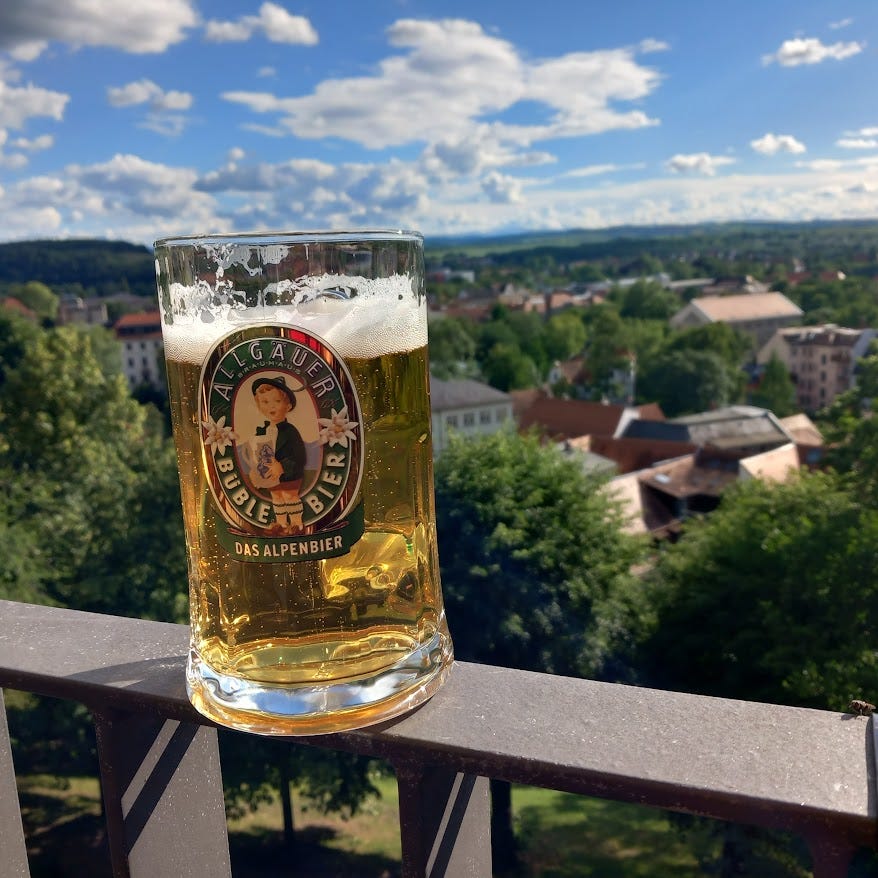
After this grim interlude I made my way to a beer garden on the other side of the hill and enjoyed a drink with excellent views over the Saxon countryside.
Back at the Airbnb I packed my bags ready for an early start. I freshened up and went out in the cool Pirna early evening on the lookout for some food and something to drink.
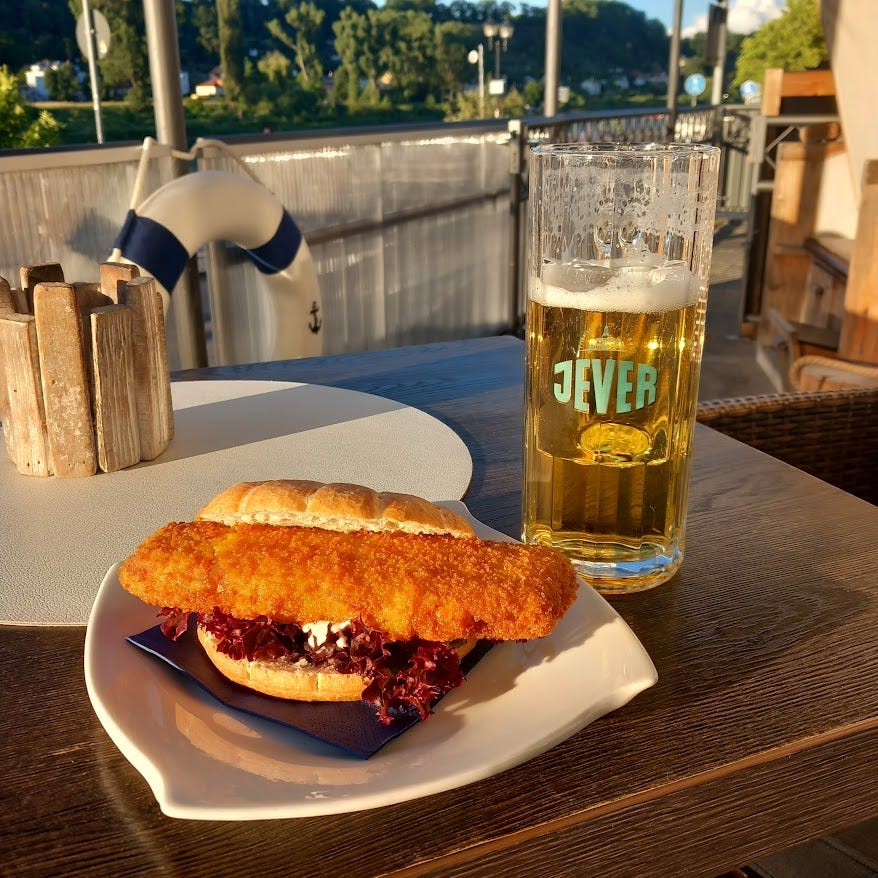
On the banks of the Elbe I came across the Landgang restaurant and enjoyed a beer and battered fish in a roll, all very tasty. The young waiter, like all the other Germans I’ve talked to, seemed very pleased with the town. “A gem,” one told me, and a gem they’d rather keep a bit hidden.
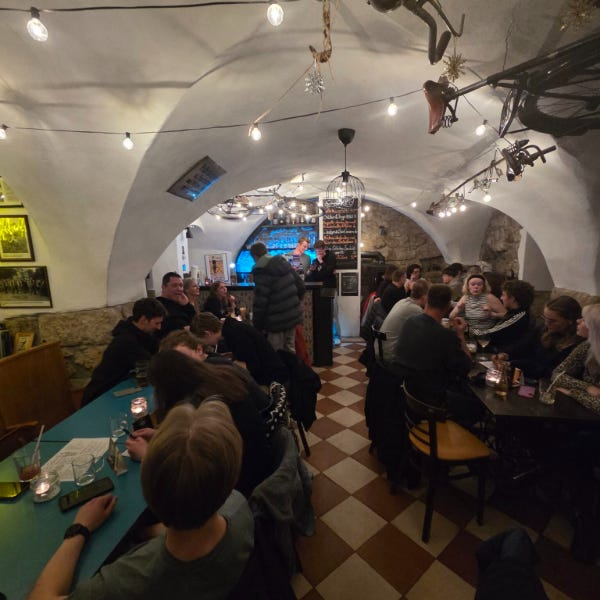
After dinner I returned to my wandering until I noticed a neon sign at the end of an alleyway. At the end of the alley, I found a little bar called GeheimRad run by a young Slovak. He was very friendly and welcoming and I settled in for the evening, chatting with him and a group of locals about Pirna, Slovakia and Seume.
I had so much fun that I completely forgot to take a photo, so I’ve included one from the bar’s website:
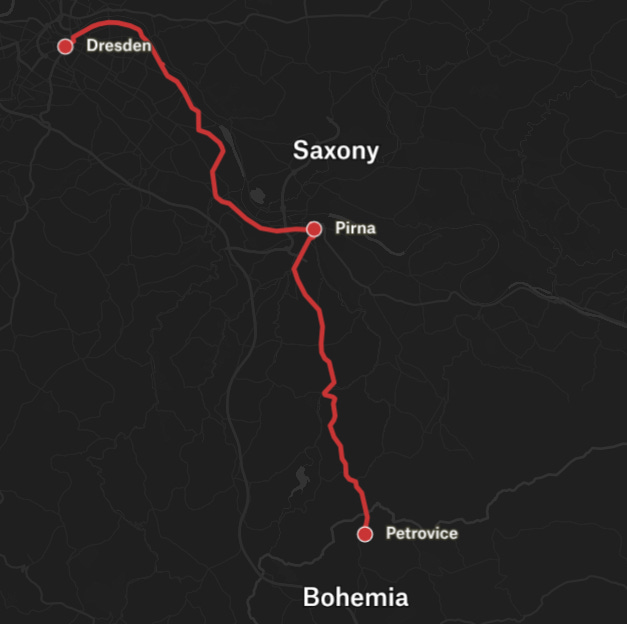
The next morning I made my way to Pirna bus station and, with the help of an extremely helpful woman at the information desk, managed to buy a ticket for the journey south to the Czech border.
Half an hour later I was on the bus, passing through the increasingly hilly Saxon countryside until I was deposited on the German side of the border.
I walked across the border (my first crossing on foot) and suddenly, there I was: Bohemia!
Next: Petrovice and Ústí nad Labem
Onwards!
No posts
Comments
Nothing yet. Say the first thing.
Sign in to join the conversation.