
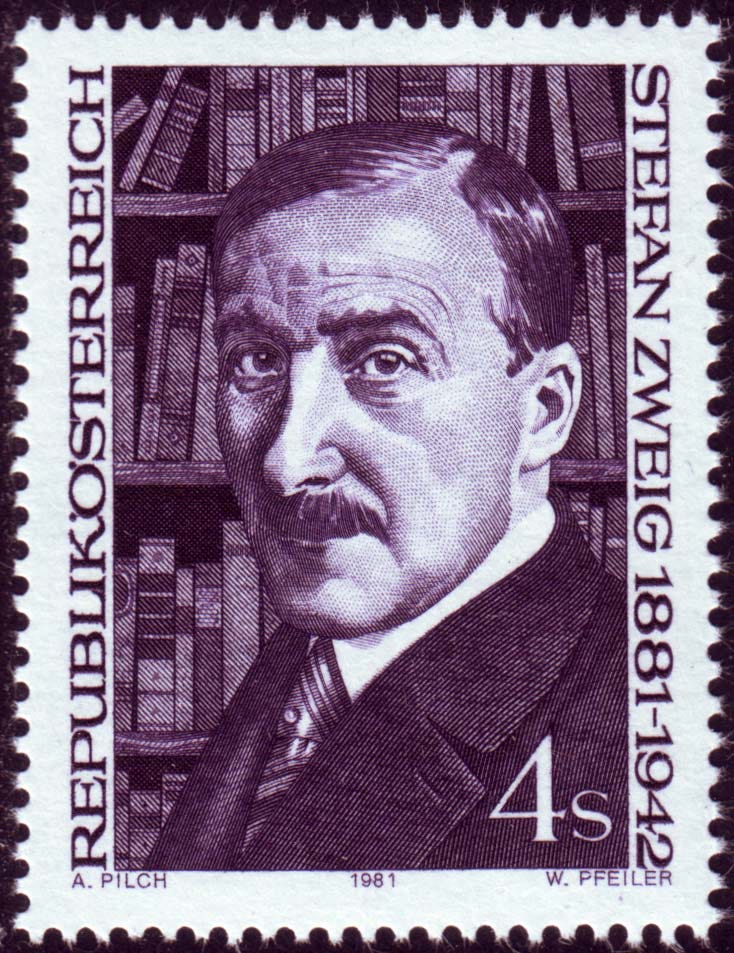
Text within this block will maintain its original spacing when published
“None of my books, none of my notes, no friends’ letters are at hand in my hotel room. Nowhere can I seek information, for in the whole world the mails from country to country have been disrupted or hampered by censorship. We live cut off from one another as we did a hundred years ago, before steamships, railroads, planes, and mails were invented. I have nothing more of my past with me than what I have retained in my mind. All else at this moment is unobtainable or lost. But the good art of not pining over that which is lost has been thoroughly learned by our generation, and it is quite possible that the loss of documentation and detail may actually be an advantage for my book. For I look upon our memory not as an element which accidentally retains or forgets, but rather as a consciously organizing and wisely exclusionary power. All that one forgets of one’s life was long since predestined by an inner instinct to be forgotten. Only that which wills to preserve itself has the right to be preserved for others. So choose and speak for me, ye memories, and at least give some reflection of my life before it sinks into the dark!”
                                                —Stefan Zweig, The World of Yesterday, Preface
In 1981, some friends returned from a screening of the new Louis Malle film, My Dinner With André. When I asked how they liked it, one said, “I turned to Stan when the lights came up and said, ‘That was like having dinner with Suzanne.’”
I went to see it soon after, understood completely, and have had a fondness for André Gregory ever since.
In mid-April this year, The New York Times ran an article called “The Books You Should Have Read by Age…” enlisting a different writer for each decade. I scanned the entries and for the last, By Age 90, the Times recruited André Gregory. One of his two recommendations was Stefan Zweig’s The World of Yesterday.
I was thrilled (which should give you an idea of what thrills me). Stefan Zweig’s autobiography has been one of the great reading pleasures of my recent life.
In late June, early July, 2024, The Rest Is History podcast spent four episodes detailing “The Murder of Franz Ferdinand”. The hosts usually open each episode by quoting some relevant person or written passage. The fourth episode of this series, “The Crime”, opened with a considerably abbreviated quote from this autobiography describing the afternoon of Sunday, the 28th of June, 1914.
I wanted more. Right away. I found and listened to a horrid AI narration of the book on YouTube, then found the book properly read on Audible. I bought the book. You can read the PDF here. I’ve read and listened to it several times since.
If you have any interest in European culture, writers, musicians, visual artists, and economics from the late 19th century to not quite the end of WWII, Zweig’s life is a remarkable document. He knew everybody. He was an inveterate collector of autographs, original music manuscripts, paraphernalia, and ephemera, clarifying that he did not consider himself their owner, only a temporary custodian.
Text within this block will maintain its original spacing when published
“I do not have at hand here—in my enforced nomadic existence—the catalogue of this long-since dispersed collection and can enumerate only haphazardly some of the things to illustrate how earthly genius was embodied in a moment of eternity.”
His extensive collection included “…a leaf from Leonardo’s workbook, Napoleon’s order of the day to his soldiers at Rivoli…a complete novel in proof sheets by Balzac…a cantata by Bach and the aria of Alceste by Gluck and one by Handel…Chopin’s Barcarolle…of Mozart I had not only a crude page written by the eleven-year-old boy…, a page written just before his death…of Goethe’s life, the first leaf a translation from the Latin by the nine-year-old boy, the last a poem written in his eighty-second year…in the matter of Beethoven…I was able to acquire all the remaining pieces of furniture from his room which had been auctioned off after his death…; the great desk above all, in whose drawers were concealed pictures of two loves, Countess Giulietta Guicciardi and Countess Erdödy; the strongbox which stood next to his bed up to the last moment, the little portable desk on which he had written in bed, his last compositions and letters, a white lock of his hair cut off on his death-bed, the invitation to his funeral, the last laundry list written in a trembling hand, the inventory of Beethoven’s goods for the auction…”
Like many, I’ve been struggling with the whys and wherefores of creative practice over the past year and a half of perpetual crisis, outrageous behavior, wanton destruction and murder. Amidst this onslaught of shock, it's a masterstroke just to focus on creative work at all—let alone with any meaning or intention that isn't purely reactive.
We’re straddling realities, eras, culture, time. It’s tricky right now to envision a future. It doesn’t look good, but it really is impossible to predict. There may be multiple futures. So, I’m turning around, as usual, to look at the past, and a good place to start is with Stefan Zweig’s description of the moment the world he lived in changed.
Text within this block will maintain its original spacing when published
“The summer of 1914 would have been memorable for us even without the doom which it spread over the European earth. I had rarely experienced one more luxuriant, more beautiful and, I am tempted to say, more summery. Throughout the days and nights the heavens were a silky blue, the air soft yet not sultry, the meadows fragrant and warm, the forests dark and profuse in their tender green; even today, when I use the word summer, I think involuntarily of those radiant July days which I spent in Baden near Vienna. …
Text within this block will maintain its original spacing when published
“Already on the eve of that twenty-ninth of June, which Catholic Austria celebrates as the feastday of Saints Peter and Paul, many guests had arrived from Vienna. In light summer dress, gay and carefree, the crowds moved about to the music in the park. The day was mild; a cloudless sky lay over the broad chestnut trees; it was a day made to be happy. The vacation days would soon set in for the people and children, and on this holiday they anticipated the entire summer, with its fresh air, its lush green, and the forgetting of all daily cares. I was sitting at some distance from the crowd in the park, reading a book. … Nevertheless, I was simultaneously aware of the wind in the trees, the chirping of the birds, and the music which was wafted toward me from the park. I heard the melodies distinctly without being disturbed by them, for our ear is so capable of adapting itself that a continuous din, or the noise of a street, or the rippling of a brook adjusts itself completely to our consciousness, and it is only an unexpected halt in the rhythm that startles us into listening.
Text within this block will maintain its original spacing when published
“And so it was that I suddenly stopped reading when the music broke off abruptly. I did not know what piece the band was playing. I noticed only that the music had broken off. Instinctively I looked up from my book. The crowd which strolled through the trees as a single, light, moving mass, also seemed to have undergone a change; it, too, had suddenly come to a halt. Something must have happened. I got up and saw that the musicians had left their pavilion. This too was strange, for the park concert usually lasted for an hour or more. What could have caused this brusque conclusion? Coming closer I noticed that the people had crowded excitedly around the bandstand because of an announcement which had evidently just been put up. It was, as I soon learned, the text of a telegram announcing that His Imperial Majesty, the successor to the crown, Franz Ferdinand, and his wife, who had gone to the maneuvers in Bosnia, had fallen victims of a political assassination there.”
                                                —Stefan Zweig, The World of Yesterday
I don’t think it’s possible to tease out one moment since that marked such profound change. There have been markers, though, since the end of the last world war. November 22, 1963. November 4, 1980. September 11, 2001. I would include particular dates for the introduction of the web, AI, social media, the iPhone, but those are impossible to nail down, or debatable. November 8, 2016, of course, is noteworthy. We—at least some of us—knew that the world had changed but not exactly how.
To learn about how other noteworthy artists and their work were impacted by war and change, see my essays on Charlotte Salomon, E. H. Shepard, Wassily Kandinsky and Gabrielle Münter, and I guess that Reclaiming Attention falls alongside this set.
More to come…
Read Stefan Zweig’s The World Of Yesterday. It will do you a world of good.
•
Enjoyed this? Share it with a friend!
No posts
Comments
Nothing yet. Say the first thing.
Sign in to join the conversation.