
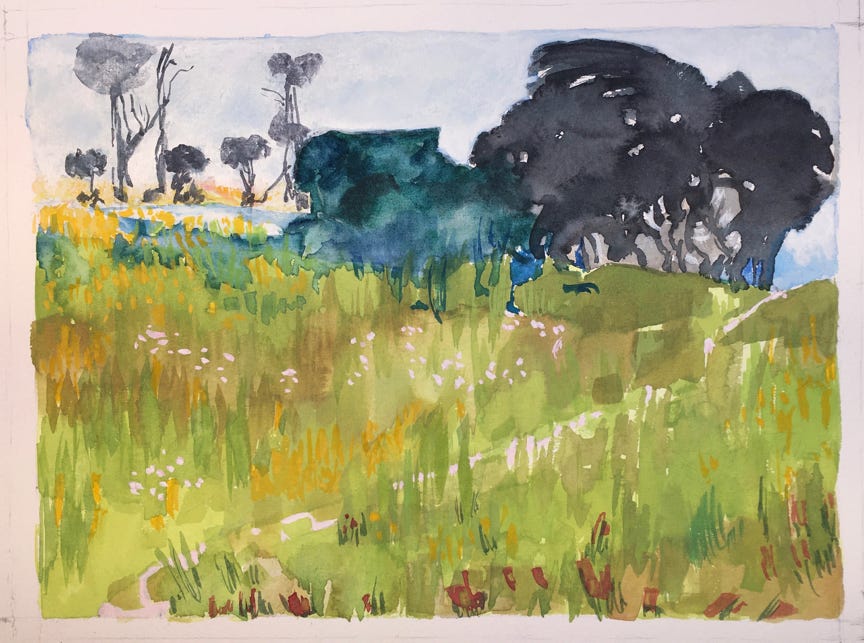
In the late spring of 2006, I moved into my new studio in Nashville, and started experimenting with varieties of watercolor paper, paint makers, color and brushes. The previous year had been devoted entirely to architectural concerns. The two or three years prior to that were spent painting large bouquets of flowers.
Now, flowers are always an excellent subject for drawing and painting, but I needed a change of focus. While playing with paper content, texture, weight, sizing and surfaces, comparing gum arabic and honey as binders, whose Prussian Blue I preferred, which brush had an adequate well and which held its tip, a funny thing began to happen.
I started painting imaginary landscapes. I couldn’t seem to help it. A door opened up and I walked right into a new field of possibility, making and learning about landscape painting.
I bought two books.
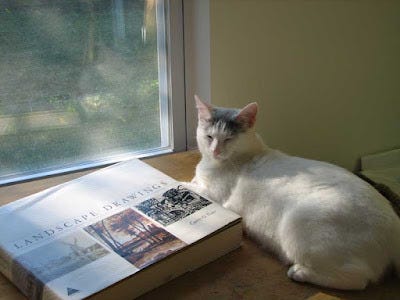
I don’t remember how I found either of them but the first was Curtis O. Baer’s Landscape Drawings. I’ve referred to and copied drawings from his collection extending from 1440 through 1962. It’s a lovingly acquired and assembled collection that, alas, was sold off, piecemeal after Baer’s death. But this book remains with his thoughts.
It weighs seven pounds, I have two copies, and it’s been within feet of me for 20 years. I’ve lugged it in and out of classrooms and every student of mine is familiar with it. I’ve urged friends and acquaintances with interest in such things to buy copies of their own and once received a thank you note for the recommendation from Luis Colon.
Another book that moved into my household around this time is Kenneth Clark’s Landscape into Art. It’s a “tidied up” version of lectures that Clark gave during the winter of 1945-6, during his first year as a Slade Professor at Oxford.
Clark examines the landscapes of Symbols, Fact, Fantasy, the Ideal, Natural Vision, Northern Lights and The Return to Order. It’s a long love poem examining the history, artists and soul of landscape painting.
On first reading, I was reminded of another “tidied up” series of lectures. In 1959, Aldous Huxley was invited to deliver lectures at University of California, Santa Barbara, on The Human Situation which were also developed into a book. That book has traveled with me since 1978.
Sure enough, the parallel held. Opening the Huxley lectures again, I found in the section “More Art in Nature”,
"There is something profoundly religious in landscape painting inasmuch as it seems to explore and to express that layer of the unconscious which is beyond the personal unconscious and which, it seems to me, is just as much given, impersonal, and not immediately connected with me as the external world. So the value of landscape paintings is not merely that they present us with images of the external world, but that they present us in the most powerful way with images of this deep, fundamental essence of Mind at large, from which the individual mind takes its source."
I then found Richard Kendall’s Degas Landscapes and Edgar Degas: The Last Landscapes, led by Ann Dumas’ entry “Degas, The Secret Landscapist”.
Let’s just say that I took to Degas’ landscapes in a big way. Both of these books have since inspired and fueled my soul, my drawings, watercolors, and teaching. Each book has many, many post-it notes sticking out the top, the sides and bottoms of pages.
I could wade much further into the weeds here, but I'll save that for another time, except to say that I became obsessed with one particular image enough to copy it in watercolor over and over again.
Degas did not paint in watercolor. Along with oil and pastel, he was seriously into monotypes, often intimately connected to his use of photography.
This small (10 5/8 x 14 1/8 inches) pastel and oil paint over monotype on laid paper, is not in either of the aforementioned books. It’s in the Morgan Library which didn’t digitize their collection until 2014. So I probably first spotted it while teaching in Raleigh.
Since the pandemic, I’ve taught exclusively online. In the last decade or so, I’ve taught, not entirely, but primarily through the use of historic painters and images. I’ll save the whys and wherefores for another post.
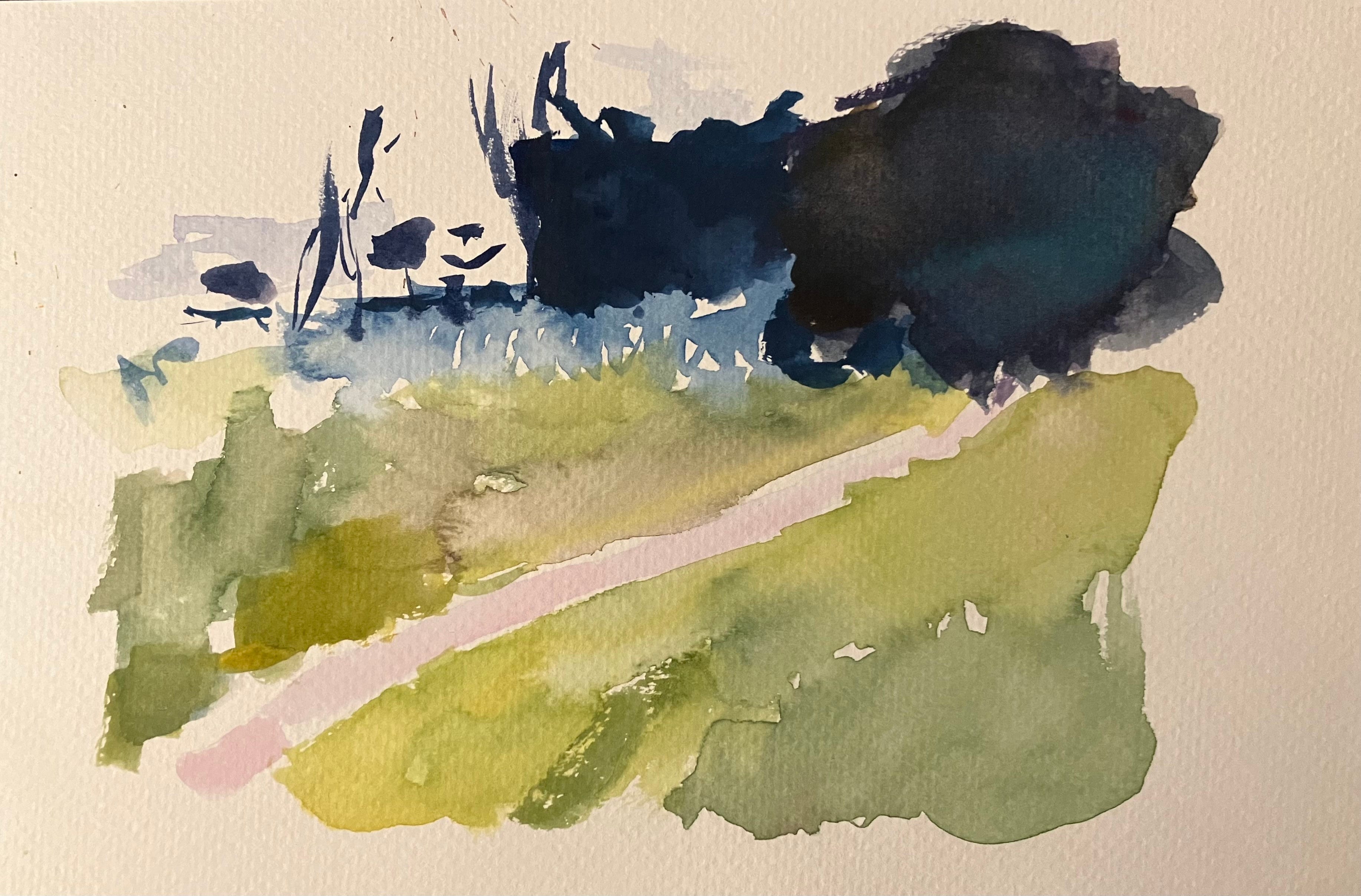
But this little monotype served as the model for a favorite lesson in 2023. I tried out my colors in a tiny scribble.
Then I filmed the step by step development of the 9” x 12”, featured at top, as my demo for that segment of the lesson. It took another year for me to satisfy my urge to blow it up full sheet.
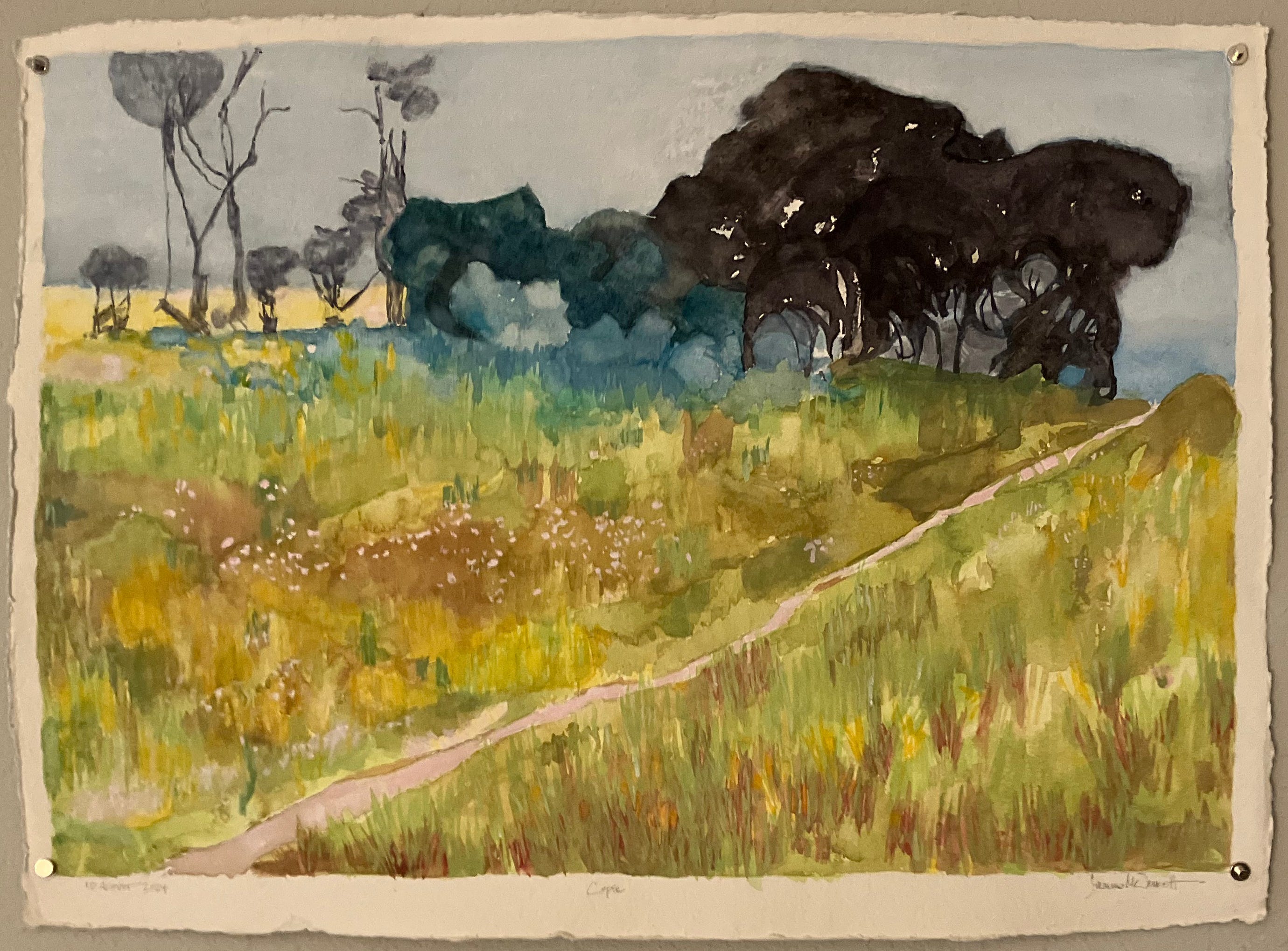
Both the small and the full sheet copies are up on my walls within glancing distance at all times. I’m not tired of them yet.
As I said, I could go on but that’s absolutely plenty, if not a little too much.
No posts
Comments
Nothing yet. Say the first thing.
Sign in to join the conversation.