
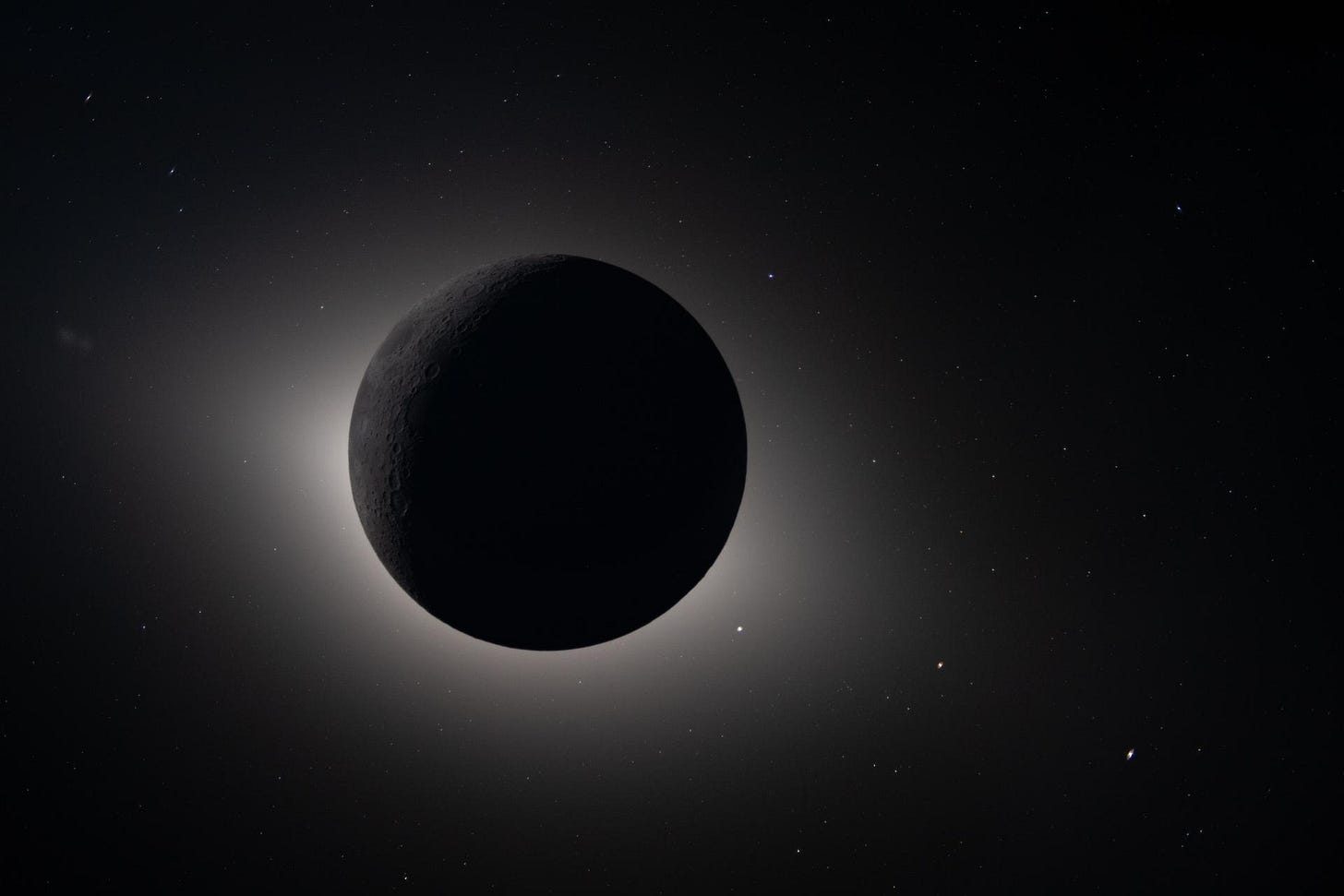
Who else was riveted to the Artemis II mission around the Moon? As troubled and expensive as this program has been, it was heartening to see our country do something meaningful and hard and benevolent. It started with a thunderous maximus liftoff on a gorgeous evening with slanted dusk light. Pure cinema. I didn’t/couldn’t bring myself to watch during the life-threatening, 6-minute re-entry blackout, but when a friend texted that they were back in radio contact, I snapped on the TV to watch the parachutes deploy and the capsule splash safely down. Then it took a week or so of perspective to get a feeling for the astronauts and to digest the photos and fully receive the wonder of it all.
A big science mission it was not. This was an engineering trip, a test flight, a shakedown cruise. But somehow, brought to us by a government that’s not exactly preoccupied by esthetics and poetry, NASA brought back beauty and wonder. The astronauts themselves were/are humane, humble, competent. I feel like Americans identified with them at a time when we’re not seeing many such role models on the big time news. Part of me did wonder what value could come from Reid Wiseman, Victor Glover, Christina Koch and Jeremy Hansen snapping DSLR photos through the window when we’ve had decades of lunar surveyors mapping the moon in detail? I asked Sam (my Claude AI secretary) about this and it observed that while some media was over-hyping the knowledge value of the flyby, it was the first time human eyes have been cast on the Moon at close range in more than 50 years and that they’re trained eyes at that - capable of describing colors and textures and features of reflectivity etc. that a probe actually can’t capture. Qualitative stuff. Touchy-feely stuff. We need that too.
Greatest of all, for me, was the vicarious awe and fullness we felt from the crew seeing the reality of our little lunar system at a middle distance. This perspective on the relationship between Earth and Moon would stop a person cold and defy belief. They could look out the window and see the Milky Way from the black shadow of the Moon’s dark side. ZERO ambient light. I’d have had a cardiac event. Down here, we have to see the cosmos on screens. It’s abstract. Staring into the unmediated void? I can’t imagine a more profound experience.
Of the many beautiful photos, I’m sharing (above) the one that most moves me - the Moon eclipsing the Sun, which the astronauts got to experience for the better part of an hour. To be clear, this alignment was a coincidence of the mission’s launch window - neither planned nor guaranteed - just a lucky break of timing. The planets Saturn and Mars are in the frame to the southeast of the Moon. The Moon’s left rim is illuminated by light reflected off the Earth, the phenomenon known as Earthshine. Houston, I’m crying up here. Please advise.
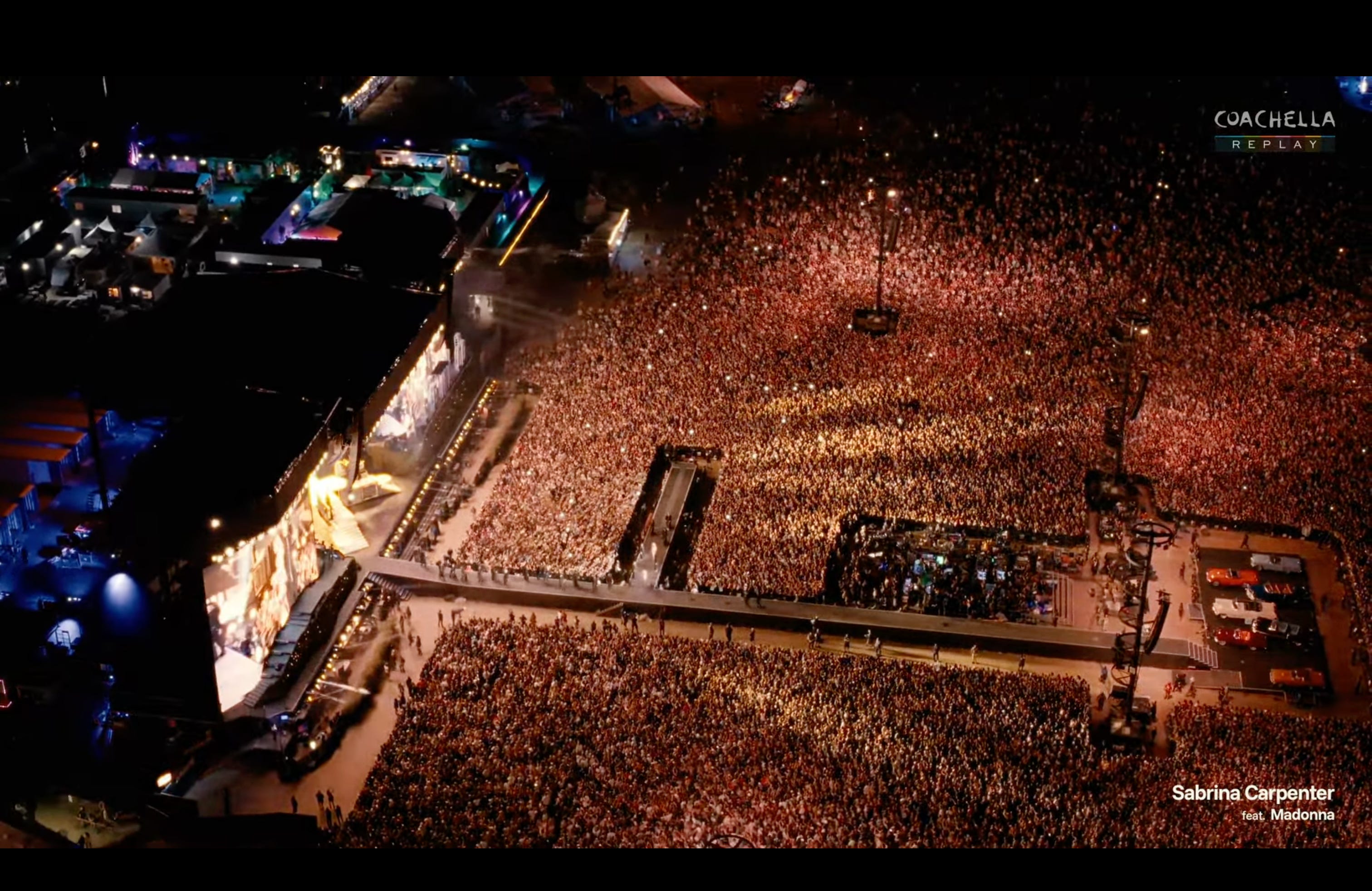
The folk singer Willi Carlisle told me in an interview that when he contemplates stadium-size shows and giant music festivals he thinks: “That’s not a concert. That’s a refugee crisis.”
Willi could have been talking about Coachella, the biggest music festival in the US, an event designed not for him and not for me. The festival’s free livestreams were as close as I’ll ever get to the horny rockin’, TikTok trippin’ mayhem of Indio, CA. This flood of video - six stages on demand - made the middle two weekends of April pretty interesting. But wow. The whole concept - megafests like Coachella or Bonnaroo - tears me in half. People gathering for live music and a good time is never a bad thing, as long as it stays safe. Coachella looks well-produced in a beautiful desert valley. It gives armies of people what they want. A music-loving friend of mine was there. And yet music at industrial scale feels off to me. Out of balance. A double bladed slicing device.
As for Coachella specifically, its a vortex of hyper-online commercialism so strong it’s been dubbed “the Influencer Olympics.” It’s a set of performances seen by its audience overwhelmingly on screens and through phones, a digital media bacchanal of epic proportions. (I stumbled upon a rather trenchant and funny commentary on this subject by a YouTuber called WyattMetal.) It’s also become one of those stratified, privilege-based experiences where the corporately orchestrated gulf between VIP access and General Admission is glaring and uncomfortable.
But what about the music? What does Coachella’s lineup and format tell us about how we’re listening and what we value?
Part of me couldn’t help but snoot-watch the livestreams and have a few giggles at the expense of pretentious artists like Xoped and ChrXXX, which I just made up, but honestly would you have known any better? I saw a showcase for rock bands that often seem unhappy to be making people happy and pop artists who operate in a bored, monotone mumble against trap beats. (Justin Bieber got paid a reported $10 million to do two unwatchable sets of this form of low theater.)
Many if not most of the performers fell in two buckets. Either they were DJs or DJ teams standing and arm vamping behind high-tech consoles for crowds of head bobbing people (I like some of this music in certain times and doses) - or they were singers with dance troupes doing variations on the hot flex choreography we’ve seen since Madonna’s heyday. In fact Madonna was there, sort of handing the crown of pop-as-Broadway to Sabrina Carpenter, whom I rather like because at least she brings humor and lightness and a sense that this is all supposed to be fun. Contrast that to one of the wannabes in her lane that I caught in my browsing - a completely sad lingerie-clad dominatrix type called Cobrah going through the obligatory undulatory motions. One of the headliners, a rapper called Sexyy Red, hit the stage literally dog walking two masked beefcakes on chains (let’s not do that with either gender hmm?) and shouting obscenities and hot-swappable hip-hop catch phrases at her audience so loud and obtuse they could only be the product of a 30-year arms race of shock factor and decadence.
There was some great stuff too. David Byrne’s show was magical. In a weekend full of standard-issue pop group choreo-jazz hands, Byrne’s show made an imaginative and beautiful flux of bodies, a floating tableaux made of the instrumentalists and singers making the music, freed up thanks to wireless instrument and vocal rigs. Even on a gigantic stage they felt human scale. Classics-loving Laufey showed why she’s one of the most unique and encouraging star turns in pop with her devotion to melody and heritage forms like bossa nova. The musicians were visible on stage. The show was subtle and entertaining. Otherwise, I enjoyed discovering Disclosure (whose name is about being discovered), a very cool semi-digital, semi-pop EDM band with a real drummer and horn players. And it was grounding to see Kacey Musgraves singing in Wranglers and a cowboy hat with a proper country band.
My agenda is not to review Coachella from my couch-ella. Instead I want to wrap by considering the contrast with the festivals that took place this weekend, JazzFest in New Orleans and MerleFest in North Carolina. This is terrain I know - festivals that helped me build my foundations in American roots music. So let’s first run the numbers. While JazzFest isn’t small, with about 60,000 daily visitors and substantial pop/rock headliners (this year including The Eagles, Teddy Swims, and Lorde), that’s only about half of Coachella’s daily influx of 120,000 human bodies. MerleFest is half again as large, with maybe 20k paid fans on the grounds at peak times. Both of the roots festivals feel manageable with a lot of choices and niches beyond the main stages.
But where they really succeed is by understanding the difference between a concert and a party, between music and a “soundtrack of our lives.” The musicianship is the main event, with all instruments, fingers and faces visible to the audience. Choreography is rare, ironic, or related to some kind of performance tradition. Regionalism is foundational to both festivals, with rosters full of artists from Louisiana or Appalachia respectively. And here’s where things live for me - America’s E Pluribus Unum in action. Not every artist sounds like the place they grew up (see my interview with Gillian Welch in the Recent Work section) but the accomplished artist in roots music knows the traditions they’re working from or mingling. The audiences are aware as well, and they’re conversant in the histories of places and sounds. That’s not the business of Coachella, where the cultural landscape is as flat as the desert floor. I’m open to rebuttals from anyone who attends and loves Coachella, because I haven’t been there. But to my eyes, its marketing and its Instagram-obsessed attendees are telling a story built on surfaces and images and status rather than sound and soul. When something’s that big, it can’t help but be an assembly line.
As usual, click the headline/photo to go to the full feature.
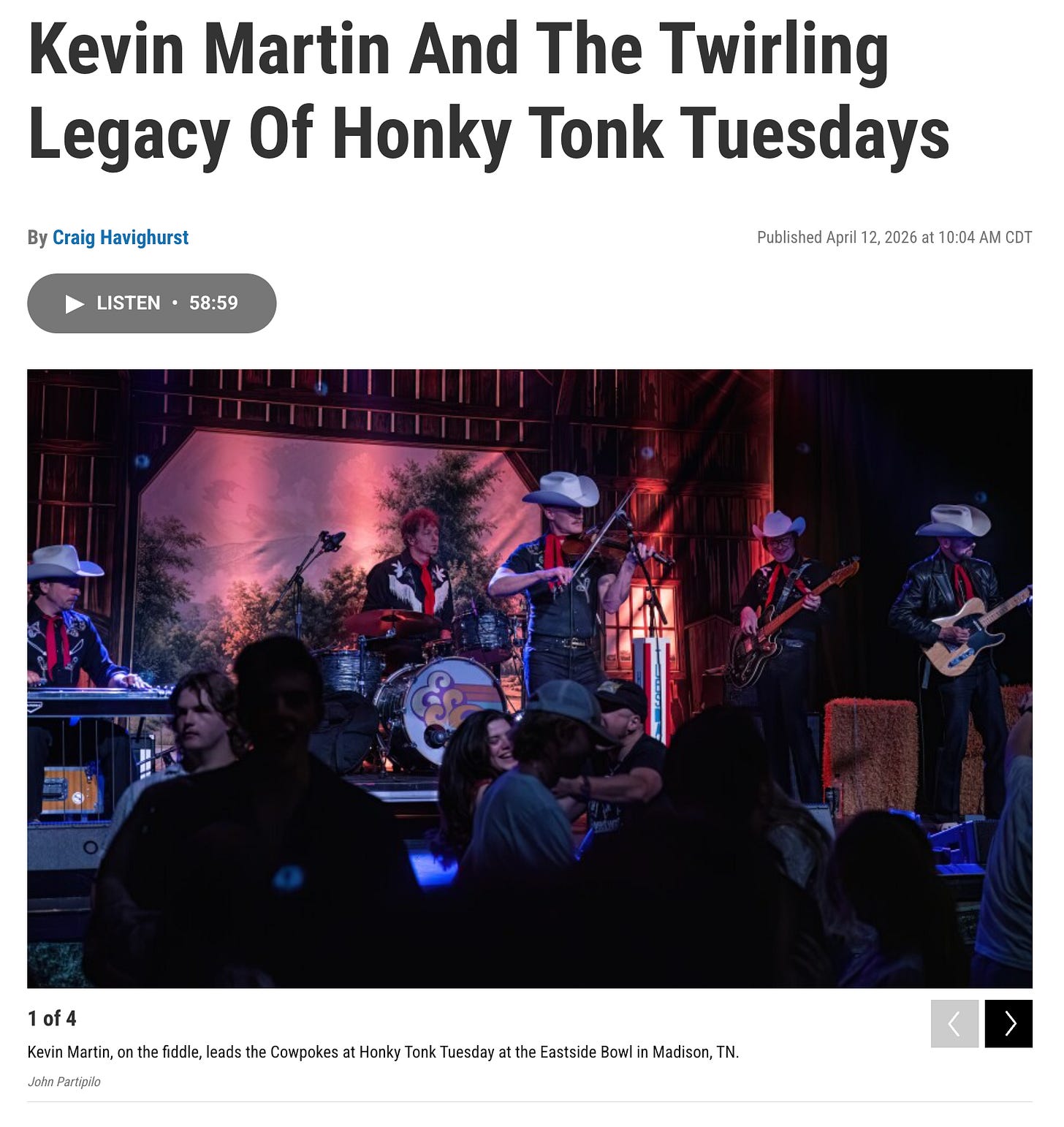
Nearly 12 years ago, an informal arrangement between the caretakers of a down-on-its-luck American Legion Post and a handful of young honky tonk musicians led to the creation of Honky Tonk Tuesday Nights, one of the most vibrant residency music series of the past two decades. It’s been a haven for people who love to dance, for East Nashville community, for visits from stars, and for talent development in roots/Americana music. I spent time with the event’s founders and takes you to the scene, now moved to Eastside Bowl in Madison. With a photo essay by John Partipilo.
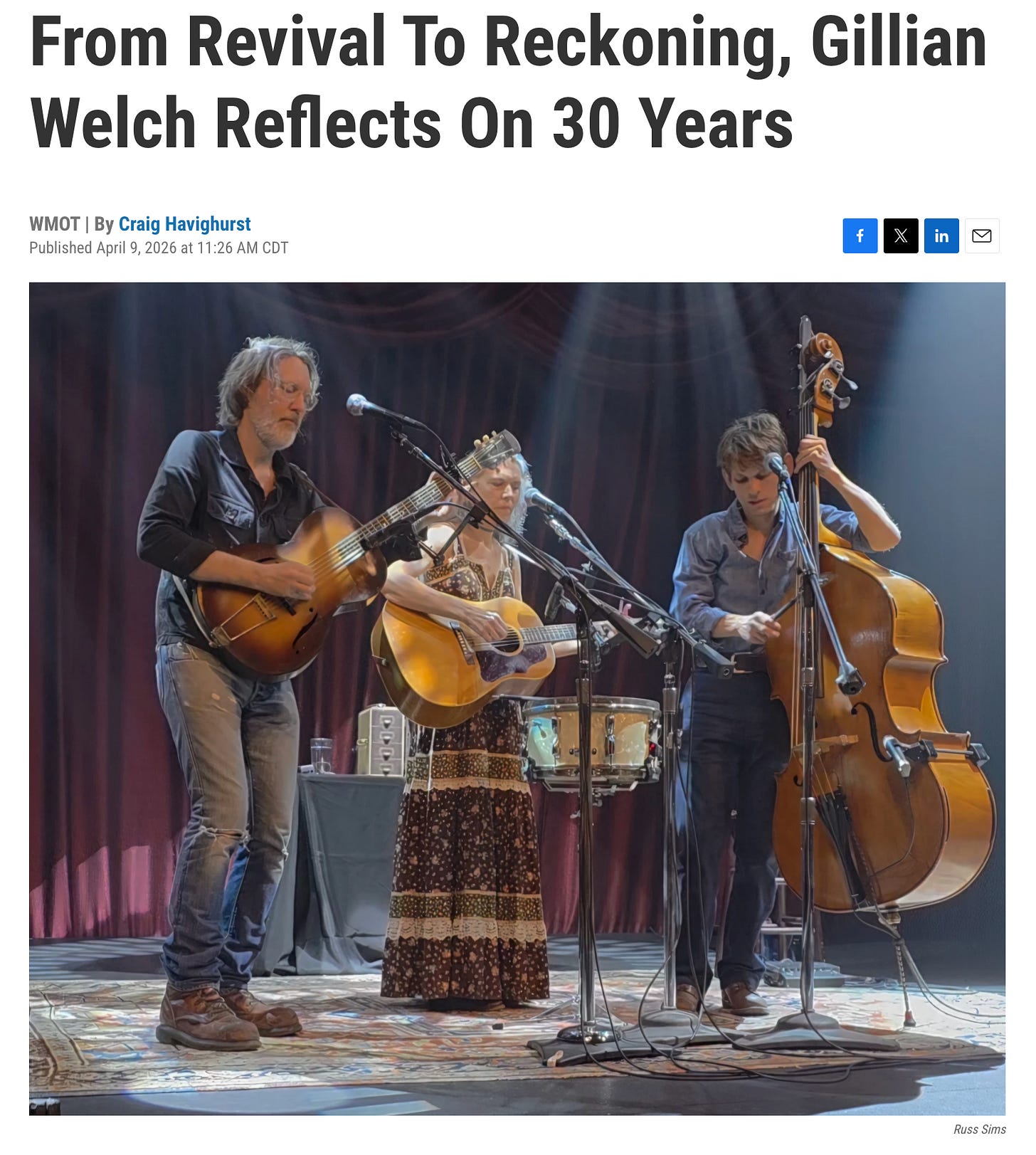
Gillian Welch and David Rawlings introduced themselves to the world 30 years ago with their seminal Americana recording Revival. Now, they’re tapping their shared youthful love of the Grateful Dead on an extensive tour celebrating the 45th anniversary of the live acoustic album Reckoning. In between, the duo/couple has made an indelible mark on American roots, with Grammy Awards and an Americana lifetime achievement award for songwriting. Just before the tour’s launch with a pair of Brooklyn Bowl shows, I caught up with Gillian Welch for this Q&A.
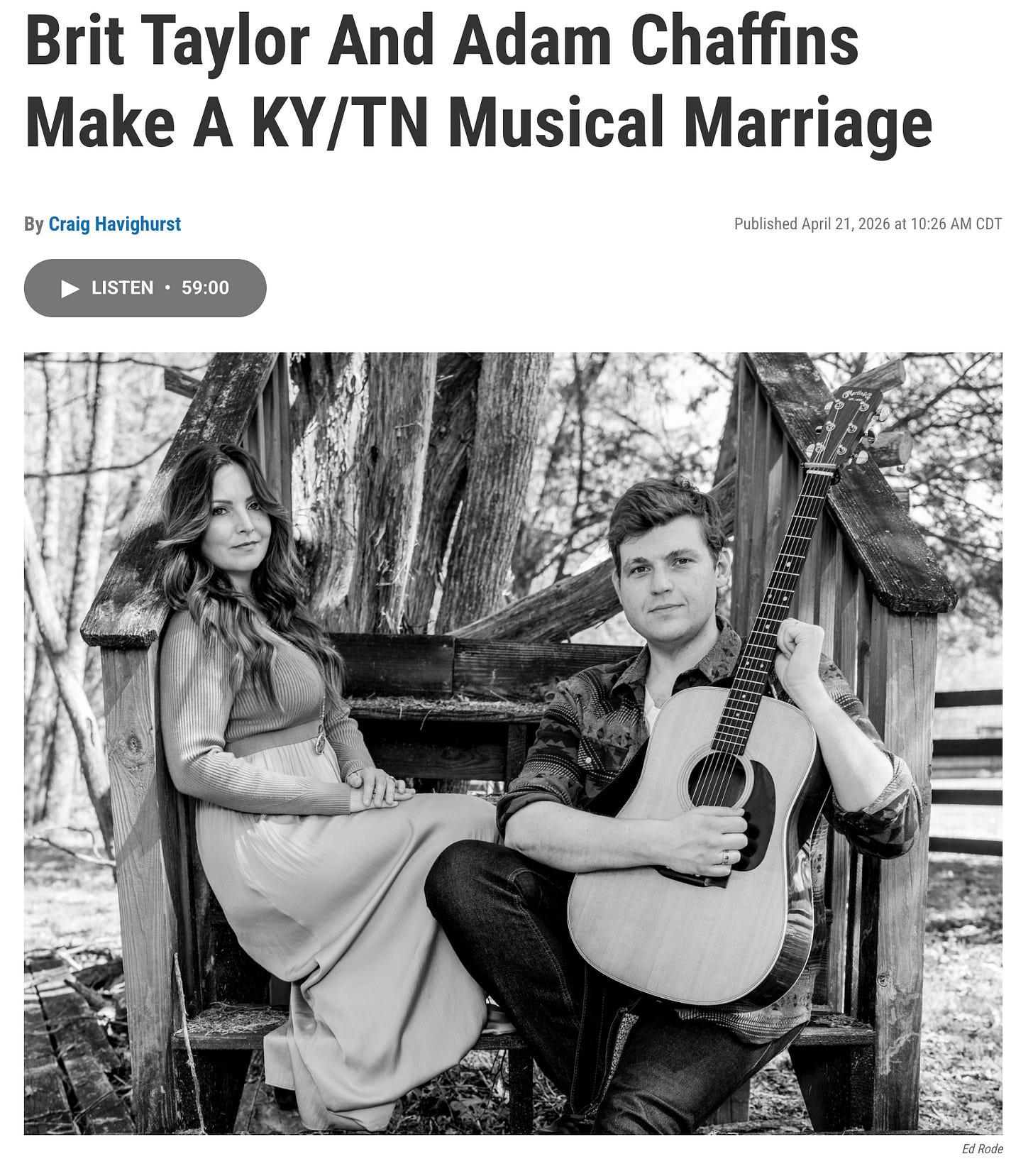
Brit Taylor came to town from eastern Kentucky chasing the US Route 23 dream that brought us Loretta Lynn and Patty Loveless - and wound up working with Cowboy Jack Clement and Sturgill Simpson. Adam Chaffins grew up one or two counties over and ensconced himself, as a bass player and singer, in the East Nashville bluegrass scene. Eventually, a friend was smart enough to introduce them, and they became a super-talented Americana couple. But not a duo. Taylor has four albums out, including two produced by her husband. Chaffins dropped a debut LP in 2020 and a soulful EP last year, with Taylor’s harmony vocals. I visited their homestead near Mt. Juliet to hear their story around their kitchen table. Lovely photos by my friend Ed Rode.
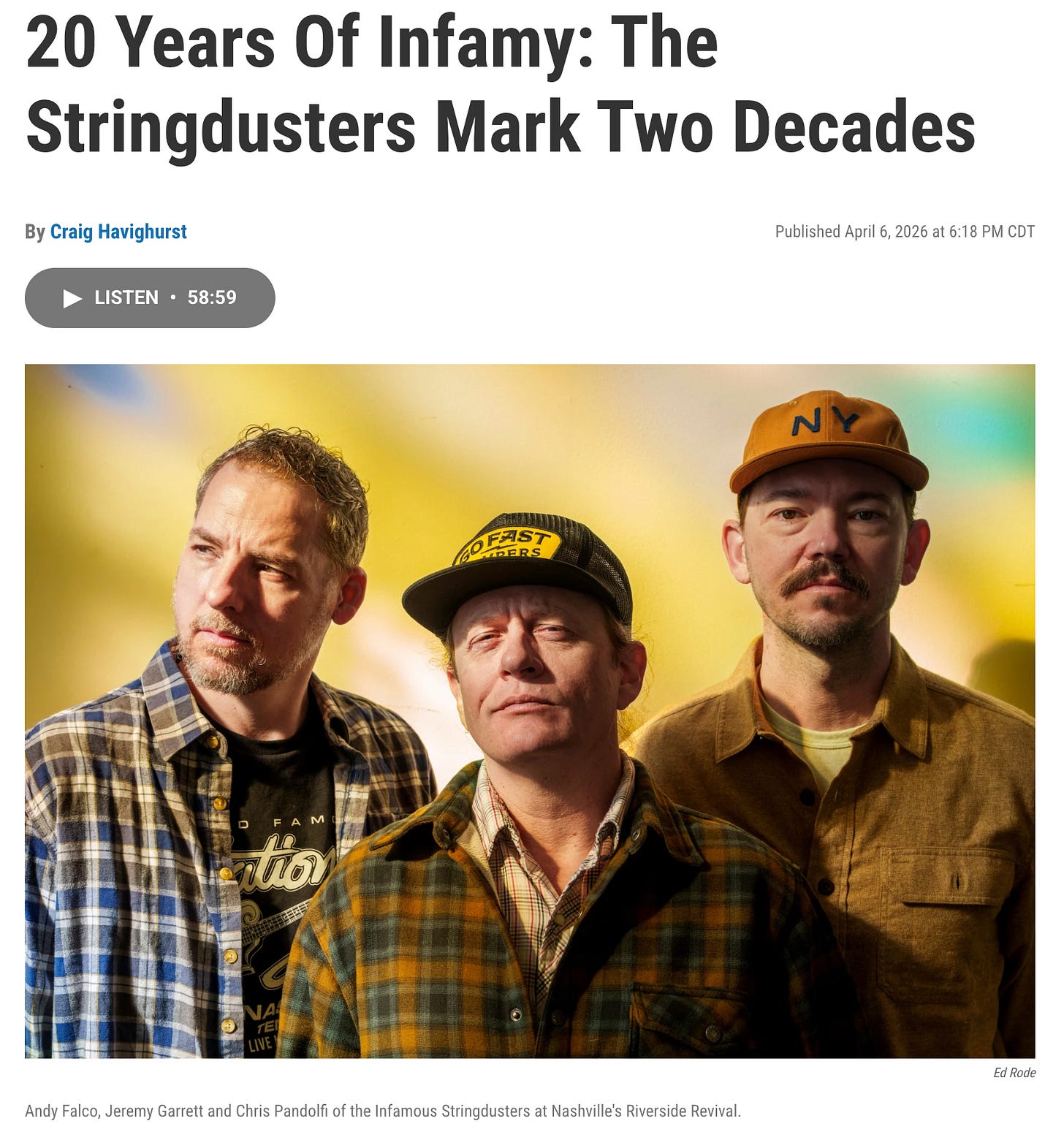
The Infamous Stringdusters emerged out of Nashville’s world-class but somewhat undiscovered bluegrass scene of the 2000s. Six guys with different professional pathways into the music and wide ranging tastes in other genres got to know each other at gigs, picking parties, and the IBMA World of Bluegrass. And their first gesture as a band - the 2007 album Fork In The Road - was a triumph, winning three IBMA Awards. Since those days and after a couple of early personnel changes, today’s quintet has become a huge force in jamgrass music with a fierce and in-demand live show. Yet they turn back to some of the simpler and more blues-based elements of their core heritage on their new 20th anniversary release, 20/20.
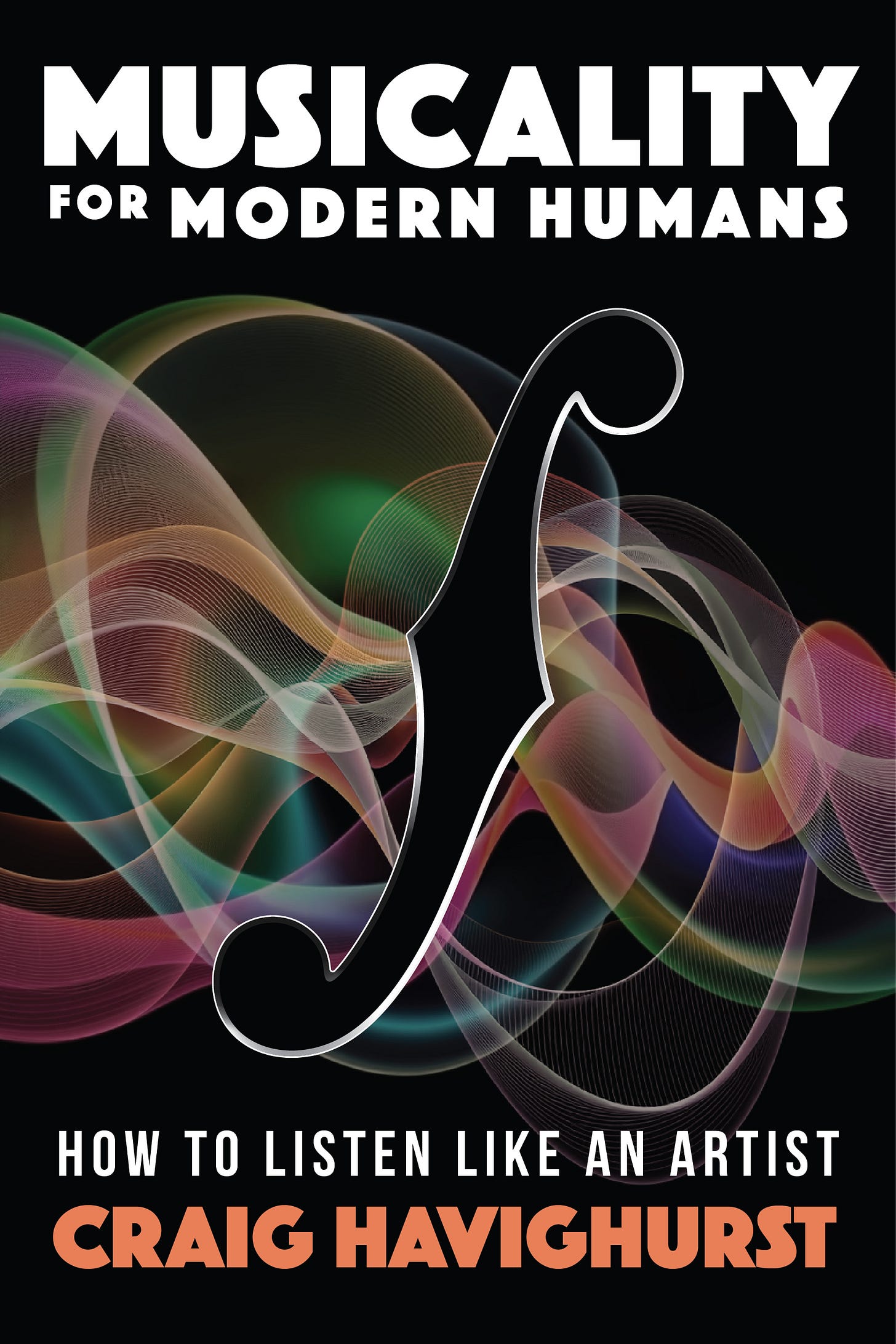
As for Musicality for Modern Humans, the cover image is a big fat link to Amazon in case you haven’t picked up a copy or in case you’ve read it and would like to leave a review, which I’d very much appreciate. Also, I’m looking for book clubs, civic groups, church teach-ins, company webinars, etc. to talk about music with folks in Middle TN and beyond. If you have ideas, please reach out to me: chavighurst@gmail.com. CH
No posts
Comments
Nothing yet. Say the first thing.
Sign in to join the conversation.