
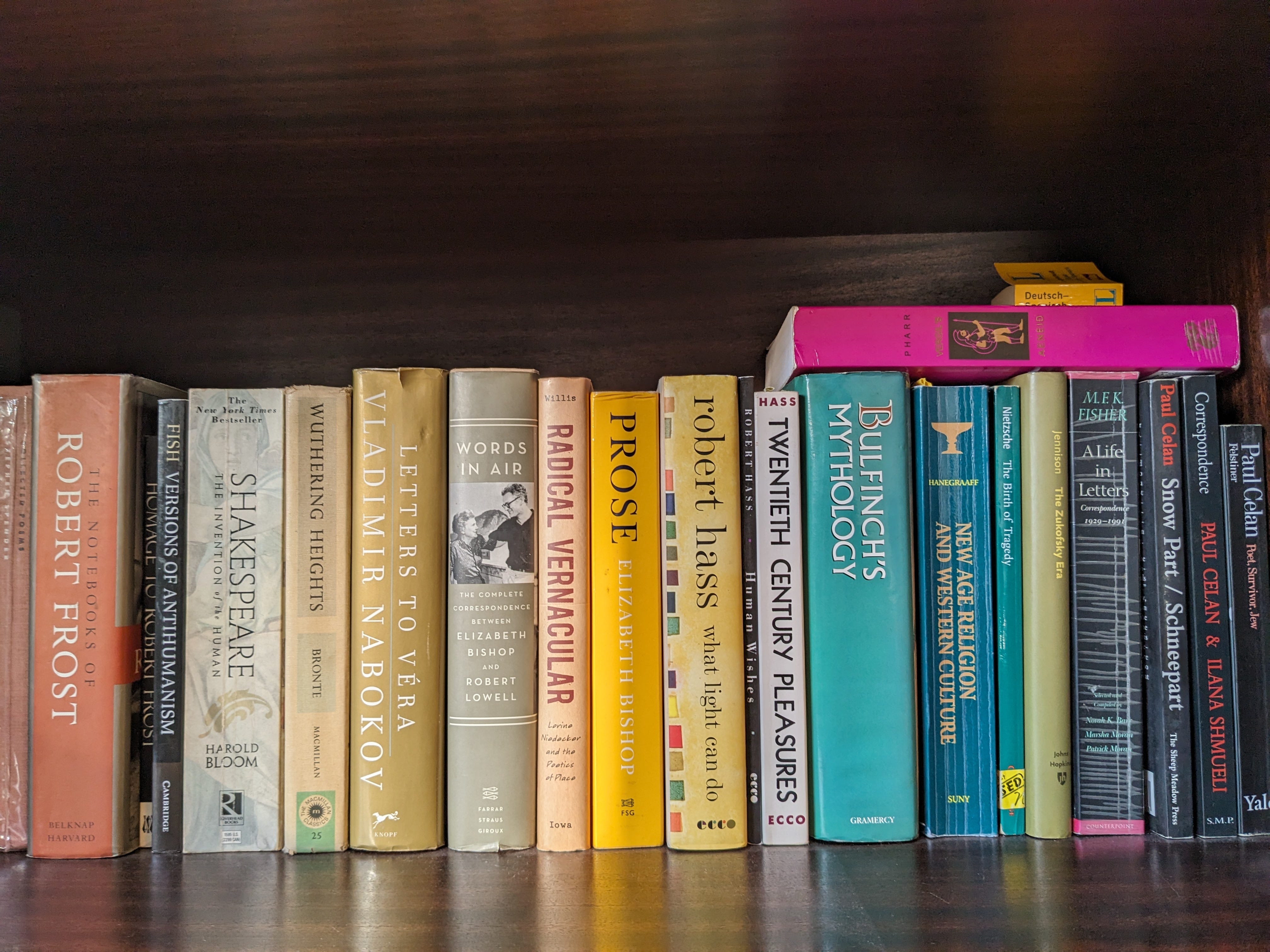
A friend visited me last week before leaving town for the holidays, and we sat on the floor talking and drinking tea. We talked about having babies, the difference between becoming a mother and becoming a father, and I enjoyed painting a scary picture of the brainmelt that happens in a person carrying a child. You die to yourself, I insisted, defending my position as woman-deliberately-as-yet-without-a-baby. Besides, I blurted, I need to publish three books first. He smiled at that. He knows my history of chronic illness and my suffering story around my menstrual cycle and my anguish at not feeling suited for academia. He gestured to the bookshelves to our right and left. Is it possible that books are keeping you from your body?, he asked.
I had no eloquent response in the moment and so the question haunted me for the next 24 hours. No, not ultimately, I would have said. The nonreality of this seeming dualism (body/books) gets at the core of my dissertation research. “Contemplation” (of ideas/images in language, i.e.) describes a state belonging to the body. Words are spells, spells move the maya; our bodies and their sensations and perceptions are of the maya; language cooked up, cast, and consumed with intention acts directly upon the body, can transform and heal it… My body brought me to books. Books bring me to my body.
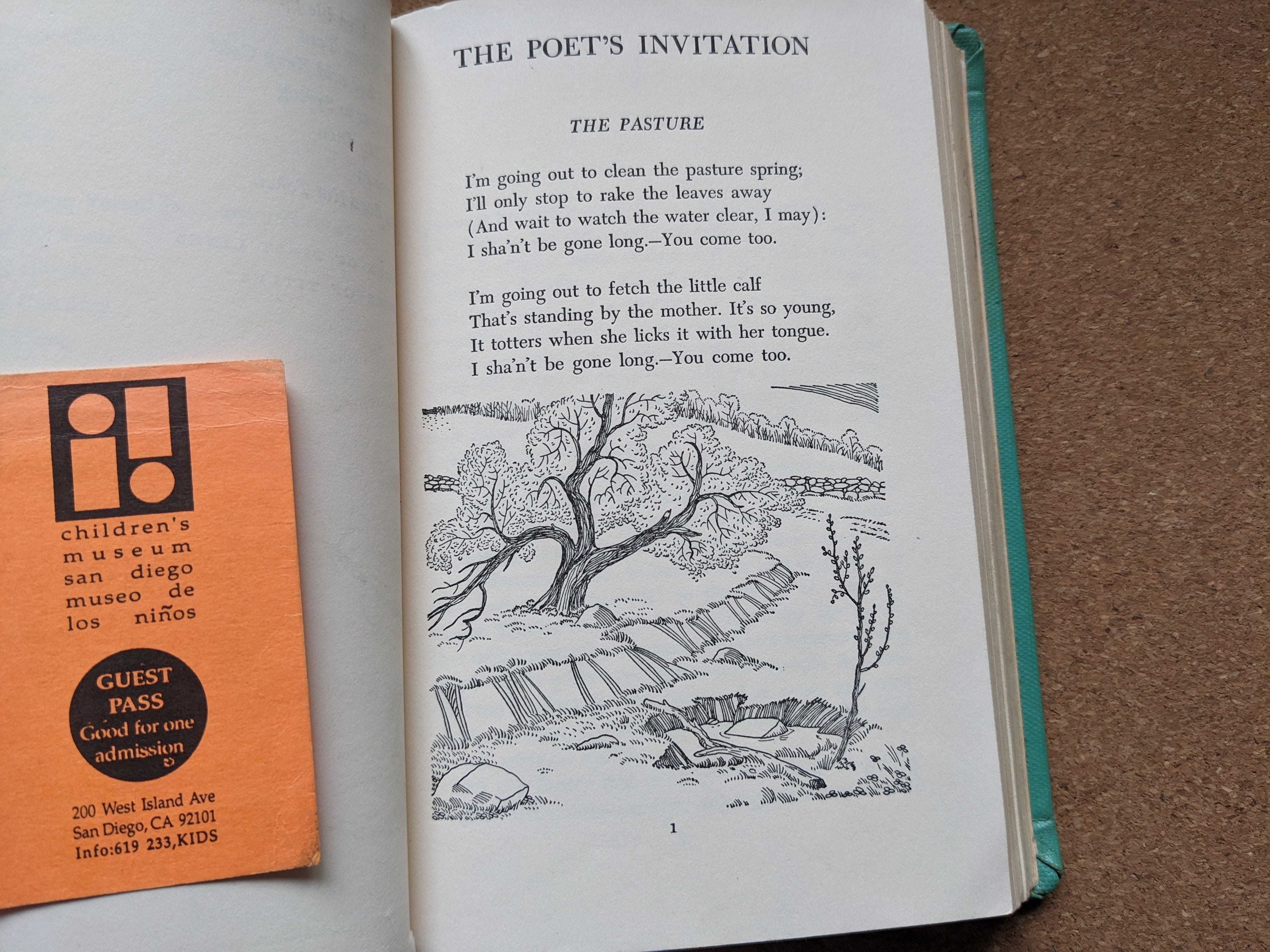
I was moved by poetry at a superyoung age, without/beyond any understanding of my “rational mind.” I can remember vividly—that is, in my body—being in the second grade, seven years old, and standing in the far corner of the Del Mar Heights School library, over in the 5th-grade section: I had gotten my homeroom teacher’s permission to check out older-kids’ books. Quiet, light blue walls, a dolphin painted somewhere (our school mascot). I was holding a selection of Robert Frost, opening to random pages as they fell—it was an old copy, with hard waxy cover of light green and cream, and there were black and white illustrations to go along with some of the poems—just reading around. I was utterly tripped out, enamored, obsessed.
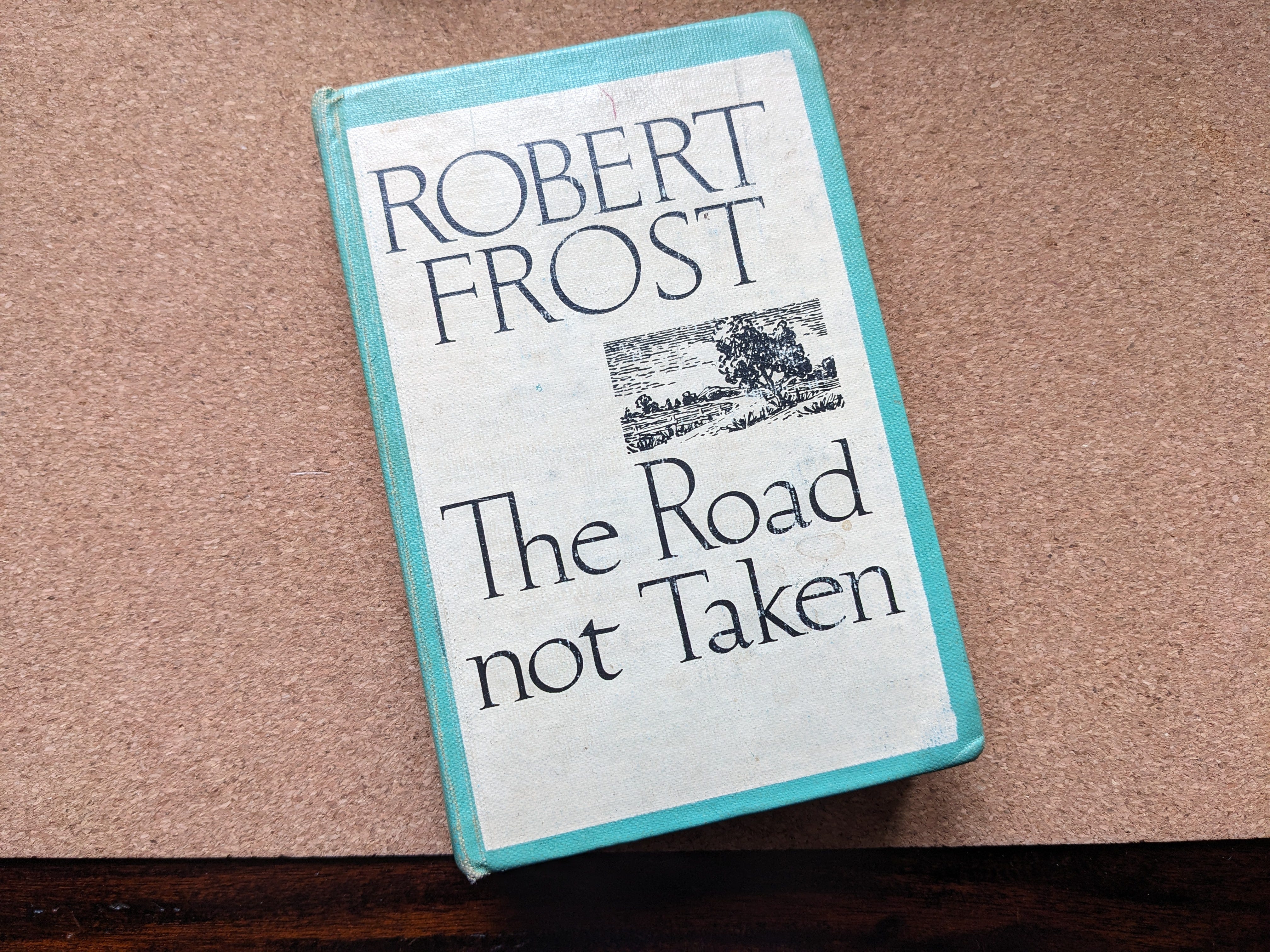
I used to wolf my lunch down and go spend recess in the library with that feeling, always returning to the same book, but discovering new poems each time. Imagine some psychedelic researcher presenting my seven-year-old self—Etnies skate shoes, Laura Ashley prairie dress, puka shells, long yellow ponytail—with the Mystical Experience Questionnaire on a wooden clipboard. I would have checked every box!
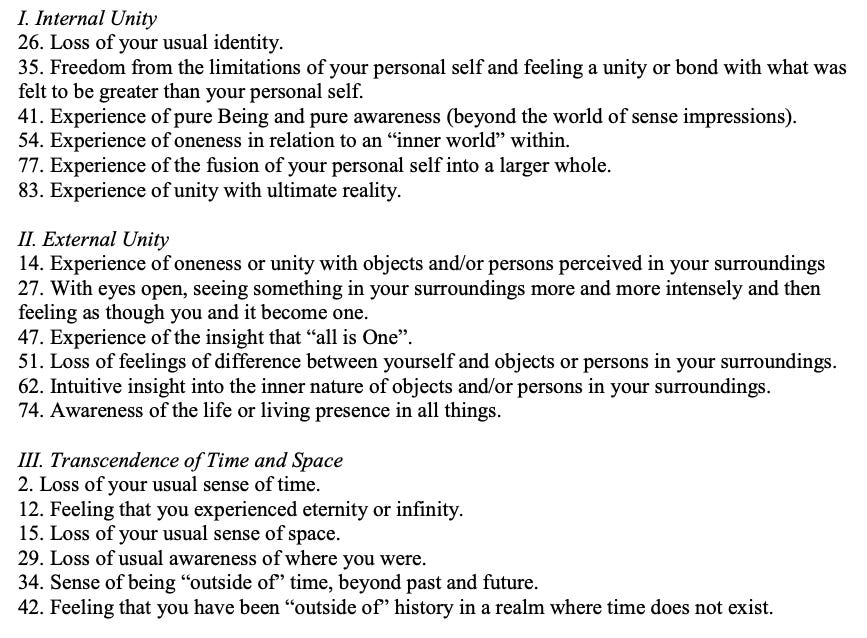
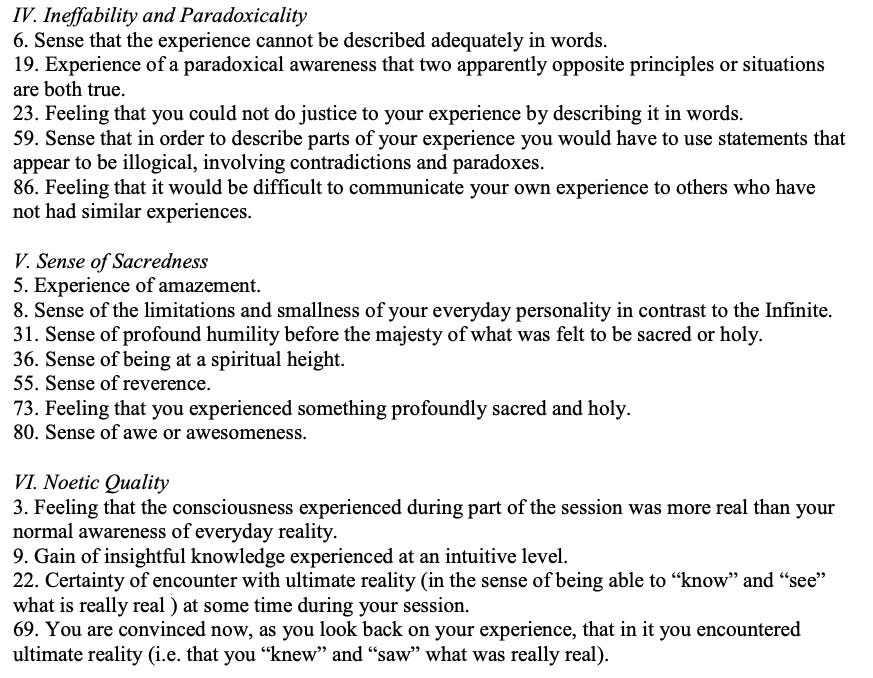
To me, the vibrancy of such a body-memory proves the bodymind/book connection; that is, stuff we’re already coming around to agreeing on, that the mind is a satellite or organ of the body, a processor (where fascia, etc., is the storage—cf. The Body Keeps the Score). Poetry can bring stored things from this and other lifetimes up to be run thru the mind for processing… consciously or not… while that unit is whirring, meanwhile, the rest of the organs, etc. are free to relax, and will naturally, in a relaxed state, release traumas, toxins, stories…
I concede to my friend that it may seem paradoxical at first that reading stories—e.g. Frost’s narrative poems, which rely heavily on story structure—facilitates a person’s ability to release their own stories about themselves. All language (starting from the level of the phrase) has story built in; a body or objects perhaps can mime story without language, but you rarely find language without story clinging to it. Story/language is something that crosses the perceived body/mind barrier; language mediates between unconscious/conscious awareness. The task of the processor (the mind) is “awareness;” to make things more or less conscious, bring them up (from the body, into [in]sight) for clearing, make the unknown known.
But we cannot stop at the mind. Here’s where I would remind my friend that from body to mind into spirit goes the game. The crucial, and I suppose neither easily taught nor widely available, “next step” in contemplative reading/writing, where language/books bring one more fully back into the body, involves the surrender of the known (that fresh insight or awareness the mind finds, what had been a small unknown) into the greater unknown once it has been retrieved, acknowledged, celebrated, mourned, what have you.. whatever your body needs/wants to do with it.
How describe such “surrender”? Maybe offering or dedicating any mental/emotional insight from one’s reading or writing to a higher, less personal level of power or consciousness than your small self; not to fix or fetishize the insight and end up (unwittingly, probably) rendering it a judgment. Slowing way down so you can even wedge your awareness between these rapid-flash movements of communication, conversion, translation that are occurring between language, body, and mind. Discipline and motivation for such practices end up being what people call “spiritual” in nature.
Due to institutional pressures on its structural definition, criticism in general cannot surrender. It is doomed to re-storify, re-language, grasping the insights, even attempting to rationalize/“factualize” these most physical and personal of responses. I understand this as a reaction to our not having easy or accessible means of letting go of our jewels of insight once they have been moved through our individual bodyminds and are ready to be composted back into the earth or respiritualized up into the ether, circulating again among the greater system of living things that makes us possible.
Reading and writing can be perfect grounds for catch-and-release insight play. See Elizabeth Bishop’s famous poem “The Fish” for a classic story of such an experience. Bear in mind, though, that to get stuck on the spoke of a word (as she exults with “Rainbow, rainbow, rainbow!”) may be like getting stuck on the spoke of the storytelling wheel, i.e., wrapped around the axle of the conscious mind—and there’s a seductive melancholy attendant there. Consider Robert Hass’ elegiac ode ending in “blackberry, blackberry, blackberry”. Bob, of course, can still see and say that “There are moments when the body is as numinous / as words,” though to me, that seems to come at the understanding backwards.
To state what is taken for granted by so many poets and readers of poetry that it felt absurd to shout it from the rooftops at the PhD: to write a poem can be a contemplative exercise, and to read one can be too; and we can acknowledge the benefits of exercise without being quacks. Consciously or not, people who turn to poetry do so because they are in spiritual crisis, i.e., in need of personal transformation. With an attitude or posture of contemplation, language itself can address these bodily needs and desires.
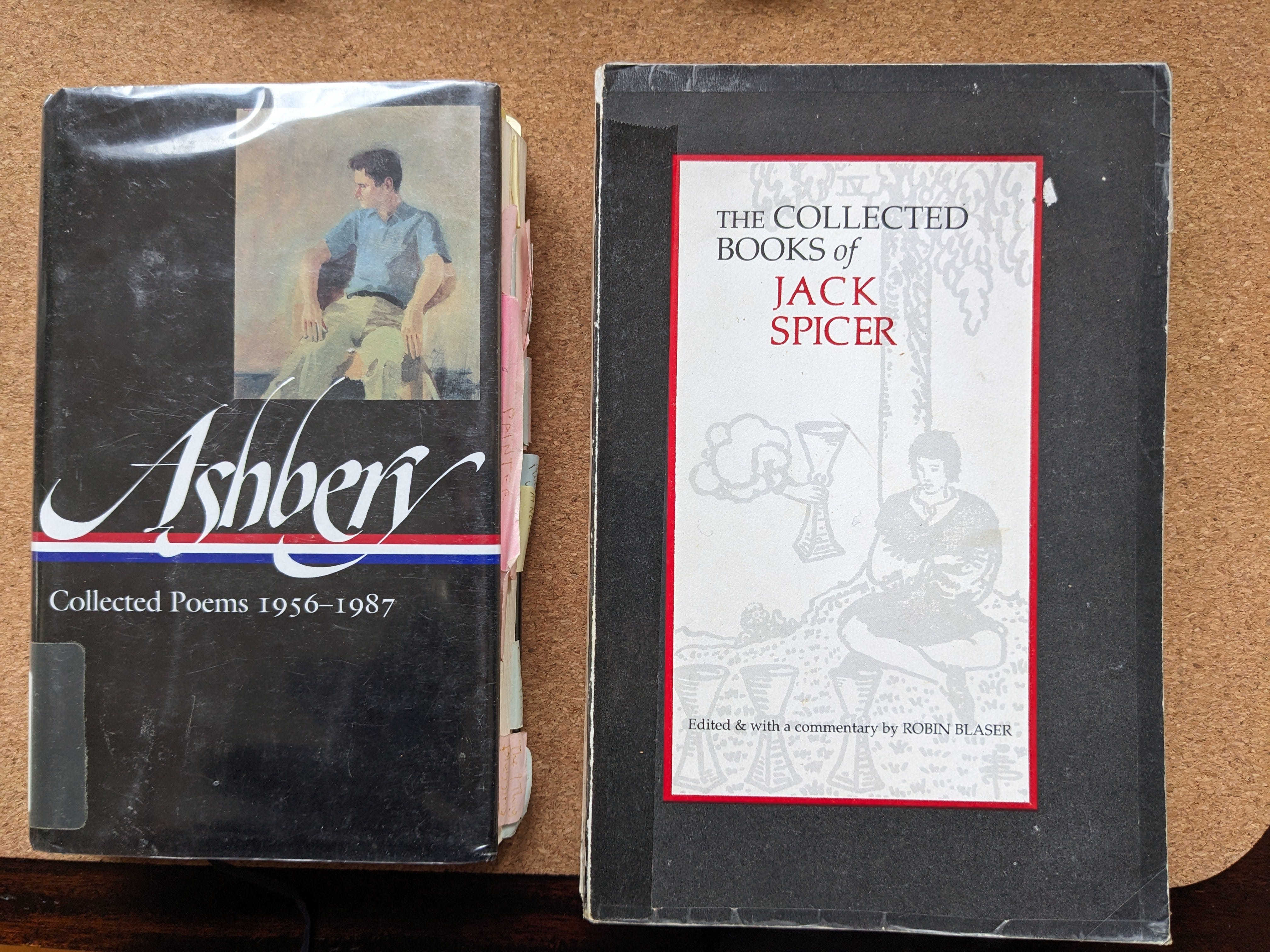
Completing the Literature PhD this summer left me (“my bodymind") crushed beneath a huge pile of grief, rage, and hollowness. No one warned me about this, though I can back-read oblique warnings—dire ones—in the behaviors and expressions of my peers and professors over the last six years. I found the hunt for meaning and/or purpose and/or peace through analysis and history futile and depressing. Sounds obvious now, of course; you can’t hunt peace. Peace, meaning, and purpose had stolen upon me in the back of that light blue library when I was seven and came upon “The Pasture.” Ashbery’s “At North Farm” would update that theme when I was eighteen, fresh at Berkeley. (One’s purpose, naturally, is love.)
The absence of personal/spiritual understanding and support of the academic environment surprised me, which often amuses others when I share it, or elicits pity. This has caused me lots of shame. I openly brought my deeply personal and highly spiritual relationship to literature into every aspect of graduate school, only to discover this was far from the standard operating procedure—even the hardcore hippies of the “holy cross” in Santa Cruz were disguising their missions as “re-enchanted” humanities in a way that—again, just for me yall—rang false.
So, I am describing another layer of global pandemic. We were isolated, and we suffered. C*VID brought the vulnerability of the body back to the front lines of awareness for everyone, even the academics; in some people, this launched the spirit/surrender third-part of the contemplative processes of criticism (reading and writing), while in others this buried it even deeper in bitterness, despair, dissociation. The body, though, keeps on working til it’s done. My favorite colleague was writing about food, class, taste, and aesthetics. Bodies keep scores.
Every poem is a love poem, Jack Spicer observed, a line that I love to repeat. Ashbery said the same about his own work, reiterating the statement throughout his prolific decades. Love happens in the body; it is my favorite “way of happening”. Using the body as its jumping-off point, Love integrates the contemplative triplicate: it is at once the ultimate sensation/perception; the ultimate insight; and the ultimate surrender.
Good reading and good writing, I want to tell my friend—“good” here meaning empowering, liberating—happen to and through the body. Long before my bodymindspiritwhatever (and the cultural moment) got hip to yoga asanas, holotropic breathwork, tantric sex, ceremonial journeying, and so on, I was having the top of my head blown off by books.
Comments
Nothing yet. Say the first thing.
Sign in to join the conversation.