
If you started investing after 2020, you probably think a Price-to-Earnings ratio of 100 is normal.
It’s not.
In fact, for most of stock market history, investors considered a company with a P/E above 30 to be expensive.
A P/E above 50? Extreme optimism. Above 100? That’s usually reserved for companies expected to dominate entire industries for decades (there are none of them)
Yet after 2020, something extraordinary happened.
The market completely abandoned traditional valuation logic.
That was the moment I closed every stock position and moved almost my entire portfolio into crypto.
Master, what is a P/E Ratio and why it’s important?
Let’s talk about it by looking at this chart:

Before the market entered this new era of speculation, investors relied heavily on one simple metric: the Price-to-Earnings ratio, or P/E ratio.
The concept is straightforward.
The P/E ratio tells investors how much they are paying for each dollar of a company’s annual profit.
For example, if a company earns $10 per share and its stock trades at $200, the P/E ratio is 20.
This means investors are paying $20 for every $1 of annual earnings.
Historically, a P/E ratio around 15-20 was considered reasonable for many established companies. A company trading at 10 times earnings was often considered cheap. A company trading above 30 times earnings needed a very convincing growth story.
The logic was simple:
You buy a company based on the profits it generates.
If a company earns $1 billion per year and you pay $15 billion for it, you are effectively buying a business that could theoretically return your investment over time through its earnings.
For example:
A company earning $5 per share with a P/E ratio of 15 would trade at $75.
If investors became more optimistic and gave it a P/E ratio of 25, the stock would rise to $125 - even without any change in earnings.
The problem after 2020 was that the process reversed.
Following the COVID crash, central banks flooded the economy with liquidity.
Interest rates were pushed close to zero.
Borrowing money became very cheap - almost free.
Investors started paying extremely high prices before the profits existed.
Instead of buying a profitable company and waiting for growth, many investors bought future expectations.
The question changed from:
“How much profit does this company generate today?”
to:
“How big could this company become if everything goes perfectly?”
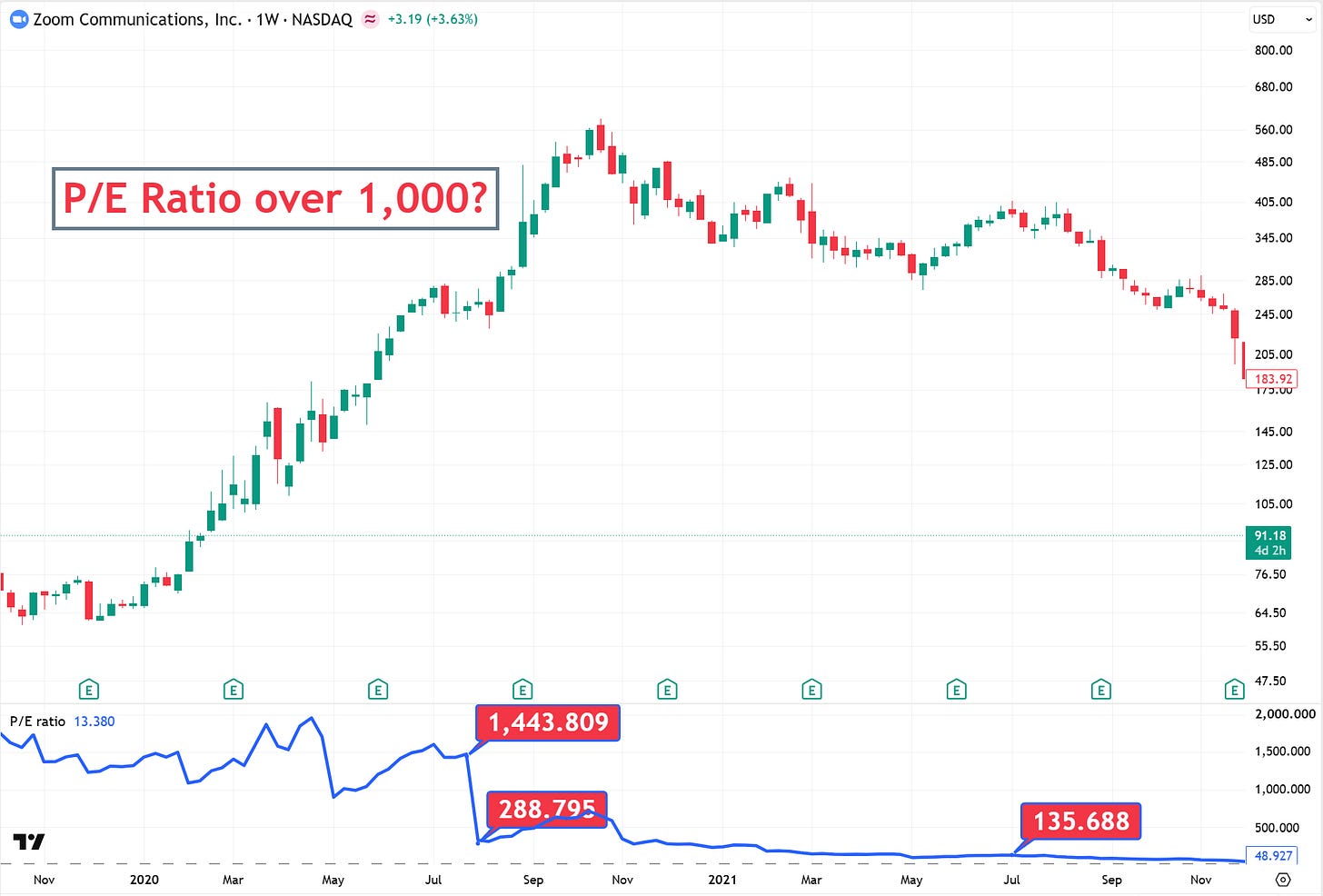
Take Zoom as the perfect example.
Between 2020 and 2022, the stock exploded from around $60 to almost $600.
Yes, earnings improved.
Yes, millions of people suddenly worked from home.
Those facts were real. The valuation was not.
At one point, Zoom traded at a P/E Ratio of almost 1,400.
Think about what that actually means.
Investors were willing to pay $1,400 for every $1 of annual earnings, while a healthy, mature company often trades closer to a P/E Ratio of 20.
That is not investing.
That is speculation disguised as investing.
When people tell me they are dollar-cost averaging into their favorite stocks or obsessing over quarterly earnings reports, I always ask the same question.
What exactly are you analyzing?
If a company can trade at 20 times earnings one year and 1,400 times earnings the next, fundamentals clearly are not driving the market.
And how did that story end?
Zoom eventually crashed more than 90% and even today remains roughly 84% below its all-time high.
Imagine buying near the top because everyone said it was a great long-term investment.
Good luck waiting decades just to break even.
That was the moment I understood something that completely changed my approach.
Modern markets reward traders far more consistently than long-term investors.
Because today’s market is driven by cycles, liquidity, and trader psychology.
Ignoring those forces is no longer investing. It is simply hoping.
Comments
Nothing yet. Say the first thing.
Sign in to join the conversation.