
“A vortex forms around the perceived body into which my world is drawn and, so to speak, sucked in: to this extent, my world is no longer merely mine, it is no longer present only to me...” – Maurice Merleau-Ponty
If the real is ‘out there’, then we are trapped within our subjective opinions. Such is the consequence of the attempt by a curmudgeonly alliance of philosophers in Bertrand Russell’s generation to eliminate metaphysics (out of hostility to religion, which is unavoidably metaphysical). This has had the unfortunate consequence of obscuring the metaphysical roots of the sciences. We are left with the fossilised remains of Immanuel Kant’s distinction between phenomena and the ‘thing-in-itself’ expressed as the subjective prison of ‘opinion’ coupled with a venerated magical objectivity.
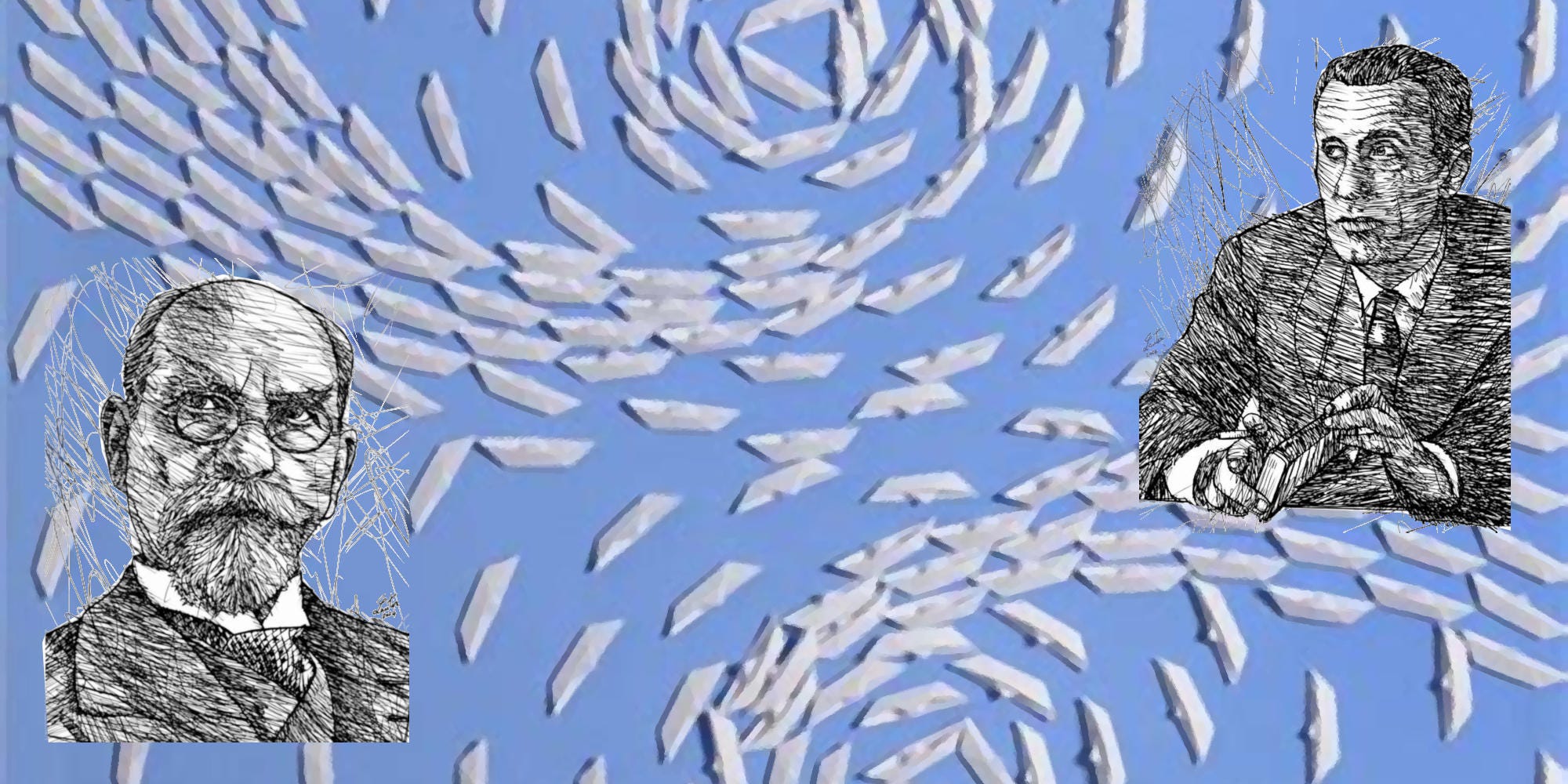
Yet there is another path opened by Kant. At the same time that Ernst Cassirer was trying to rescue Kant’s original insights, another German philosopher was founding a new philosophical movement called phenomenology. Edmund Husserl (hoos-erl), pictured above left, initiated an approach with an evident debt to Kant that should be immediately clear: while Russell and his crew were lusting after the thing-in-itself as ‘objective truth’, Husserl focussed instead upon Kant’s phenomena. Both had the same aim – eliminate metaphysical speculation – but Husserl’s phenomenology aimed at being a science of consciousness, one that studied the topic from the inside, as it were.
Husserl inspired an entire generation of brilliant philosophers, including all the French existentialists – Simone de Beauvoir, Jean Paul Satre, and Maurice Merleau-Ponty (mer-loh pon-tee). Each rejected Husserl’s dream of an internal science of consciousness in favour of a foundational idea of being-in-the-world. Whereas de Beauvoir and Satre’s philosophy emphasised the freedom to create ourselves, Merleau-Ponty mounted a bold attack on an even older philosophy that that of Kant: Descartes’ splitting of existence into a dualism of mind and body. For Merleau-Ponty, Kant was correct that our subjectivity is the very framework by which we experience existence, but this means objectivity is something we constitute together.
For Merleau-Ponty, pictured above right, we are first and foremost embodied. Down Russell’s road, Descartes dualism of mind and body became mind versus matter, and then an attempt to pretend there was no mind, only matter. Down Merleau-Ponty’s road, mind cannot be removed from body because we were always within the real, directly experiencing it, albeit with our own deceptions and mistakes. Whatever claims the sciences assemble require an intersubjectivity, the engagement of multiple perspectives that triangulate the truth through verification (and a parallel argument can be made for the arts too).
At the heart of our experiences is a kind of vortex of the real that we all live within at all times. As the opening quote illustrates, our sensory functions connect us to other beings irresistibly. When another human is around us, we cannot ignore them. Rather, we are drawn into the whirlpool that forms around our perception of their bodies, one that pulls us inexorably together, such that “my world is no longer merely mind, it is no longer present only to me”. This is the fundamental truth of shared reality that is utterly obscured by the metaphysics of one objective reality and infinite subjective realities. Other people’s bodies live within “the same structure as my own.”
Children find human objects “like meteorites from another planet”, and do not question that everyone engages with these items in the same ways. It takes the bad habits of an adult to forget this. The sciences have been singularly uninterested in spoons and doors and chairs, but the essence of shared reality is that these things-at-hand are what make up the worlds we live in and necessarily share. Languages are also tools, requiring our embodiment to use (yes, even when mediated by computers, even if wired up by neuralink!). The intersubjective world is a problem for adults, and yet completely natural for children!
Like monks withdrawing from contact with other people, those drawn to the scientific become like metaphysical ascetics, pretending they live alone, worshipping a great machine whose gears and pistons deliver up the real. But it is we who live in the real, and we live there together. Once we can look upon their work honesty, the successes of the sciences are the great achievement of our shared reality, something that literally could never have happened had we truly been imprisoned alone within our subjective opinions.
No posts
Comments
Nothing yet. Say the first thing.
Sign in to join the conversation.