
If you’re new here, welcome to Stolen Wives. I write hotwife & cuckold erotica with emotional heat and psychological depth. If you enjoy the setup below, subscribe to get the next parts straight to your inbox, as well as access to all the stories in the archive.
The chicken had another eight minutes. I stood at the island watching the timer on the stove while Claire worked at the dining table behind me, her laptop open beside a yellow legal pad covered in her handwriting. The house smelled like rosemary and hot cast iron. She was on a call with someone in procurement, her voice the flat, competent one she used when she was herding a conversation toward a decision without letting the other person notice.
I poured two glasses of wine. Set one near her elbow without interrupting. She glanced at it, mouthed thanks, went back to her screen. I took mine to the island and checked my phone. A text from my project lead about a structural review tomorrow. An email from my mother I’d answer later. Nothing from anyone I shouldn’t have been hearing from, because there was no one like that anymore, and hadn’t been for months, and I’d already stopped thinking about it.
We ate at the island because the dining table was Claire’s. Had been since we moved in. I’d designed the renovation of this house the year after we got married, back when I was still doing residential work at the firm and could justify spending weekends with a tape measure and graph paper making something for us. Open kitchen to the living room. Master bedroom with recessed shelving I’d built to her specifications. Guest room down the hall with a daybed I’d picked out of a catalog because it looked good against the east-facing window. I was proud of that house. I’d made it a self-portrait, the version of me I wanted to live inside.
After dinner she went back to her laptop. I cleaned up, loaded the dishwasher, wiped the counters. Stood there for a moment with the sponge in my hand looking at the back of her head. Her hair was pulled up in a clip, a few dark strands loose against her neck. She was typing something fast, her fingers sure on the keys, correcting someone or approving something or building one of her timelines. Seven years of marriage and I could still register that she was beautiful without doing anything about it. That’s what I mean by low-voltage. The wire was connected. Current ran through it. But nobody was turning up the dial, and we’d both stopped noticing.
“I might go to bed early,” I said.
“Okay.”
She didn’t ask why. A year ago she might have. Two years ago she would have looked up from the laptop and said something like “everything alright?” and I would have said fine, just tired, and she would have accepted that because we were both fluent in the language of not pressing. We’d gotten good at it. Efficient. We could go an entire evening exchanging nothing but logistics, who was picking up the dry cleaning, whether the dishwasher needed the rinse aid refilled, and call it companionship.
I went to the master bedroom, brushed my teeth, got into bed on my side. Passed the guest room door on the way, which was open the way it was always open, because no one used it. Her side of the bed was smooth and cool. I read for a while, something about load distribution I’d been meaning to finish, and fell asleep before she came in. I don’t know what time she joined me. I didn’t feel her weight shift the mattress.
That was a Tuesday.
⁂
She found the texts on Thursday.
I was at the office. She’d stayed home to finish a deliverable, and my personal laptop was on the kitchen counter because I’d been running structural calcs on it the night before. She needed to print a site plan for a client meeting and my machine was closer than going upstairs for hers. My iMessage was synced and open. She wasn’t looking for anything.
I don’t know how long she read before she stopped. I don’t know if she went through the whole thread or just enough. I’ve played it back a hundred times since and what I keep returning to is the gap. Her sitting there reading, me across town in a conference room talking about setback requirements with a municipal planner. Two versions of Thursday afternoon. In mine, nothing was wrong.
What I know is that when I walked through the front door at six-fifteen, she was sitting at the dining table with my laptop open in front of her, her hands flat on either side of it, pressing down as if the table might lift off the floor. She wasn’t typing. She wasn’t moving.
She looked at me the way she looked at contractors who’d deviated from the approved drawings. She was pricing the repair.
“Close the door,” she said.
I closed it. Dropped my bag by the wall. I still didn’t understand.
“Sit down.”
I sat across from her. The laptop was turned so I could see the screen. I recognized the thread before I recognized what was happening. Gray and blue bubbles. Leah’s name at the top.
Something in my chest went sideways.
“How long,” Claire said. Her voice was level. She could have been asking about a project timeline.
“Three months. It’s over.”
“Who.”
“Leah Marsh. She was a coordinator at Benson’s firm. She took a position in Portland in January. I haven’t spoken to her since.”
“Where.”
“Her apartment. Mostly.”
“Mostly.” She let the word sit between us. I could hear the refrigerator humming.
“Once at a hotel. Near the airport. After a site visit that ran late.” I heard myself say it and it sounded like a deposition. Every detail I offered was supposed to demonstrate cooperation, good faith. Instead each one landed like another small coin dropped on the wrong side of a scale.
Claire’s expression didn’t change. She was collecting data. I’d seen her do this in meetings, the stillness that preceded her actual response by hours, sometimes days. People who mistook it for calm were people who didn’t know her.
She scrolled through the thread with one finger. I watched her read the messages I’d stopped thinking about months ago. Times and addresses. Logistics. A message from Leah that said can’t wait for Thursday and my reply, which was a thumbs-up emoji.
There was a long pause. Claire had stopped scrolling. Her eyes weren’t moving. She was staring at the thumbs-up.
“You weren’t even in love with her,” she said.
She was measuring the size of the waste.
“No.”
“And this is all of it. Three months, her apartment, done in January.”
“Yes.”
“You replied to ‘can’t wait for Thursday’ with a thumbs-up emoji.” She said it again, weighing it.
I opened my mouth and nothing useful came out. I tried to say something about how it had already been winding down by then, how the emoji meant nothing, but every word I reached for made it smaller, and smaller was the problem. If I’d burned down the marriage for a grand passion, at least the scale would have matched the destruction. This was a man setting fire to his house to light a cigarette. She was looking at the wreckage and finding out the cigarette wasn’t even a brand I liked.
I could see her doing the math. Seven years of marriage. The move from Denver, where she’d had a promotion track she’d built from nothing, to here, where she’d started over without complaint because my firm had the better offer. The renovation she’d let me design because she’d believed I was building us a life. All of that weighed against three months of Thursdays and a thumbs-up emoji. I watched her run the calculation and I watched the answer arrive.
Claire closed the laptop. The click was precise.
“I’m going to ask you not to talk for a while,” she said. “Can you do that?”
I nodded.
She sat there for what felt like a long time. Maybe two minutes. Maybe five. I couldn’t tell. The kitchen timer had gone off at some point while I was sitting down and I’d never heard it. Outside, someone was running a leaf blower three houses down, the sound coming through the walls like something from another country. I watched Claire’s face and tried to read it. I couldn’t. The expression was one I’d never seen, something structural, as if a load-bearing wall in her had shifted and she was recalculating what the building could hold.
“Claire,” I said.
“I asked you not to talk.”
She stood up. Pushed her chair back from the table. Walked down the hall toward the bedroom, and I heard the closet door open.
⁂
She packed a bag that night. I sat on the bed and watched her do it. She moved through the closet the way she moved through a project plan, item by item, no hesitation, nothing reconsidered once it went in the bag. She took the blue overnight case she used for work travel. Two changes of clothes. Her laptop charger. Toiletries from the bathroom, selected individually rather than swept off the counter. Moisturizer. Contact lens solution. The small zippered pouch with her makeup, which she picked up and then set down and then picked up again. That was the only hesitation.
She did not take the robe I’d given her for Christmas. She did not take the novel on her nightstand. She took her running shoes. I watched her pack them and thought she was planning to be gone long enough to need a run. The thought was precise and useless, the kind of observation my brain kept offering because it didn’t know what else to do.
“Where are you going?” I asked.
“Beth’s.”
“How long?”
“I don’t know.”
She zipped the bag and carried it to the front door. I followed her down the hall, keeping a distance of a few feet that felt like a much larger number. She put on her jacket and picked up her keys from the hook I’d installed next to the coat closet during the renovation. Brushed nickel. I’d spent twenty minutes in a hardware store choosing it.
“Claire.”
She stopped with her hand on the door. Didn’t turn around.
“I’m sorry” is what I said, because I am not an original man and I didn’t have access to better language. It came out as what it was, something I needed to say more than she needed to hear. I wanted to say more. I wanted to say that Leah was nothing, that it was over before it started, that I didn’t know why I’d done it. But those were all versions of the same sentence. I am smaller than you thought. And she already knew that. She’d been looking at the texts.
She left. The door closed behind her with the soft click of the latch engaging. She didn’t slam it. I almost wished she had.
I stood in the hallway. Then I walked through the house looking for damage, the way I’d walk a site after an inspection. Kitchen. Living room. The dining table with her legal pad still on it, her handwriting face up. I didn’t read it. Master bedroom, where the sheets were pulled back on her side from that morning. Guest room, where the daybed sat against the wall under the east-facing window, still made, the coverlet smooth. My office, the converted sunroom off the back, where my drafting table held a set of plans I’d been detailing for three weeks and would not look at again for longer than that.
I ended up in the guest room. Sat on the daybed. The mattress was thinner than I remembered. I could feel the frame through the padding.
I did not sleep. I sat there and listened to the house settle and thought about Leah’s apartment, which had been small and under-furnished and always too warm, a one-bedroom in a complex near the freeway where the walls were thin enough to hear the neighbors’ television. None of what happened there had ever felt like something I was doing on purpose. That was the thing I couldn’t say to Claire without it sounding like an excuse. I hadn’t pursued Leah. I hadn’t planned any of it. She’d suggested drinks and I’d said sure, and drinks became her apartment, and her apartment became Thursdays, and Thursdays became three months of something I barely thought about when I wasn’t in the middle of it. I’d ended it the same way I’d started, by not doing anything. Leah left for Portland. I didn’t miss her. Going back to the marriage was like handing back a rental car.
The carelessness was the thing. I’d treated the marriage like something that would hold still while I wandered off.
Around two in the morning I got up and went to the kitchen for water. The laptop was still on the dining table where Claire had left it, closed now, dark. Her legal pad beside it. The pen she’d been using for work, capped and placed parallel to the pad’s edge. Even in crisis, she organized.
⁂
Two days. I went to the office Friday morning because I didn’t know what else to do. Sat through a design review where people discussed setback variances and I nodded at the right times and retained nothing. My project lead asked if I was feeling okay and I told him I’d slept badly, which was true. At lunch I sat in my car in the parking structure and held my phone and looked at the last text I’d sent Claire, a week earlier: Chicken or pasta tonight? The ordinariness of it was obscene. A week ago I’d been a man texting his wife about dinner. Now I was a man sitting in a parking garage trying to figure out whether his marriage still existed.
Came home. The house was the same except for the spaces where Claire’s things should have been: the blue bag gone from the closet shelf, the toothbrush slot empty, the charging cable missing from her side of the bed. I made dinner for one. Ate it at the island. Washed the plate. The routines felt like scenery from a play that had closed.
Friday night I texted her. I know you need space. I’m here when you’re ready. She didn’t respond. I typed other messages and deleted them. I love you. I’m so sorry. Please come home. Can we talk. None of them survived the backspace key. They all sounded like dialogue from a movie about a man whose wife had found his texts, which is what I was, and the fact that my crisis came with a ready-made script only made it worse.
Saturday I cleaned the house. Vacuumed. Scrubbed the bathroom she’d left two days ago. Changed the sheets on the master bed even though only I had slept in it, and even that only one night before I’d drifted to the guest room. I wanted the house to look the way it looked when things were normal. I wanted her to walk in and see it functioning. As if functioning was what she’d been missing. As if the problem was dust.
In the afternoon I stood in the doorway of the guest room and looked at the daybed. I’d picked it out three years ago. The frame was walnut, mid-century, with tapered legs and a low profile that looked good under the window. I’d never thought about whether it was comfortable. I’d thought about how it looked from the hallway.
At night I lay on the guest room daybed with my feet hanging off the end and stared at the ceiling and waited for the phone to light up. It didn’t.
⁂
She came back Saturday evening. I heard her key in the lock from the kitchen, where I’d been standing at the island for the better part of an hour, holding a glass of water I kept forgetting to drink. The door opened. She came in, set the blue bag by the coat closet, hung her jacket on the hook. She was wearing clothes I hadn’t seen her leave in. Dark trousers, a cream blouse, a dark cardigan. Borrowed from Beth, maybe, or bought. She looked ready for a meeting.
She walked through the kitchen without commenting on the clean counters, the vacuumed floors, the scrubbed bathroom I’d spent an hour on that morning. Either she didn’t notice or it didn’t matter. I think it didn’t matter.
She didn’t hug me. Didn’t look like she’d been crying. If anything she looked rested, and that was its own kind of cut. Two days away from me had put color back in her face. Her posture was different too. Straighter, held, the way she stood when she was about to run a meeting she’d spent the weekend preparing for.
“Can we sit down?” she said.
We sat at the dining table. Her territory. She moved her legal pad aside and placed a single sheet of paper on the surface between us, folded in thirds like a business letter. I could see the edges of text through the fold, the neat geometry of a formatted document.
“I spent two days thinking about whether I want to be married to you,” she said. “The answer is I don’t know. But I’m not ready to quit either. So here’s what I’m offering instead.”
She unfolded the paper and slid it across the table.
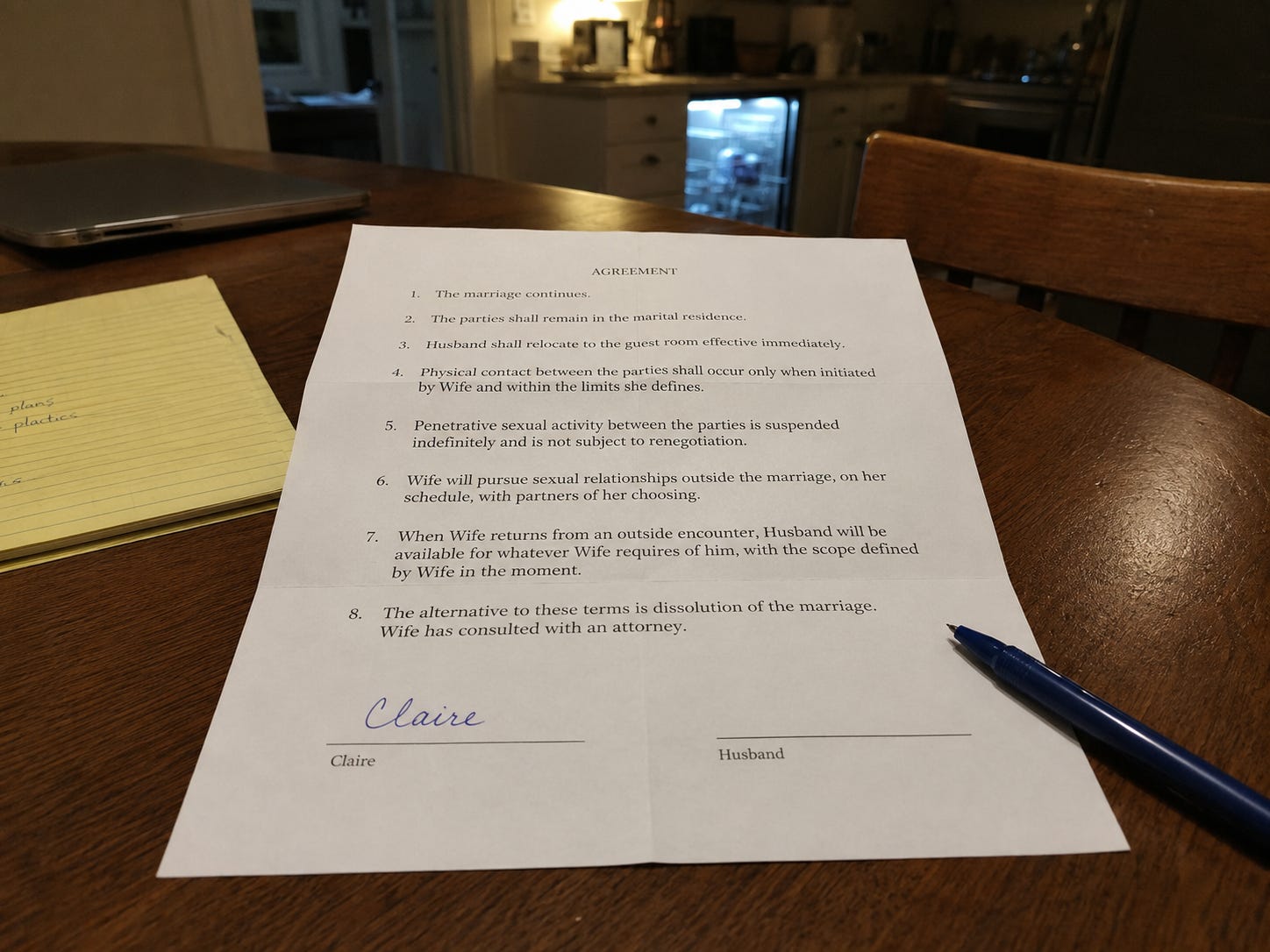
Twelve-point font. Numbered clauses. A horizontal line at the bottom with her name printed beneath it and her signature above it in the blue ink of the pen she kept in her work bag. Below her signature, another line. My name printed beneath it. The space above it blank.
I read the document. It was short. Eight clauses. The language was Claire’s professional register pressed flat into a shape I’d never seen it take.
Clause one. The marriage continues. Clause two. We remain in the house.
Clause three. I move to the guest room, effective immediately. The guest room. The daybed with the walnut frame I’d chosen for its lines. The thin mattress. The east-facing window that let in a bar of light at six a.m. that I already knew because I’d been sleeping there for two nights, my feet hanging off the end.
Clause four. Physical contact between us occurs when she initiates it and within limits she defines. Those limits will change at her discretion and she will inform me when they change.
Clause five was the one that stopped me. I read it twice, then a third time, the words rearranging themselves in my head, refusing to assemble into anything I could hold. Penetrative sex between us is suspended indefinitely. Not subject to review or renegotiation. She’d used indefinitely as a boundary condition, no endpoint written in. I read it again. The sentence did not change.
Clause six. She will pursue sexual relationships outside the marriage. On her schedule. With partners of her choosing. I will be informed as she sees fit. I will not seek details she hasn’t offered. I will not attempt to influence her choices. The language was careful and clean and described a future I couldn’t picture.
Clause seven. When she returns from an outside encounter, I will be available for whatever she requires of me. The scope of that availability will be defined by her, in the moment.
I read clause seven again. The phrase “whatever she requires of me” sat on the page like a door left open onto a room I couldn’t see into. The scope of that availability. What scope. What did she picture happening when she came home from another man’s bed and found me in the guest room, awake, waiting? What would she require? The clause didn’t say. It drew a line around an empty space and told me I’d stand inside it when she decided to fill it.
Clause eight. The alternative to these terms is dissolution of the marriage. She has consulted with an attorney.
That sentence was the only one that might have been a bluff. I couldn’t tell.
I put the paper down. My hands were steady, which surprised me. The rest of me was not. There was a sound in my ears like pressure changing on a plane, a high thin hum that made the kitchen feel farther away than it was. Claire sat across from me with her hands folded on the table, watching my face the way she watched a client read a proposal she already knew was airtight.
“These are the terms,” she said. She wasn’t asking.
There was a pen on the table beside the document. Blue ink. The same one she’d signed with. She had placed it there, cap off, pointing toward my side.
I looked at her. I wanted to ask whether this was forever, what “available” meant, what she meant by partners. But every question was a negotiation, and I could feel that negotiation wasn’t what was being offered. The document was not a draft. She had typed it, printed it, signed it, folded it into thirds, and carried it back to this house in her overnight bag. The terms were the terms.
Claire didn’t move. She didn’t soften. She sat there the way she sat through procurement reviews when a vendor tried to renegotiate scope after signature. Patient in a way that contained no flexibility.
I looked down at the paper again. Her signature in blue ink, unhesitating. The same hand she used on contracts and closing documents and the mortgage on this house. Below it, my name in twelve-point print. The empty line above it.
The house was quiet. The dishwasher was running in the kitchen, a low mechanical hum beneath everything. Outside the window the neighbors’ porch light threw a yellow rectangle across our lawn. I could hear Claire breathing. I could hear my own pulse in my ears.
And beneath the shame, beneath the sick understanding that I had built all of this, the document and the guest room waiting down the hall and the blank line with my name printed under it, my body did something I wasn’t ready for. Warmth low in my stomach. A tightening. Brief and involuntary, a nerve firing before the brain could override it. I shut it down. I told myself it was adrenaline, the animal machinery of crisis, nothing more.
Claire was still watching me. Her hands were still folded. The document lay between us on the table she’d claimed the week we moved in, in the house I’d built for a version of our life that no longer existed. Somewhere outside a car door closed. A dog barked once and stopped.
I looked at Claire’s signature. I looked at the blank line.
No posts
Comments
Nothing yet. Say the first thing.
Sign in to join the conversation.