
Some goals don’t fail on the day you miss a workout or skip a task. They fail much earlier. They fail at the moment they’re written. The failure is baked into the design. A goal built on perfect conditions dies the first time conditions aren’t perfect. A goal tethered to an outcome dies the moment the outcome refuses to arrive on schedule. A goal that demands more than the minimum viable commitment dies the first time energy is low. The failure isn’t in the execution. It’s in the architecture.
Hey there. It’s me, Kore. And you’re listening to Exercising Consistency: From Fitness to Flourishing.
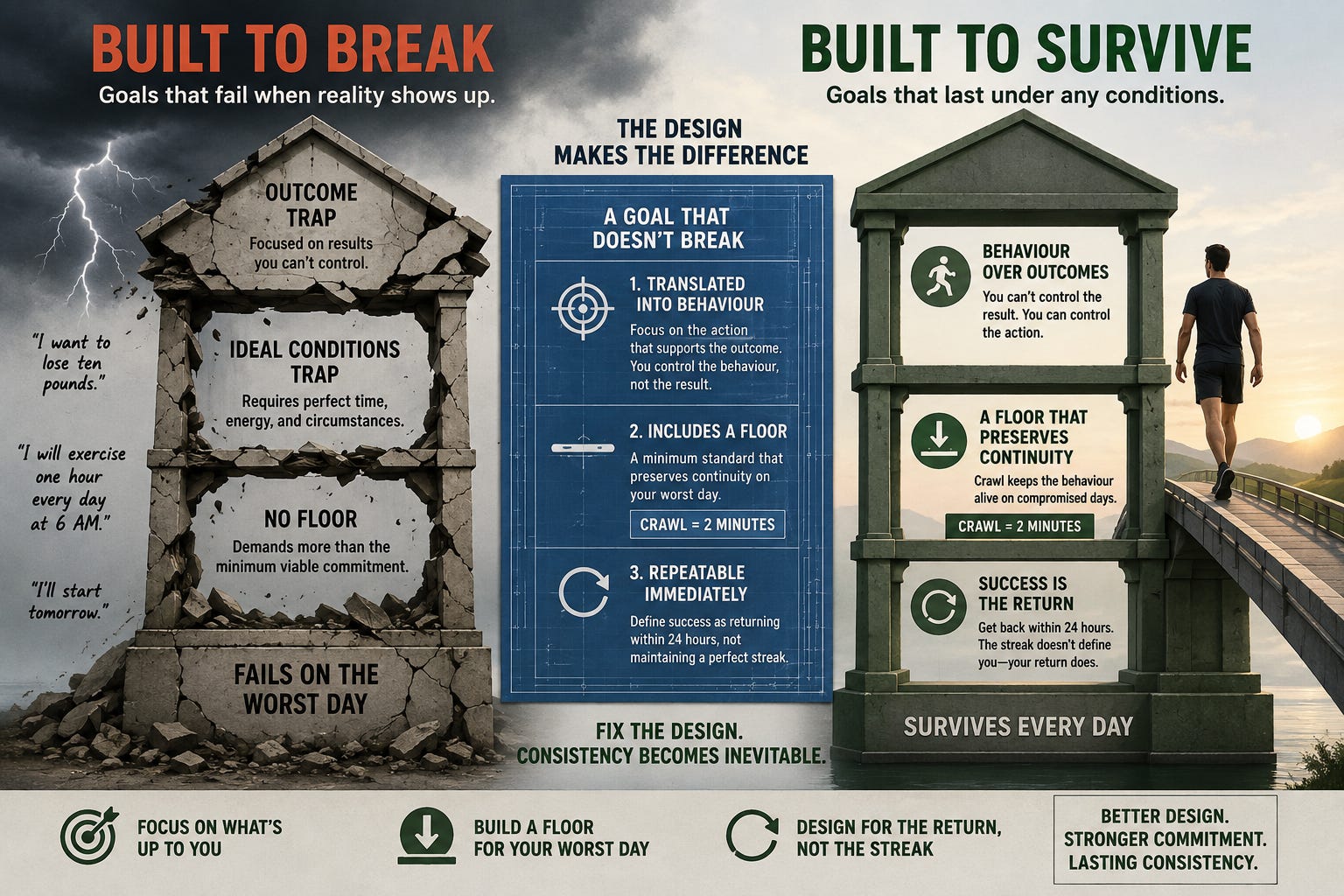
Outcome‑based goals are the default. “I want to lose ten pounds. I want to earn $10,000 per month. I want to run a faster mile.” These goals are defined by results you cannot directly control. You can create conditions that favour the outcome. You cannot command the outcome itself.
When the goal is an outcome, every session is judged against a result that may not appear. If the scale doesn’t move, if the revenue doesn’t arrive, if the mile time plateaus, the goal becomes a scoreboard of failure. What was meant to motivate now produces frustration. The goal is abandoned because it was designed with failure as an option. It’s doing exactly what it was built to do.
Another common structure assumes ideal conditions. “I will exercise for one hour every day at 6 AM. I will write for three hours every morning. I will work on my business every evening after dinner.” It looks ambitious. It’s actually fragile.
It requires a specific time, a specific duration, and a specific energy level. When one of those conditions disappears, the goal becomes unreachable. The person who can’t do the full hour often does nothing. The person who misses the morning window waits until tomorrow. The goal never accounted for the variability of real life. It didn’t include a minimum viable standard for compromised days. It was built for the best day and collapsed on the worst one. The Floor was never part of the design.
A goal that survives reality meets three criteria.
First, it’s translated into behaviour. You choose the action that reasonably supports the outcome. The achievement isn’t yours to control. The behaviour is. “I want to lose ten pounds” becomes “I exercise daily at Crawl, Walk, Run, or Fly. Crawl is two minutes. Everything above that is discretionary.”
Second, it includes a Floor. A minimum standard that preserves continuity when conditions are compromised. Success must be defined on the worst day, not just the best one. Crawl is the daily two‑minute minimum.
Third, it’s repeatable immediately after a lapse. A goal that requires a perfect streak is a goal designed to fail. A goal that defines success as returning within twenty‑four hours survives the broken streak. Success is not the streak. Success is the return.
Most goals fail before the first step because they’re built on assumptions that can’t survive contact with reality. Outcome‑based goals fail when results don’t obey your timeline. Ideal‑conditions goals fail when life refuses to cooperate. Both fail for the same reason: they were designed to break.
A goal that survives is engineered differently. It’s built around what’s up to you, not what isn’t. It includes a Floor that keeps the behaviour alive on your worst day. And it defines success as the return, not the streak. When the design is resilient, the behaviour becomes inevitable.
The failure here is not in the execution. It’s in the design. Fix the design, and consistency stops being something you chase. It becomes something you do.
To put this practice in place and turn it from an idea into a lived experience, start your Day 1 inside The ACT Score Challenge. Go to exercisingconsistency.com.
That’s it for today. Catch you next time.
Comments
Nothing yet. Say the first thing.
Sign in to join the conversation.