
Goals live in your head as clean, simple ideas. But your brain lives in the real world, with real limits. You can set an intention (wake up early, exercise, execute your task list) and for a moment it feels settled. Then the moment of action arrives and you feel resistance. That gap between intention and execution is your brain doing what it was built to do: keep you alive.
When it’s time to act, your brain doesn’t ask, “Is this desirable?” It runs a different checklist: prediction, efficiency, and perceived safety. If a behaviour fails any of those checks, your brain pushes back because survival is the priority. Once you see that, consistency stops being a moral issue and starts becoming a design issue.
Hey there. It’s me, Kore. And you’re listening to Exercising Consistency: From Fitness to Flourishing.
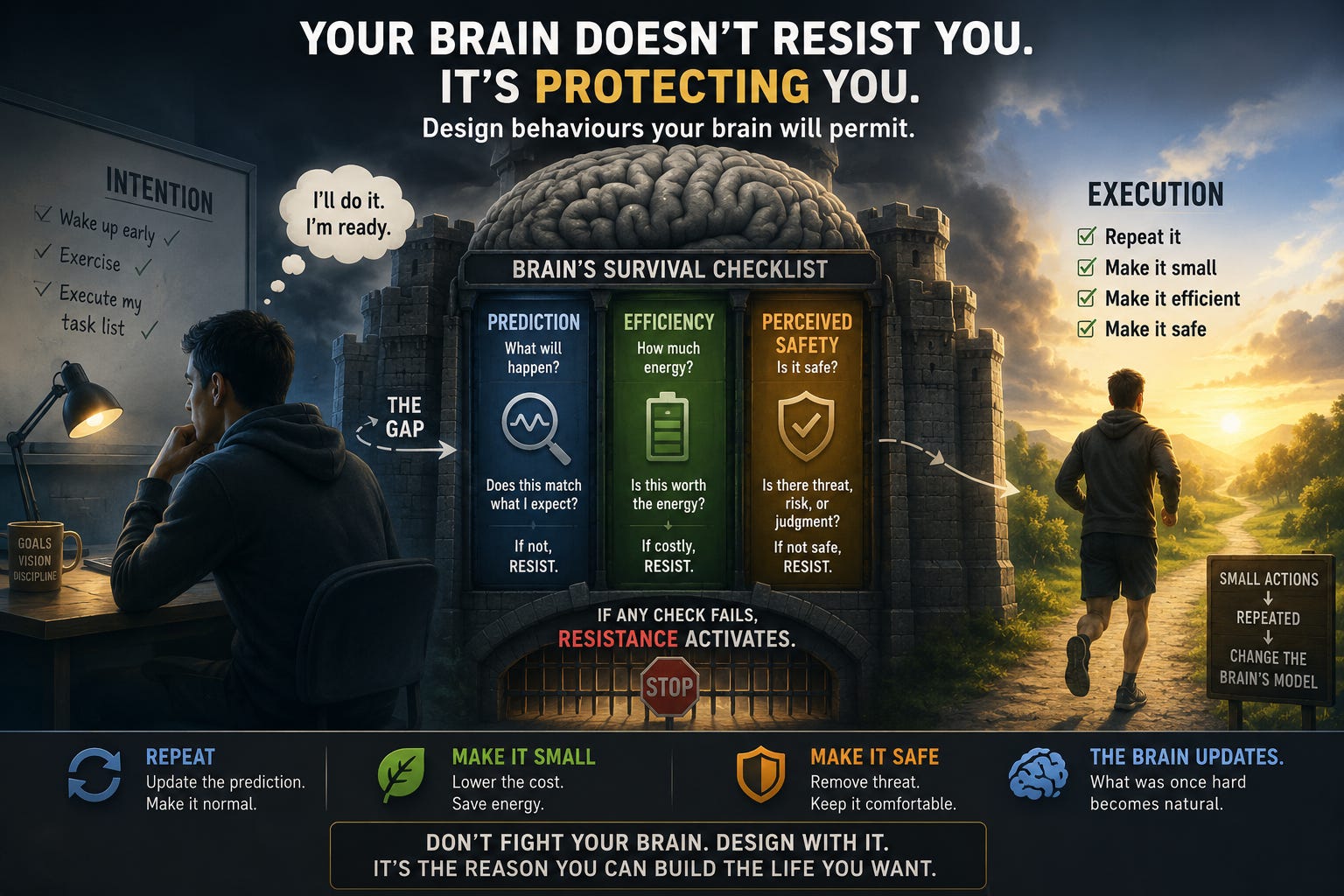
The brain is a prediction machine. It constantly compares what’s happening now to what it expects to happen next. When reality matches the model, everything feels smooth. When reality doesn’t match, the brain registers a prediction error. That mismatch demands attention and energy, which is why new behaviours feel ‘difficult’ even when you’re motivated.
A new habit is basically a prediction error on repeat. If your current model is “I sleep until 7:00 AM,” then “I exercise at 6:00 AM” isn’t just unfamiliar, it contradicts what your brain has stored as normal. So it resists.
The fix is repetition. Every rep updates the model. Eventually, waking up and training becomes the predicted state, and the resistance drops because the brain no longer treats it like an exception.
Your brain is expensive. It uses a huge chunk of your daily energy budget, and it’s optimized to conserve fuel. Deliberation, self-control, and forcing yourself through a task are high-cost. Habits are low-cost. When you rely on pure willpower, you’re asking your brain to run in an energy-heavy mode. You can do that for a while. You can’t do it long-term.
The elegant path is to make the desired behaviour cheaper. Shrink the task until your brain doesn’t need to burn extra resources to do it. Lay out your clothes the night before. Reduce the number of steps. Make the first action tiny. Once the pattern is established, the cost drops, and what used to require effort starts to feel easy. Efficiency and intention finally meet.
Before your brain cares about growth, achievement, or progress, it checks for threat. Threat isn’t only physical. It can be social, emotional, or tied to identity. This is why people avoid the gym even when they truly want to train. The brain reads it like danger: “I’ll look foolish. I’ll fail. I’ll be judged.” And once that threat system activates, avoidance makes sense.
This is where the smallest possible start becomes powerful. Two minutes of exercise. One set. A walk around the block. When the action is small, it often doesn’t register as dangerous, so the brain allows it. Safety first, progress second.
Put it all together and the solution becomes simple: design behaviours that your brain will permit. Repeat them until the prediction model updates. Make them small enough that they cost almost no extra energy. Remove perceived threat so the safety system stays calm. In this way you’re working well within the parameters your brain uses to decide what’s allowed.
Your brain doesn’t care about your goals the way you do. It cares about prediction, efficiency, and perceived safety: the same architecture that kept humans alive long enough to start setting goals in the first place.
So don’t fight the system. Use it. Repeat it. Make it small. Make it safe. And the brain will update.
To put this practice in place and turn it from an idea into a lived experience, start your Day 1 inside The ACT Score Challenge. Go to exercisingconsistency.com.
That’s it for today. Catch you next time.
Comments
Nothing yet. Say the first thing.
Sign in to join the conversation.