
Yesterday, in Part 1, we learned to understand the problem of having too many reasons to exercise consistently. Multiple reasons actually weaken the decision. They dilute the conviction, creating fragility. The solution, though, is not to discard all reasons. It’s to find the one that matters most.
Though we can still know all the benefits of exercise we can’t use them all as reasons to exercise. At least, not if we’re struggling to establish and maintain a consistent exercise practice. So, instead of asking, “What are all the reasons to exercise?” we could ask, “If I could keep only one reason to exercise, which one would it be?”
That question shifts the direction from gathering to stripping away. You stop accumulating justifications and start revealing the one core pillar. Today you’ll learn how to do that.
Hey there. It’s me, Kore. And you’re listening to Exercising Consistency: From Fitness to Flourishing.
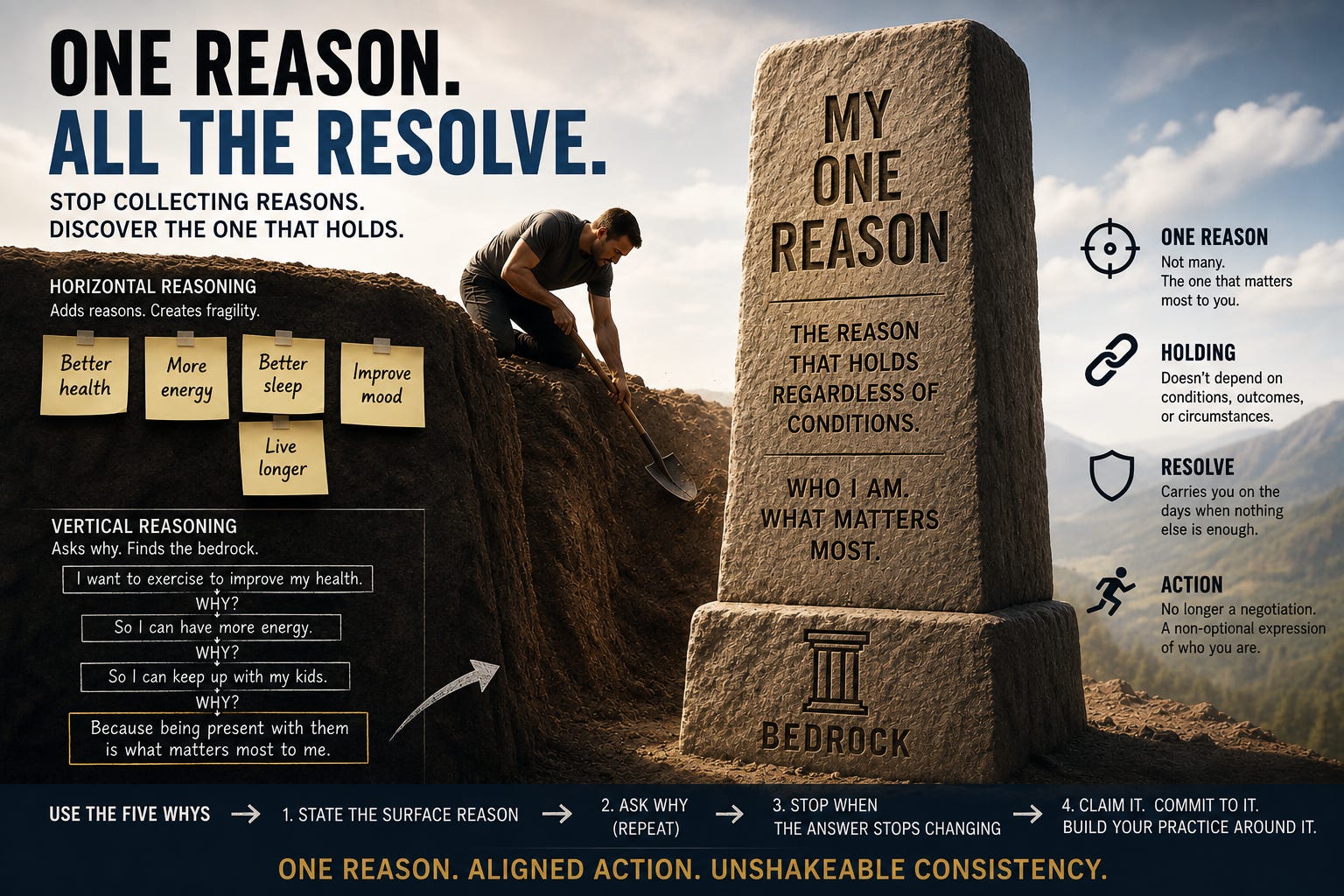
There are two directions you can move when asking why. Horizontal reasoning adds parallel justifications. “I exercise for my health, my energy, my sleep, my longevity, my mood.” This is a list. It’s what Nassim Nicholas Taleb, author of Antifragile, warns against. Each new reason waters down the others. The decision becomes a scaffold of minor justifications, collapsing when conditions change.
Vertical reasoning is different. Instead of a list you get a deep dive. It takes a single answer and asks why again. “I want to be healthier.” Why? “So I can have more energy.” Why? “So I can keep up with my kids.” Why? “Because being present with them is what matters most to me.” That’s the bedrock, in this example.
The horizontal list produces fragility. The vertical chain produces clarity and resolve.
The Five Whys was developed at Toyota as a root cause analysis tool. It assumes that every surface problem is the symptom of a deeper one. The solution is to ask why repeatedly until the answer stops changing. Usually this will be around the fifth why you ask.
Applied to your exercise practice, the method strips away secondary justifications. Start with the surface reason. For example, it might be “I want to exercise to improve my health.” Then ask why that’s important to you. For every answer you repeat the question: “Why is that important to me?”
Initially the answers will typically be surface level, practical, and fairly obvious. But as you keep asking “why is that important?” your answers will become deeply personal.
The Five Whys does not add reasons. It removes layers until the core is exposed. That core is the one reason that holds regardless of conditions.
The one reason is not universal. It’s yours. It’s the answer that feels true when no one else is listening.
For one person, it’s the feeling of being capable in their body. For another, it’s the mental clarity that follows a session. For another, it’s the identity of being someone who follows through.
The one reason is the reason that would hold even if every other benefit disappeared. It does not depend on the gym being open, a friend showing up, or a particular outcome appearing. It’s the bedrock. The reason that does not change when circumstances change.
You know you’ve found the one reason when the answer stops changing. The first few whys produce different answers. Eventually, one answer holds. It feels right. It does not need justification. And it will carry you through the days when no other reason seems sufficient.
The one reason is a pillar. When you find it, your training stops being a negotiation and becomes a non‑optional expression of who you are. You’re no longer asking, “Do I feel like exercising?” You simply act in alignment with your one reason.
So don’t chase more motivation. Don’t collect more benefits. Dig with the Five Whys. Stay with it until the answer stops changing. Claim it. Commit to it. Build your practice around it. Everything else will follow.
To become the person who follows through on their most important goals, go to exercisingconsistency.com and join The ACT Score Challenge.
That’s it for today. Catch you next time.
Comments
Nothing yet. Say the first thing.
Sign in to join the conversation.