
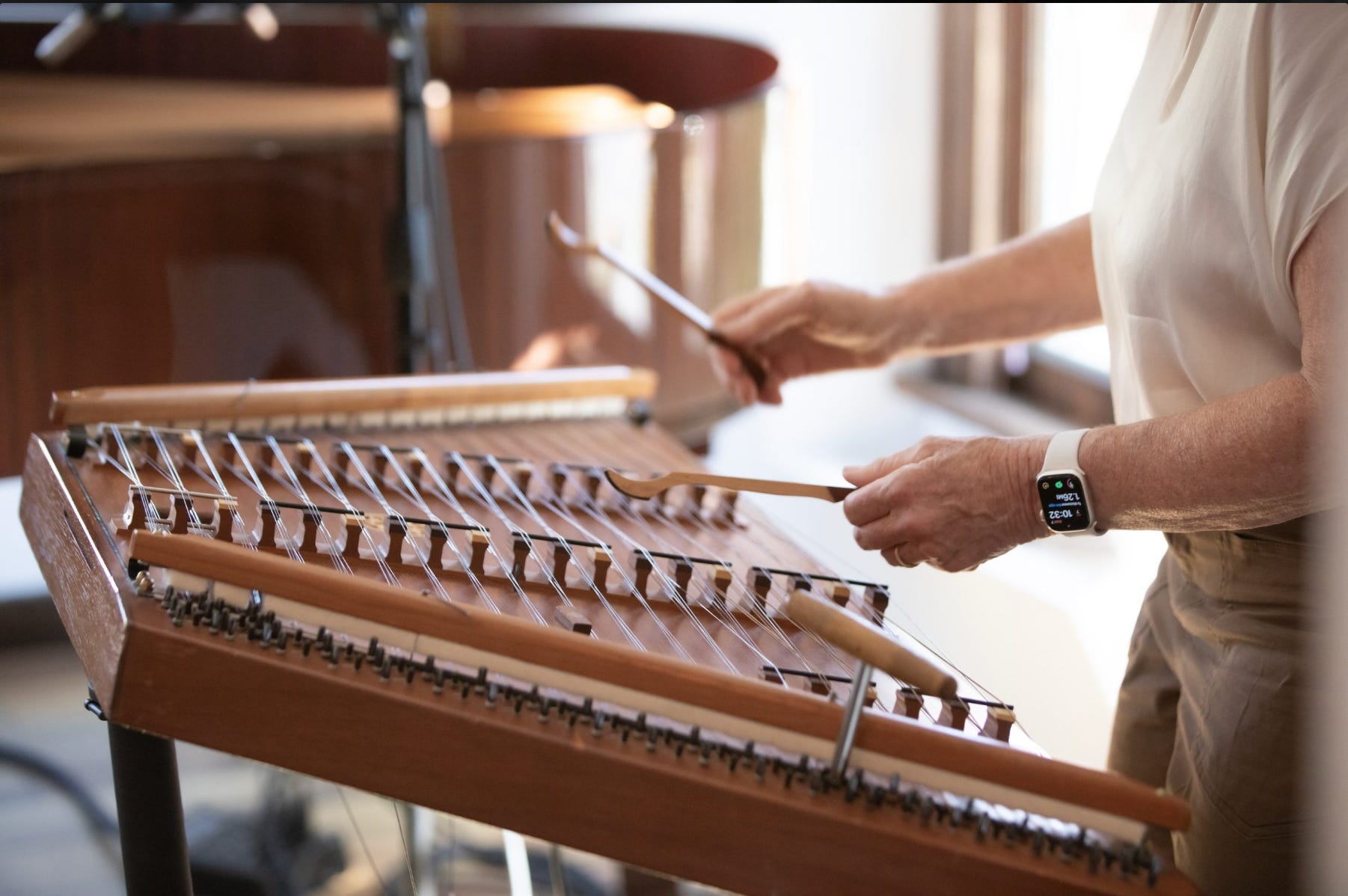
Welcome to Stoicism Today! This week we are delighted to bring you an edited transcript of Sharon Lebell’s keynote talk at the Stoic Arts Conference, hosted by Tufts University and Modern Stoicism in April 2026. Lebell is a musician and writer whose 1996 book, The Art of Living: The Classical Manual on Virtue, Happiness, and Effectiveness, is a modern-day Stoic classic. At the conference she performed on her hammer dulcimer and spoke about attention, creativity, and being present for all that life has to offer. We know you will be moved by her stunning talk and performance.
Thank you for sharing these utterly irretrievable moments with me and with each other. Above all, thank you for your attention because, as we know, that is the most valuable asset any of us possesses.
Yesterday morning I was talking with a few conference colleagues, Phil and Kathryn, and I mentioned that I view living as a series of moments we improvise. Not unlike musical improvisation. And, as I thought more about this, I realized this is a very Stoic or Stoic-adjacent idea because Stoicism urges us, of course, to direct our attention to that which we can control. And toward that which is choice-worthy. In a way, Stoicism is really—I wouldn’t want to be overly reductive—but we could see it as a body of prescriptions for how to improvise our moments with dignity, with care, with real listening, and most of all with that steady confidence that we always have sovereign control over our reactions, right? To anything. Absolutely anything. And thus we can be free inside, regardless of what’s going on out there. That’s very exciting to me.
But first, let’s take a step back. What’s going on here? Each of us beat astronomical odds to find ourselves alive. That sperm found that egg. And all went well enough after that to bring you to Medford and to put us here together, and now we’re sharing oxygen together. So, we find ourselves alive. And we find ourselves alive in an endlessly fascinating but very noisy, chaotic, uncertain world. And so, what should we do about it? What should we do about this? Seriously, folks, how might we best live? Above all, how can we access that inner freedom from which personal honor increases and artistic expression flows?
Well, the older I get, the fewer conclusive answers I have. But this I know: The body of ideas that we loosely refer to as modern Stoicism and the making of meaning and the finding of meaning, which is the best definition I can think of for what art actually is, are two things I really care about. Modern Stoicism and art as both experience and as making things, discovering things: they really naturally connect in very meaningful ways. So, I’ll get a little personal for a while, but the point is to extrapolate the universal from my words.
Since the early 1990s, I’ve spent a lot of time grappling with the teachings of the Stoic Epictetus. And many of his ideas, his particular teachings, dovetail beautifully with the arts. Most prominently, I’ve noticed standout themes in his philosophy that act as a bulwark against the menace of despair born of just the avalanche of absurdities inherent in any given day. They also act as a lever of motivation that has personally helped me to grow and to give as a person and as a musician.
So, I’m going to introduce my best friend here. This is a five-octave, fully chromatic, supersized, one-of-a-kind hybrid of a hammered dulcimer and a cimbalom. It’s got 106 strings that are all itching to go out of tune. Some of them already have. And you really have to have a lot of patience to play this thing, or you might be certifiably crazy, because you can spend more time tuning this thing than playing it. But the reason I am here and will play it some more is rooted in a kind of Stoic fable, which happens to be my personal story.
Okay, we’ve got to roll back the tape a long time. When I was 18 years old, I had a job as a food service worker at one of the college dorm dining rooms at the college I was attending at that time, the University of California, Santa Cruz. So, one day I was cleaning up after the students and the faculty had finished lunch. I was alone in this big, very echoey dining room. My job was to refill the containers in the condiment station.
So, I’m pouring ketchup and mustard and relish and so on into those squirt bottles. And then I heard noise from a door far away. This door to the cafeteria opened, then it closed, and I saw a man with really long hair carrying a small, trapezoid-shaped instrument. Without a word, he sat down, set himself up, and he pretty much just gave me a private concert as I darted between the kitchen and the condiment kiosk, toting refills of Parmesan cheese and salt and pepper and mayonnaise.
Anyhow, as I went about my work, the ethereal sound of his instrument put me under a spell. I’d never heard anything like it. Maybe the Japanese koto, something like it. Well, in a moment—I want to put an asterisk above the word “moment,” because you’re going to notice it shows up a lot—in an instant, in a moment, without articulating it, I unknowingly made a kind of covenant with myself to be an ambassador for that enchanting sound for the rest of my life.
In that one decisional instant, I was sent on a fresh trajectory forever. A box with strings that go out of tune. I couldn’t know it at the time, but only great things would come in the wake of those few moments spent with that stranger. Joy, purpose, an improbable love, a husband who I don’t know if he’s going to live much longer, but we’ve had a great love. A literary agent, six children, seven grandchildren, to name a few. I could connect the dots. They all come back to this. How easy it could have been to miss the man with the long hair. What if I hadn’t shown up for my shift? What if I hadn’t been assigned condiment duty? (I still hate mayonnaise.)
When the man finished playing, he rose, then returned his instrument to its case, and he made to leave. As I watched his figure recede, I realized: uh, I’m going to have to get over my awkwardness in a nanosecond. So, I shouted after him, “Hey, what’s that thing you were playing?”
“It’s a hammer dulcimer.”
“Wait, where do I get one?”
“You got to make it or get someone to make it for you.”
(This is the ‘70s, you know. You couldn’t get everything from Jeff Bezos like you can now.)
“How do you learn how to play it?”
“You have to teach yourself.”
And then he was gone, and I never saw him again. So, long story short, I found some guys in Seattle, Washington, who were starting to build hammer dulcimers, and I commissioned one. Over the years, I designed and had built by an assortment of luthiers ever larger, more complex versions of this instrument. And, uh, here we are. This is this one.
So, what makes this little origin story Stoic? Many things, but let’s highlight a couple of reasons that come to mind, particularly the recurring themes found in Epictetus’ ideas.
First, duty. Whatever do duty and the making of music have in common? Well, some of you know that the Greek word deon, meaning duty, is one of the favorite concepts in Stoicism. It’s an imperative that we accept our particular place in the world and perform our duties as they emerge from that context. So, Marcus Aurelius describes at length that our duty is to fulfill specific roles life gives us.
Well, here’s the thing. All of us simultaneously live at least two lives: Our outwardly lived lives, you know, our thoughts, our feelings, our words, our deeds. And then there’s our unlived or tentatively lived or as-yet-lived lives. You know, the aspirational part of ourselves. That part of ourselves that knows exactly what we’re supposed to be doing if we would just quit hiding, trying to please people, and play it safe. So, I’m talking about that ever-present undercurrent whispering to us of our possibilities. It’s the self that dares to change, to step out, however wobbly, however unprotected, to shine, to love anyway, to just try with no guarantee of success. Who cares? To stop worrying about every darn thing. Everyone’s thinking about themselves. They don’t care about you. We can just let it go.
So, how do we get those two lives to come together, to kiss, to become one? Well, the Stoic idea of duty is the ticket. Duty is that sense of covenant with ourselves, with others, and with life itself. All those promises we make, including the ones we want to make. Well, what happens when we start to, however incrementally, keep those promises, even and perhaps especially the tiny ones?
When we start to keep those promises to ourselves and to others, we move toward virtue, toward integration, toward the real. We can stop feeling like fakes or posers. We can drop the ego, we can drop our obsession with outcomes. And we can, however quietly or brashly, obey our destiny. Aye, aye, captain. What’s next?
Okay, Lebell, it’s time to learn the Phrygian scale.
What? That’s too hard.
Oh, for heaven’s sake, stop mewling. Get up. Get to work. At least try. There it goes. Are you going to let a little flatted second interval bully you? Come on. Get it together. Give the world what happens to come through you.
Aye, aye, captain.
Okay, duty in the arts, duty and creative expression. Yes, they fit. And it’s my duty to liberate and to share the celestial sound of this instrument. Who else is going to do it? This Stoic notion of duty every day powers my exertions to practice, to push forward, especially when it’s uncomfortable. And the funny thing is this duty really is a gift. My duty to this instrument helps me locate myself in the world, and it helps me flourish rather than to flounder.
The other thing about Stoic-style fulfillment of duty is that whenever your duties don’t place a real demand on you, they’re not doing much for the world. I’m not making the case that duty should be arbitrarily difficult, but difficulty is salubrious. It really is.
An example. About 10 years ago, for no reason I can fathom, one day I couldn’t hear, and I discovered that I was deaf in this ear. And over the years, I’ve become very hard of hearing in my other ear. Well, that’s just great! I’m a musician. Suddenly, I’m wearing hearing aids, I’m reading lips, and doing a lot of guessing about what’s going on around me. And the hardest part is playing music with other people, because I can’t hear myself, and I can barely hear them. I am surrounded by insistent yet undifferentiated sound.
And I’m not going to lie, when this happened to me, I was not pleased. If I could bring my hearing back, I would really take it back in a heartbeat. I miss it a lot. But don’t cry for me, because I have a duty. “Aye, aye, captain,” and all that. My job is to make sure this sound is heard by others. So, even though I continue to struggle to hear what people are saying, the funny thing is, I’ve actually improved as a musician, because, in order to be a musician now, I have to be a virtuoso listener. And I’m sure you can imagine the obvious extrapolations from that. Being a better listener creates benefits that well extend beyond music making. Most importantly, I’m more deeply engaged with my moments, and I’m more deeply engaged with all of you for this loss.
So, I ask you, what’s your duty? By that I mean, just what is it? Not that it’s singular, of course not. What are your duties? And you know, we’re not talking about those obvious things: of course you’re a parent, you’re this, you’re that. Yeah, we have to inhabit those roles. But I’m talking about when you get those nudges, when something happens just in the crevices of mundanity, or something beeps at us and says, “Hey! Hey, you, go this way.” And, where do those summons show up? In the most banal moments of our lives. There’s no burning bush. What are you waiting for? There are no pyrotechnics. It’s just you. It’s just you in a moment with its potent but ephemeral call.
Will you answer it? I hope you will.
Stoicism does not cotton to religious-sounding language. But I still get put in mind sometimes of the word redemption when I’m reading Stoic books, or when I’m reading the Enchiridion in particular. Stoicism teaches us that our lives don’t change for the better through some intervention by an outside force. It ever reminds us that it (life) is on us. It’s on us to caretake how we view and how we react to the world. It’s on us. We might say that Stoic redemption is that moment, ever repeated, when we stop being ruled by what happened and begin to live instead from what is best in us.
So, now I’m thinking of a little Bob Marley. Yeah. [plays what turns into Redemption Song and applause]
I really appreciate you flying without a net with me. I was very surprised that came out. Okay, just a few more things and then I’ll knock off the talk. Let’s really get to the point here, okay? We’re not going to pussyfoot around.
There are two things I know to be true. We all know this: No matter what your life circumstances are, life is so hard. Life is really hard. It’s so hard to be a person. That’s number one. And number two is we just all want to go home. I mean, oh god, we just want to go home. What is this home? It’s not your apartment; it’s not what you’re paying the mortgage on. You know, home. You know, the place where the bad guys can’t get you. It’s the non-geographical, but no less real, place where we’re anchored, where we belong, where our hearts soften and the urge to make or to give something is not clouded over by all the uncertainty about the long-term consequences of AI or the daily firehose of headlines or the worrisome wars and the famines and the exploited children and the gross injustices, all this stuff that inexorably multiplies in the mind-numbing absurdity of pressing numbers on the phone to get some indifferent robot to do some banking task or something. We just want to go home. I don’t want to press four. I want to go home! I just want to go home to that place where I’m free inside. We just want to go home to that place where we’re free inside. Or, as the ancient Greeks might call it, ataraxia. Or being on the train to eudaimonia, human flourishing, dynamic and deep well-being. We want to live in a way that fulfills our nature, a life that’s morally serious, a life that’s meaningful and inwardly steady. We want to be free inside. We want to be free from paralyzing self-consciousness, from objectless anxiety, from caring overmuch what other people think, from the effects of others’ scolding words or their heedless deeds. We want to feel safe, unembattled, cheerful, light.
And this is where artistic expression can border on salvific if you approach it with some Stoic guidance. Inner freedom ceases to be a fantasy. Really. When we’re able to drop inside, just drop inside, averting our attention from all those things we can’t control, we’re free.
That’s it. In an instant. And if we can go inside, I think we can go anywhere. And what does this mean? It’s not a protocol, it’s not a meditation technique, it’s the place we go before something has been turned into a theory or a definition or an opinion or a preference. Because when we’re free inside, we just ditch the rank ordering. I want to be very clear about this: this does not mean we’re giving up on value. Quite the contrary, quite the opposite. What we discover is absolute or non-comparative value, whether aesthetic, practical, utilitarian, spiritual, if that’s your jam. There’s a place in us where value appears in the encounter between you and an object. It’s in the in-between, between you and a person. Between you and what is in your field of attention. It’s the meaning in the meeting point between those things. This non-comparative value, which is another way of looking at Stoic virtue, is self-evident.
Once we drop the worry, the anticipation, the rumination, the regret, the sorrow, we’re playing on repeat. It’s right there. It’s right at hand. And then we begin to do the duty that uniquely belongs to us with steadiness and without complaint and with honor. That was a quotation. Inner freedom comes out of hiding. (Coming into the finish line.) As we focus on controlling ourselves and not the world, freedom comes out of hiding, and as we focus on a good life built on character, not comfort, inner freedom comes out of hiding. And as we point our thoughts and our efforts and our person toward virtue, inner freedom is accessible. Virtue and its pursuit organically foster inner freedom, art, dignity, and joy. Traditional Stoic virtue is typically expressed as wisdom, justice, courage, and temperance. And that’s all good. But I like to think of virtue synthetically rather than analytically: as something all of a piece. So, when I try to explain virtue, I think of it as something we recognize before we can define it. It’s that felt sense of excellence, that rightness, that worth in an experience or, say, in an action, in a book, in an idea, in a poem. It’s the thing that makes you say, “Yeah, that’s good.” And you say that even before you can explain why. So, let’s not confuse this with mere taste. We’re not talking about, “I like chocolate versus vanilla.” Virtue is bigger than that. It’s not merely subjective. It’s not merely, “I like it.”
It’s also not objective. It’s not a measurable property out there. It’s something prior to the split between subject and object. Virtue precedes the observer and the observed, the mind and the world. I think virtue comes before we even separate the world into me and it. We encounter it directly. “Hello, virtue!” When a piece of music lands perfectly, when a person acts with real care, there’s a virtue there that we apprehend immediately. And in the arts or in anything, really, virtue reflects a deep harmony of care, of understanding, and excellence.
I may differ from the ancient Stoics in believing that the moment you define virtue too rigidly, you reduce it. I experience it as something directly known. We don’t want to trap it in language. In everyday terms, I think virtue is the living reality of goodness before theory gets its mitts on it. So, it’s the thing we notice when something’s really good, when something’s fitting, when it’s alive, when it’s right, when it’s excellent. And I’m just going to repeat it. We notice this before we can explain it.
And since virtue is not a personal opinion and not just a cold fact, it is something we encounter directly. Which is why the arts are the ideal mouthpiece for it. You can hear a sentence, and you know it’s awkward. You can hear a piece of music. You can taste a meal. You can watch someone work, and you can feel there’s something deeply harmonious about it. And then someone can play some music with perfect polish, and it’s so wooden. There’s nothing there. It’s just like a casing. They did it all right. Who cares? We know the difference. We can identify the good stuff.
Modern life points our attention toward appearances, immediacy, response, mood, surface attractiveness, sensations. And the Stoics understand the danger of this because this comes with the sacrifice of our personal and collective sanity. This is not an overstatement. To stay pointed toward virtue, this means to actively care for your mind. It takes work. I, for one, find it so strenuous. Sloppiness, impatience, resentment, ego, inattention- they all damage our lives: our personal lives and our civilization as a whole.
Virtue just shows up when we’re fully present and engaged with what we’re doing. Why do I keep talking about virtue instead of neatly defining it? Because this is the point. The most important things in life are known directly, and they resist tidy definition. The more tightly you might try to pin virtue on your little butterfly collection board with your push pin, the more it’s going to fly away. It’s like trying to define exactly why a certain face looks noble or elegant or wise. Or why one line of poetry works or why one act feels honest. Virtue requires presence. They are inseparable. When we do something with real virtue, we aren’t scattered, we aren’t resentful, and we’re not half asleep. We’re paying attention.
You know this, I know this, but we’ve got to say it a lot because there’s not a lot of reinforcement for it in our everyday lives. We. are. here. We’re here! Virtue is a form of reverence. When we truly care about good work, we’re showing respect for reality itself. When we act with patience, sincerity, and exactness, what are we doing? We’re honoring something beyond our immediate convenience. And this begins to look a lot like reverence, which is one of the roots of the spiritual life.
And why is this? Because spirituality, we all know, is not pointed toward escaping the world. It’s about meeting the world, encountering the world more truthfully and whole-heartedly. Not as a concept, but just with your awkward self, stepping out and meeting it. Hello, life! Pleased to meet you! When we point ourselves and our work towards virtue, ordinary action then turns into something that’s almost sacramental. It quiets the ego. The noisy self just gives it a rest. We’re no longer performing. We’re no longer posturing. We’re no longer trying to impress. We’re just trying to get it right. Whatever “it” is. We’re just trying to get it right.
This humility, and I think that’s what we’re talking about, is spiritual because it resembles the kind of ego-lessness that’s described in contemplative and religious traditions. There’s less self-display, more contact with what actually is. And in this state, we serve the task rather than dominating it. We’re trying to get beyond the divided life. We don’t want intellectual brilliance without care. What a bore. Real virtue embraces contact with reality, sincerity of engagement, care in action. Let’s do all of that.
So here’s the last thing, friends. How does this moment change everything? That was the original promise of this talk. When I read Marcus or when I read Seneca or Epictetus, I find a subtext there that always points to the possibilities and the infinite potency that live in any given moment. We’re repeatedly enjoined to take our attention off of what we can’t control, then the party starts when we avidly put our attention on what we can control.
That’s the part that doesn’t get emphasized enough, I think. Because we control a lot. But the only place we find that control, or I should say, the only place where we can exercise control, is in this moment. This one brief moment is everything. And sure, you can space out if you want. You can not engage with it. Your choice. But you can also use it as the beginning of changing anything for the good. You know what you could do right now? You could just say, “I’ve been meaning to tell you I love you.” You could start that painting. You could turn tail and leave the abusive relationship. You could put the drink down for the final time. Enough already. Right now, right now, you can step into the next mighty chapter of your life. Right now, you can fulfill that idea that occurs to you, which will make our world a more just place. Right now.
Right now.
Right now.
There is much we could continue to talk about, but it’s good to end when you’re having a good time. So, I’m going to conclude with a tune that I hope will convey at least half the joy I sincerely feel being in this room with each of you. I have noticed each of you. I know what you’re wearing. I’m going to call your mother. But before I play this for the last time—or I could think of it as the instrument playing me—I’d like you to just consider these words to a song that my late friend Nathan Siegel wrote. His words are the most natural, straightforward way I can think of to express the Stoic ideal of seeking to live a life of virtue and serenity in community. In community: that place that turns out to be our home all along. That place within which we all ideally flourish.
Nathan’s words:
From you I receive.
To you I give.
Together we share.
And this is how we live.
From you I receive.
To you I give.
Together we share.
This is how we live.
Thank you so much.
Sharon Lebell is an internationally bestselling author and teacher who brings ancient wisdom into modern life. For over 30 years, her beloved book The Art of Living: The Classic Manual on Virtue, Happiness, and Effectiveness—a contemporary interpretation of Epictetus—has been a trusted daily guide for readers seeking clarity, meaning, and ethical grounding. Known for her direct, accessible style, she invites students into deeper engagement with life’s essential questions, emphasizing inner freedom, civic responsibility, and the role of beauty and art in a well-lived life.
Drawn since childhood to the question of how to best live, Lebell writes and speaks on philosophy, spirituality, meditation, Buddhism, Judaism, ethics, and feminism. She is also the author of Naming Ourselves, Naming Our Children and co-author, with Brother David Steindl-Rast, of The Music of Silence. A composer and performer on a one-of-a-kind five-octave hammer dulcimer, she leads a weekly musical-contemplative gathering, Strings of Holiness, where music and reflection open the heart and steady the mind.
Thanks for reading Stoicism Today! This post is public so feel free to share it.
Comments
Nothing yet. Say the first thing.
Sign in to join the conversation.