
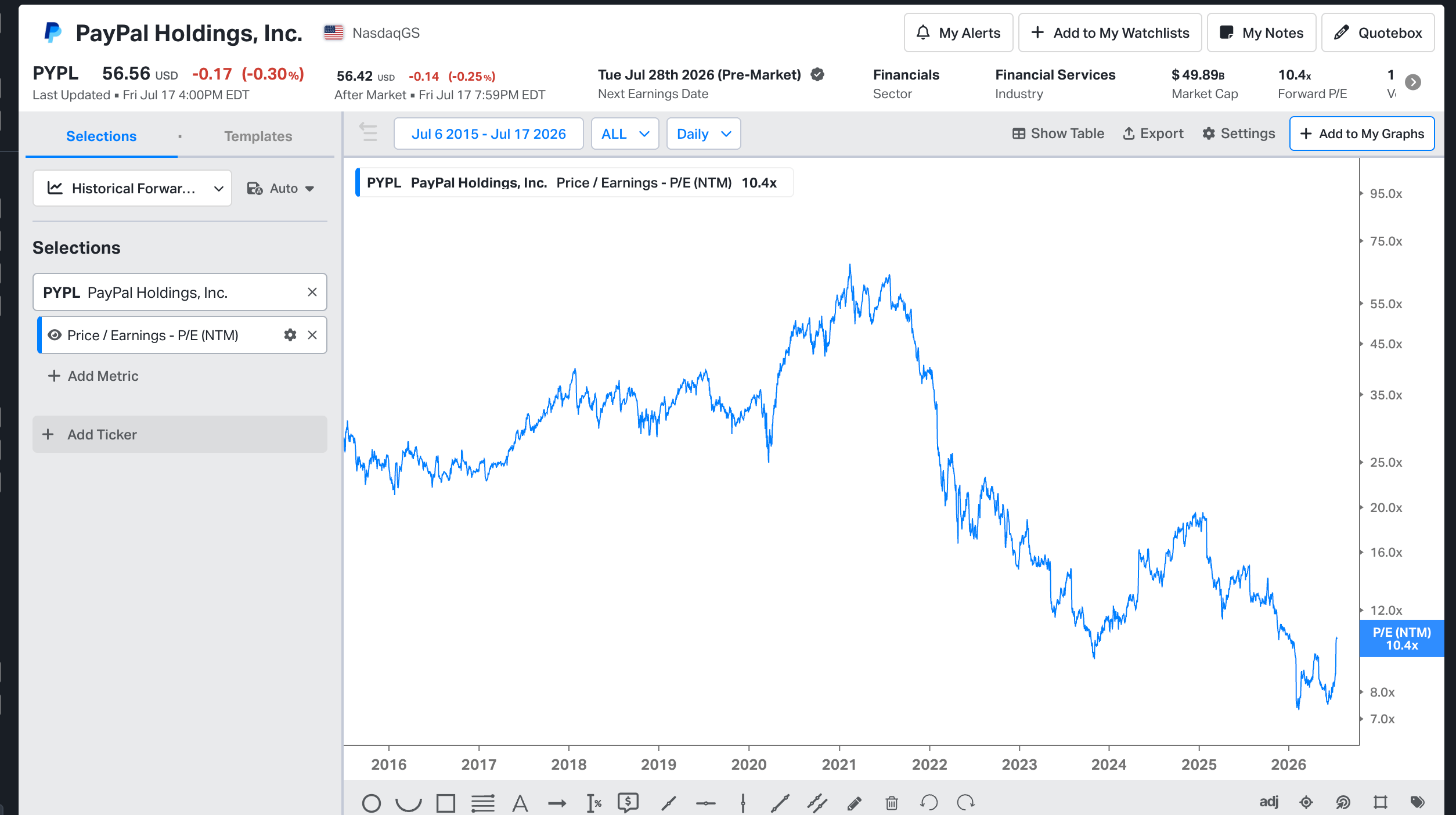
PYPL’s multiple has contracted from close to 60x in the go-go days of 2021 to around 10 today, which is 2.5 turns up on a rumored $60.50 cash bid from Stripe and private equity firm Advent. The bid would be funded with ~32% equity and ~68% debt (Stripe / Advent is rumored to have banks lined up). At $60.50, the buyout offer is at 11x consensus 2026 EPS estimates of $5.32/s.
Reuters is reporting that PayPal’s board will reject the offer as they believe it undervalues the company. I’ve read a good amount of reaction pieces to the deal rumors at this point, and I think most bullish arguments are centered around one of following arguments:
PYPL has more terminal earnings power than $60.50/s implies. Giving away the company at 11x forward is too cheap. From Michael Burry (IV stands for intrinsic value and the number is the discount rate to use, Michael is using his own estimates for normalized earnings):
The bid is at 1.21x IV15 and simply too low… IV10 is $75-$80. IV8 is $110-$115. A buyout should be in that range. IV10 plus a control premium puts the winning bid at roughly $100. That is still below my IV8.
PYPL’s 430m+ active accounts, brand and consumer franchise even if it struggles in the hands of current management is worth significant distribution power to someone like Stripe.
From James Emanuel: “The ‘customer first’ ethos has never existed at PayPal. It has never been particularly shy about extracting value from its network. From a position of strength, it aggressively monetizes international shopping with hefty cross-border surcharges and currency conversion markups, while simultaneously earning interest on the billions of dollars sitting idle in user accounts. It is a remarkably valuable consumer franchise. Viewed through this lens, Stripe’s strategy starts to make sense… It’s buying distribution.”
As I was researching this article, I was reminded of an investor I have immense respect for who I talked with last week who said in so many words that buying a stock trading at a historically low multiple - or a multiple way below peers - rarely works. The reason why is that investing on a re-rating thesis requires cooperation from the rest of the market. In contrast, investing on an “earnings should increase” thesis is more in the control of the company.
There are many reasons why PayPal’s multiple has tanked from the COVID years and its historical multiple range, but the biggest ones that jumped off the page from my research are:
Slowing growth and declining margins since 21’. New growth is also lower quality growth. TPV (total payment volume) decelerated from the 20s and 30s to 7% last year. Take rate measured as net revenue / TPV is down from over 2.5%+ to 1.85% (and the last quarter was mostly Braintree growth, which has the lowest margins)

Continually broken promises on branded checkout growing (mentioned essentially every quarterly call for 2+ years as the next leg of growth up), which led the company to pull Investor Day guidance (issued less than a year ago when it was pulled). From its Q4 25 call:
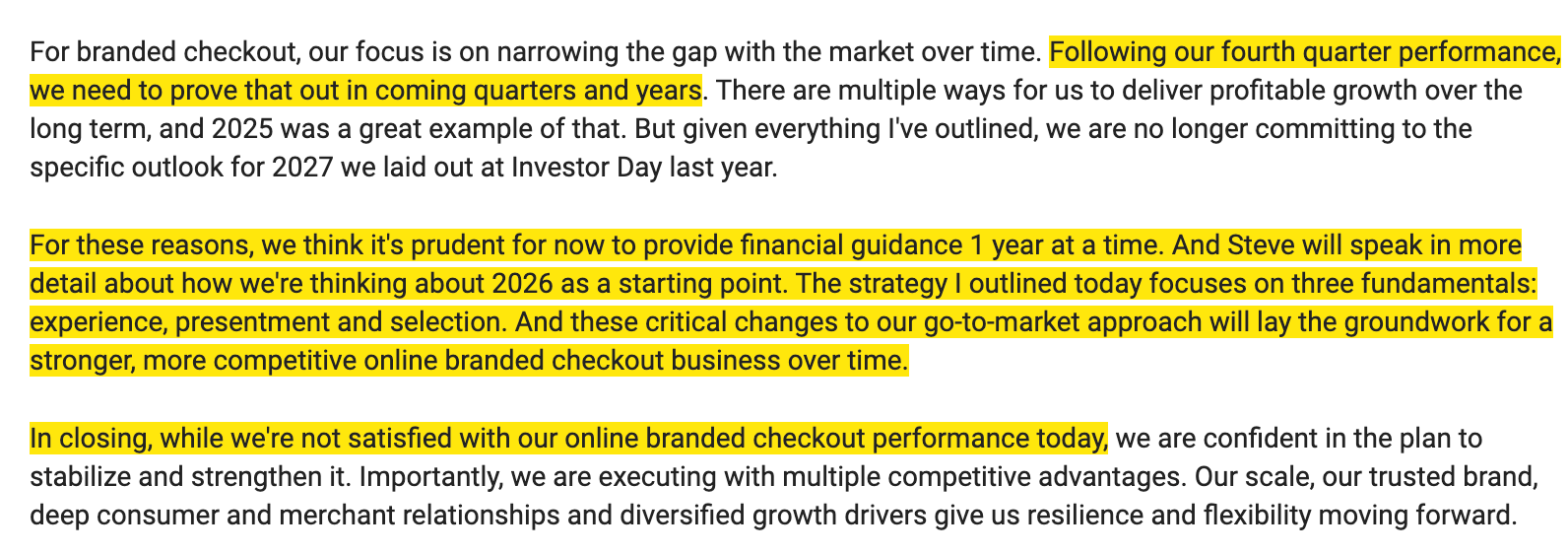
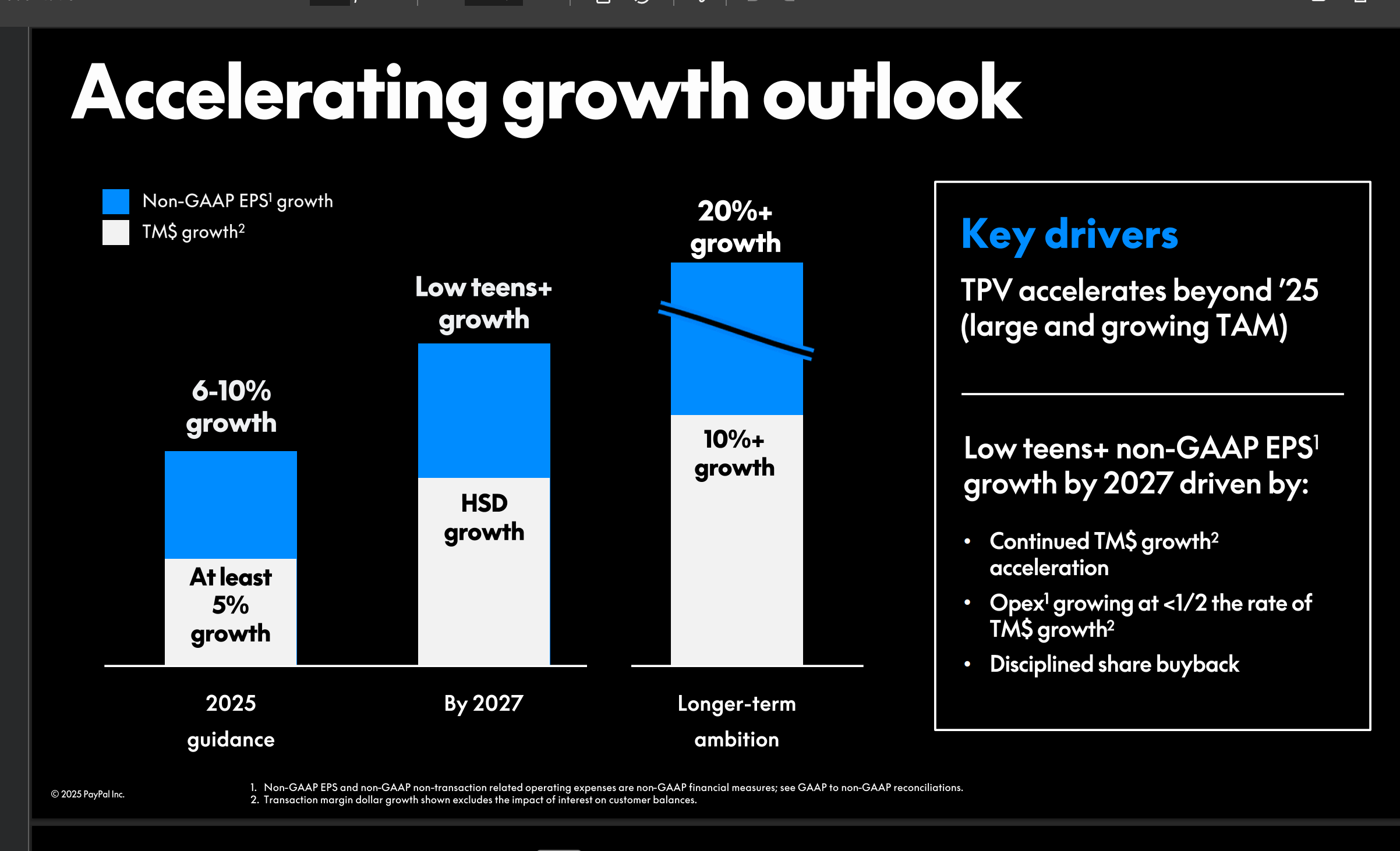
I want to emphasize this point - Investor Day guidance issued in February 2025 clearly was a management mistake. It feels a bit intellectually dishonest to guide to 20%+ EPS growth with low teens by 26’ when a year later in Q1 26’ GAAP EPS was down 6% and non-GAAP EPS was up 1%. Here is the slide from investor day:
Well funded and cheap cost of capital competitors offering their own branded checkout (Apple Pay, Google Pay, Shop Pay, Stripe, the list goes on). If you’re underwriting earnings here, I am not sure how you’re getting terminal value right.
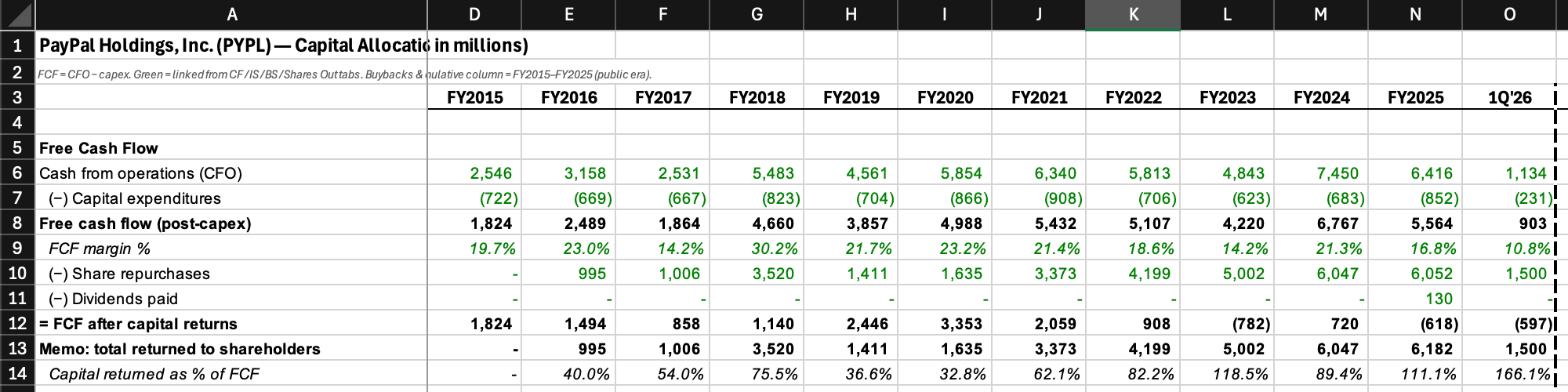
Buybacks - which I’ve been around long enough to know can be a bear signal as much as a bull signal - I think are propping up EPS and potentially are misallocated capital. Shares out have declined 5.6%, 7.4%, 7.4% and 3.7% in Q1 26 alone (biggest buyback quarter in years) and share repurchase dollars are often above FCF. All of FCF going to buybacks concerns me in a very competitive space. TPV is decelerating and active accounts is barely growing - I would think reinvestment in the business could help both.
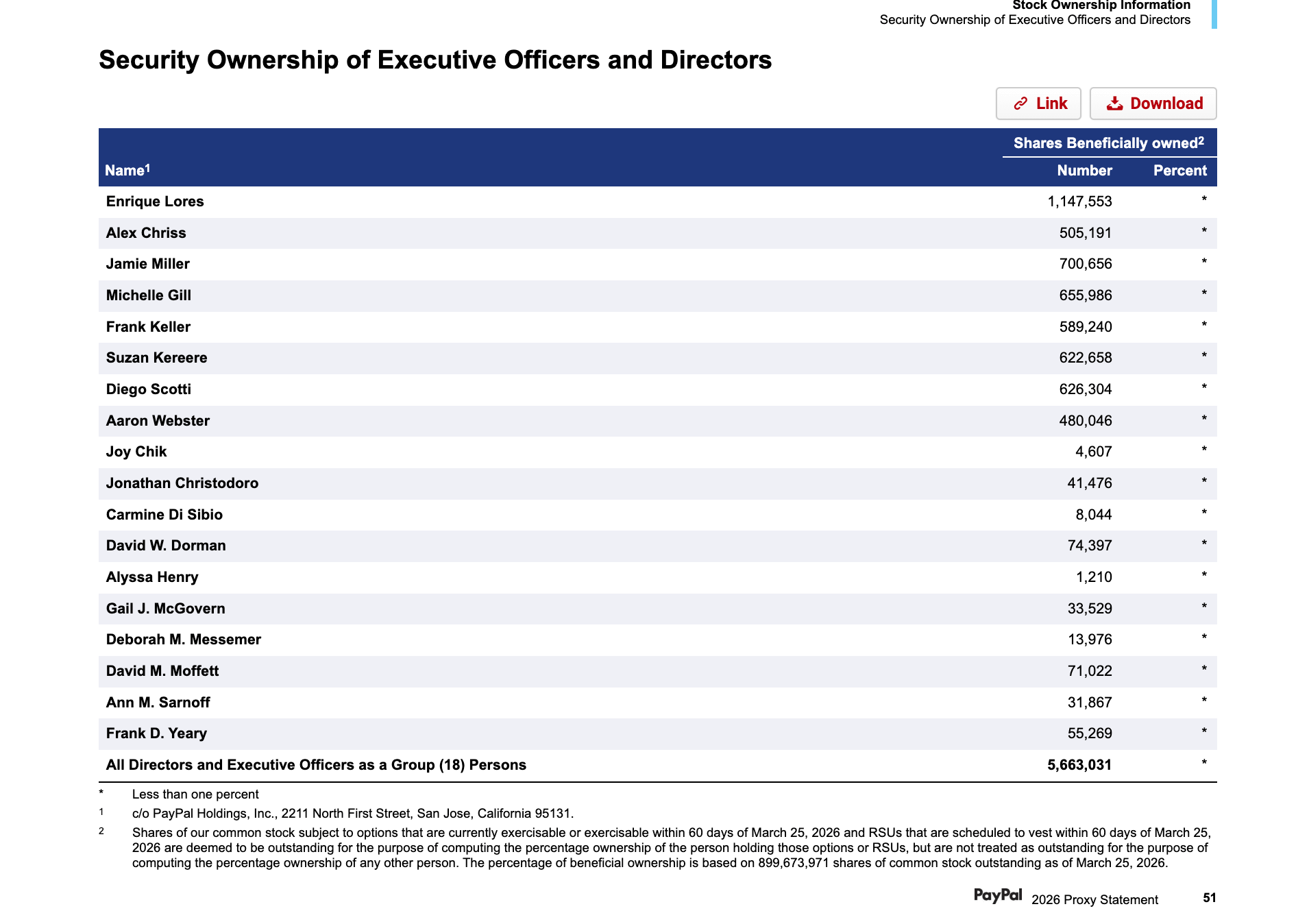
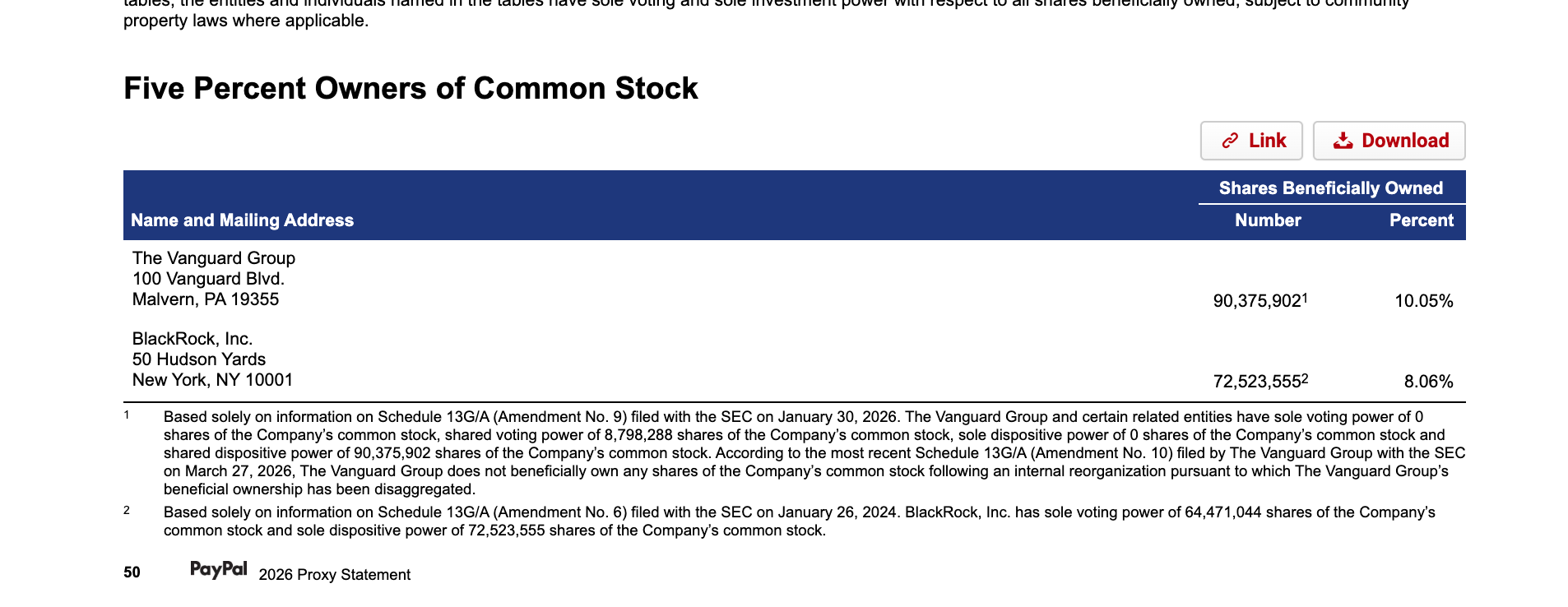
Lack of a controlling shareholder is a huge negative. Directors and officers own <1% of the company. The only 5%+ shareholders are institutions (Vanguard and Blackrock). Given the lack of alignment here, I don’t have conviction the board will get the best offer out there or may be tempted to focus more on selling the company (I thought this was a good take here) than building long term shareholder value. Experience / narrative bias, but I have seen at least a few cases where a potential acquirer emerges and then for the next few quarters results go down the drain as the company takes its eye off the ball. Check out the 26 proxy statement:
I normally get interested in companies where I think a takeout bid or an activist could change hearts and minds on intrinsic value, but in this case my work on PYPL made me very cautious.
I appreciate the arguments that we easily could see a $70+ offer. I agree Stripe likely submitted a low bid with the intention to go up and there are valid arguments as to why the distribution power in PayPal isn’t reflected in earnings.
However, in the case where Stripe and others pull out and the takeout narrative goes away, I worry shares could go much lower than $48 and a single digit P/E multiple is warranted if we see margins and growth continue to decline. So at ~$57, I actually think upside and downside are about equal.
Separately, I think there are some very interesting angles here on Stripe / payments:
The consensus view on Stripe IMO for years has been they own developer mind share and are coming for all of payments (I do not agree, more on that in a second). The Collison brothers are extremely AI oriented. AI was the theme of the Stripe Sessions I attended in 2025 (along with stablecoins), where they interviewed Mark Zuckerberg and Dwarkesh Patel. Stripe trying to buy PYPL (and there were rumors of an acquisition in February) IMO is proof that distribution matters more than AI tailwinds or developer mindshare for many parts of software.
I have used Stripe for 10+ years now as a developer. I can say from experience while developers like Stripe’s APIs / SDKs, they do not like the pricing. There is from my experience significant frustration with Stripe’s fees and the on-the-ground scuttlebutt (which I agree with) is they overcharge for pretty much everything.
Stripe has now been rumored to be going public for several years. For various reasons (some good, like tenders to get employees liquidity), it has not happened. Reading between the lines here, do they need PYPL more than PYPL needs them? PYPL in addition to giving them signification distribution & data improves the financials significantly and adds $6bn+ of FCF. PYPL has a public listing which they can use
I think there’s a non-zero chance we see Elon Musk and X make a play for PayPal, as X has been rumored to be looking at payments for two years now and obviously Elon built the foundation of PYPL and likely still feels wronged on getting ousted as CEO. Still, I wouldn’t buy on this thesis as it’s separate from how I view the intrinsic value of the company and relies on someone else entering the fold
A final thought here - when the news first broke on Stripe’s bid, I had not done serious work on PayPal and thought this might be a good buying opportunity. Fast forward to this morning when I’ve done a few hours of research and I just can’t get comfortable with the long-term earnings power. I am a generalist in a complicated space - PYPL falls in both the “too hard” pile and I also am not encouraged by the last few years and future outlook.
I also realize I could publish this and we could see a bidding war that ends in $100+ share; if that does happen, I think where I was wrong was what this could be worth to an acquirer. Again, I don’t run a payments company for a living and am content to play in areas where I feel I have an advantage.
No posts
Comments
Nothing yet. Say the first thing.
Sign in to join the conversation.