
Hello Darlings,
I’m writing to you to share some thoughts I’ve been having on the burning of the pop culture rainforest and how to rebuild the internet.
As I return to being in your inbox on a more regular basis, I’ll be experimenting with sharing more of my nonfiction writing in between the novels. You may look forward to more newsletters of this kind in the future (in addition, of course, to the eventual publication of A Companion in Vice.)
The question of our time is how do you artistically rebel — and win — against a totally flat cultural landscape?
(The only taboo left is copyright infringement)
The more cultural power the internet wields, the more everything on it seems to feel the same. The same discussions and talking points show up on every platform, the same aesthetics (with only minor variations) permeate every corner of the web — even the weird stuff is all weird in the same way. I’m sure you know what I mean. It’s boring, it’s depressing, and it contributes to the widespread pessimism about the possibility that anything can ever change or be improved.
In the early-to-mid existence of the internet, people predicted it would lead to a splintering of culture — society dividing into many interlocking spheres with no centre. Instead, the opposite has happened. Because the internet is now experienced by the majority of people through a handful of massive platforms, we are all trapped in the same impossibly large room together at all times. Everything that gets big enough on a social media platform becomes mainstream.
Recently, there has been some discussion about what all of this means for us as a society. It began with the February 18th issue of Garbage Day, “The only taboo left is copyright infringement,” in which Ryan Broderick wrote about Gen Z’s struggle to understand what “cool” is, and pointed to changes in our media landscape as the cause of that struggle. As he describes it, the media of the 20th century was centred around institutions — things like Time Magazine and Hollywood — which would raise up pieces of underground culture, both canonizing them and making them no longer “cool” in the process.
Culture, in the 2020s, has become a thing that mostly happens on social media platforms:
Hollywood lost to YouTube. Magazines lost to TikTok. Radio lost to Spotify. And most artist management teams are basically just hype houses now. As The New York Times’ Jon Caramanica said recently (on a livestream, it should be noted), “The gap between ‘I’m a comedian,’ ‘I’m a content creator,’ ‘I’m a musician’ — we used to think of those as three different jobs. They’re not three different jobs anymore. It’s basically just one job, which is getting attention. That’s the main job.” ...
But if everything is just attention now, and attention is completely commodified by algorithmic tech platforms, how can you push back against that? Well, I am slowly coming around to a theory on the new cool: You have to essentially pre-deplatform yourself.
Culture right now is determined not by human teams of editors and producers picking and choosing what youth culture gets the spotlight, but, instead, by the unthinking algorithms that power YouTube and TikTok. Which means the only things that have the level of scarcity and danger required to be seen as cool by young people will, slowly, but surely, be whatever is unacceptable on those platforms.
(The only taboo left is copyright infringement)
Cory Doctorow responded to this in his February 23rd post for Pluralistic, “Deplatform yourself,” where he points out that, because everything happens online now, the creation and commodification of culture happens at the same time and in the same place. Everything is “metabolized by the mainstream,” as he puts is, almost immediately after conception.
He then picks up on another thread of the discussion started in Garbage Day, which is how this has served to further the far right online.
The “edgelords” that defined forums like SomethingAwful and /b/ made heavy use of slurs, rape “jokes” and other beyond-the-pale rhetoric. Whether this reflected sincerely felt beliefs or a mere desire to shock (or both), it had the effect of making these subcultures very difficult to commodify. If you and your friends barely utter a single sentence that can be quoted in a mainstream news forum or office email, it’s going to be very hard to co-opt you. For a long time, edgelords festered in the “dark corners” of the internet. But that’s changed. The Holocaust denier Nick Fuentes – who thinks that “every woman and girl” should be “sent to a gulag” – has had dinner at the White House:
Together, Broderick and Doctorow outline the evolution of this subculture online. Over time, the spaces that engaged in “edgelord” behaviour shed the people who were participating from anti-commercial impulses, while retaining the people who sincerely believed in the things they were saying. Nevertheless, their extreme and hateful rhetoric continued to protect these spaces from co-option, while the rest of the internet evolved to prioritize commercial interests. When these reactionaries were banned from social media platforms, their exclusion from the new epicentre of commercial media allowed them to become cool in a way that is denied to anyone participating in those spaces.
But I actually think that whole world is losing steam. It’s still too dependent on social media. As streamer Hasan Piker pointed out last week, the reason it feels like there’s a new “cool” far-right streamer every week is because of Discord clip farms. They trawl through hours-long streams for tip-of-the-iceberg moments [that can be crossposted to social media.]
(The only taboo left is copyright infringement)
The problem is how little room there is to escape the mainstream. The trend online over the last decade-and-change has been toward a polarity of online spaces — walled gardens like group chats, Discord servers, and Telegram channels; and fishbowl-like public spaces like Bluesky, Tiktok, and Instagram. The walled gardens have their uses, but anything made within one needs to enter the public sphere before it can begin to matter culturally.
At the same time, everything said or done in the public spaces constantly has the potential to be exposed to the collective mass of all users on that platform — and, if it spreads far enough, onto other platforms as well. In fact, that kind of exposure is rewarded by the platforms. Getting the online attention of as many people as possible can translate directly into real life power and money — which creates incentives towards constant accumulation of more attention, more followers, more views.
In a social media environment where everything is constantly under the pressure of mass scrutiny, where we are always a part of the mainstream, it becomes impossible to evolve unique underground cultures. That is why nothing online feels cool.
But it goes further — personal algorithms make the process of discovering new art an antisocial experience. Spotify delivers your personally tailored music recommendations to you every week and the TikTok algorithm serves you the videos it thinks you will like. Art, instead of being one facet of a culture shared with the people around you — a thing you can participate in — comes to you as isolated, decontextualized products.
The idea of building a community, subculture, etc. through a shared artistic language — what psychedelic rock was to the hippie movement, DIY fashion and zine making to the punk subculture, or even webcomics to the online culture of the 2000s — is by and large foreign to the way people approach art in the 2020s. We are living through an era in which our ability to come together to form communities in which we can participate and find a sense of belonging has been profoundly disrupted. Yet art is inescapably social; writing is literally a form of communication.
Things do not need to be this way. These conditions are not inherent to the internet. Up until the mid 2010s, there was a thriving discussion around how the arts should work in the 21st century, using the internet in positive ways to further human potential. People experimented with different ways of organizing communities online and the internet’s various potentials as a creative space. This discussion ended not because these problems were solved, but because the structure of the social media-driven internet became so suffocating, it seemed to preclude any hope of other possible ways of living. I see no reason why we are not capable now, in this era of mass dissatisfaction with the way the internet works, of trying again.
In his response to Ryan Broderick, Cory Doctorow quotes the author William Gibson:
What we’re doing pop culturally is like burning the rain forest. The biodiversity of pop culture is really, really in danger. I didn’t see it coming until a few years ago, but looking back it’s very apparent.
I watched a sort of primitive form of the recommodification machine around my friends and myself in the sixties, and it took about two years for this clumsy mechanism to get and try to sell us The Monkees.
In 1977, it took about eight months for a slightly faster more refined mechanism to put punk in the window of Holt Renfrew. It’s gotten faster ever since. The scene in Seattle that Nirvana came from: as soon as it had a label, it was on the runways of Paris.
There’s no grace period, so that’s a way in which I see us losing the interstitial.
I was excited to see that as far back as the 1990s, he had reached the same line of thinking that I have been feeling my way toward over the past year: that what is happening to us culturally bears a striking resemblance to the devastating effects of resource extraction on the environment. What the social media era has done to culture resembles nothing less than clear-cutting a forest and strip-mining the earth beneath.
Social media is designed for advertisers, not its users. These platforms are structured around treating each of us as a separate, isolated individual because our value to them is as collections of identifiable traits to which products can be sold. I hope I am not blowing anyone’s mind by saying that the same algorithms which feed us our music and videos also serve us advertisements. These are the environments within which we try, however feebly, to connect with one another and make things together — but the total isolation of the individual is so foundational to the design of these platforms that there is little we can do to escape it from within.
On top of that, everything created within these social media platforms is immediately seized by the recommodification machine. This is done first by the platforms themselves, through leveraging everything made by their users to their own benefit. After that, what remains is picked clean by the class of professional users, who are incentivized by the structures of the platforms they work within to constantly put out as much new content as possible as fast as possible. This means they’re always on the hunt for anything people are paying attention to. The platform then recaptures a portion of the money these content creators make off of this behaviour, in what is essentially a form of rent. Much like a forest being repeatedly logged before it has the chance to develop into an old growth ecosystem, this prevents anything made within the social media ecosystem from reaching full maturity before being mined for all of its value.
It seems possible to me that the problem ought to be approached with a conservationist’s attitude — which always makes me think of the California condor.
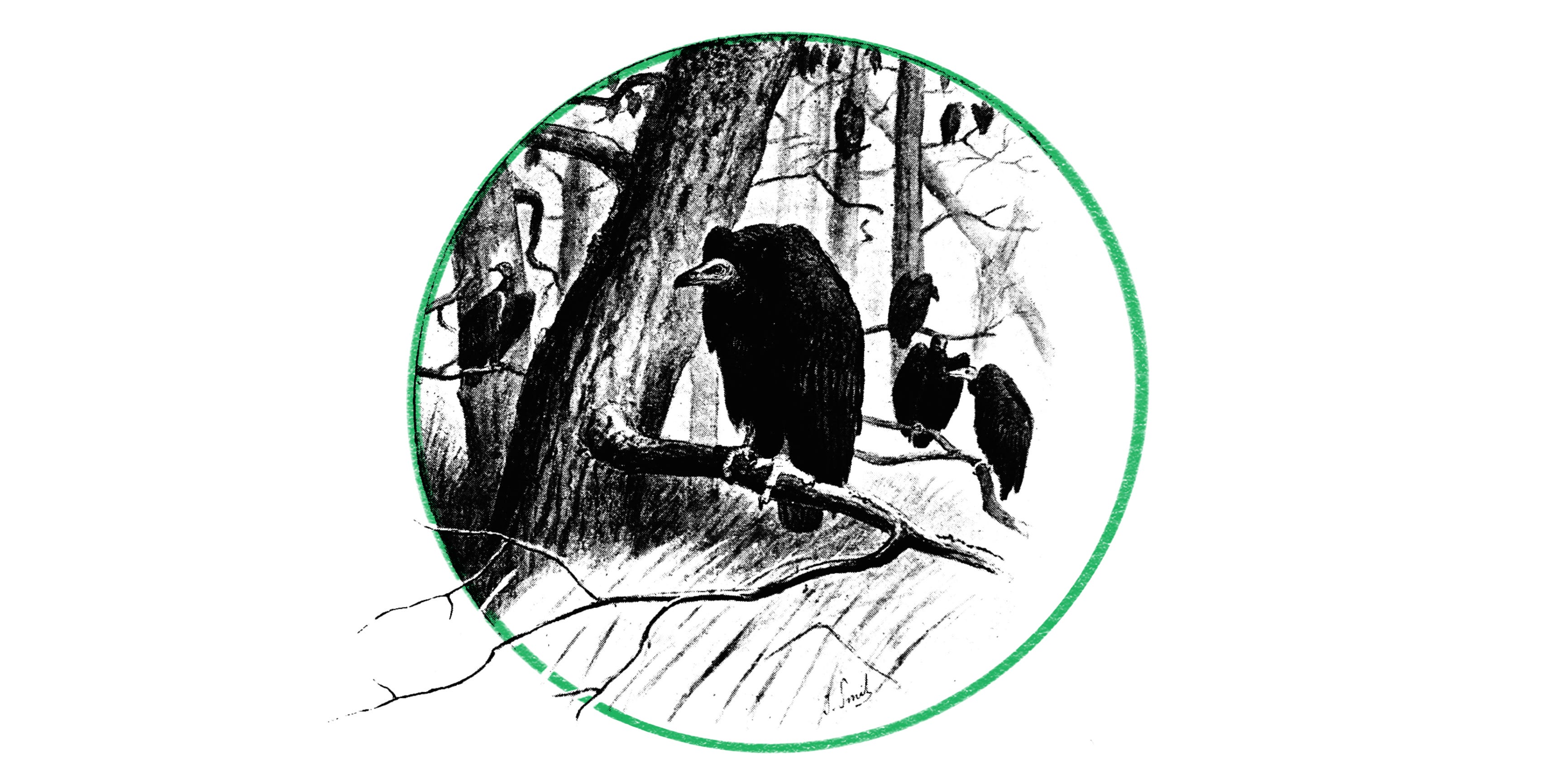
The California condor is the largest land bird in North America. It is also critically endangered. Through a combination of pollution (pesticides like DDT and lead poisoning,) poaching, and habitat loss, by 1982 there were only 22 condors left in the wild. The US government organized a plan to save the species, through capturing the remaining birds and breeding them in local zoos. After several years of captive breeding, the birds were able to be reintroduced to the wild, and as of the beginning of 2026, their population is back up to 607 individuals. Healthy online cultures are like the California condor in the 1980s — and they, too, need to be taken from the wild until they are strong enough to survive on their own, along with restoring their habitat.
What does it mean to restore online habitats? If the internet is polarized between extremes of public fishbowls and private walled gardens, it seems to me the path forward is to rebuild the middle. Anyone who was online in the 2000s will have some intuitive sense of what I mean by this — what I am calling “the middle internet” is occupied by finite, bounded communities. They may vary in scale, but they have defined edges in a way that social media platforms do not. This allows them to have their own unique cultures and senses of identity, as well as to have some control over who is present and what types of conduct are allowed. Although they may have varying private and public elements, they are nevertheless not completely hidden behind closed doors (as the walled garden Discord servers are.) They may have, as their public face, an associated website, publication, archive, project, etc.
The emphasis on limits is crucial. If one of the biggest problems of current platforms is their scale, then one of the challenges of the moment is to invent new ways to create limits and boundaries, to separate spaces and groups out from the homogenous whole. Cultures need to have edges in order to evolve unique identities.
Ideally, we would have a vast, interlinked network of such communities — possibly multiple, separate networks. The best approach to anything of this kind is one of redundancy. Having many communities available gives people the ability to choose where they want to be, and leave for somewhere else if a space isn’t working for them. It protects against the failure of any one community, and allows for schisms — for the entire network to survive after drama has broken out. It lets people experiment with different community architectures and infrastructures, and means that the network as a whole is not tied to a single large tech company that hosts all of them.
Experimenting with different ways of organizing social spaces may be one of the most important challenges of this era. There are many different ways to fail (as anyone who has ever participated in a forum with a power hungry and ban-happy mod team will know) but within these middle spaces it is possible to succeed at building something that works for most of its members, whereas moderation on large scale social media platforms has been an abject failure.
With an established network like this, the algorithm can be replaced by systems of human curation. With a sufficiently healthy network of communities, we may also be able to have online webpages and archives with living lists, publications that review and highlight works according to their own criteria, and similar projects. We may find ways of organizing ourselves and the things we make that are human and outside of corporate control.
Doctorow and Broderick are right to focus on how people can defend themselves from commodification. Any project of this kind will need to think about how to prevent what they build from being strip-mined before it has had a chance to reach maturity.
I think some answers to the problem of commodification will be found in the concept of informal, or gift economies. The formal economy is the one most people are familiar with — the one that focuses on the exchange of goods for money. Informal economies, on the other hand, do not involve money. Instead, they rely on giving things to your community for free, in exchange for intangible, social rewards. A large body of anthropological work exists on how these types of exchange work in nonwestern cultures, but of particular relevance to this discussion of the internet is the role of the gift economy in fandom.
Fandom is a bit of an odd place to end up in a conversation that started with what is and is not cool. Fandom is — and I mean this with all love — quintessentially dorky. Nevertheless, it is a staple culture of the internet, one which revolves around making and sharing free works of art as a gift to the community in exchange for social rewards. People draw fanart as part of building a reputation in their community, they engage in fanfiction exchanges, and so on. I don’t have space in this (already very long newsletter) to do much analysis of the way fandom structures itself, but there is a body of academic writing on the subject.
Fandom is not unique in operating as a gift economy — many alternative cultures work on the same principle. You form a band to play for your local scene not to make money off the people there, but because you want a reputation in the scene, admiration, a legacy, sex, and so on.
(It’s worth mentioning that discussion about the fan gift economy originates in the old school science fiction fandom, which got its start in the 1930s.)
Gift economies are where the overwhelming majority of future professional artists get their start. Before any artist gets to a professional level, there is a period of time in which they’re very likely participating in some group setting where art is informally exchanged between participants. Anyone who got their start as an author by writing fanfiction has done something like this, as has anyone who has participated in a local music scene, zine exchange, or any similar setting. Communities built atop gift economies are where artists learn their craft and hone their artistic identities. Spaces like this are crucial to having a healthy and diverse culture. They are also becoming increasingly endangered.
The internet has removed all barriers between any given person and the formal economy, giving us the ability to enter the market without even leaving our homes. Someone who has written a novel can (theoretically) begin selling it more or less immediately. This means that there is an opportunity pressure that has never existed before. If you are giving your art away for free, you are — to a far greater extent than ever — actively choosing to not try to make money off of it. Participating in the formal economy has become, if anything, the default mindset towards making art that the internet pushes on us — the assumption that we are here to make money is built into the structure of the platforms we live within. A cursory search will reveal entire ecosystems of people discussing tricks and strategies to play off the various online systems that exist in order to make money off of any kind of art imaginable.
At the same time as introducing new opportunities to enter the formal economy, the internet has broken the systems of social rewards that sustain gift economies. The scale of social media platforms, and the lack of edges between social spaces within them, degrades the meaning of social success. Without edges to a community, or a sense of where its centre is, it becomes a lot harder to be certain of your place within it, who cares about you, or who is even a participant in the first place. Being admired within a small and extremely nebulous group of people feels even less rewarding when that group is at all times confronted by their insignificance in the infinitely large “room” we’re all socializing inside (not to mention the background anxiety from all those unfriendly eyes potentially watching you.) How can you possibly feel like anything you’re doing matters when you have no ability to affect the overwhelming majority of people who share your social space?
The other factor is that the infinitely large “room” that exists on these platforms breaks the defenses that gift economies can employ to protect themselves against incursions of the formal economy. Like their rewards, the defenses that gift economies have are social. People who participate in gift economies know that the formal economy is a threat to the stability of their social system (although they would never describe it in those terms.) Therefore they develop taboos against prioritizing money over the community — calling it things like selling out, voicing their disapproval, and so on. The mechanics of the way conflict works on social media are extremely complex, but suffice it to say that it makes attempts to enforce social consequences far more destructive.
This is why the restoration of artistic gift economies must be done in tandem with rebuilding the middle internet. Communities are capable of regulating themselves — but only if they are given space to do so. Defending oneself and one’s community from commodification in the social media environment is essentially impossible. It is simply not an environment that is habitable for these communities. A species can only be restored to the wild when it has a habitat to live in.
![Tumblr post. cathartidae: hey. dont cry. 566 california condors, okay? 369 free flying.[1] it's gonna be okay. cathartidae: for the record, in 1987 there were 27. [2] things can get better. cathartidae: HEY. DONT CRY. 607 CALIFORNIA CONDORS, OKAY? 392 FREE FLYING. [3]](https://substackcdn.com/image/fetch/$s_!2gmU!,f_auto,q_auto:good,fl_progressive:steep/https%3A%2F%2Fsubstack-post-media.s3.amazonaws.com%2Fpublic%2Fimages%2F5e95ec83-2d7f-4255-820b-d4297b25108a_772x765.png "Tumblr post. cathartidae: hey. dont cry. 566 california condors, okay? 369 free flying.[1] it's gonna be okay. cathartidae: for the record, in 1987 there were 27. [2] things can get better. cathartidae: HEY. DONT CRY. 607 CALIFORNIA CONDORS, OKAY? 392 FREE FLYING. [3]")
Some readers may at this point be growing nervous that I am suggesting we set up a system that makes it impossible for artists to make money off of their work. That is not at all what I am saying (I am a professional novelist.) What I am saying is that the pressures of the formal economy are so great, and its eventual victory so inevitable, that it will require equally strong social forces pushing back against it to maintain any distance between the creation of culture and its co-option. The majority of artists who achieve widespread recognition for their work will eventually become professionals. The goal is to create friction, to slow down the recommodification machine, not to stop it entirely (which is not practically possible.)
These gift economy-run communities are necessary to prop up the existence of institutions that prioritize values outside of maximum financial gain. If we want to have professional websites and publications are resistant to a capitalistic race to the bottom, they need to be built atop the bedrock of stable communities that determine what those values are. If we want to have an old-growth forest, we must first have fertile soil.
Hyperbolic as it might sound, the current state of culture is essentially post-apocalyptic. Social media is one gigantic cultural Superfund site. The atomization of online platforms has decimated our ability to organize and cooperate online, to have shared social identities, and to create art together. There is very little space online to invent together, to experiment and learn who we are as a group and what we’re expressing, free of mass scrutiny, where we feel like what we’re making can matter in some way. Humans are social, culture is not a solo activity.
This sort of network is not something that is made overnight, but through steady, gradual effort. That is the only way to build something that survives. We all have to believe this is possible, that in some small way, we are capable of things that matter.
Here is how we escape corporate platform fiefs and culture-slurry fed to us by the algorithm: we create human-made pathways through the wasteland of the internet, connecting protected and carefully managed nature reserves. We must protect our ability to have varied and rich cultures in the same way we protect the biodiversity of our environment because both are threatened in the same way by corporate-driven resource extraction. And I believe that — as with conservation action in the natural world — if we put forward the effort and resources necessary to nurture cultural growth, it will work. Like the California condor, we can claw our way back from the brink.
This is the first of what I hope will be many newsletters of this kind! I have several in progress exploring some of the ideas I’ve only touched on here. Patrons will likely be able to see those before everyone else.
My currently-in-progress novel, A Companion in Vice, is still on track to be published in 2026. Like What Manner of Man, it will be published serially, one chapter per week, in this free newsletter.
Yours in love and terror,
St John Starling
Comments
Nothing yet. Say the first thing.
Sign in to join the conversation.