
Oxford University Press named “rage bait” its Word of the Year for 2025, defining it as, “online content deliberately designed to provoke anger or outrage to drive engagement” highlighting a shift from simple clickbait to emotional manipulation online.
Finally some one talking about what I’ve been privately feeling as I scroll the internet these days.
My feed:
Dreamy, kid-friendly travel destinations.
Child behavioral neuroscience videos.
Dark-comedy memes about late-stage capitalism.
Women blissfully living off the land in long dresses, raising eight children in the forest — somehow setting up multiple camera angles along her path.
And then BAM — when I least expect it — gut-wrenching guilt.
A whole new bucket of content I keep seeing over and over again: “You’re doing it wrong” content. Or, as I’m calling it: Guilt Bait.
It’s like the algorithm knows exactly who you are and how you’re parenting (spoiler: it does), and then feeds you content that opposes your choices or parenting style —delivered in a way that feels deeply triggering, targeted, and shameful.
While I’ll focus on childhood sleep in this article, this tactic spans an increasingly wide range of topics: from food and health to careers, politics, and more.
This article is about so much more than childhood sleep. It is about mindfulness and autonomy. It is about recognizing our strong emotional reactions to what we see online and, rather than letting it over come us — Pausing. Observing. And asking why. — Why did the algorithm feed me this particular post at this particular moment? What does it want me to do? Who profits and benefits from my rage, guilt, and a deeply divided public.
The topic that seems to utterly stalk my feed? Sleep — and how/where my baby should be sleeping.
She’s a spicy topic. Click-baity, if you will. A subject that delights and conquers the algorithm.
I believe the majority of this content is well-intentioned. However, some — either by intention or algorithmic conditioning — is guilt-baiting parents to engage.
It follows a familiar pattern:
Share a divisive topic i.e. childhood sleep
Validate some while shaming others
While the guilt bait is often taken (🙋🏻♀️) and the numbers soar, the unfortunate result is a deeply divided culture that highlights our differences more than our similarities. And for many in power, this division is a perfect recipe for control.
It feels like the moment you have a baby, the central topic of research, discussion, and life becomes sleep.
Before long, either through intention or the algorithm, you’re exposed to a variety of spicy opinions on how to care for your child, especially as it relates to sleep.
At a certain point, many mothers feel the need to pick a side, to sleep train or co-sleep. In previous generations, decisions like this were often made in private. There wasn’t a constant swirl of research, podcasts, and videos making you feel guilty either way. You would most likely get advice from your mother, grandmother, and/or community. And hopefully, you’d have space to drop deeply into your own intuition and inner wisdom as a mother.
That is not today, at least not if you have access to social media.
The topic of motherhood, especially as it relates to childhood sleep, has reached a level of identity-style politics.
It says, I am this type of mother if I do this.
It becomes a form of virtue signaling, I care the most about my child.
I keep coming back to this one Instagram Reel. It’s a series of night-vision clips filmed over one night, where the moment her baby cries, she picks them up and holds them to her chest until they fall asleep. The caption reads, “Watch how long it takes me to respond to my bed sharing one year old. 6 seconds.” In a similar post she says, “Co‑sleeping reflects our evolutionary biology; human infants evolved to sleep in contact with a caregiver, not alone.”
Happy Cosleeper, another co-sleeping account says -
“Human infants are designed to sleep with their caregivers. Sleeping alone is cultural, not biological. — This shift [to separate bedrooms] didn’t happen because science proved it safer or healthier. It happened because of industrialisation, the rise of separate bedrooms, and cultural ideals that valued independence over connection. Sleep and caregiving advice from doctors and other sleep professionals (and later, sleep trainers) began to reflect those values, not our biology.
I am not here to judge either of these mothers — their research or their parenting styles. Their style of sleep routines fits their children’s needs. And from my perspective, that is a truly beautiful thing. 👏
What I do want to examine is the often shaming tone to the captions and the one size fits all approach to parenting.
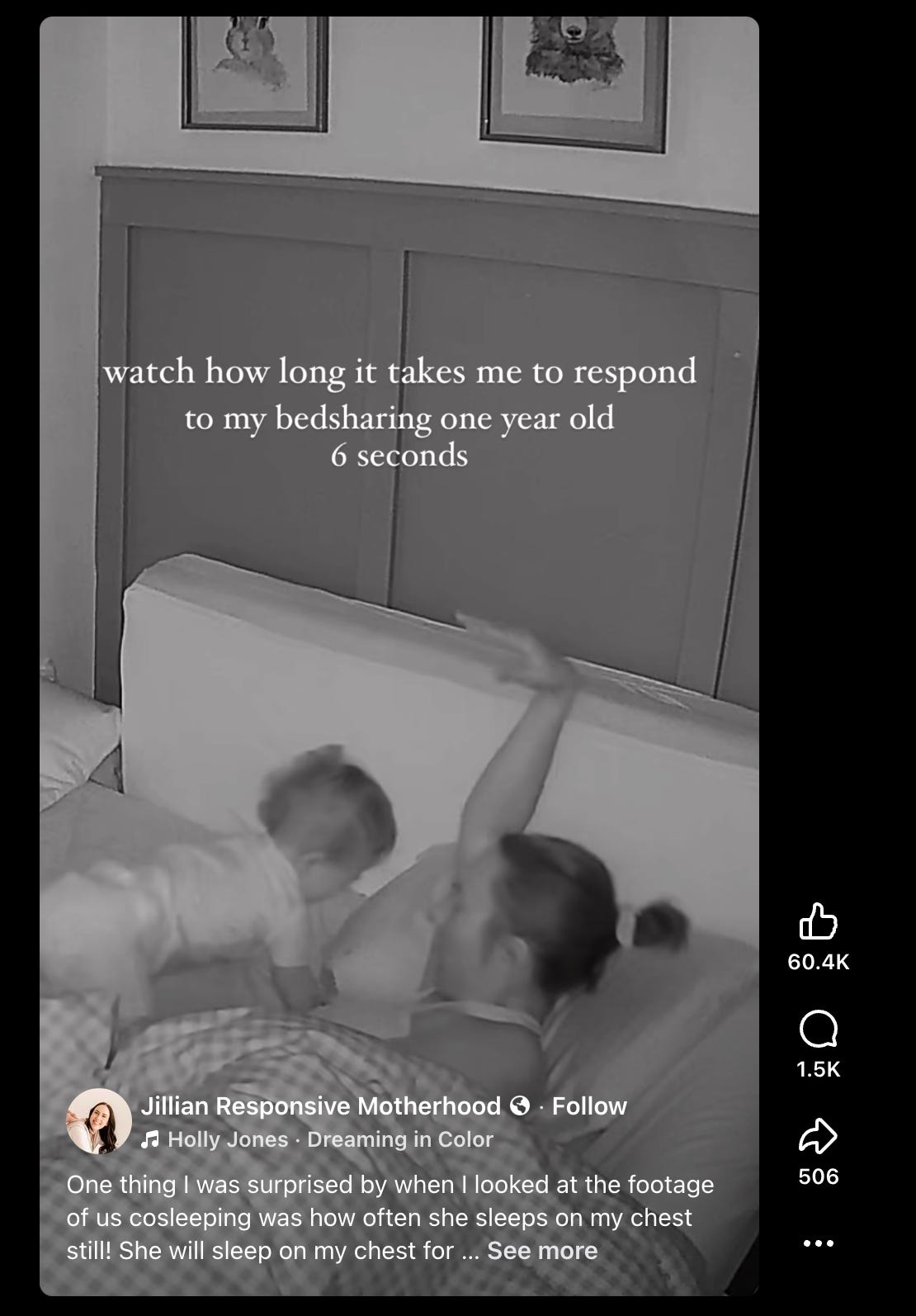
Some of these videos feel genuine. Many co-sleeping videos and articles seem rooted in a desire to normalize co-sleeping. And that’s a nice and important thing to do. However, what I’ve noticed recently is how easily that line blurs, from normalizing co-sleeping to shaming and ridiculing mothers who don’t.
And this goes both ways.
In the sleep-training or separate-room arena, there’s often an air of “you’re coddling your child,” “you’re not allowing them to learn self-regulation,” or “research says XYZ.”
No matter what you choose, your decision is being ridiculed.
And that, my friends, is the issue.
It’s a zero-sum game. We villainize other mothers’ choices to make ourselves feel better about our own.
What we’ve lost in the Instagram swirl is the understanding that every child is deeply unique, and that uniqueness requires different mothering. Every situation is different. Every family is different.
When we feel attacked, we tend to attack back, forgetting that we are all on the same team.
At this point, you are probably trying to figure out what side I am on? The TLDR of this article is that I am not on any side. I’ve done/tried both. However — unfortunately, or fortunately — co-sleeping does not work for me and my child.
I’ve tried it. My son, Forrest, is a very sensitive sleeper. If I roll over in the night, or my husband does, he’s awake. And Forrest doesn’t just want to cuddle. He wants playtime. When we co-sleep, we actually wake him more than he wakes us. My child does not respond to or benefit from co-sleeping. That’s why our family doesn’t co-sleep.
Outside of that, I can’t say that if Forrest was an exceptional co-sleeper, I would 100% be co-sleeping. There’s also a sense of autonomy that Ryan and I get at night that feels really special.
However, just because Forrest sleeps in a separate bed doesn’t mean I judge or look down on mother who co-sleep (or anything in-between). Despite my initial reactions to over justify my decision, I actively chose to reground myself — and see those mothers as just that — mothers who are doing what works for their children and family.
So, for a variety of deeply personal and unique reasons, co-sleeping doesn’t work for our family. Decision made. Intuition locked in. Responding to my baby’s needs, check.
And yet, not really.
Every time I’m on some form of social media, I’m fed the message that I’m a bad parent because I don’t co-sleep. We’ve all seen the reels of animals in the wild naturally co-sleeping. I’m made to feel unnatural every time I open the internet.

And when I see more judgmental, pro-co-sleeping posts, they often come from a place of defense — mothers who have been attacked by their decisions to co-sleep.
It is a vicious cycle of shaming others to soothe our own insecurities.
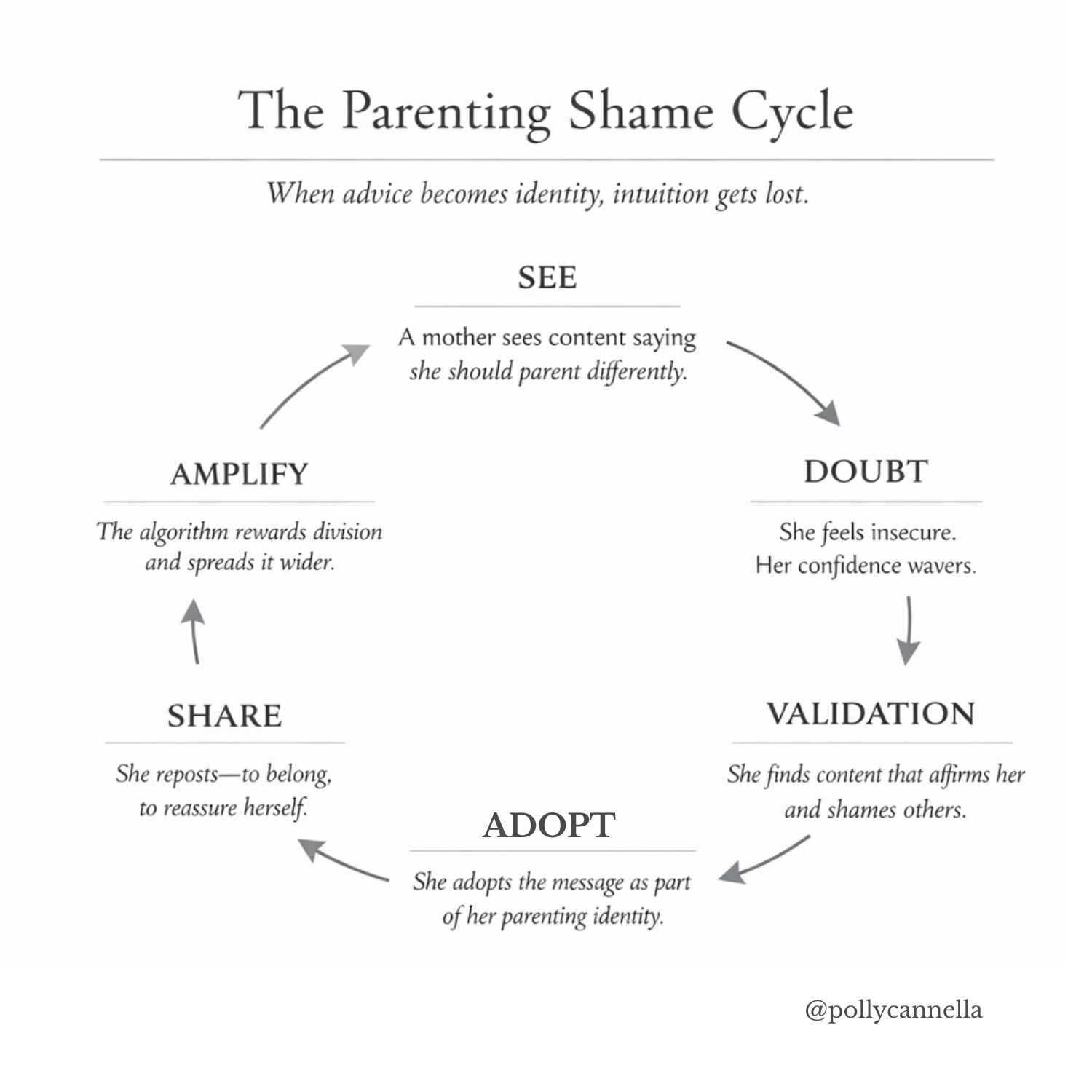
And I am not innocent in this. Especially in the early days, I imparted my sleep “wisdom” onto many baggy-eyed, new mommas.
It’s not that we shouldn’t offer advice or share what we’ve learned — it’s about how it’s delivered. Advice should always be layered with: this is what worked for me. It may not work for you, and that is normal and okay. You need to do what’s best for your child and your situation. I honor you as a mother. Trust your intuition.
So, because I am a nerd I love taking emotion out of it, taking a step back, and attempting to understand…what’s really going on here?
Why the sheer amount of incessant content about co-sleeping and sleep training on social media?
Because it’s divisive, and divisiveness is profitable. As parents, many of us (myself included) are constantly looking for external validation that we’re doing things the right way. When we see contradicting evidence and feel guilt, we tend to pause the scroll and watch. And our eyes, our attention = equal money. Our engagement equals = money.
So in a way, very similar to politics, when a content creator posts something divisive, the algorithm gods reward them.
Do I think content creators are doing this intentionally? Mostly, no. I don’t think the majority of this content is coming from a place of intentional ill will. But as a former social media manager, I know the insatiable appetite for appeasing the algorithm gods — the likes, the comments, the blast-off of a successful post.
Over time, creators are conditioned by the algorithm to repeat what performs. And often, the more divisive our language, the more rigid our stance — the more comments, likes, and engagement we get.
The result, from a viewers perspective, is a “this-or-that” style of parenting — a way of parenting so deep in the weeds of research and opinions that we drown out our own intuition.
Aside from sheer profitability and algorithmic addiction, “me vs. you” language taps into our deeply wired tribal instincts. Research in social psychology shows that humans naturally organize into ingroups and outgroups, tying beliefs and behaviors to identity rather than nuance. When tribalism is activated, disagreement feels like a threat — not a difference.
Parenting debates have becomes yet another identity battleground — a space where opinions turn into categorical group markers and where pushing a single perspective becomes not just an argument, but a social identity. If you do one thing, then you must believe all these other things too.
So, while I don’t think most of these content creators are doing this intentionally, I see political parties and brands hopping on decisive, deeply personal issues, sticking their flag in the ground and saying this is also what we stand for.
“Vote for us, buy our products and we will protect and stand up for you.”
Unfortunately the protection, in material form, is often non-existent. Rather than leading with actual policy, political movements increasingly lead with this identity style politics — and parenthood has become a powerful entry point — (I’m looking at you “I 🫶 breastmilk” RFK).
In a world where so many parents are searching for answers and validation, political parties find success in and offering a shiny, idealized version of parenthood. Political party allegiance becomes a form of virtue signaling — rather than a fight for policies that actually support mothers and families.
When you are forced to pick a side, co-sleep or sleep train, you erase visibility for the many nuanced, deeply unique approaches to sleep and parenting.
It’s either this extreme or that extreme, when in reality many mothers do something completely unique and tuned into their child every day and night. Unfortunately, these different shades of love and parenting don’t fit into a tightly curated social media bio. They don’t appease the algorithm gods with comments and spicy opinions — rather, they represent a deeply personal and unique flavor of love and sleep that works for them.
It also doesn’t account for the ebbs and flows of early childhood development. One style of sleep may work for a child at one stage, and just a few months later that child may need something completely different.
The problem is when we attach parenting styles to our identity — we stop listening to our intuition. We stop listening to our children and start doing what we think we should do. Maybe the “should” is right, or maybe what’s needed is something more nuanced and dialed in to your specific child — something no book, influencer, or research study can fully capture.
For every divisive topic, there are usually different shades of colors that are not being represented:
Gas or electric vehicles — what about a hybrid?
Carnivore or vegan — what about a veggie burger with cheese?
Guns or no guns — maybe just no assault rifles?
When we are made to believe there are only two sides to every topic, and we attach that belief to our identity we stop listening to our own values and intuition.
So here’s my rally cry — Moms, parents, caregivers — let’s stop shaming each other. As I mentioned in my last article (Delete the F*ing App), we need to engage with content mindfully.
Be vigilante when you are feeling shammed — Does it serve you?
Is it bait? Can you block this content creator vs commenting or engaging with their post?
If you feel shamed IRL by a friend or family member, know it’s often coming from their own insecurities, or they’re just being an ass. :)
Be vigilante when you are being validated.
Is it simple validation or does it shame other mothers in the process? Is is imparting a one size fits all to parenting? Is is attaching a parenting style to your identity — I am this type of mother if I do this type of thing.
Understand that divisiveness and “othering” is just another tool to divide and distract us from the one thing we should all be focused on, supporting each other.
We need to be on the same team. We need to fight for maternity leave, access to safer births, childcare, and real support, vs shiny identities of ourselves that do more to separate us than unite us. Let’s drop the judgment and trust mothers and parents in their decisions.
Thanks for reading Still Human! This post is public so feel free to share it.
Comments
Nothing yet. Say the first thing.
Sign in to join the conversation.