
Everyone has the moment where they realize the power of coding/building/designing products with AI. And for most it hits in waves.
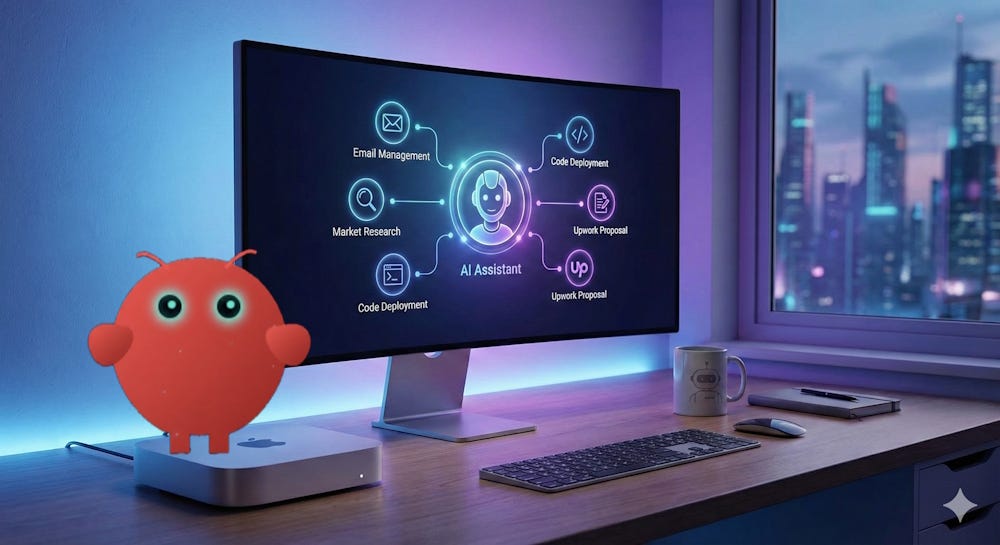
The most recent wave and rush of, “holy shit this is powerful” — OpenClaw. I haven’t worked directly with this product but as a UX designer and wife of a software developer we already have a mac mini spun up and autonomously building products in our den.
How my husband describes it:
“An autonomous AI agent that uses large language models as its reasoning engine to complete almost any task you define. It’s like a digital employee.”
For some the immediate reaction is an amplification of the things we already hear — This thing is evolving even faster than we thought. It is coming for your job. There will be massive layoffs. It will flatten organizations and consolidate wealth.
And as I mentioned in a previous article, The AI Tidal Wave: From a UX Designer, I’m not here to deny this however,
“depending on how people use AI, we could also add a lot more competition.
A product that once required 20-50 highly skilled workers and a few million in venture funding could now be built by a non-coder in weeks.
The tech giants who have been propped up by venture funding could be outpaced by lean startups providing better user experiences with less reliance on aggressive monetization goals.
So, while there will be job loss, there will be new opportunities everywhere.
We’ve seen this before. When the economy collapses, people build. During the 2008 recession, the rate of new entrepreneurs rose in step with unemployment — people who lost jobs didn’t just wait, they started things. Then the pandemic hit and the same thing happened, only bigger. During the first quarter of 2021, new business applications averaged 450,000 per month — nearly double the pre-COVID baseline. Bipartisan Policy Center Retail alone saw a 54% increase in business applications. The Science Survey Layoffs didn’t just shrink the workforce — they launched the next wave of founders. People who never saw themselves as entrepreneurs suddenly had no reason not to try.
That same energy is coming again, and this time they’ll have AI.
All to say, we are at an inflection point in our technological future.
We can either accept the consolidation of wealth and power by technocrats, or we can leverage AI to build something different. The only trick — succeeding will require the exact skills we’ve spent our whole lives being trained not to use.
In this article I’ll mostly focus on jobs in tech, but the fundamental principles ring true across every industry.

For most of our lives we’ve been told what to do.
From the time we are young we wake up and are sent to a classroom where time is structured for us. Bells and schedules fill our days. As we go into middle and high school we are told
what to study,
when to learn, and
when to play.
And then into adulthood, our 9-5 jobs begin to mirror the middle school structures we grew up in. Time is structured. Days are filled. Personal time and weekends are finite.
As most know this is by design. The modern American education system is meant to produce workers.
The foundation of American public schooling was largely borrowed from Prussia (modern-day Germany) in the early-to-mid 1800s. Horace Mann, often called the “Father of American Education,” visited Prussian schools in 1843 and came back enormously impressed. The Prussian model was designed with a specific purpose: to produce obedient, disciplined citizens who would follow instructions, respect authority, and function reliably within hierarchical systems — whether that meant the military, the bureaucracy, or eventually, the factory floor.
As education administrator Ellwood Cubberley put it in 1916, schools were “factories in which the raw products — children — are to be shaped and fashioned into products to meet the various demands of life.”
Sound familiar? We spent our whole lives being shaped into obedient workers — and now we're doing the exact same thing with AI.
Sorry if this is sounding straight out of a science fiction novel. The goal of this article is not to scare you but for us all to realize our own programming. If you’ve ever been to a “cool” company retreat you can smell it on the freshly printed company t-shirts — we have been programmed to listen, conform, and stay small.
For many if not most, this is a pleasant way to live and I don’t want to dismiss the hard work and true intelligence needed to perform these jobs. Also, work for most is more than a paycheck — it provides community, purpose, and connection.
However, in a post-AI world many will need to move from being individual contributors to being managers of AI agents. Doers to architects.
When job loss happens many of us will have the power to build and create like never before, but the tools to be successful will require imagination, courage, creativity, and independent initiative — the very things we’ve been told to suppress.

This power to create is arriving at a pivotal moment where monopolies that have swallowed entire industries whole, and the line between corporate interest and government has never been blurrier.
For the user, these monopolistic trends mean a shittier user experience at a higher cost.
Cory Doctorow describes the “Enshittification” of digital products like Amazon, Facebook, and Google: “all enshittify in the same predictable fashion. First, they’re good to their end users. They find a way to lock those end users in. And then, now that their end users are locked in, they make things worse for those users because they know they can’t leave easily, and they make things better for business customers.”
He uses Uber as an example on the podcast, Offline with Jon Favreau: “[Uber] went to this venture capitalist called SoftBank. This guy, Masayoshi Son, who had $31 billion from the Saudi royal family. They gave it to Uber. Uber lost 41 cents on every dollar they brought in for 13 years, drove all the other cab companies out of business, drove all the other ride share companies out of business, became the dominant player, doubled the price of rides, halved the compensation they gave to drivers.”
We are living in a time where lean, incredible tech can now be built at scale and we need to be building it. We need to unshackle ourselves from our undignified reliance on these companies — the kind that can only be truly felt in when stranded at LAX with no way home except a $100 Uber/Lyft and the glaring realization that you have no other choice.
We may not be programmed to build. But we need to.

Get better at tolerating imperfection. See it as a skill and get better at it. Like kicking a soccer ball for the first time, you will most likely fumble a bit at any new venture. Find things you are new to or always thought you were bad at and give it a go. The goal is not even to get better — it is to improve your tolerance for imperfection and failure. As Ken Robinson put it in the most watched TED Talk of all time:
“If you’re not prepared to be wrong, you’ll never come up with anything original. And by the time they get to be adults, most kids have lost that capacity. They have become frightened of being wrong. And we run our companies like this. We stigmatize mistakes. And we’re now running national education systems where mistakes are the worst thing you can make. And the result is that we are educating people out of their creative capacities.”
— Sir Ken Robinson, Do Schools Kill Creativity? TED Talk, 2006
Move toward ideas. Take steps to learn more about the space. Talk about it with Claude or another chat agent. Have it come up with an actual list, learn about your target audience and monetization models. Lead with curiosity, not conviction.
Figure out what you don’t know. Maybe it’s how to paint. Maybe it’s how to get a license or insurance for the thing you want to do. Identify those hurdles and tackle them one by one.
Pause. If there’s one thing I’ve learned with AI it’s that you can build high-fidelity too fast. We’ve lost friction in building products, and while yes, this entire article is talking about why that is a good thing — there is another side to the coin. Friction is what allows you to stop and learn about your user and the problem before building 10 apps that will die on the home screen of your iPhone — not that I know by experience or anything. 🙂
A return to core product principles. Start with the user and build backwards based on what they need. Ship scrappy and iterate quickly.
While this might be what some call the eternal optimist view of AI — the democratization of tech, yay. Increased competition, yay! — I am not naive to how large these behemoth companies have become and how much they’ve sunk their teeth into our politics.
Competition will not come easily and neither will starting a business. There is a reason people are employed. We need to support founders, artists, and builders in our communities.
In case you missed it last week, my co-author on Still Human, Philip Deng, talked about how to do just that.
To build on his arguments, the United States needs to make starting and running a business easier and safer for people.
Easier by simplifying business registration and small business taxes (I am looking at you, Enshittification master, Intuit). If you don’t know about Intuit, this oldie but goodie episode of Patriot Act with Hasan Minhaj talks all about it.
Safer by providing people with universal healthcare.
Oh hey Susan, why did you never pursue that idea? Oh, right because you and your entire family would lose their healthcare coverage. Makes sense.
Healthcare’s tie to employment is by design. Not only is it highly inefficient (we spend more of our GDP on healthcare than any other industrialized nation), but it locks people into jobs in order to survive.
We are at a pivotal moment where we can either let corporations rule us into more expensive and shittier products, or we can tip the balance in our favor. OpenClaw — built by a single, admittedly very talented person as a personal project — is exactly the kind of thing that shouldn't exist yet. And yet here it is.
We can build. In some cases we don’t even need to think of the new thing — we can just build competitors to, say, Facebook, that aren’t knowingly causing body dysmorphia in young teens.
We can build with a new set of values. One that is not defined by venture funding, but by the decentralized renegade coders who got us here in the first place.

Thanks for reading Still Human! This post is public so feel free to share it.
Comments
Nothing yet. Say the first thing.
Sign in to join the conversation.