
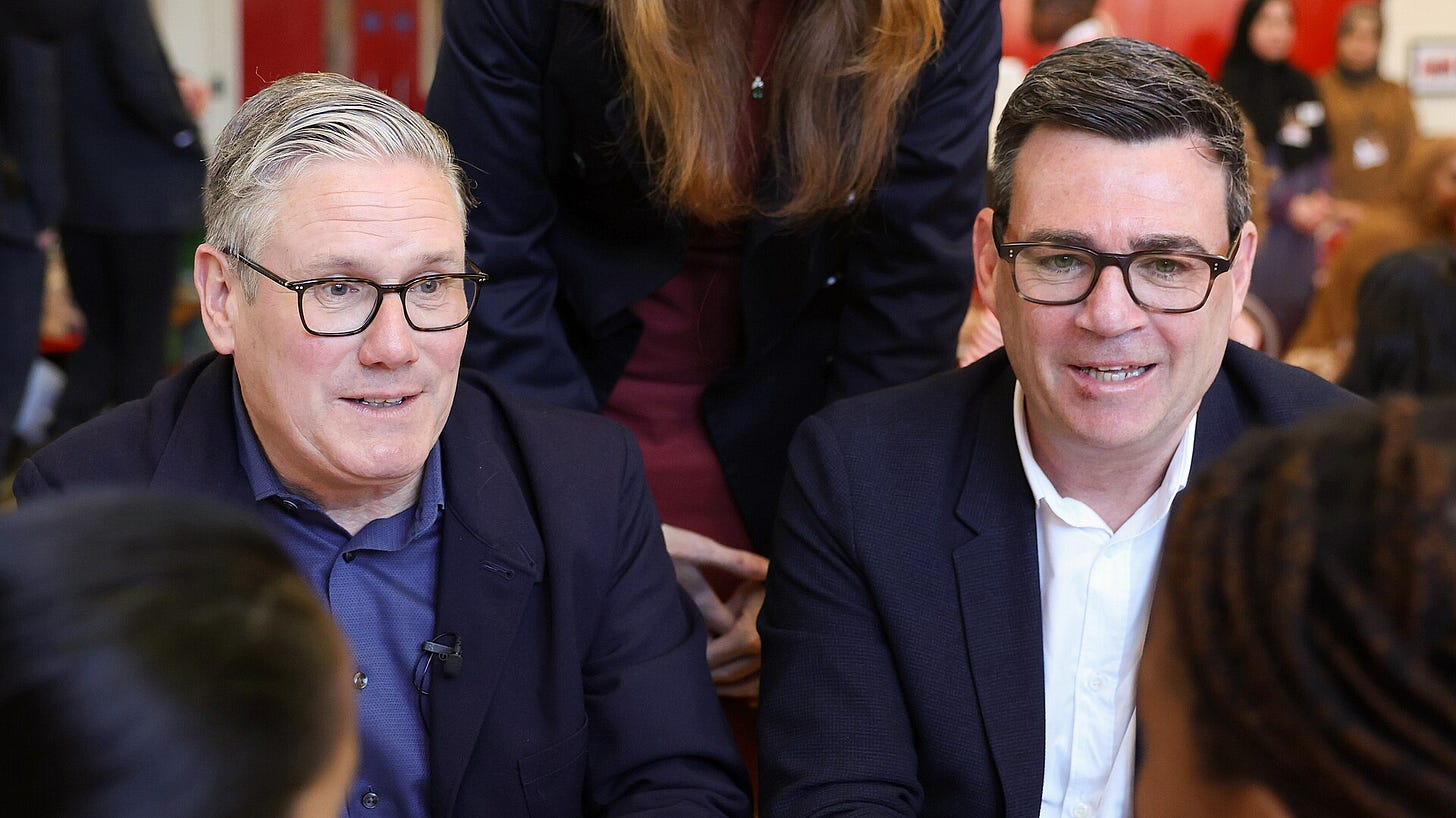
Less than two years after securing a historic majority, in the wake of truly bad local election results, the UK Labour Party has embarked on a course of bloodletting, self-immolation and a factional tussle for control of the leadership. In other words, the party is back in its comfort zone. In reliably Millenarian fashion, Britain’s historical centre-left party is consumed with the search for a saviour. Current King Across the Water is Andy Burnham, Mayor of Manchester, who is throwing his hat into a by-election prompted by a resignation of an existing MP, under the slogan of ‘Only I can save the country from my party.’
In the UK, it is perfectly possible for governments to change leaders mid-term; at the same time, the public rarely rewards parties who do so. And they are likely to be even harsher on the Labour Party for doing it, because they are always harsher on the Labour Party, whose rare periods in government always begin against a background of scepticism due to prejudice and precedent.
Some might say though that a party which describes itself as a ‘moral crusade or nothing’ might be inviting a certain amount of ethical scrutiny upon itself. In part due to an electoral system which means that Labour is the only social democratic game in town for British politics, the Labour Party has a slightly mythical, storied quality that can be off-putting for those of who want a sane centre-left part much in the same way as we want a good dentist; to perform a function, not fulfill a mythic arc. Seeing the Party embark on its current self-immolating course feels, for someone not steeped in Labour Party lore, a little bit like being on holiday and watching people perform a strange ethnographic dance. You can learn its significance but the passion of it feels abstract.
Of course, I understand the logic in taking swift action. Current Prime Minister Keir Starmer is terribly unpopular in a way unlikely to improve; he comes across as wooden and is deeply disliked by the public. Labour wants to avoid the Joe Biden drift, with a dud candidate dragging the party’s fortunes and no-one brave enough to challenge him before it was too late.
Yet you can challenge too early too. The example of the 2025 Canadian election is salient here; the Liberals traded out Justin Trudeau, a similar dead electoral duck, for Mark Carney just six weeks before the vote. The result was a stunning last-minute comeback victory for the Liberals. As long as there’s a good candidate, a change of leadership can be done later, and it would be better to give Starmer a chance to suck up difficult decisions and own them if he’s going to be made an electoral sacrifice of anyway, to take the opportunity to position the next leader with a more than putative inheritance. I share the analysis that Starmer – somewhat unfairly in my view – is electoral hemlock and cannot win another election, but I find this way of doing it, the haphazard, uncoordinated, scheming spectacle we’re seeing, to be below the wit of the average chump. What’s needed is not urgency but a timetable; what’s needed above all is a period of cool heads and strategy.
And of course the Tories have done it. The Tories have swapped leaders like Tazos. In the period of 2010-2024 under Tory rule, we had Cameron liberal Toryism with hostility to immigrants, Mayeian Merkelism with hostility towards immigrants, Johnsonian populism with both overtures and hostility towards immigrants, Sunakian technocratic Thatcherism with hostility to immigrants, plus whatever Liz Truss was. That’s at least two more species of government than there were elections in the period.
For though the British system does allow for a change in PM mid-term, the new broom soon loses legitimacy without a fresh mandate. A new Prime Minister has to go to the people. Witness the case of the most radical of all those shifts in gear, Liz Truss, who came only with a mandate from the tiny Tory leadership, no more than a couple of constituencies in size; that is to say the most radical economic experiment of British politics’ recent years, Truss’ careening libertarian interlude, came without any real popular mandate at all. The Tories are still paying the price.
Indeed, it’s worth saying when acknowledging the Tory precedent of swapping leaders, where are the Conservatives now? Reduced to a Parliamentary rump of 121, with this towards the upper end of expectations at the 2024 General Election. Polling 18%, shattered to their right, and having just lost 433 Councillors in the local elections which they are hailing as a victory because Kemi Badenoch comes across well on television. The Tory Party is screwed, with much of its Home County heartlands lost to the Liberal Democrats, and stands sporting around its neck the albatross of its last period in power.
Those years took the UK from being a confident, mid-sized European power with problems, to a declining, sclerotic constitutional mess, after an extended period of sampling pretty much every flavour of right-wing governance. To the extent that you could make a case for any of those periods as competent, actual impact of policies aside, it would be the coalition of 2010 between the Conservatives and Liberal Democrats, which endured for five years and in the face of multiple thumpings in local elections. It then ended with the election of a Conservative majority government in 2015.
The fact is that Keir Starmer didn't win a majority for Andy Burnham or Wes Streeting or god forbid Ed Miliband to do with as they wish. Starmer was on the front of the Labour manifesto, won his majority on that program and has a mandate to see it through. It was Starmer who proved sufficiently electorally unthreatening that even the centre-right liberal middle class broke Lib Dem as they had no real fear of him being Prime Minister, even when up against the similarly unthreatening Sunak.
What Labour actually needs to do is clear; it needs, in exceptionally turbulent times, a year of head down governing, ignoring media froth, and getting the fundamentals in place for economic growth. There are green shoots already appearing; NHS waiting list down, train ridership up, GDP forecasts modest but upscaled. The foreign policy has been by and large just right. If these trends continued for a year, whatever personal objections people have to Starmer, it’d be worth a few percentage points for Labour in the polls, and it’s not an exaggeration to say none of this would be happening if Labour were on 25% on the polls and not 18%. Or even, say, 23%. After all that, a new man or woman could come in and have something to run on.
The media and the wider electorate have to take some responsibility for why this kind of political patience is not possible or does not seem to be. For it feels like the reaction to Keir Starmer has not been proportionate to his shortcomings. From the populist-right nickname of ‘two-tier Keir’ to the left accusing him of personally killing children - an accusation which besmirches the accuser more than the accused - it is Starmer’s very dullness and diligence that has functioned as a blank space into which personal grievances and obsessions can be projected. The tale of the boy who cried wolf comes to mind, with the boy now ‘British voters’.
For his part, Starmer clearly believes in the essential decency of the British, or at least of the English, but my have they monstered him. At worst Starmer has been wooden and earnest. This level of public hatred is just not commensurate with stuffing up the winter fuel allowance, nor with the very short amount of time Labour has been in after fourteen years of misrule; it’s more a tantrum by an electorate which has, from voting for Brexit or trying to make Jeremy Corbyn Prime Minister and indeed actually doing so with Boris Johnson, been off on one for some time now.
The irony is that Starmer is, in his biography, just as working-class as Burnham; Starmer seems to have an almost touching blue-collar belief that if you do your work diligently and well enough people will see your efforts and reward you. Ha! What the Labour Party seems to want instead is someone who is better at performing being working-class than embodying working-class virtues of persistence and grit, the kind of man who, asked for his favourite biscuit, replies ‘chips and gravy’. Really. That’s why a lot of the media class seem to like ‘Andy’; he looks more their idea of what a working-class person is than Starmer, jogging around in his Everton top and dressing casually at funerals.
I’m not saying Burnham’s class background is fake, by the way; his dad was a telephone engineer. Just that he’s better at performing he is than Keir is. And Burnham is a much better communicator than Starmer and might indeed come in and boost his party in the polls – an uptick of, say, 3%. Is this all worth it, in times of crisis, for a single-figure spike in polling, to have a new leader with all the same problems but who seems to like making harder choices even less? After all, being Mayor of Manchester is probably the easiest gig in the Labour Party these days. The economic growth is all there already and you just need to stay out of the way of the new housing developments.
There is an argument sometimes made in left circles that all that would be needed was a one-term Labour government to truly radically change things. Ken Livingstone used to say it. The current moment has shown, I’d suggest, why that would never be possible, because at any point of resistance (and the greater the radicalism, the greater the resistance), Labour’s internal coalition would inevitably self-destruct. This is almost unforgivable to me, this mass wobbly by a social democratic party which, elected on an incrementalistic ticket, seems to have decided to dress for the government it wants rather than the government it was elected to form.
I’m really sorry for Labour members that they don’t fancy another few years of managerial technocracy with redistributive features but that’s all their party has a mandate for. Flailing around for a change without strategy is the height of self-indulgence, of party before country, and of ambition over the greater good. It just so happens that, at the moment of crisis, the only solution is apparently what the Labour Party has wanted all along, or at least the particular faction’s conception of it. At the first sign of turbulence, the intellectual culture around the Labour Party always comes up with the same answer: ‘What voters are demanding is a shift to the left! Us, but more so!’
It feels, absent Blair-time levels of economic growth and Blairite brilliance of political leader, that Labour will always do this, will always at the first sign of trouble not keep course and try to damn the critics but instead indulge in factional warfare, will wilt, that whatever faction which has been spurned will take up arms against the one currently in power, for no party seems to treasure its winners less. Hence the shortness of the list of them.
The Labour Party, faced with the eking out of compromises and yes, the inherent unpopularity of trying to govern in straitened circumstances – and let’s be clear, there’s no money for Burnham, none for Streeting, and all this chaos probably means less for Starmer even if by some miracle he stayed – has retreated to its safe space of internal warfare, coupled with risible projections of a political messiah onto Andy fucking Burnham. Burnham, same unspectacular figure who ran so unconvincingly for the leadership in 2015. It reminds me of England World Cup campaigns past where we would always have been world-beaters if we only played the one player out of the team; all this hype around the Manchester Mayor, to use a footballing analogy he might favour, has strong ‘Gareth Barry in 2006’ vibes. And when he finally turns up he’ll be a decent hard-working midfielder but not the kind who wins you pots.
Meanwhile, the electorate has proven that, whatever it says about wanting a return to stability and good governance, it no longer has the patience to give anyone or anything a chance to improve things before reaching for vituperative hatred and gaudy lies. Lost in fantasies, craving magic bullets, and unable to hold fire, perhaps the best thing you can say about these voters and this Labour Party is that they deserve each other.
No posts
Comments
Nothing yet. Say the first thing.
Sign in to join the conversation.