
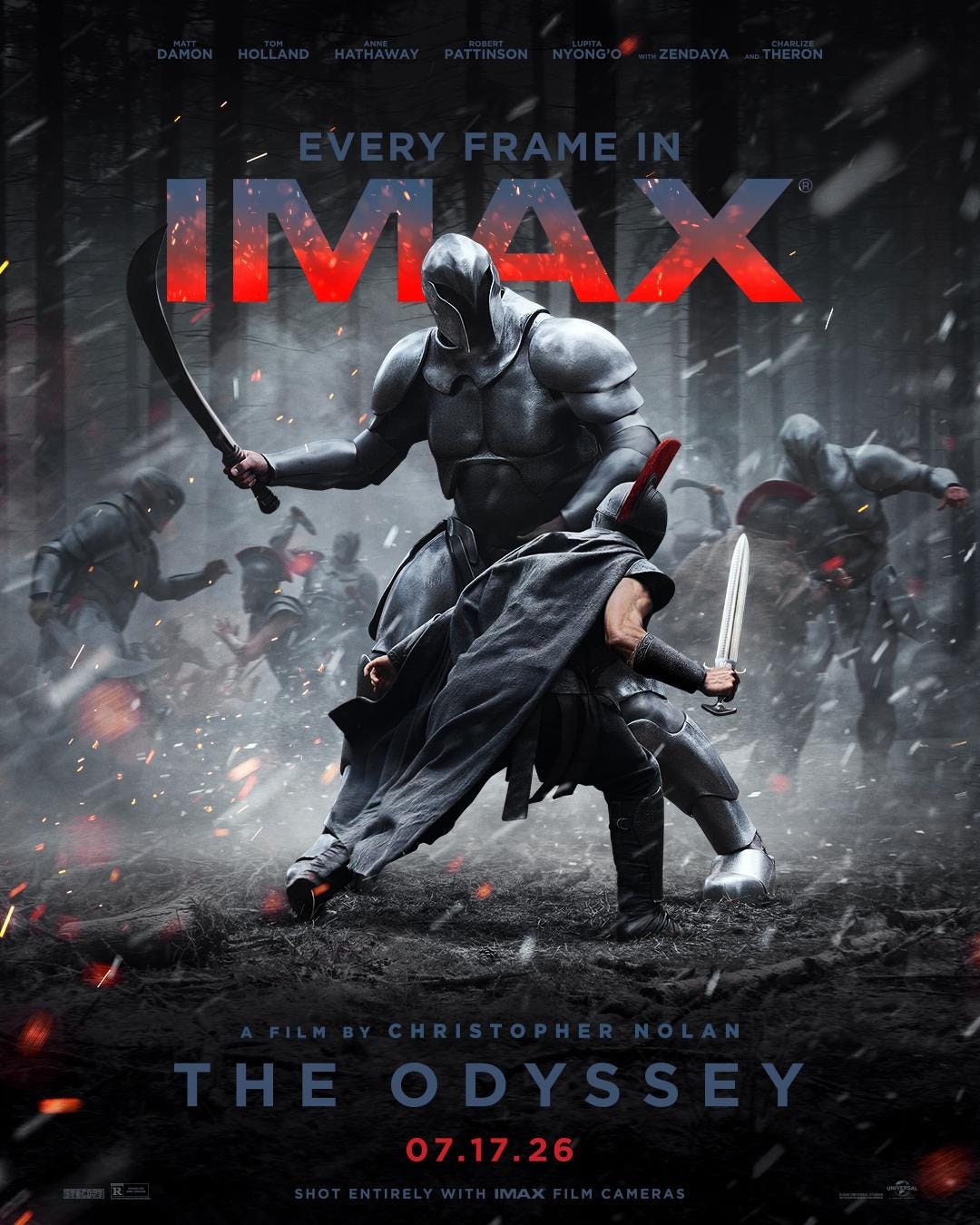
I hadn’t planned on writing about The Odyssey, as movie criticism isn’t my usual jam in this Substack. However, following the commentary on this movie has become an odyssey of its own! The three-hour film and its director Christopher Nolan have attracted the wrath of conservatives with accusations of “woke casting.” They are quick to point out that Helen of Troy was not black! And Elliot Page, a trans man, does not look like their conception of a Greek warrior. Elon Musk is so incensed that he’s announced his AI platform will create a “historically accurate” full-length movie of the epic before the end of the year.
First of all, I feel the need to point out that Homer’s Odyssey is a work of fantasy, filled with gods and monsters. It is not history; it is not even historical fiction. It is a story, one of our oldest surviving tales (like Gilgamesh and the books of the Bible). It is part of the Western canon — undeniably a piece of classic literature. I believe there are many valid ways to translate a classic into an entirely different medium for a modern audience. What’s more, as a culture we long ago seem to have agreed this is acceptable. Jesus Christ Superstar was a global phenomenon more than half a century ago (and is, incidentally, my favorite retelling of the Christ story).
Despite the self-righteous protests of conservatives, it is by no means self-evident how a director should approach casting a movie set in a distant time and place. So, before we condemn Nolan for “giving in to wokeness,” let’s look at what his choices actually were in casting this picture.
Nolan chose color-blind casting. According to Google AI, color-blind casting “is the practice of casting roles in film, television, and theater based purely on an actor’s talent and suitability, without considering their race or ethnicity.” I can’t say I always agree with this approach in historical movies. There are times when it takes me out of the story to see an Asian person or someone with African heritage wandering around an otherwise historically accurate drama set in Elizabethan England or medieval France. But if the movie is good, if the acting feels authentic, this moment passes and I’m able to appreciate the story being told. That was the case with The Odyssey. Even if I hadn’t been aware of the controversy beforehand, it became clear very early on that Nolan chose this particular casting convention.
Nolan could have opted for complete historical accuracy. He could have cast only people who were Greek or plausibly look like they could be from the region. The problem with this approach is that Hollywood movies are made and sell tickets based on their stars. Can you name ten Hollywood stars of Greek descent? I checked and there are many who have some Greek heritage, from Jennifer Anniston to Theo James and Tom Hanks — but they are not fully Greek and do not necessarily look Greek. Even if he accepted partially Greek actors, this approach would have drastically limited his casting options. That is why I can’t think of a single mainstream Hollywood movie that has done it this way when the story involves people who are not of Northern European descent.
Alternatively, Nolan could have gone with the traditional, old Hollywood approach of casting a bunch of gorgeous white movie stars (back in the day, pretty much all movie stars were white). This is how we got actors like Jeffrey Hunter (Scottish descent) and Max von Sydow (Swedish) portraying Jesus, a Mediterranean Jew, or Elizabeth Taylor as the Egyptian Cleopatra. But as Hollywood and America in general became increasingly multi-ethnic, and there actually were movie stars with a variety of skin tones and ethnic backgrounds, this approach came to feel problematic. Conservatives seem to wish Nolan had gone this route. But I guarantee that if he had, he would have faced a backlash from the liberal media.
All movies require the willing suspension of disbelief to some extent. Real people from the Bronze Age would have had terrible teeth and skin by modern standards, but creating that level of accuracy is not necessarily desirable. Nolan probably didn’t want audiences getting distracted by jacked up teeth and pock-marked skin. He is telling a story, not teaching history. And I think he’s done a magnificent job. No, he’s not “faithfully” recreating what Homer wrote (and I don’t think he ever claimed he was). An epic poem is a completely different medium from a film, and a modern moviegoer is a very different audience from a Bronze Age farmer hearing this tale recited around a campfire. A line-by-line re-creation of the poem would likely result in a chaotic, long, uninteresting movie that a modern audience would have little interest in (we may get to find out for ourselves if Musk follows through on his plans).
If Nolan had cast bad or mediocre actors of color simply to appease the woke mob, that would have been worthy of condemnation. But the actors he cast do a magnificent job of telling the story he wants to tell. Admittedly that story is not the same as the one Homer tells. And that’s fine. Homer’s Odyssey still exists, as it has for thousands of years. Modern retellings of classics are always different from the source material, especially when moving from one medium to another. I would argue this is true even when filmmakers are trying their best to be faithful to the original. Ayn Rand wrote, “Art is a selective re-creation of reality according to an artist’s metaphysical value-judgments.” As such, no two filmmakers are going to make the same choices. If you don’t like the choices Nolan made, that’s your prerogative. But many of those condemning his approach haven’t even seen the movie! In fact, some of them can’t even get their basic facts straight, claiming that Elliot Page plays Achilles (in fact, Achilles doesn’t appear in the movie; Page plays a character named Sinon). Some don’t find Lupita Nyong’o attractive enough to be the “face that launched a thousand ships.” Leaving aside the objective fact that she is a beautiful woman, part of Nolan’s point is that Helen was a pawn, used as an excuse to start a war that Agamemnon wanted to fight for entirely unrelated reasons. In Nolan’s film, her beauty is not the point.
As is so often the case, MAGA’s reaction tells us more about them than it does about Nolan or the movie itself. They want to be angry. They enjoy feeling righteous indignation. What’s ironic is that in focusing on the casting, they’ve missed out on being offended by one of the central themes of the movie. Odysseus is a strong believer in the “law of Zeus,” the ancient Greek sacred code of hospitality, reciprocity, and the respectful treatment of strangers. He believes that by breaking that code, he and his fellow Greeks essentially “broke” the world, plunging civilizations into centuries of darkness. The Greek word for this code is xenia — which is where we get the word xenophobia. Nolan’s movie, at least in part, is calling out xenophobia and the cruel treatment of outsiders. But most of the MAGA faithful apparently aren’t smart enough to grasp this, or perhaps they do grasp it, but can’t offer a reasoned defense of their own xenophobia and so avoid discussing this theme entirely.
The bottom line, of course, is that if Nolan’s casting or his approach to the story don’t appeal to you, then don’t go see the movie. But the fact that it’s on track to earn over $1 billion worldwide indicates that, at least from a commercial perspective, he got a lot of things right. “Go woke, go broke” doesn’t seem to apply this time.
No posts
Comments
Nothing yet. Say the first thing.
Sign in to join the conversation.