
For the past 16 years, starting with the Citizens United decision in 2010, the conservative majority on the U.S. Supreme Court has led a backward march to take power away from the people and put it in the hands of the rich and powerful, as if the rich and powerful needed any help to get richer and more powerful. The consolidation of power for those at the top of the economic food chain, with no relief in sight for the makeup of the court, has led to talk of expanding the court to stop the erasure of basic rights our nation has worked hard to ensure for several centuries.
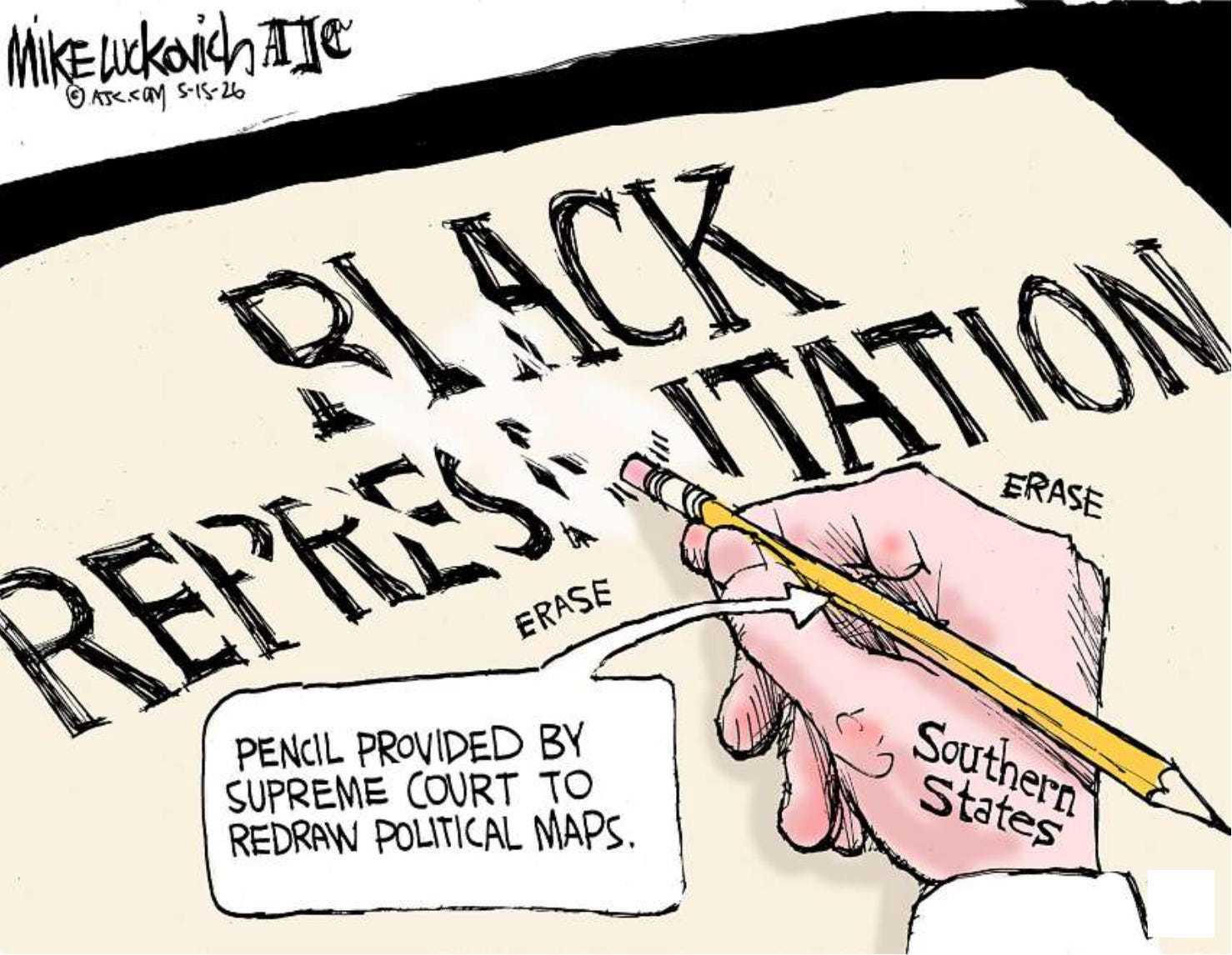
I’ve been reluctant to jump on the “expand the court” bandwagon, fearing it would bring an end to a system that, despite its flaws, has served our nation well for the past 250 years. However, the recent ruling of the court in Louisiana v. Callais, which gutted the Voting Rights Act of 1965, convinced me that desperate times require desperate measures. Within hours of the court’s decision, racist Republican-led governments throughout the South moved to redraw congressional lines to eliminate Black-majority districts that gave people of color representation in Congress.
To quote Popeye: “That’s all I can stands, and I can’t stands no more.” It’s time to open up that can of spinach and kick some ass.
To make the case for expanding the court, let’s review some of the court’s disastrous decisions.
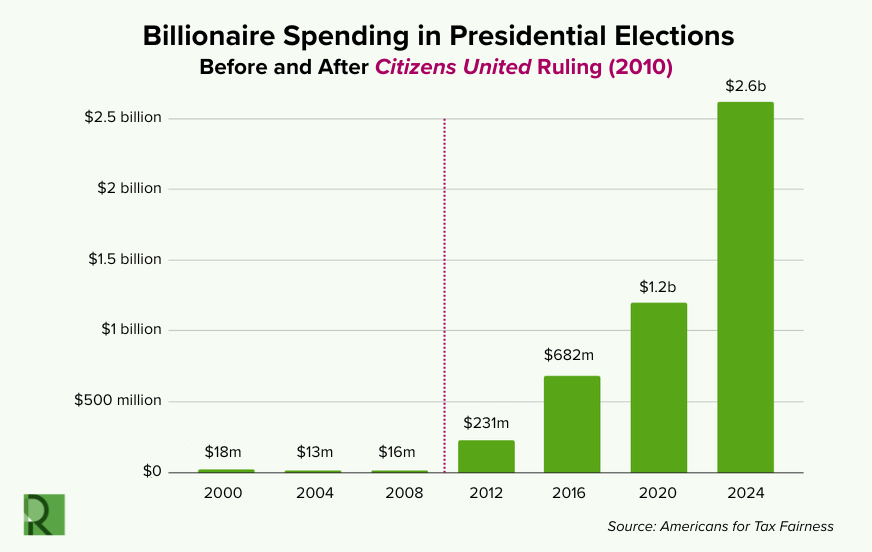
2010, Citizens United v. FEC: Looking at the chart above, it becomes readily apparent why the main priority last year of President Trump and the Republican Congress was to pass trillions in tax cuts that overwhelmingly benefitted the wealthy. Billionaires got a handsome return on their investment, an investment made possible because Citizens United allows them to give unlimited campaign contributions without having their identities revealed. And while the rich were getting a huge windfall, millions of Americans lost their healthcare coverage, because the same bill cut subsidies to the Affordable Care Act that made health insurance affordable.
Billionaires weren’t the only ones who benefitted from Citizens United. The Supreme Court decided that corporations were people, too, entitled to the same free speech protections as individuals. Big oil took advantage of the ruling by threatening to primary any Republican who supported climate legislation that would reduce the use of their product. As climate champion Sen. Sheldon Whitehouse notes, prior to the decision, there was bipartisan support for climate legislation but not after Citizens’ United, effectively thwarting the passage of significant measures to rein in climate change. “I got elected in 2007, and for all of that year and 2008 and 2009, there was a constant steady heartbeat of Republican climate change activity in the Senate… Then comes January 2010 and the Citizens United decision, which the fossil fuel industry asked for and expected and took instant advantage of. And from that moment forward, no piece of carbon dioxide regulation legislation has managed to get a single Republican co-sponsor in the Senate.”
2013, Shelby County v. Holder: This was the first assault on the Voting Rights Act, which was enacted in 1965 to break down barriers that denied Black people the right to vote and be represented in local and federal government. Under Section 4 of the VRA, states and municipalities with a history of racial discrimination were required to submit changes to voting rules and districts to get federal approval. By canceling Section 4 of the VRA, the court was saying that racial discrimination does not exist in America anymore, therefore there is no need to get approval for voting changes anywhere. Immediately, states and local jurisdictions erected voting barriers like stricter ID rules, aggressive voter roll purges, and closure of polling places that disproportionately affected minority communities.
2014, McCutcheon v. FEC: This decision removed limits on the number of candidates, parties and PACs that individuals could contribute to during an election cycle. In other words, the rich and powerful could buy as many candidates as their bank accounts would allow. Writing a dissenting opinion, Justice Stephen Breyer said, “If the court in Citizens United opened a door, today’s decision may well open a floodgate.”
2015, Obergefell v. Hodges: This case legalized same-sex marriage throughout the nation and was actually one of the good decisions the court made this century. I mention it here because the makeup of the court has changed substantially since 2015. If challenged, there may now be enough votes on the court to overturn this landmark decision, denying people the right to marry anyone they choose regardless of their sexual orientation. This is one more reason to resort to the drastic measure of expanding the court.
2019, Rucho v. Common Cause: With this decision, the Supreme Court ruled that federal courts could not hear challenges to partisan gerrymandering. Writing the dissenting opinion, Justice Elena Kagan said, “The practices challenged in these cases imperil our system of government. Part of the court’s role in that system is to defend its foundations. None is more important than free and fair elections.” Aided with today’s sophisticated computer models, state legislators can now maximize partisan advantage at the polls. The only remedy will be for Congress to enact legislation putting redistricting in the hands of non-partisan panels.
2022, Dobbs v. Jackson Women’s Health Organization: Despite several justices saying in their confirmation hearings that Roe v. Wade is the law of the land where abortion is concerned, the Supreme Court overturned the half century-old decision that made abortion legal (Surprise!). The Dobbs decision allows states to outlaw abortion, with 13 states making the procedure illegal entirely except to save the life of the mother and another 10 states outlawing abortion after specific time periods. In half the country, women seeking to terminate a pregnancy must travel to another state, an option not available to the poor. In states that have implemented a ban, women face harm or death because doctors must “delay necessary care until patients [are] at risk of death or permanent injury.”
2024, Trump v. United States: Since our nation’s founding, we’ve operated under the assumption that NO ONE, no matter how powerful, is above the law. The Supreme Court obliterated that assumption with Trump v. United States, in which they granted presidents immunity from prosecution when they commit crimes as part of their “official duties” in office. The ruling was so vague that Trump probably has a “get out jail free card” for inciting an insurrection on Jan. 6. Thomas Wolf from Brennan Center for Justice wrote, “This ruling from the Court’s conservative supermajority pulls a new constitutional rule from thin air. And it raises daunting, unjustifiable barriers to criminally prosecuting lawbreaking presidents. Trump is now positioned to renew his push to dismiss the charges against him and evade accountability for the grave crimes he’s accused of committing against our democracy. The Court has left the rule of law in tatters — even as it looks the other way.”
2026, Louisiana v. Callais: With this ruling, the Supreme Court gave the middle finger to every Black person in America. It finished the job of dismantling the Voting Rights Act, and it was the straw that broke my back. When the VRA was enacted in 1965, its aim was to make amends, at least in part, for hundreds of years of oppression inflicted upon Black people in the U.S. A major facet of the law was to prohibit the dilution of Black voting strength, ensuring they would get representation in Congress that had been denied since the end of Reconstruction. In Tennessee, Alabama, Louisiana and South Carolina, Republicans wasted no time in getting legislators to redraw congressional lines that erased Black-majority districts. Here’s what the Legal Defense Fund said about the ruling: “The Callais decision puts the diversity of our elected bodies and representation of all communities at risk. We’re already seeing legislatures moving to eliminate fair districts that provide crucial representation for voters of color without checkpoints from the courts. Now, Black communities will have to fight harder to ensure their votes hold weight at the ballot box and their voices are heard in policymaking that affects their lives, their families, and their communities.”
I could cite more horrendous decisions by the court, but these are the greatest hits (to our democracy). But let’s get to the “In case of emergency, break glass” segment of this piece.
First question: Can Congress expand the size of the Supreme Court? Yes, it can. The Constitution says nothing about the number of justices that comprise the court. The size of the court has fluctuated between six and 10 throughout our history, settling at nine in 1869, where it remains to this day. Before you say, “Wouldn’t that be cheating to expand the court?”, let’s review recent history:
Scalia kicks the bucket: On Feb. 13, 2016, Justice Antonin Scalia’s heart gave out at age 79, touching off a controversial battle to fill his seat on the bench. Complicating matters was the fact that Barack Obama, the Democrat who was president at the time, controlled who would be nominated, but Republican Mitch McConnell was the majority leader in the Senate who controlled the confirmation process. Despite the fact that the presidential election was nine months away, McConnell made the dubious argument that it was too close to the election — wink, wink — to fill Scalia’s seat and refused to bring the nomination of Merrick Garland forward. Within weeks of being inaugurated, Donald Trump nominated Neil Gorsuch, who was confirmed by the Republican-controlled Senate. McConnell, in effect, stole a Supreme Court seat for the conservatives.
Kavanaugh joins court: In July of 2018, Justice Anthony Kennedy retired and Trump nominated Brett Kavanaugh to fill the vacancy. Kavanaugh’s confirmation was marred by allegations that he sexually assaulted young women in his youth. The most convincing testimony came from Dr. Christine Blasey Ford, who alleged that a drunken Kavanaugh pinned her to a bed, groped her, and attempted to remove her clothes at a high school party in Maryland in the early 1980s. A few years later, the story came out that at the time of Kavanaugh’s confirmation, the FBI failed to follow up on thousands of tips about his sexual misconduct. They didn’t steal the seat, but they put a scumbag on the court.
Ginsburg succumbs to cancer: On Sept. 18, 2020, in the waning days of the first Trump administration, Ruth Bader Ginsburg died due to complications from pancreatic cancer. Her death came six weeks before the presidential election that would put Democrat Joe Biden in the White House. Applying the “logic” Mitch McConnell used to block Merrick Garland’s nomination in 2016, Ginsburg’s seat should have been held open until after the election. Instead, in the fastest confirmation in U.S. history, the nomination of Amy Coney Barrett was rushed through the Senate and completed eight days before the election. McConnell had stolen another Supreme Court seat for the conservatives.
Bottom line, save your arguments about fairness. In a fair world, liberals would hold a 5-4 majority on the court.
To stop the demolition of democracy, the best solution is to expand the number of justices on the Supreme Court from nine to 13. That, of course, won’t happen until Democrats control Congress and the White House. Despite the Republicans’ gerrymandering gold rush, it appears Democrats will retake the House in the midterms. The Senate, considered a longshot for Democrats not long ago, now appears within reach, too. Much can happen between now and January of 2029, but for now let’s assume the Democrats will control the legislative and executive branches after the 2028 elections.
It appears I’m not the only one calling for expansion of the Supreme Court in the aftermath of the court’s Louisiana v. Callais decision. The Independent reports that former Vice President Kamala Harris, speaking on a call with nonprofit organization Emerge last week, said reform of the Supreme Court should be considered, “including the notion of expanding the court.” The court’s decision to further gut the Voting Rights Act apparently was the last straw for Harris, too: “What they have done with this decision, by saying that the politics of redistricting is OK, is they are back-dooring racism through politics… What they are doing is intentionally… trying to suppress the voice of the people.”
There is already an appetite among congressional Democrats for court expansion.
In 2023, Democrats in the House and Senate reintroduced the Judiciary Act of 2023, a bill that would add four seats to the Supreme Court. Lead sponsor Sen. Ed Markey said in a press release at the time, “Republicans have hijacked the confirmation process and stolen the Supreme Court majority—all to appeal to far-right judicial activists who for years have wanted to wield the gavel to roll back fundamental rights. Each scandal uncovered, each norm broken, each precedent-shattering ruling delivered is a reminder that we must restore justice and balance to the rogue, radical Supreme Court. It is time we expand the Court.”
The biggest obstacle will be getting past the filibuster in the Senate, which requires 60 votes to end debate on legislation and bring it to a vote. Democrats previously achieved a super majority needed to bypass the filibuster in the 2008 election that gave them 60 seats in the Senate. If they don’t get 60 seats after the 2028 election, Democrats should take the “nuclear option” of changing the filibuster rules to allow legislation to move forward with a simple majority vote. As I said, this is a break-the-glass emergency and no time to stand on ceremony.
The current court has shown time and again it is an unworthy steward when it comes to upholding the rule of law and protecting civil rights. Expand the court at the first opportunity.

No posts
Comments
Nothing yet. Say the first thing.
Sign in to join the conversation.