
If you’ve been around as long as I have, you remember a time when a family with two parents and two to three children could make ends meet with one income that was usually provided by the father. Career options for women were limited — nurse, secretary, teacher — but the upside of that era was that most moms did not have to enter the workforce to keep the family financially solvent. They could stay home to take care of their kids, and — most importantly — the family did not have to pay somebody else to look after their children.
In 1960, about 70 to 75 percent of married-couple families were supported by one income earner. Fast forward to 2020 and we find that the share of one-income families has fallen to 33 percent. Wage growth started to slow down in 1979 when the Iranian revolution created an energy crisis that led to a recession. The Reagan era then ushered in “trickle down” economics with tax cuts for the wealthy, cuts to social programs and a war on labor unions that had given Americans livable wages, a five-day work week, health care benefits, paid vacations and overtime pay.
From 1979 on, the American middle class experienced an erosion of economic vitality, and more and more families found it required two income earners to afford the same lifestyle their parents enjoyed with one income. With both parents needing to be in the workforce, families must now pay for child care while parents are on the job, an expense that takes a significant bite out of their household income. Today those costs can average $15,000 annually per child, more for infant care. And we haven’t even touched on the impossible situation of single-parent households — usually women — where child support payments may not even cover the cost of child care.
Skyrocketing housing costs, along with the cost of child care, have led to a decline in birth rates. In 1990, the fertility rate was 2.08 births per woman, but by 2023 it had fallen to 1.62, far below the replacement rate of 2.1 births per woman. This presents a number of economic and societal problems, not the least of which is a shortfall of workers to fund the Social Security system. It is now estimated that the Social Security trust fund will become insolvent by 2032, requiring cuts to benefits for one in five retirees unless Congress acts to remedy the funding shortfall.
New York Times writer Jia Lynn Yang recently published an excellent piece about the parenting crisis in America and the toll it takes on families and society at large:
The numbers tell an alarming story: In one survey, 48 percent of parents said that most days their stress is completely overwhelming, compared with 26 percent of other adults, a gap that has grown over the last decade. Another poll found that seven in 10 Americans say that raising children is unaffordable, an increase of 20 percent points over the last decade. Indeed, the cost of child care has more than tripled since 1990, far outpacing the rise in wages. To be a parent in America is to race constantly in vain against the clock. In a recent survey of parents of young children under 6, nearly three in four said they wished they had more quality time with their children. Instead, many are working, too crunched financially to contemplate having more hours to enjoy family life.
How much of a squeeze is child care putting on household budgets? The U.S. Department of Health and Human Services suggests that an affordable percentage of household income for child care should be 7 percent. On average, though, working parents are paying 24 percent of their income on child care, putting this necessity far into the unaffordable range.
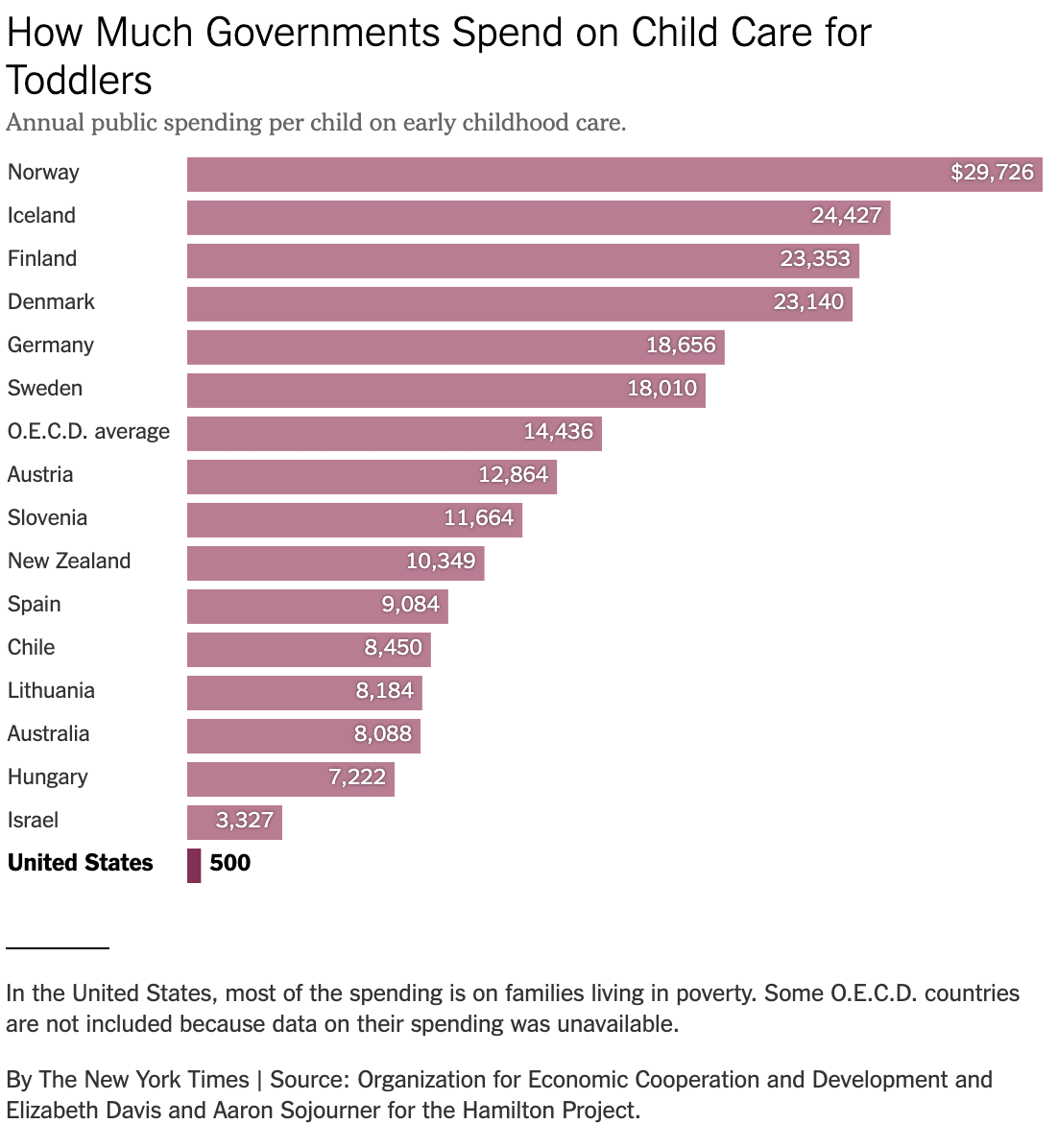
The American government, however, spends very little to ease the financial burden of child care, especially when compared to other wealthy countries, as this chart from the New York Times illustrates:
The need to lift the financial burden of child care is starting to resonate in government. Last November, New Mexico became the first state to offer free child care for all families, regardless of income level. In New York, newly-elected Mayor Zohran Mamdani is launching a free child care pilot program for city workers.
It’s clear, though, that the crisis of affordability for child care extends to every city and state in the nation, a need that can only be met with the kind of resources the federal government can provide. One of the biggest leaders in Congress addressing child care affordability is Sen. Elizabeth Warren (D-MA). In late March, she and several congressional Democrats — Sen. Patty Murray (D-WA), Rep. Alexandria Ocasio-Cortez (D-NY) and Rep. Bobby Scott (D-VA) — launched the Child Care for America working group to build broad support for legislation to make child care affordable for all families.
“Delivering high-quality child care is one of the best tools we have to make life more affordable for families. In the richest nation in the world, we should invest in child care like public infrastructure — not treat it like a privilege reserved for only the wealthiest Americans,” said Warren.
Here are the principles that Warren and her colleagues say will guide their legislation:
Affordability: Family costs must be predictable and affordable, with payments capped at no more than 7 percent of income, free child care for families with the lowest incomes, and guaranteed access with no waiting lists.
Child Care as Public Infrastructure: Federal funding must expand and stabilize child care supply, support safe facilities, and ensure resources meet all families where they are.
Boosting Worker Pay: Child care workers must be paid fairly and supported as professionals, with living wages, access to benefits, paid leave, retirement, and professional development.
High Quality and Accountability: Federal responsibility must be clear and enforceable, with the federal government covering at least 90 percent of system costs and having the ability to directly support localities when states fail to act, bolstered by strong reporting, oversight, and accountability standards.
Accessibility: The child care system must meet families where they are, with support for nontraditional hours, inclusive care for children with disabilities and developmental needs, language access, culturally responsive services, and full-day, full-year integration with Head Start and Early Head Start.
Urgent Implementation: The federal government must provide investments and support to ensure the child care supply scales up rapidly and addresses the immediate affordability crisis.
For all the deficit hawks who worry such a program would add unsustainable debt to our national budget, let me suggest a few ways to find funding:
Don’t start unnecessary wars: Our 20-year war in Iraq, predicated on the false belief that the Iraqis had weapons of mass destruction, cost nearly $3 trillion. The current war with Iran, which made things worse than they were, will easily cost more than $100 billion.
Do not subsidize fossil fuels: Oil and gas companies, already reaping record profits from the war with Iran, currently get $34 billion a year in taxpayer money.
Make billionaires pay their fair share: The ultra wealthy pay taxes at a rate far lower than most Americans. Bernie Sanders introduced legislation for a 5 percent wealth tax on billionaires that would raise $4.4 trillion over a 10-year period.
The current Congress is unlikely to address child care affordability, which makes the upcoming midterms a matter of life and death economically for millions of American families. A change in leadership, both in Congress and in the White House, will be needed to bring relief to struggling households.
No posts
Comments
Nothing yet. Say the first thing.
Sign in to join the conversation.