
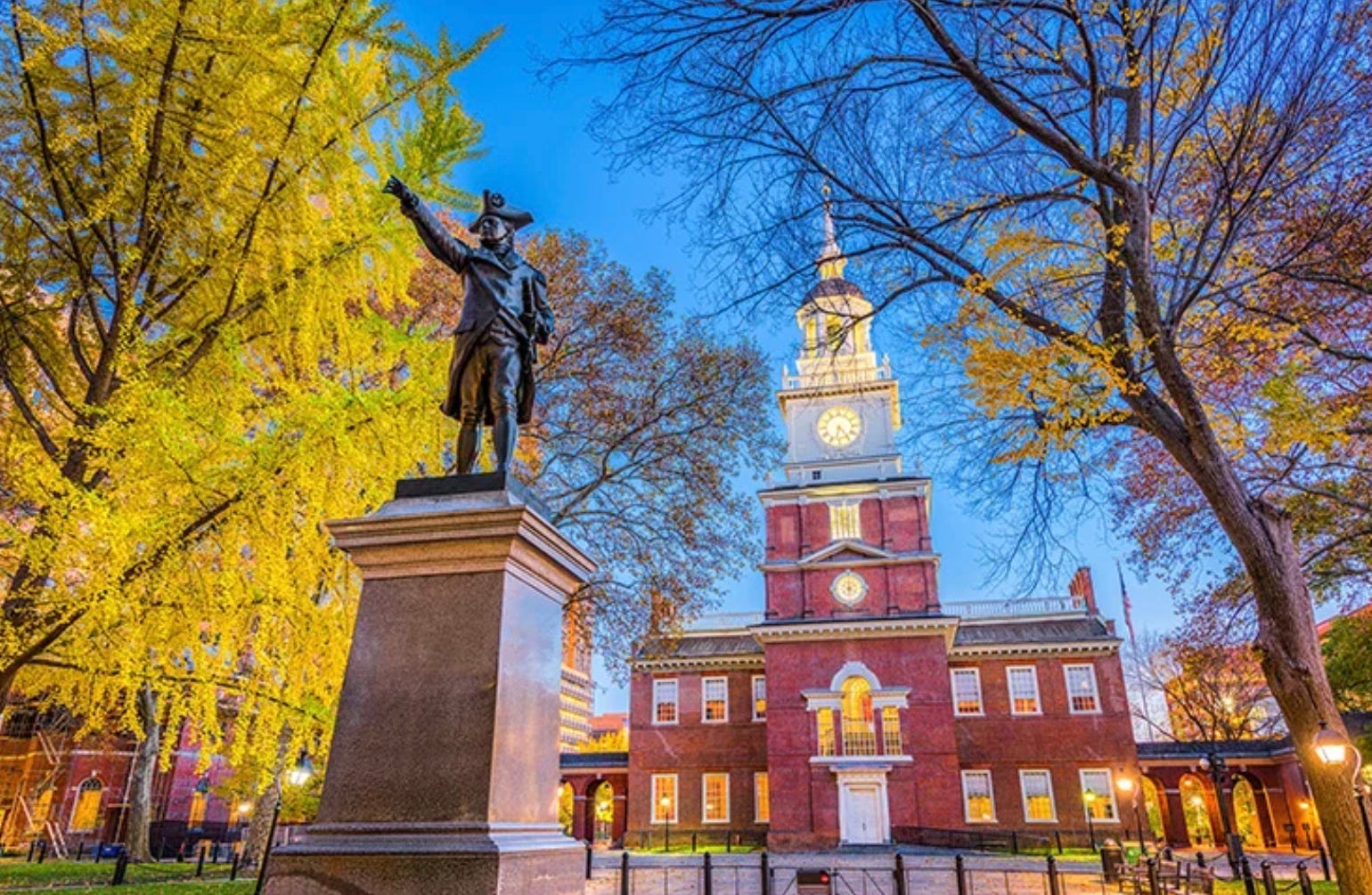
Recently, the incompetent Democratic National Committee announced that it had narrowed the list of possible sites for the 2028 Democratic National Convention to three cities: Boston, Denver and Philadelphia.
There is only one choice: Philadelphia.
There is only one American city equal to this moment of crisis.
When the gavel falls to open the 2028 Democratic National Convention, it should fall in Philadelphia.
Why?
Because, as Franklin Delano Roosevelt said in his re-nomination acceptance speech in 1936:
Philadelphia is a good city in which to write American history.
It was.
It is — and history is waiting to be written there again.
The Democratic Party must return to Philadelphia. It must come home like the prodigal son of Scripture.
The falling gavel should announce something larger than the beginning of another political convention.
It should announce a return to first principles, the Declaration, the Constitution, the sovereignty of the American people, and a return to the oldest American answer to the oldest political question: who rules?
In the United States of America, there can be only one answer: we the people.
Philadelphia was green with spring when Colonel George Washington came up the road from the South in May 1775.
The days had lengthened. Leaves covered the trees. Farms and fields surrounded the largest city in British North America. Beyond them rose brick houses, church steeples, taverns and crowded wharves along the Delaware.
The roads were bad. We know because John Adams told Abigail so.
Adams was coming toward Philadelphia from the opposite direction when his mare bolted around a rock on what he called a “shocking bad road.” His sulky overturned and smashed. Adams left the wreck behind, bought a saddle, and continued south on horseback.
Washington was coming north.
Adams was coming south.
News was moving faster than either man.
Lexington.
Concord.
Blood.
The colonies were moving toward a destiny nobody could see.
On May 9, Colonel Washington breakfasted at Chester, and rode the final miles into Philadelphia.
He was 43 years old. Six foot two. A soldier who had commanded Virginia troops in war. A Burgess who had served in Virginia’s legislature. A planter from Mount Vernon. A Virginian arriving for the Second Continental Congress.
His diary recorded the day:
Breakfasted at Chester, & dined at the City Tavern Phila.
That was all.
The next day Massachusetts arrived.
John Adams.
Samuel Adams.
John Hancock.
Citizens rode miles outside Philadelphia to meet them. Horsemen joined. Militia joined. Carriages joined. The procession grew as it approached the city, rolling and gathering, Silas Deane wrote, “like a Snowball.”
The bells rang. The streets filled. Huzzahs rose.
Virginia had come from the South.
Massachusetts had come from the North.
They met in Philadelphia.
Five weeks later, Washington left Philadelphia. He left differently than he had arrived.
Colonel Washington rode in.
General Washington rode out.
Behind him, hundreds of miles to the south, was Mount Vernon. His home. His fields. His beloved Martha. Everything familiar. Everything safe.
Washington rode away from all of it. North toward Cambridge, an army of strangers who would become his countrymen, danger and a war whose ending nobody could know.
Before departing, Washington wrote Martha. His appointment had filled him with “inexpressible concern.” He told her he would rather have one month with her at home than all the glory he might find abroad.
Then he wrote something extraordinary. It had been, Washington said, “a kind of destiny” that had thrown him upon this service.
Destiny.
Washington rode out of Philadelphia toward his.
He could not see Trenton, Valley Forge, Yorktown, independence, the presidency, the country.
He knew only that duty had called.
So he rode away from the woman he loved and the home he cherished toward danger on behalf of strangers who would become Americans.
During the long years of struggle and loss that followed, Washington asked those Americans to think about people they would never know.
Us.
On the eve of battle in 1776, he told his army that “the fate of unborn Millions” depended upon their courage and conduct.
Think about that.
Farmers. Tradesmen. Young men who were cold, hungry, frightened and often unpaid. Men who would leave bloody footprints in snow. Men who possessed almost nothing being asked to risk everything for millions of people who did not yet exist.
We are those millions unborn.
John Adams asked the questions that followed:
Would we be worthy of them?
Would posterity understand what had been sacrificed?
Would people born into liberty understand its price?
Would we preserve the inheritance?
Would we sacrifice for others as they had sacrificed for us?
There is an answer.
Cross the Atlantic. Go to France. Go to Normandy. Stand on the bluff at Colleville-sur-Mer above Omaha Beach. Look across the grass. 9,389 American graves. White crosses. Stars of David. Row after row. Young Americans beneath French earth.
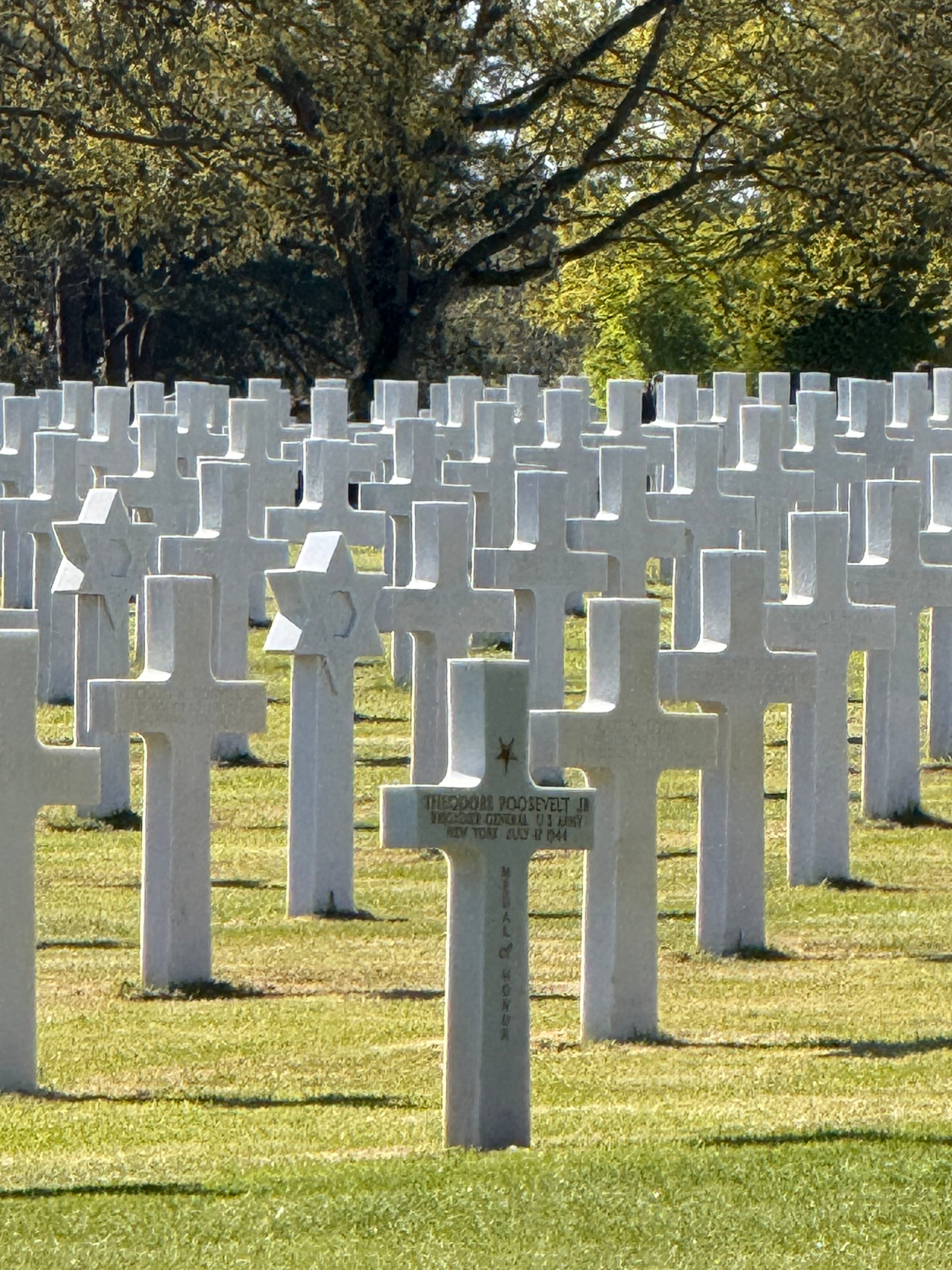
Beyond them is the Atlantic and home.
There is your answer, John Adams.
Look at them.
There is your posterity.
There are Washington’s millions unborn. They understood. They remembered. They were worthy.
The liberty purchased for them was not hoarded. It was returned.
Now find Lafayette.
Find the young Frenchman who crossed that same Atlantic in the opposite direction because he believed the American struggle for liberty mattered to the destiny of mankind.
He came for us. He fought beside Washington. He was wounded for America. He bled for a country that was not his own. He believed that what was being born here would someday matter to the old world.
He was right.
Europe descended into catastrophe. The democracies were imperiled. America crossed the ocean.
On July 4, 1917, Americans marched through Paris to Lafayette’s grave.
Across the generations came the answer: “Lafayette, we are here.”
You came for us.
We came for you.
Then darkness descended again. And we came again. Millions of Americans crossed the Atlantic. Farm boys. Factory workers. Students. Mechanics. Clerks. Immigrants and sons of immigrants.
They came ashore beneath the guns at Normandy. They climbed the cliffs. They fought through the hedgerows. They liberated villages and cities. They crossed France. They entered Germany. They opened the gates of camps. They helped destroy fascism.
Some never crossed the Atlantic again. 9,389 of America’s military dead lie today above the Norman coast.
Tell Lafayette. Tell him what became of the little republic he crossed an ocean to defend. Tell him what became of Washington’s millions unborn. Tell him what became of Adams’s posterity. Tell him about the white stones above the Atlantic.
Then tell him: you were right, General Lafayette.
The republic you crossed an ocean to defend survived. It grew and became might.
When darkness descended upon the continent you loved, America crossed the ocean in the other direction.
The country you bled for bled for yours. America, which you bled for, saved the old world. Your prophecy was fulfilled.
Now find Washington.
There is something he does not know. Tell him what happened after he was gone. Tell him that British royalty eventually came to Mount Vernon. Tell him that descendants of the monarchy against which he had taken up arms crossed the Atlantic and came to his home. Not as conquerors, but as pilgrims.
They descended to his tomb. They bowed their heads. They laid wreaths in honor of George Washington.
Tell him that George III himself was reported to have understood the magnitude of what Washington had done. When told that Washington intended to surrender his military command after victory and return to his farm, the king reportedly said that if Washington did so, “he will be the greatest man in the world.”
Washington did. He surrendered his sword. He went home.
Later, the people summoned him again. He became president. Again, he surrendered power. Again, he went home.
That was the greatness — not that Washington defeated a king, but that he refused to become one.
Long after Washington was laid in the earth at Mount Vernon, kings and descendants of kings descended to his tomb and laid wreaths before the man who had shown the world that there was something greater than possessing power: giving it back.
Now bring Billy Lee forward.
William Lee rode beside Washington through the Revolution. An enslaved Black man beside the man who became the great symbol of American liberty.
The contradiction of America standing side by side. The promise and the betrayal.
Let them look across the centuries.
Let them see a Black American walk onto the inaugural platform at the United States Capitol. Let them watch him place his hand upon a Bible. Let them hear him take the oath Washington first took.
Barack Hussein Obama. Forty-fourth president of the United States.
Billy Lee rode through a revolution for liberty while enslaved.
A Black man became president.
The contradiction was not erased.
The suffering was not undone, but the promise moved.
Generations fought and bled to move it.
Generations demanded that the words written in Philadelphia finally mean what they said.
Now find Adams again.
He wondered about posterity. Whether we would understand. Whether liberty would survive prosperity. Whether we would measure up.
Mr. Adams, you have seen the graves.
You have your answer, but there is one more.
Take them outside. Washington. Adams. Franklin. Lafayette. Billy Lee.
Take them beneath the Philadelphia night, and look up.
Do you see the Moon? Upon it flies the 50-star flag of the United States of America.
We went there.
The descendants of the people who gathered in Philadelphia crossed a quarter-million miles of darkness and stepped onto another world.
A young American president had told them why.
We chose to go to the Moon, John F. Kennedy said, “not because they are easy, but because they are hard.”
And when Americans arrived, they did not claim the Moon for a king. They did not claim it for an empire. They did not even claim it for America.
They left behind words announcing that human beings from planet Earth had first set foot upon the moon and “came in peace for all mankind.”
Look up, Mr. Washington, Mr. Adams, Mr. Franklin, General Lafayette, Billy Lee.
That is what became of the fragile thing you carried into Philadelphia. That is what became of the sacrifice. That is what became of the millions unborn.
Here we are.
The republic endured. The inheritance grew. The promise widened. America helped save the old world. America walked upon another one.
And now their descendants are returning to Philadelphia. We are returning.
More than that, we are coming home.
Before America can renew its journey, America must come home.
Home to Philadelphia. Home to the headwaters of American freedom. Home to the place where a people declared themselves citizens instead of subjects. Home to the place where they proclaimed that human beings possess rights no king may give, and therefore no king may take away. Home to the place where Americans wrote a Constitution beginning with three words that settled the question of sovereignty:
We the people.
We arrive in Philadelphia in the most uncertain of hours. So did they.
We cannot know what sacrifices will be demanded. We cannot know what tests will come. We cannot know what history will say about us, but we know where we must go: Philadelphia.
Here the headwaters of American freedom are found.
We come home to those headwaters for a baptism in the holy waters of American liberty.
Not to worship the past.
To renew its promise.
Not to retreat from the future.
To prepare ourselves for it.
We must come home before we can renew the journey.
We know what we stand for. We stand for peace and goodwill toward all people.
We seek no enemies. We hunger for no conquest. We covet no other people’s land.
We believe American strength should defend liberty, deter aggression, protect the innocent and preserve the peace.
We stand for the upward progress of humanity: science, discovery, exploration, learning, creation, enterprise.
The restless human desire to know what lies beyond the horizon.
We believe tomorrow can be better than today, but progress without human dignity is not progress.
That is the great question before us in the age of the machine.
Will technology liberate human beings, or diminish them?
Will artificial intelligence become an instrument of human possibility, or an instrument through which human beings are measured, manipulated, monitored and controlled?
Will the machine serve humanity, or will humanity be made to serve the machine?
Our answer is absolute.
The machine, the economy, the government, and technology serve the human being.
Human beings are not data points, inventory, algorithmic predictions, or units of economic extraction.
Human dignity and liberty cannot be digitized or monetized.
We stand for the freedom of human dignity in the age of the machine.
Above all, we stand for the Constitution of the United States of America with full devotion.
We stand for Article I and the Congress of the United States as a co-equal branch of government.
We stand for a presidency powerful enough to perform its constitutional duties, but never powerful enough to become a throne.
We stand for an independent judiciary.
We stand for the Bill of Rights, free speech, free worship, a free press, due process, equal protection, free elections, the peaceful transition of power, the rule of law, checks and balances and limits.
We stand for the magnificent proposition that in America no person is above the law because no person is beneath its protection.
Now return to the words that opened this argument: “Philadelphia is a good city in which to write American history.”
At that time, in 1936, another age of concentrated wealth and concentrated power had produced another class of Americans who believed their success entitled them to something more.
Roosevelt came to Philadelphia because he understood something permanent about human nature: the names and technologies change, and the fortunes grow larger, but ambitious men and women, schemers and plotters, acquire wealth and power and decide success is no longer enough.
They want influence, privilege, exemption, obedience, and finally, they want a crown.
Roosevelt called them “economic royalists.”
A greedy class is never content with success. Success becomes wealth. Wealth becomes influence. Influence becomes privilege. Privilege becomes immunity. Immunity becomes dominion.
Dominion produces the oldest political delusion in human history: I should rule.
Roosevelt drew a line. Behind it stood the sovereign American people. He told the economic royalists who despised him:
They are unanimous in their hate for me — and I welcome their hatred.
His argument was the argument of Philadelphia.
Who rules?
Who decides?
Who owns America?
The people.
Then Roosevelt gave his generation’s challenge its immortal name:
This generation of Americans has a rendezvous with destiny.
They did.
They kept it. They endured depression. They crossed oceans. They stormed beaches. They liberated continents. They defeated fascism. They rebuilt a shattered world. They carried the inheritance forward.
Now, the royalists have returned.
They do not wear powdered wigs. They own platforms. They control monopolies. They command immense fortunes. They possess technologies capable of reaching into the private lives of billions of human beings.
They have decided algorithms are a new royal writ. They collect our movements, conversations, purchases, friendships, fears, desires and weaknesses.
They digitize our dignity. They monetize our privacy. They manipulate our attention. They reduce human beings to data, and call the extraction a business model.
Success is no longer enough. They demand privilege. Then immunity. Then political power. Then submission.
They want the crown.
No.
That is the American answer.
No king. No royalist. No monopolist. No oligarch. No corporation. No algorithm. No billionaire. No president. No pretender possesses sovereignty over a free American citizen.
We are not subjects, serfs or products.
We are citizens. Free citizens.
And so we return to Philadelphia. Not simply to hold a convention. Not simply to nominate a candidate. Not simply to defeat another political party.
We return to make a declaration — a new declaration of an ancient truth: we the people are sovereign in the United States of America.
We seek no compromise on the question.
Waves of corruption have built across America. They have combined into a tsunami rolling toward the American republic in slow motion.
Here in Philadelphia we build the American breakwater. The city where Americans said no to kings.
Here we say it again: we bow to no kings or pretenders in America.
We have come to overthrow concentrations of power and privilege incompatible with a free republic. To break monopolies. To confront oligarchs. To smash their kingdoms of greed to bits. To restore competition where monopoly has strangled it. Privacy where technology has invaded it. Accountability where wealth has purchased exemption from it. Liberty wherever power has trespassed upon it.
This is not radicalism.
This is Americanism.
This is the destiny of the Democratic Party in this hour. Not merely to win an election. Not merely to replace one collection of officeholders with another. Not merely to administer government more competently.
To restore the American republic.
To return to Philadelphia, and announce that the long surrender is over. That Congress will rise from the realm of the neutered and dead, and reclaim the powers vested in it by Article I. That the legislative branch will again stand as a co-equal branch of government. That presidents will again hear the constitutional word that keeps republics free: no.
That human dignity will not be surrendered to the machine. That Americans will bow before no king, oligarch, monopolist, billionaire, algorithm or president.
That sovereignty remains exactly where the founders placed it: with the people.
The representatives of Washington’s millions unborn have arrived.
Adams’s posterity is here.
The 9,389 graves above Omaha Beach have answered his question.
Lafayette’s prophecy was fulfilled.
Kings descended to Washington’s tomb.
Billy Lee’s country elected a Black president.
The flag of their fragile republic flies above 50 states.
It flies upon the Moon.
America helped save the old world.
America walked upon another one.
Now the inheritance has come to us.
We arrive in Philadelphia in uncertain hours.
So did they.
There are moments when a generation chooses its destiny. There are other moments when destiny chooses the generation.
History does not ask whether the hour is convenient. It arrives. It summons — and sometimes it summons a people to a particular place.
Ours summons us to Philadelphia.
We must save ourselves.
Ninety-two years ago, Franklin Roosevelt’s words rang out across Philadelphia.
Now they have returned to the city where they were spoken. They have arrived for us.
Another American generation has been chosen by the hand of fate.
The inheritance is ours.
The danger is ours.
The duty is ours.
The destiny is ours.
This generation of Americans has a rendezvous with destiny.
Comments
Nothing yet. Say the first thing.
Sign in to join the conversation.