
Two summers ago, I went through the exquisite Wright Museum of World War II in Wolfeboro, New Hampshire, with my daughter.
We came upon a large black-and-white photograph of a young Black man wearing the crisp white uniform of an enlisted sailor in the United States Navy.
I asked her if she knew his name. She did not.
Here is the photograph:
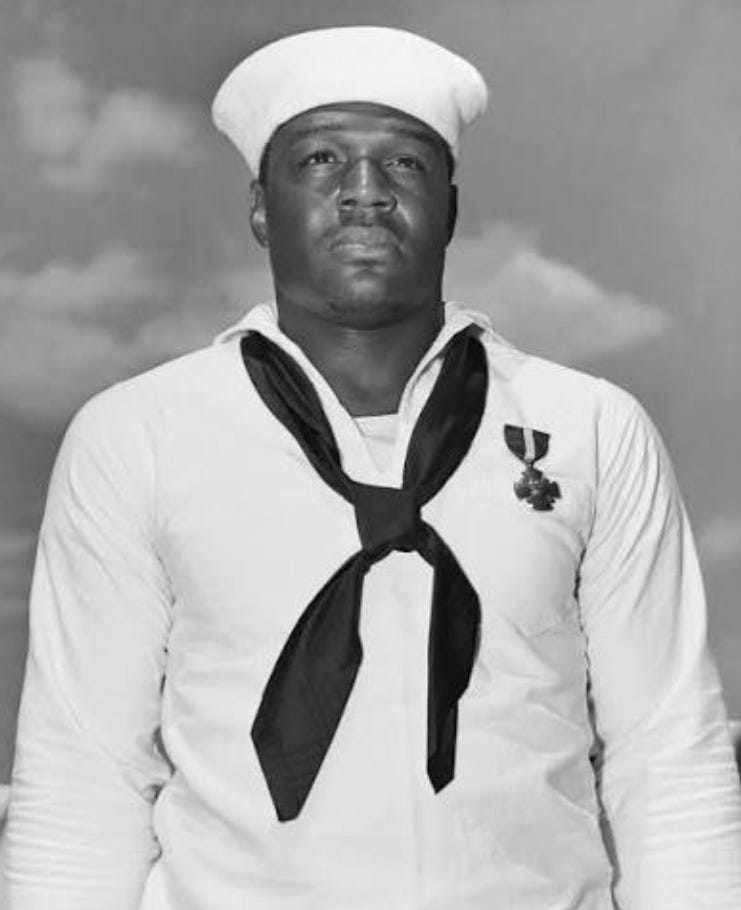
His name was Doris Miller. Everybody called him “Dorie.”
He was born in Waco, Texas, in 1919, the son of sharecroppers. He played fullback on his high school football team, worked the family farm, and enlisted in the United States Navy in 1939.
He was 19 years old.
Handsome. Strong. Patriotic.
There is no service filled with more meaning than that rendered by Americans who loved a country that did not love them back with equal measure, yet believed so deeply in her promise that they refused to give up, give in, or ever surrender to hopelessness.
Dorie Miller was one of those Americans.
He put on the uniform of the United States Navy.
The Navy had a place for a young Black man like him: the mess.
In the judgment of the United States Navy of 1939, Dorie Miller’s highest purpose was pouring coffee in a segregated officers’ mess, clearing tables and scraping plates.
He could serve the officers. He could clean up after them. He could not become one of them.
The Navy had decided where Dorie Miller belonged. It had decided the limits of his possibility.
And then a new day dawned.
It was Sunday, December 7, 1941. It would live in infamy.
Dorie Miller awakened aboard USS West Virginia at Pearl Harbor. His Sunday morning duty included collecting laundry.
Then the Japanese arrived.
Bombs fell. Torpedoes struck. Battleships burned. The Pacific Fleet exploded around him.
Dorie ran toward his battle station. It had already been destroyed, so he went topside. Men were wounded, dying, dead.
Everywhere there was acrid smoke and searing flame. Burning oil spread across the water. Explosions ripped through steel. Japanese aircraft screamed overhead, while anti-aircraft guns hammered back into the sky.
The battleship beneath his feet was dying.
Dorie Miller had no training for anything he was about to do.
The Navy had trained him to serve meals. To clear tables. To scrape plates.
It had not trained him for combat. It had not trained him to rescue wounded sailors under fire. It had not trained him to operate the Browning .50-caliber anti-aircraft gun he was about to seize.
The institution had prepared Dorie Miller for the limits it had imposed upon him.
History had something larger in mind.
Men needed to be carried. The ship was burning.
Dorie Miller went to work. He carried wounded sailors through smoke and flame.
On the bridge, Captain Mervyn Bennion lay mortally wounded. Miller helped move him to greater safety.
Then Dorie reached a Browning .50-caliber anti-aircraft machine gun — the kind of weapon his segregated Navy had never considered it necessary to teach him to fire.
He took hold of it. He looked into the sky, and opened fire.
The Black mess attendant whom the Navy had trained to pour coffee was firing at the aircraft of the Imperial Japanese Navy. No permission, no training, no hesitation — only action.
That morning, Dorie Miller had awakened to collect laundry. By nightfall, all had changed.
America was at war.
The Pacific Fleet lay shattered. More than 2,400 Americans were dead — and the son of sharecroppers whose Navy had decided the limits of his possibility had shown his country the dimensions of his courage.
The Navy awarded Dorie Miller the Navy Cross, its second-highest decoration for valor, surpassed only by the Medal of Honor. He was the first Black American to receive it.
There were Americans at the time who believed it wasn’t enough. Members of Congress, civil-rights organizations and Black newspapers pressed for Miller to receive the Medal of Honor.
He never did.
It is impossible to look honestly at the segregated Navy of 1941 — the Navy that would not even train Dorie Miller to fire the gun he seized — and pretend race can simply be removed from that judgment.
Had Dorie Miller been white, there is every reason to believe the medal pinned to his chest would have been the Medal of Honor.
America gave him the Navy Cross.
History gave him something else: his name.
Dorie Miller would not survive the war.
On November 24, 1943, he was serving aboard the escort carrier USS Liscome Bay when a Japanese submarine torpedoed the ship.
The explosion was catastrophic.
Dorie Miller went down with his ship. He was 24 years old. His body was never recovered, but his name was.
There is another photograph:
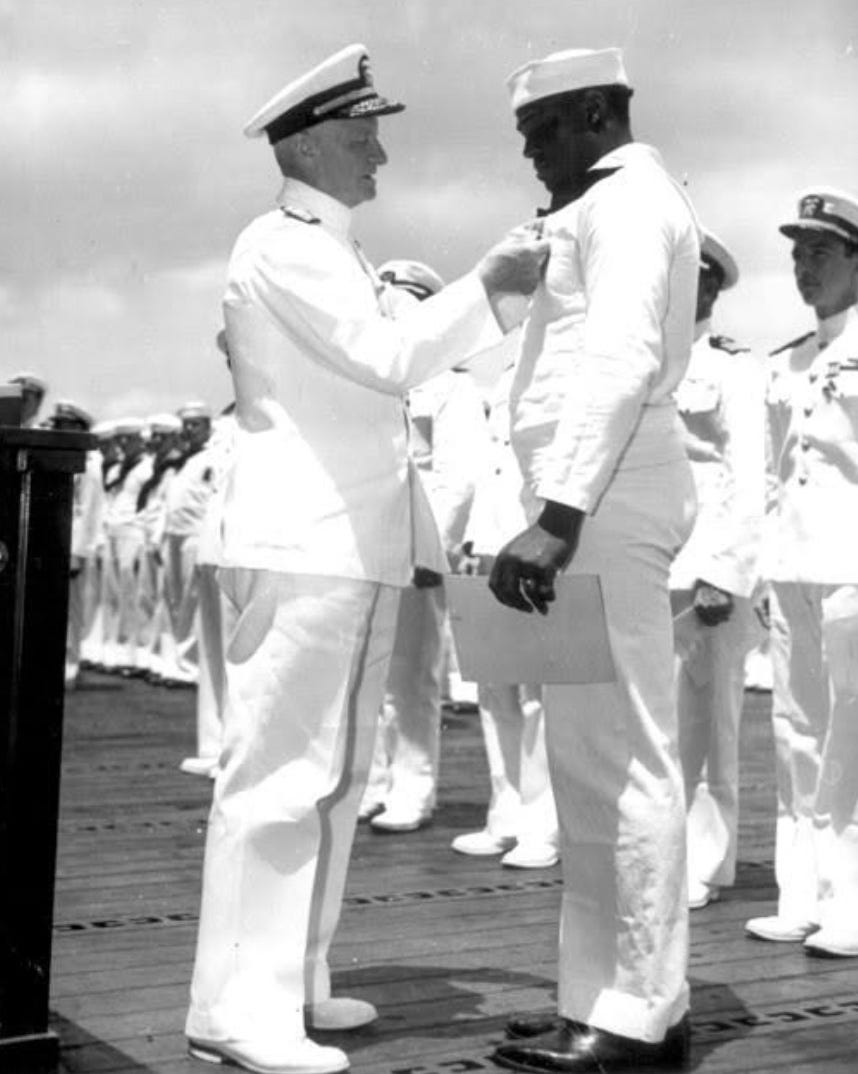
May 27, 1942. Pearl Harbor. The flight deck of USS Enterprise. Admiral Chester W. Nimitz stands before Mess Attendant Second Class Doris Miller, and pins the Navy Cross onto his uniform.
Look at them. Two Texans. Two sailors. One white. One Black. One an admiral. One a mess attendant. One commanded the Pacific Fleet. The other had entered a segregated Navy that determined his highest purpose was pouring coffee and scraping plates.
Their lives could scarcely have begun farther apart — yet there they were. Face to face on the flight deck of Enterprise.
Their lives crossed. Their fates merged. Their destiny was to become American giants.
Neither man could possibly have imagined what America would eventually do with their names. It would send both of them back to sea.
USS Nimitz.
USS Doris Miller.
Two Texans. Two sailors. Two aircraft carriers.
Nimitz would live a long life. Miller would live a terribly short one. Both lived American lives.
A great Navy carries memory to sea.
And that is what generations do with memory.
They carry it forward.
There is another photograph. This one is mine.
I took it on June 6, 2018, when I brought my then 12-year-old son to Normandy:
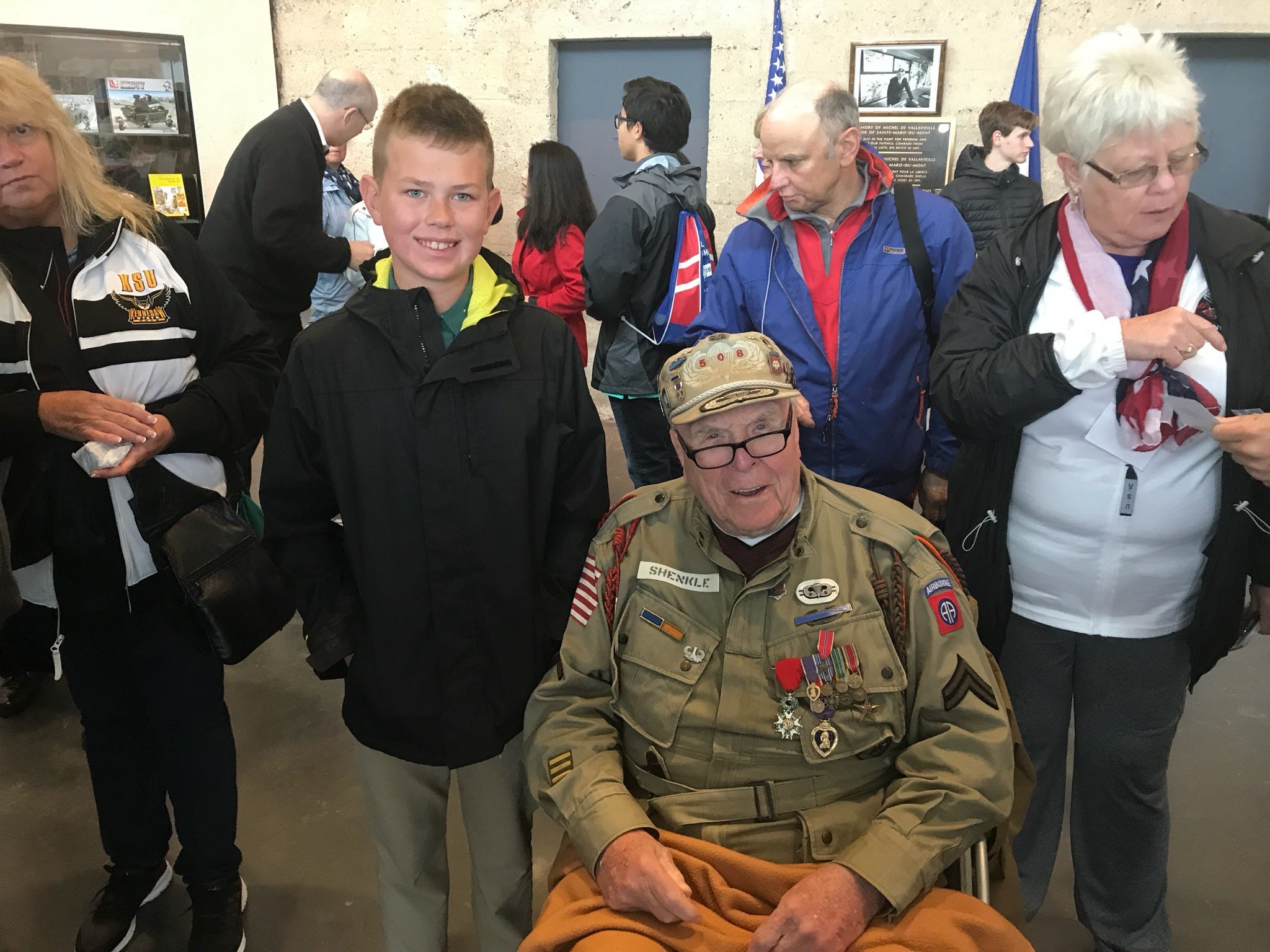
Look at the two of them.
My son was born in 2006. The American paratrooper sitting beside him was born in 1924.
Eighty-two years separate their births. Inches separate them in the photograph.
The old soldier had crossed the Atlantic as a young man, and gone to war in Europe.
My son crossed the same ocean more than seven decades later to learn what men like him had done.
We went to the beaches. We looked across the English Channel. We walked among the white crosses and Stars of David at the American cemetery. Row after row. Young Americans beneath French earth.
There are things children should not encounter first on a screen. They should stand where they happened. Walk the ground. See the distances. Read the names.
Understand that history was populated not by characters, but by human beings. And then my son met one. He was 94 years old. An American paratrooper.
They shook hands.
Think about that.
A boy born in 2006 reached out, and touched the hand of an American soldier born in 1924. My son shook the hand of one of the Americans who had crossed an ocean when civilization itself was in mortal danger. One of the soldiers from the generation that helped save the world.
History wasn’t behind glass. It wasn’t carved into marble. It reached out its hand.
If the actuaries are right, my son may live into the opening years of the 22nd century.
Imagine him in 2100.
He is 94 years old — the same age as the paratrooper he met in Normandy. Perhaps beside him stands his own American great-grandson, a little boy born in 2095.
My son reaches out. The child takes his hand. And my son tells him: “When I was twelve years old, I shook the hand of an American soldier who fought in the Second World War.”
A man born in 1924 reaches through one handshake to a boy born in 2006.
That boy reaches through another to a child born perhaps in 2095.
If that child lives 94 years, his life reaches 2189.
Two handshakes. Two hundred and sixty-five years. Nearly three centuries.
We are all connected.
George Washington understood this.
During the desperate years of the Revolution, Washington spoke to his soldiers about the fate of “unborn Millions.”
We are those millions unborn.
Dorie Miller was one.
The paratrooper was one.
My son was one.
And somewhere beyond the horizon are millions more.
The unborn eventually arrive.
They inherit what the living leave behind. The country. The Constitution. The institutions. The stories. The names.
We receive them. We hold them for a little while. Then we place them into another hand.
That is why the names matter.
They have mattered from the beginning.
In 1794, Congress authorized six frigates that became the foundation of the permanent United States Navy: United States, Constitution, President, Congress, Constellation and Chesapeake.
George Washington personally selected the names of the first five.
The nation. The Constitution. The elected executive. The people’s legislature. The stars of the new republic.
These were not vanity plates. They were declarations.
The young republic sent its ships beyond the horizon carrying the language of American self-government on their sterns.
There was another name available to Washington: his own. He did not choose it.
There is a lesson in what Washington chose. There is an even greater lesson in what he did not.
That is republican restraint. That is the opposite of vanity.
Having an aircraft carrier named for you is not a perk of presidential retirement. It is not a going-out-the-door present. It is not political swag. It is not a presidential library with catapults.
An aircraft carrier is an American warship. It belongs to the country. Its name belongs to the country. And almost nobody rates one.
Bill Clinton doesn’t.
George W. Bush doesn’t.
Not now. Not ever. Not in 10,000 years.
Clinton never served in uniform. He avoided military service during Vietnam. He was impeached. His presidency contained accomplishments and failures that history will weigh.
None of it earns an aircraft carrier.
George W. Bush doesn’t rate one either.
His father did.
George H. W. Bush was a teenage naval aviator during the Second World War. He flew combat missions. He was shot down over the Pacific and rescued by an American submarine.
His son had a different encounter with carrier aviation. In 2003, George W. Bush landed aboard USS Abraham Lincoln for the presidential spectacle forever associated with two words: MISSION ACCOMPLISHED.
The war was nowhere near accomplished. Its bloodiest years were ahead.
That doesn’t earn an aircraft carrier. Neither does winning an election. Neither does winning two. Neither does being a Democrat. Neither does being a Republican.
Now consider the man who did not become president: John McCain.
Naval aviator. Combat veteran. Shot down over Hanoi. Prisoner of war. Tortured. Five and a half years in captivity. United States senator. Presidential nominee. Son and grandson of admirals.
McCain wanted to be president. He sought the office twice, but there were things he wanted less than he wanted the presidency.
There were lines he would not cross to obtain it.
He campaigned with dignity, restraint and limits.
There is no aircraft carrier named for John McCain.
Nor does there need to be.
That is the point.
Almost nobody rates an American aircraft carrier. The names are too few. The ships are too consequential. The history is too great.
There are names larger than politicians: Lexington, Saratoga, Yorktown, Hornet, Ranger. And one name above all: Enterprise.
CV-6 fought through the Second World War.
CVN-65 became the world’s first nuclear-powered aircraft carrier.
CVN-80 will carry the name again.
There should always be an Enterprise in the United States Navy.
The name belongs not to a politician, but to generations of American sailors.
Remember the photograph.
Nimitz is pinning the Navy Cross onto Dorie Miller. They are standing on Enterprise.
There is the standard.
The name on the stern matters — which brings us to this moment.
The United States Navy is considering stripping Doris Miller from CVN-81. Reporting says discussions have included replacing Miller’s name with Donald Trump’s. No final decision has been announced.
It is an obscenity. It is a sick joke. It must never happen.
Take the honor from a powerless young sailor who demonstrated greatness when history unexpectedly summoned him.
Give it to the most powerful man in America.
Take the son of sharecroppers off the stern.
Put the sitting president on it.
No.
No American president should appropriate from a dead American war hero an honor his country has already bestowed upon him.
This is an era in which presidential egotism must be restrained, not memorialized in 100,000 tons of American steel.
The presidency is not a throne.
The Navy is not a royal possession. Its ships belong to the American people.
Washington understood that. He could have named one for himself. He didn’t.
There is something uglier here. It must be said plainly.
Race matters in this story.
Dorie Miller entered a segregated Navy that judged a Black man fit to pour coffee, but not fire a gun.
Eighty-five years later, Pete Hegseth’s Pentagon has restored the familiar names of Confederate-associated Army bases, ordered the Confederate Memorial returned to Arlington, removed the first woman to serve as chief of naval operations, and intervened in an admiral promotion list in a way that eliminated every woman under consideration and two Black officers.
Now comes the possibility of removing Doris Miller from an aircraft carrier. Taking that name away would not merely rename a ship. It would reverse the meaning of the honor.
Replacing it with the name of a sitting president would make the insult complete.
George Washington understood something Donald Trump apparently does not.
The Navy belongs to the republic. Its honors belong to the republic. Its ships are not monuments to presidential vanity.
Leave the name alone. USS Doris Miller.
Comments
Nothing yet. Say the first thing.
Sign in to join the conversation.