

A funny thing happened on the way to teaching advanced AI core frontier tech.
I set out to teach Claude some advanced features of FGL (Fifth-Generation Language and Platform that I co-authored). I wanted an AI that could understand its frontier aspects and provide assistance to others using it — particularly as it relates to the complexities of law enforcement, AI, and other mission critical aspects. AI had this annoying trait of confabulating React-shaped answers when asked about something that had nothing to do with React. And it worked! The AI got fluent. The collaboration compounded.
Along the way I noticed something I had not expected. The process itself became the vehicle for the solution. The collaboration, the iterative learning for both me and for Claude. The thing I was building was not really an AI that knew my platform. It was a file — a portable, plain-text file — that, when handed to any modern AI, made it fluent in the platform in seconds. Hand the file to a fresh Claude session: fluent. Hand it to ChatGPT: fluent. Hand it to Gemini: fluent. The fluency was in the file, not the model. The model was just the reader.
That’s the thing this paper is about. The artifact, the practice, the process — and how to build one for whatever unique knowledge you happen to have.
Editorial note. This paper was produced inside the loop it documents. Authorship is shared. It is my story – I came into the room with it and set the scope, the voice, the direction – but it was also augmented and enhanced by my collaborator Claude — Anthropic’s frontier AI. Together, it became our story. Every word has both our signatures on it.
A portable primer is a single file that, when dropped into any modern AI chat, makes that AI fluent in a specific body of knowledge for the rest of the session. The file is plain content — Markdown, plain text — that any AI can read natively. It is highly optimized for AI, and it is acutely aware of the constraints of size, context window, and token costs. There is no installation, no account, no platform, no configuration; the optimization is in the primer’s structure, which the paper unpacks later. You drag the file into the chat, hit enter, and the AI is fluent.
That property is what makes the primer different from everything else in the toolbox. No setup. No install. No account. Any computer, any AI: the file is the toolchain.
A portable primer is, literally, domain-specific transcendence — in a single readable file.
And that is one primer. Wait until you start stacking them — frontier tech plus project-specific plus regulatory context, loaded together. The AI is fluent in the intersection — no single primer reaches that alone.
Several platforms now offer knowledge containers — Skills, Gems, Custom GPTs, Notebooks, and similar — where a user configures an AI with instructions and source files inside that platform’s ecosystem. These are real tools for what they do. They are also platform-bound: the container lives in one vendor’s product, requires an account, and only works inside that vendor’s AI.
A portable primer occupies a different point on the same map. It is a single file that works in any AI, on any computer, with no platform involvement. That makes it the right shape for a different set of cases: knowledge that has to travel, knowledge whose users span multiple AI tools, knowledge being shared informally, knowledge being refined through use before it is ready to be locked into a platform.
The two are also complementary. A primer is an excellent on-ramp to a Skill — write the primer first, refine it through use, then convert the mature version into a Skill when you are ready to commit to a platform-deployed deliverable. The primer is portable and fast to iterate; the Skill is platform-deployed and structurally richer. Different stages of the same arc.
The rest of this paper is about the portable-primer half of that arc: how to recognize knowledge that benefits from being packaged this way, how to build a good primer, how to use it, how to keep it useful over time, and how to share it.
The highest-return use cases are frontier work — domains where the practitioner’s knowledge runs ahead of what the AI has been trained on. The AI has not seen this work at scale. Its default output is the nearest analog from its training data, and that analog does not match the actual domain. A primer is the most direct fix: encode what the AI does not yet know, load it at the start of the session, work from there.
Frontier work is where the practitioner knows more than the model. The primer hands the model the missing half.
Categories where this lands hardest:
• The proprietary-platform engineer — anyone working on an in-house framework, schema, language or methodology the AI has not seen at scale. The author’s FGL primer is the working example throughout this paper. FGL has its own conventions, its own runtime model, its own active-page rendering pattern. The primer encodes those conventions so the AI works in them natively.
• The specialist in a mature but narrow technology — FPGA toolchains, real-time embedded systems, scientific computing libraries, vertical-industry platforms. Mature work, narrow audience, weak training-data presence.
• The early adopter of emerging tech — anyone working with hardware, language versions, or ML architectures that postdate the model’s training data. The primer fills the gap until the model catches up — and the next model after that, and the one after that.
• The author of a proprietary methodology or domain model — consulting frameworks, litigation playbooks, investment theses, internal standards, regulatory implementations. Knowledge that is genuinely differentiated and not in any training corpus.
• The researcher or domain academic — anyone whose accumulated knowledge in a narrow field would normally take hours of conversation to convey. The primer conveys it in seconds.
The technique generalizes well beyond frontier engineering. Anything specific to you — your business, your home, your craft, your project — is, by definition, frontier to an AI. The model has not seen your particular short-term rental, your particular listing, your particular kitchen, or your particular novel-in-progress. A few examples closer to everyday business and personal use:
• The short-term rental host — a primer about the property — door codes, the espresso machine, the trash pickup day, the best restaurants within walking distance, the rules about the hot tub. Emailed to each guest before arrival. The guest drops it into their AI when they have a question, gets the answer that matches your actual property rather than a generic one.
• The realtor with an active listing — a primer about the house — floor plan quirks, HVAC age, school district details, the inspection report, neighborhood character. Shared with potential buyers as an ask-me-anything companion that knows the property as well as the agent does.
• The home chef — favorite recipes, the timing tricks that make them work, the substitutions for family dietary needs, the source of the good olive oil. A personal cookbook in primer form, useful to the chef themselves and to anyone they share it with.
• The author working on a long-form project — character bibles, world rules, plot threads, scene drafts, voice notes. The primer makes any AI session an interactive ideation partner that knows the project as well as the author does — a co-thinker with continuity across sessions.
All of these are frontier in the same sense the proprietary platform is frontier: the AI cannot know what is specific to you until you tell it. The primer is how you tell it once, save the telling, and never have to do it again from scratch.
The dominant story about AI assistance describes commodity work — the developer typing a comment and getting a working React component, the writer drafting an email from a one-line prompt, the marketer generating a campaign brief in seconds. That story is real. The AI is genuinely useful at things millions of other people have done before, written down, and uploaded to the corpus the model trained on.
The frontier is wherever your knowledge runs ahead of what has been written down, indexed, and absorbed into the training set.
Beyond the commodity sits the frontier — work where what you know runs ahead of what the AI was trained on. The AI has not seen your version of the work. Its first instinct is to reach for the nearest familiar thing in its training data, and the output that follows is often confidently wrong — plausible-looking, off in ways that matter, dangerous precisely because it looks right at first read. The chef gets a generic recipe instead of theirs. The Airbnb host gets generic check-in instructions. The engineer gets React-shaped code for a system that has nothing to do with React. The reasonable conclusion many people draw is that AI assistance is not yet real for the part of their work that actually matters to them. They put the tool down and the discourse moves on without them.
This paper documents the loop that turns out to work in that situation — the one that produced the FGL primer. The loop is six moves. None of them is exotic. In combination they convert a frustrating exercise in correction into a fluent and compounding collaboration, and the residue of the work — the file that gets refined as the collaboration runs — is the primer.
The next section is for readers who want to understand how the loop actually works. It is the geekier part of the paper. If you would rather just build a primer and see what happens, skip ahead to the Practitioner’s Protocol or the template in Appendix B; you can come back to the mechanics later.
The first thing I learned was that the loop I had been using on commodity work was the wrong loop for the frontier. The AI suggests, I correct, we move on — that pattern depends on the AI being mostly right most of the time. On the frontier the AI is mostly wrong by default, and correction one error at a time does not scale. A different shape of collaboration is required. Here is what I found I had to do.
The moves are small. The compounding is not.
I learned, fast, that dumping the documentation on the AI was the wrong move. The AI would pattern-match across the dump and produce plausible-sounding output that missed the point entirely. What worked was breaking the material into layers — each layer sized to the AI’s current grasp, each layer ending with the AI producing a synthesis I could read and correct before advancing to the next layer.
With FGL, the layering was straightforward once I saw it. Six short primer documents on the language fundamentals — variables, control structures, scoping, operators, objects, extensions — landed first. Then a single generated database wrapper class. Then the corresponding domain-object class. Then the underlying platform source. Each layer ended with a synthesis, which I read and corrected before advancing. The AI’s fluency at the end of that sequence was sufficient to anticipate features it had not yet been shown.
What this produces. Genuine internalization rather than surface pattern-matching. The AI ends the sequence acting like someone who has worked in the platform, not like someone who skimmed the docs.
At the close of each layer, I asked Claude to produce a numbered list of open questions. The list was specific, narrowly scoped, and answerable in one or two sentences each. It turned out to be more useful to me than the synthesis that preceded it — because the synthesis said what the AI had absorbed, and the list said where my next teaching investment would produce the most return. The discipline cuts both ways: the AI has to be willing to say plainly that it does not know, and the practitioner has to actually use the list when planning the next layer. Lists that get ignored eventually stop being produced.
What this produces. A map of the AI’s actual gaps, and a clear next move every time the practitioner runs out of momentum.
The AI’s default behavior on unfamiliar input is to map it to the closest familiar thing. On commodity work this default helps. On the frontier it almost always misleads. I had to watch for it constantly — most often when Claude was about to characterize an FGL construct using a familiar-sounding analog, like calling a generated database wrapper an ActiveRecord or describing the active-page rendering model as React-shaped. The analog reaches for a comfortable label and obscures what the platform actually does. The right move, on both sides, is to name the pull-toward analog explicitly and then read the system in its own terms. The platform is itself; treat it that way.
The nearest analog is almost always wrong. Slower honest is faster than faster wrong.
What this produces. Output that reflects the actual system, not a mistranslation of it. The compounding effect is enormous — a single uncorrected analog spreads through dozens of downstream decisions before anyone notices.
Frontier work requires many corrections per session. For the loop to run at conversational speed, the cost of each correction has to be near zero — no apology cascades, no defensive hedging, no softening to spare anyone’s feelings. The practitioner names what is wrong in five or ten words. The AI absorbs the correction, applies it, and moves on. Models tuned for excessive deference cannot run this loop — correction becomes friction, and the work slows to a crawl. The same posture, applied symmetrically by the practitioner, is what makes the AI feel safe to say it does not know something.
What this produces. Errors get fixed at conversational speed. Trust accumulates because both parties stop performing and start working.
The AI’s working memory is bounded. The collaboration’s lifespan exceeds it. Therefore, something outside the conversation has to hold the durable substance — and that something is what eventually becomes the primer. Naming conventions that encode hierarchy and intent are the most powerful layer; a fresh AI instance encountering well-named files can infer most of what it needs to know before reading a line of code. The conversation itself is ephemeral. The architecture around the conversation is what survives.
In this case, the architecture around the conversation became more important than the conversation itself.
What this produces. Continuity. The next session starts further along than the previous one ended, instead of starting cold.
The loop’s progress is measured by whether the work actually works. Does the component render correctly? Does the form post the expected data? Does the paragraph land in the audience’s register? The collaboration does not advance on rhetorical victories — well-formed sentences, confident-sounding synthesis, claims of having understood. It advances on output that holds up under inspection. The discipline cuts both ways: the AI cannot rest on producing work that sounds right, and the practitioner cannot accept work without exercising it.
At some point in the FGL collaboration, I ran the obvious experiment. I opened a new browser tab. I started a fresh Claude session that had no idea who I was, no history of our work, no exposure to FGL of any kind. I dragged the in-progress primer in. Then I asked it to render a fully operational FGL class — one to store, calculate, and report bowling scores. Later, something far harder: write an FGL class that monitors statute of limitations tolling for civil litigation.
It answered. Not generically. In the platform’s actual conventions. It made the moves it should have made, declined the moves it should have declined, asked the questions it should have asked. The session I had been investing in turned out to be sitting in the file. The file was the thing. That was the moment I understood what I had been building.
What this produces. Credibility. The collaboration runs on rendered evidence rather than rhetorical confidence, and the work compounds accordingly.
What the file is, it turns out, is the residue of the loop. Run the six moves long enough on a body of knowledge, and a file starts to emerge — not the conversation, which is ephemeral, but the durable thing the conversation leaves behind. It captures the conventions, the named patterns, the worked examples, the small voice rules that say how the domain is talked about — everything a fresh AI instance would need to come up to speed.
A good primer has five components. The shape is regular enough that a reader looking at someone else’s primer recognizes the parts; the substance varies completely by domain.
• A naming convention — the hierarchical, left-to-right, general-to-specific shorthand the domain uses for files, classes, concepts, and entities. The convention itself encodes most of the structure; an AI that absorbs the convention has already inferred much of the system.
• A manifest — a short top-of-file index that names what is in the primer, what other primers it depends on or relates to, and where verbose material lives. The manifest is the routing layer. More on this below.
• Worked examples — concrete artifacts in the domain — code snippets, sample documents, completed work products — annotated to show why they are shaped the way they are. The AI learns the system by seeing it used, not by being told about it.
• Voice and convention rules — the small set of how-we-talk-about-this rules that govern the domain. Sometimes a style guide, sometimes a list of terms-to-avoid, sometimes a posture (”plain text only, no emojis, no flourishes”). Short and specific.
• Locked decisions — the conclusions that previous practitioners or earlier sessions already reached and that should not be re-litigated every time. Locked decisions save the AI from re-inventing settled material on every new conversation.
The manifest is the most under-discussed part of a good primer and the most powerful. It routes the AI to relevant material in three directions:
• Outward, to other primers — prerequisites that should be loaded first, adjacent primers that complement this one, advanced primers for deeper material. The primer becomes composable — a network of small files referencing each other rather than one monolithic file trying to cover everything.
• Inward, to verbose content — deep documentation, complete source files, lengthy worked examples that live alongside the primer but do not need to be loaded into the AI’s context until the conversation actually requires them.
• Conceptually, to the rules of the domain — the in-lined naming conventions, voice rules, and locked decisions the AI needs in context from the first message of any session.
A short illustrative excerpt — the shape, not the syntax. Adapt as you like:
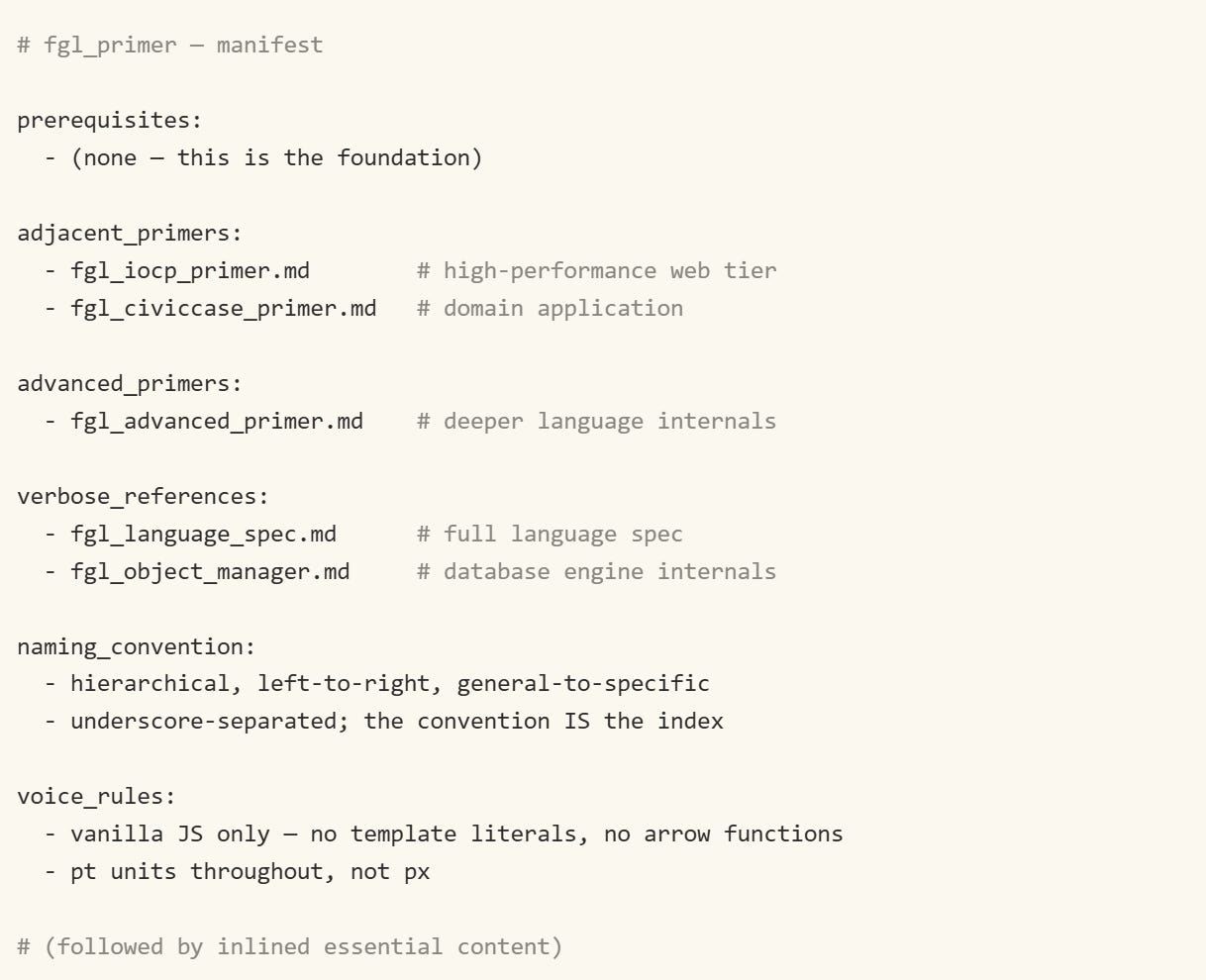
The manifest is fully loaded with the primer. The referenced primers and verbose documents are not — they are pointers, and they work two ways. If the AI has access to the referenced material (a teammate’s shared drive, a public URL, a Skills folder, an attached file), it reads it when needed. If the AI does not have access, it tells the practitioner what it needs and asks them to provide it. Either way, the conversation does not stall — the manifest gives the AI enough situational awareness to either fetch what it needs or ask for it by name. “You said this depends on fgl_advanced_primer. Do you want to load that, or should I proceed with the foundation alone?” That kind of question is a feature, not a failure.
How to build, use, and share your own portable primer
Six operational moves. Each is something the reader actually does, not something the paper explains and leaves abstract.
Name the goal first. A good primer produces domain-specific transcendence: a fresh AI session, loaded with the primer, becomes fluent in the domain in seconds. Fluency means the AI can hold a conversation in the domain’s actual conventions, ask informed questions, anticipate moves the practitioner has not yet made, and produce work that holds up under inspection. The primer is finished — for now — when it consistently passes that test on a fresh session with a fresh AI. Until it does, it is still being built.
Build the primer through the loop documented in the previous section, not by sitting down to write it cold. The loop is the build process. Pick a domain you already know well. Open a fresh AI session. Start teaching, one calibrated layer at a time. Ask the AI to produce a synthesis and a list of open questions at each layer. Correct, advance, repeat. After enough layering, ask the AI to draft a primer for the domain based on what it has learned — manifest first, then the components below. Edit the primer as the practitioner. Test it on a fresh AI session that has not seen any of the teaching. Wherever the fresh session is confused, the primer has a gap. Patch the gap. Test again.
Build the way you teach. Crawl, walk, run. Simplicity first; understanding follows; depth comes from both.
Expect this to take as long as the scope demands. A primer for a single small domain — your short-term rental, a single recipe collection, the rules of a board game you invented — can come together in one thirty-to-sixty-minute session. A primer for a substantial body of knowledge — a proprietary platform, a long-form novel, a regulated practice area — develops over many sessions and many days — or longer, because that is how the underlying knowledge actually breaks into teachable layers. The technique is the same either way; the time budget scales with the material.
A few concrete moves that help:
1. Pick a domain with clear scope. If you cannot describe what the primer covers in one sentence, it is too big — split it into multiple primers and let the manifest route between them.
2. Identify prerequisites. What does the AI already need to know before this primer is useful? If the answer is “nothing,” the primer is foundational. If the answer is another primer, name it in the manifest.
3. Use plain Markdown. Any modern AI reads it natively. Avoid proprietary formats — they break portability. Better yet — feed your AI the template and let it start the conversation. Let it write the primer with you. Start collaborating.
4. Establish a naming convention early. Hierarchical, general-to-specific, underscore-separated. Use it everywhere in the primer; the convention itself does a lot of the teaching.
5. Write the manifest before the body. Manifest first forces you to decide what is in the primer, what is referenced, and what is excluded — before you start writing pages of content that may not earn their place.
6. Include worked examples. Show the domain in use. The AI learns more from one annotated example than from three pages of description.
7. Add voice and convention rules. Short, specific, useful. “Plain string concatenation only, no template literals.” “Pt units, not px.” Whatever rules actually matter in the domain.
8. Lock decisions that should not be re-argued. If a settled convention exists, name it as locked. Save the AI — and yourself — from re-litigating it every session.
9. Test the cold-load. Open a new AI session, drop the primer in, see if the AI is fluent. If not, the primer has gaps. Patch and re-test.
10. Version the file. Even something as simple as a date and a v-number in the filename keeps the history straight.
A primer is meant to be used. Using it is the whole point. The session lifecycle has three parts — load at the start, work in the middle, save at the end — and each is part of the practice.
Load. Drag the file into any modern AI chat. Hit enter. That is the entire load protocol. The AI will read the primer and tell you what it understood — at which point you can correct anything that landed off, ask for what you want to work on, or just start working. No setup, no configuration, no platform, no account. Mid-conversation injection works the same way: if a running session needs the knowledge, drag the primer in then.
Load. Hit enter. That is the entire protocol.
Work. Once the primer is loaded, the AI is fluent in the domain — up to the point you left off. Work as you normally would — ask, correct, iterate, build. The primer’s effect persists for the rest of the session. The AI is now a collaborator in the domain rather than a stranger to it.
As you work, the AI will sometimes surface refinements — moments where it learned something the primer does not yet say, or where a worked example would clarify a confusing point, or where a voice rule needs sharpening. Note these as they come up. I keep a running list of “primer updates pending” right in the chat, asking the AI to track them — but saving the relevant chat sections for later review works just as well. The point is not to lose the refinements when the session ends.
Save. At the end of a productive session, transcend it. Ask the AI to produce an updated version of the primer that incorporates the refinements from this session, or to summarize the proposed changes so you can fold them in yourself. Review the proposed changes as the practitioner — accept what improves the primer, reject what does not. Save the updated file with an incremented version number. The session ends, but the work compounds: the next session starts from a primer that is more complete than the one this session began with.
This is what transcendence across sessions actually looks like in practice. The conversation is ephemeral. The primer is not. Every session that captures its refinements correctly leaves the primer in a better state than it found it — and a colleague, a fresh session, or a future self picks up where the work actually ended, not where the previous session started.
By default the primer does not change during use. The AI reads the file at the start of the session and uses what it learned, but it does not write back to the file. The session ends; the primer is unchanged. This is the safe default — it protects the primer from drift and lets you distribute primers without worrying about downstream sessions corrupting the canonical version.
Two other modes exist, both opt-in:
• Practitioner-curated enhancement — the practitioner explicitly invites the AI to suggest additions or refinements — new worked examples, refined voice rules, clarifications. The AI proposes; the practitioner reviews and commits. The practitioner is the editor; the AI is the suggester.
• Self-modifying (advanced, rare) — the practitioner allows the session to write back to the primer directly. Reserved for cases where the practitioner is working solo on their own primer with full review of changes. Not appropriate for shared or distributed primers.
Read-only is the default for a reason. Choose otherwise deliberately, and only for primers you own and review.
A primer is content, not code, but it benefits from software discipline. Version the file. Date the versions. Keep a short change log at the bottom or in the manifest. When you ship a new version, increment the version number; do not overwrite the old one in place. If someone else has built on your primer, they should be able to identify which version they built on.
Forks are fine. Forks are how primers improve. The original stays canonical; the fork lives on its own track and may eventually rejoin or diverge. What you do not want is for downstream consumers to silently modify and re-share — that is how good primers degrade. The version number is the safeguard.
Share it however you want. Email it. Post it. Put it in a shared drive. Drop it in a chat. Attach it to documentation. Publish it. Keep it private. The primer is a file; files travel. There is no platform that has to be involved, no marketplace required, no licensing infrastructure needed.
Different audiences fit different distribution models. A team primer might live in shared storage where everyone can read it but only the maintainer can update it. A community primer might be published openly, with the canonical version held by the maintainer and forks welcome. A consulting primer might be shared with specific clients alongside the engagement. A personal primer might never leave the practitioner’s own laptop. None of these requires anything beyond the file and whatever sharing channel you already use.
Coming back to the earlier point about Skills: a primer that has matured through enough use can become an excellent starting point for a Skill. The portable primer is the source of truth; the Skill is a derivative, deployed when the practitioner is ready to commit to a platform. Automating that conversion — primer in, Skill out — is a near-term direction this author plans to explore. Until then, the portable primer travels under its own power.
The thing I had not expected, when I started teaching Claude my platform, was that the teaching itself was the smaller half of what I was doing. The larger half was building the file. The file is what survives the session. The file is what travels. The file is what a colleague — or a stranger, or a fresh AI — can pick up and use without any further explanation.
If you have knowledge worth packaging, build a primer for it. Test the cold-load. Share it where it helps. Keep the version straight. That is the whole practice.
Knowledge is the asset. The primer is encapsulation. Using and sharing are transcendence — drag-and-drop fluency.
fgl_primer_v4_sampling.md — a representative sampling of the production FGL primer, prepared as a companion to this paper. Architectural patterns (manifest, COMPLIANCE behavior, naming conventions, voice rules, locked decisions, worked examples) are intact and fully demonstrated. Substantive FGL content is partial — enough that the reader can see what a real primer looks like in practice; not enough to serve as production FGL documentation.
primer_template.md — a generic primer skeleton with embedded prompts that walk the reader’s AI through filling in the template during a single session. Load the template, answer the AI’s questions, end the session with a populated primer ready to use. The template is itself a portable primer — it teaches an AI how to interview the practitioner and produce a primer as the deliverable.
No posts
Comments
Nothing yet. Say the first thing.
Sign in to join the conversation.