
My favorite way to spend time with friends is over long weekends together. Sure, I love getting drinks or playing a round of golf — but the best memories I have with friends are being in one place with them for multiple nights in a row. In my experience, you just learn so much more about someone when you have that amount of time with them.
Something happens on the second or third night that never happens over drinks. The performance wears off and you hear the stories a person doesn’t lead with. By the drive home, you know them differently. Better.
I think the same thing is true of authors.
Most of our reading lives are drinks and golf. We give a writer one book and move on. Read the Rooney, then the Whitehead, then the Ishiguro. Don’t get me wrong I love variety! But sometimes I need to get deep with one author for a little bit. I need to book the cabin and go on the long weekend.
So the assignment I’m putting in front of you for the next month, should you choose to accept it, is to spend 3 books with one author. And in case you have read a ton of books, I’m choosing authors that have largely ben forgotten even though they are critically acclaimed.
Which author, though? Your color answers that.
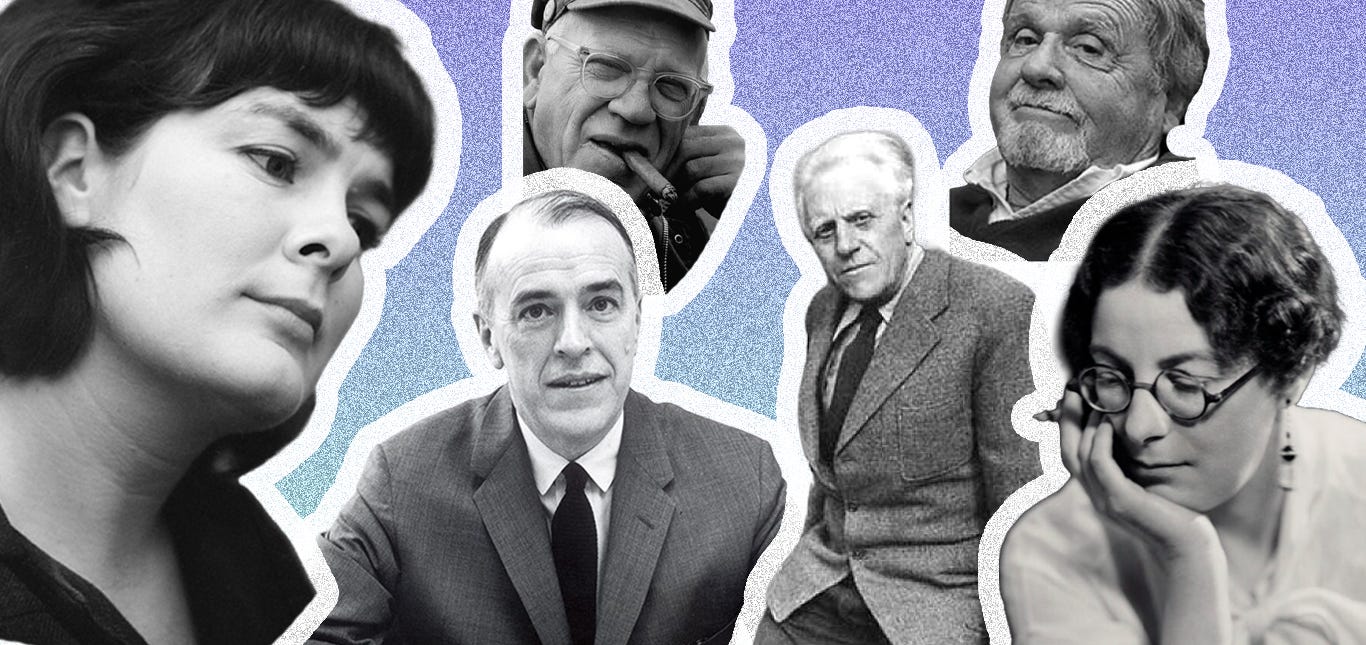
Like I said, every author on this list is forgotten. I don’t mean bad, and I don’t mean obscure for good reason. These are writers who won or nearly won the biggest prizes we have (there’s a Nobel laureate down there, plus a Pulitzer finalist and a National Book Award winner), writers the critics argued over for decades. Bring one up at dinner tonight and you’ll likely get blank stares. Critical acclaim without popular acclaim. It’s the best deal in reading! The hardest judges alive already vetted the books, but the experience still belongs entirely to you. Nobody will spoil them for you. There’s no discourse to catch up on, no adaptation with the wrong casting.
Find yours below. If you don’t know your color yet, pay attention to the question each one asks, because one of them is the question you’ve been asking your whole reading life.
The Green syllabus is free in full, so you can see how these work. The rest are for my paid subs only! Consider subscribing — it’s a cup of coffee a month for what I believe will give you a better reading life!
Green readers read for clarity. Your question is “How does this work?”
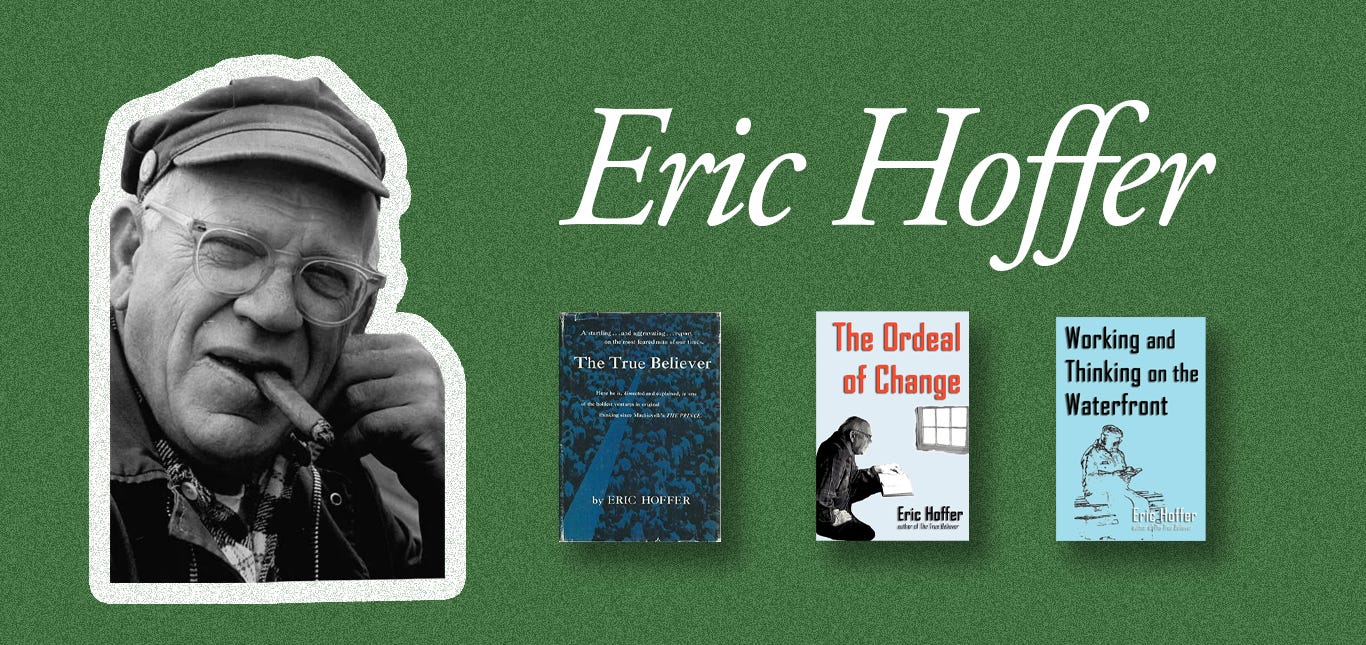
From 1943 to 1967, the most lucid social thinker in America loaded cargo on the San Francisco docks. Eric Hoffer had no formal education to speak of. He picked crops, worked as a longshoreman, read whatever the public library had, and filled notebooks between shifts. The books that came out of those notebooks were so clear that President Eisenhower quoted him and CBS ran prime-time specials about him. Then the country moved on. What survives of the “longshoreman philosopher” today is mostly a name on quote sites.
Hoffer is the purest Green writer I know. He does the exact thing Green readers are starving for: he takes the fuzziest subjects in human life — fanaticism, mass movements, why change scares us so badly — and brings them into focus. He never theorizes from a distance, because he couldn’t. He’d spent his whole life inside the phenomena he was explaining. And remember the two Green modes. If you’re a Student, Hoffer feeds that hunger to understand how the world fits together. If you’re an Apprentice, nearly every page hands you a tool you can use by Friday.
Book one: The True Believer (1951). His masterpiece. A short, cold anatomy of why people hand themselves over to mass movements, and why the actual content of the movement barely matters. It’s written in numbered sections you can read like aphorisms, it’s seventy-five years old, and it will explain half of your news feed.
Book two: The Ordeal of Change (1963). The book Hoffer liked best of his own. Essays on why change, even the good kind, is so destabilizing, and what people do with the fear it produces.
Book three: Working and Thinking on the Waterfront (1969). A diary of one year on the docks. He unloads ships in the morning and wrestles an idea about human nature in the afternoon. After two books of conclusions, you get to watch the machine that produced them while it runs.
The other five syllabi are below the paywall. Waiting for you down there is a National Book Award winner who edited half the writers you love, a Pulitzer-finalist western Thomas Pynchon calls one of our best American novels, a Nobel laureate you can read in an evening, the first Book of the Month Club selection in history, and a British experimentalist who makes most “experimental” fiction look timid.
Comments
Nothing yet. Say the first thing.
Sign in to join the conversation.