
The facts were meticulously constituted, but very little emerged. Everything that was the case.
It’s an office day, but we’re at the bar, or the garden outside the bar, and the bar is closed. An abandoned, Dominican Cohiba rests between the slots of my bench-seat. There’s a full glass of water on the ground from last night’s service or because the daytime manager’s pit bull came to run around while the bar is closed. I don’t see why they’d make a pit bull drink from a water glass.
The wine that we’re tasting must have died twenty years ago. Nevertheless there is a little crowd forming to make some sense of it. They are assembling in a circle around the bottle and I keep wincing at the water glass on the floor. I’m going to knock it over later, absentmindedly. The old wine seems to carry more truth in it — a wine as old as some of us are has a special aura. We’re tumbling over the dog to play the game.
The dog is blind too. Can you believe it? The game is to guess the wine. The sun is shining and it’s chilly in the shade of the cherry tree, still pink and handsome with half its petals in piles on the floor.
The guy with the wine bottle loves to dust off these kind of ancient bottles. He has a foolhardy audience of equinumerous age downing the 30-year-old liquid without question. I venture to guess that a decent chunk of them would refuse an aspirin past its expiration date, but for vino they are full Dionysians. For this I applaud.
Blinding a wine is remarkably difficult but not so difficult that 1 in 4 blinds might be deduced in a timely enough manner to signal genuine deduction. One or two times today someone will guess a wine’s small region, producer and vintage. Someone who is not me. But I’ve got ideas, and I’m huffing my glass accordingly.
It’s good that the weather is nice and that we’re in a pretty place. I feel for the new contestants and the strangeness of the days we spend in the office. Here abroad, everyone is walking around the garden of the bar with enough familiarity. The swirling, slurping, spitting, and the wine babble are at least sun soaked, and everyone is catching on.
We’re calling out guesses in a didactic order but it’s hard to make sense of what’s left of this failing wine, and what’s come to fruition doesn’t quite line up.
An early consensus is found and defeated. The tannins are soft but still gripping, there is alcohol and body, though the ripeness has soured. The fruit is dark, and not completely oxidized. It feels of its time in substance and style, that is 80s or 90s era tough-guy wine if and when ‘tough guys’ means rich guys and “Anglo” includes Bordeaux.
“Oh, it’s Bordeaux,” a scrawny wine teenager shouts, and I concur, silently, internally, in a debonaire fashion. I think: This gang of criminals has learned something yet! Surely both of us are right and everyone will enjoy the glow of our wisdom.
But no, replies our tester, “It is not Bordeaux,” and a sadness falls upon the place. Cherry blossoms fall like tears and not a selfie is snapped for what feels like minutes.
A curious thing happens now. Questions become haphazard and shots are taken from the hip. There is an urgency towards resolution borne out of the anxiety of ignorance. I like the dramatic tension, but it’s a lot for some people and it burns off quickly with leading questions and scattershot guesses.
This is a skill I neither possess nor desire to obtain. I’m half-listening, watching the blind pit bull make a path towards its owner , dodging a thousand waves of flippant affection, pitifully gaze-less, brushing a dozen or so wooly sweaters.
I hear that we’ve zeroed in on Burgundy, premier cru. The businesslike and unmussed rationalizing begins. Of course some Parkerite Pinot Noir presents as discontinuous with Bordeaux 30 years on! In our age of elegance, tannin-free Burgundy could never be mistaken for the Cru Classé. With this bottle, forged in the era of “legs” and robustness, who is to say?
Suddenly there is less fear in the group and one-by-one eager players lose interest. It’s harder to hear what’s going on as smattering conversations peel off, and the promise of the next wine having some living fruit steals our interest.
There is but one hanger-on with a deeper knowing than the rest of us, confused and skeptical. He’s a young wine professional and a fisherman. We’re often cornered on these Monday afternoons discussing gear that I pretend to know something about. In this game, he’s competitive and won’t drop the bone. So much so that our tester questions himself and peeks at the label. He surprises himself this way every so often. I see the problem. He takes a long drag of his cigarette.
“Sorry,” he says, “It is Bordeaux.
The folks have a laugh in the excitement of a revealed thing. Quickly, the moment is lost as trays of buffalo chicken wings enter the garden. I’m only saying, you should come one Monday. It’s a pleasant afternoon.
They’re talking about our parents’ era in wine, but actually just a set of prolific wine dorks from our parents’ era. When we talk about style, we engage in a pernicious and necessary synecdoche. This loud and influential crew of Wine Spectators speak clearly to a time and place not because of the style’s ubiquity, but just because of the opposite fact — the constraint of the influence to a handful of wine regions, in a very specific stretch of time. (We should recall that Parker was essentially persona non grata in Burgundy).
The vindicated fisherman says, “I knew it couldn’t have been,” for he knew.
“I felt crazy! I guess we know the next bottle that you brought will be Burgundy…”
We will taste the bottle later on. It also shows like a gutter full of dead leaves and soy sauce. If either of these wines ever instantiated a style, it was a long time ago.
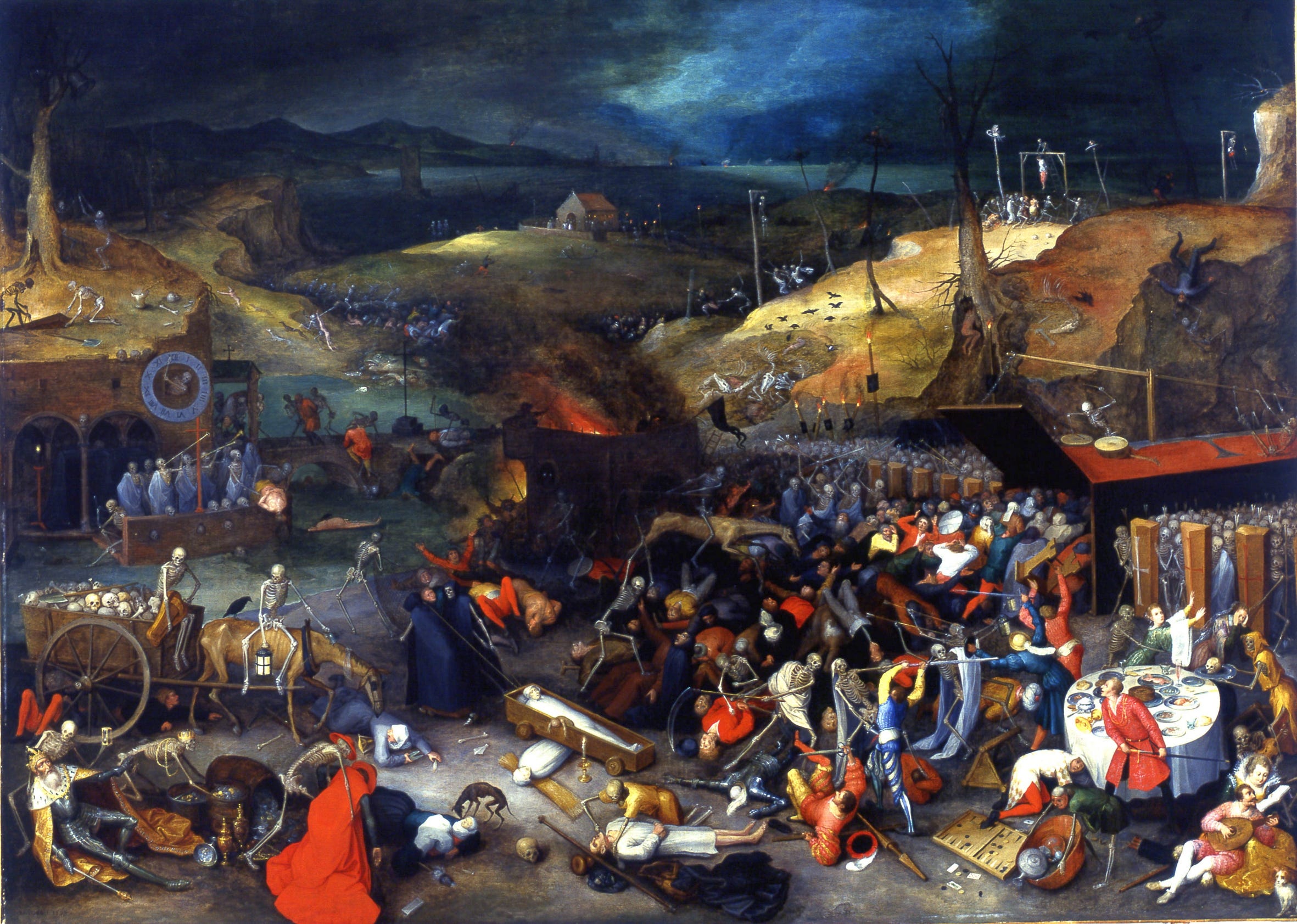
Triumph of Death, Bruegel the Younger
Next we blind about a dozen Jura wines. Will this style ever die? Ten years ago, at a wineshop in Brooklyn, Trousseau and Poulsard caught dust on the shelves. We liked to crowd around the Loire Valley section, but these Jura reds were often a relative value and moreover something unpredictable. We liked that. Now, the varieties are a vocation.
The Jura drinkers’ elements of style include a brightness and transparency of fruit. The acid is cut and angular, and the body is remarkably light. This all refers to the red wines. Really, the reason for this profile is as terroir driven as it is stylistic. True, innovations in the Beaujolais inspired winemakers in all parts of the country, but the red wines of the Loire Valley, Beaujolais, Jura, Savoie… are all from climates where many noble, red varieties struggle for ripeness. Lighter varieties do well, and their vinification serves to treat and highlight this quality.
Also, you can drink a lot of light wine, so our festive Monday evenings often attract an array of specimens that don’t weigh so heavy on the palate. The lush nature of our natural wine community is culpable here, but the recent rise of the burg hounds betrays a similar proclivity.
Maybe for a lot of people, this style has taken the place of anything important happening in the natural wine sphere, but this is an opinion from someone who doesn’t get to drink as well as me.
Georgia asks if the wine is Austrian.
No.
“Is this an Italian variety?”
No, maybe? They have it there.
This goes around and around until we’re all properly confused and our tester reveals a Grüner Veltliner from Sicily and we all moan a lot. Aaron is scratching at his 5 o’clock shadow while the cigarette smoke starts to take over the little courtyard and the poorly layered drinkers find their way inside the bar for one of the more beloved rituals of industry inclusion, smoking indoors.
Here we sit in the time machine with our psychic companion adjusting the lighting for proper temperature and historical accuracy. Special occasions such as these bring out some industry names who love only smoking indoors above wine. I allow for my nasty cigar habit. I knock over a glass of water.
The names talk shit about winemakers and the industry they pretend to hate. Less a style and more a mode. Less a new chapter than a truism. There’s a group of young winemakers in the south balancing their volatile acidity with residual sugar. Everyone wants to talk about their new red under floor. Oloroso is on the tongue far more than whole-clusters and stems and the wine keeps coming and we keep talking about it.
No posts
Comments
Nothing yet. Say the first thing.
Sign in to join the conversation.