
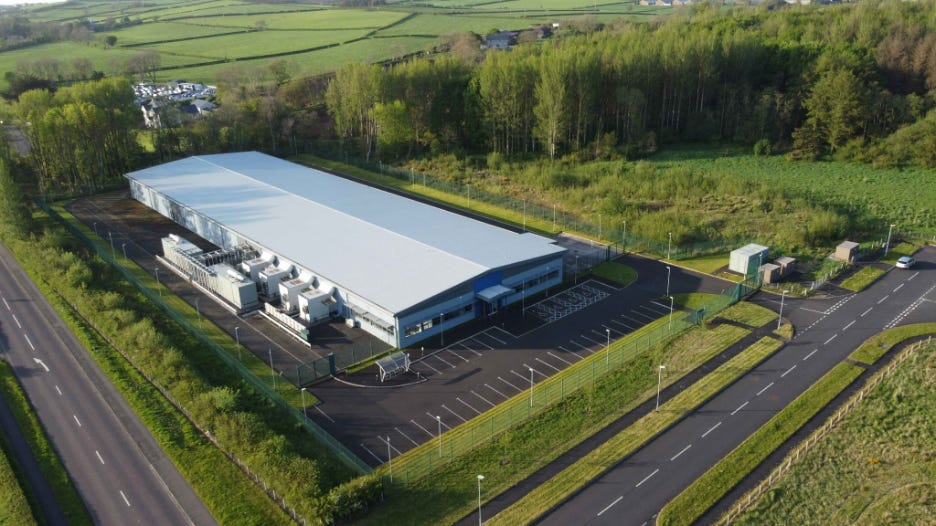
(image: Geoffrey Moffett for Unsplash)
Last week a popular local radio station was looking around for someone who might defend the proposed construction and operation of an AI data centre in the city in which I live (as a counterpoint to previous guests who were apparently vocal data centre resisters). I was recommended as someone who was likely to be that person (they were right), and I was duly interviewed on the subject. My host, a generous and smart man, gave me a long leash, and I roamed freely on the pro-tech side of the field. After the interview, a slew of new analyses crossed my screen which cast some alternative light on the subject. The whole matter is a lot more complex than the technology it represents.
Consider this. In March, Gallup asked Americans whether they would accept an AI data centre in their local area. Seventy per cent said no. Asked the same question about a nuclear power station – the technology of Three Mile Island, Chernobyl, Fukushima and four decades of accumulated cultural dread – only 53 per cent objected.
Think about it. A windowless shed full of servers now polls worse than splitting the atom and releasing massive amounts of energy and radiation. No threat of meltdown, no chance of exclusion zones, no mutant lore. Just a big box that computes.
And it’s not just polling; the activism is getting, well, action, especially in the US. Data Center Watch counted 75 projects worth $130 billion blocked or delayed in the first three months of 2026 alone – matching the total for all of 2025. Heatmap has identified more than 500 US counties running severe restrictions. Seattle, hometown of Microsoft and Amazon, has passed a one-year pause on its own industry. Maine came within a governor’s veto of a statewide ban. Reuters has reported that community resistance has become so widespread that banks are now treating local opposition as a credit risk when financing projects.
Where does this all come from? And, rather more to the point, what does anyone imagine it will achieve?
Start with the environmental case, which is partly sound and partly overheated – a typical mélange of truth and misinformation when it comes to advanced tech.
The water-usage alarm is perhaps on the shakiest ground. While excessive water usage was true five years ago (ironically at a time when no one objected to data centres), most new designs from the big data centre operators now use low-water solutions – from closed-loop systems where the same water is re-used, to grey-water cooling, to machines immersed in liquid coolants.
On electricity, the data is mixed. Data centres obviously use electricity, but many hyperscalers now bring their own power in the form of solar and batteries, hydro and, more recently, nuclear. Other data centres do indeed suck at the teat of the national grid, as do mines, smelters and paper mills. So the question is more complex. If other industries use the national grid, why not data centres, especially given the centrality of AI to the future of economic growth?
There are other objections too – noise, or low labour usage. Neither holds up as a serious objection. Data centres do emit noise, just like other industrial plants, but they are not being built in quiet residential neighbourhoods. Finished data centres employ relatively few people, but so do ports and airports. It is the downstream economic impact which is much more important (but often ignored) – the number of businesses that are enabled or advantaged by lower-cost access to bits, especially AI bits.
But the truth is that there is no getting away from the white heat of broad-based citizen objections, which cross political and class lines (in the US the resistance is about the same in both Democratic and Republican polls). Why is everyone so pissed off?
Because it is not the building, it is what it represents,
Milltown’s Tom Brookes noted that the AI transformation is arriving just as “Americans already feel angry, insecure and pessimistic”. The analyst Nathaniel Whittemore is blunter: this is about lost agency, the sense that “a world people didn’t choose is being imposed upon them”. The data centre is simply the only part of AI you can picket. You cannot picket a model.
And so the data centre has become a symbol. It represents AI threatening human labour. It represents the extraordinary concentration of wealth in Silicon Valley. It represents billionaire technology companies whose influence increasingly rivals that of governments. Above all, it represents a future that many people neither chose nor entirely trust. That observation captures the mood remarkably well. People are not simply objecting to concrete buildings and cooling towers – they are objecting to what those buildings signify.
This distinction matters because it changes the nature of the debate. If the principal concern is environmental, then there are practical policy responses. Governments can require closed-loop cooling systems, and they can insist that operators finance new generating capacity. These are engineering and regulatory challenges, and history suggests they are entirely solvable.
But if the real issue is distrust of AI, big tech and political institutions, then no amount of environmental mitigation is going to help.
There is, however, another dimension to the discussion that receives remarkably little attention. AI is not an optional technology. Unlike a social media platform or a fashionable consumer gadget, AI is becoming a general-purpose technology comparable with electricity, the microprocessor or the internet itself. It is already transforming scientific research, pharmaceutical discovery, manufacturing, defence, logistics, finance and education. Every major economy understands that AI will be a primary determinant of future productivity, economic growth and geopolitical influence.
The real question is where the computing power underpinning that revolution will reside. If the United States and Europe make it increasingly difficult to construct AI infrastructure, the demand for computing does not disappear. It simply migrates. China will continue building data centres. India is investing heavily in AI infrastructure. The Gulf states see an opportunity to become global compute hubs. Emerging economies would welcome the investment, employment and tax revenues that accompany these projects.
AI progress will not pause while Western democracies debate planning applications. The models will still be trained, the scientific breakthroughs will still occur and the economic value will still be created. The only variable is who captures that value. Communities that successfully prevent local data centres may understandably feel they have protected their environment, but they will not have prevented AI from its dizzying march into everything. They have simply transferred the investment, the tax revenue, the engineering expertise and the long-term strategic advantages to another jurisdiction.
Seen in this light, the debate becomes less about whether we should pay the environmental price of AI and more about whom we wish to enrich. The enormous economic rents generated by the AI economy will certainly be paid by someone. The question is whether they flow to fellow citizens working under domestic environmental regulations, labour laws and democratic institutions, or whether they accrue to foreign governments and companies that were more willing to host the necessary infrastructure. Artificial intelligence cannot be wished away by refusing planning permission.
Because you will pay either way. You will pay in subscriptions, in the embedded cost of every service AI touches, in the productivity of the economy you retire into. What is genuinely at stake is whether the offsetting revenue lands in Texas, Cape Town, China or an emirate. Blocking it locally is self-defeating.
You have merely arranged for the rent to be paid to a foreigner.
Steven Boykey Sidley is a professor of practice at (ex-JBS, University of Johannesburg) and a partner at Bridge Capital and a columnist-at-large at Daily Maverick, Daily Friend and Currency News. His new book “It’s Mine: How the Crypto Industry is Redefining Ownership” is published by Maverick451 in SA and Legend Times Group in UK/EU, available now.
No posts
Comments
Nothing yet. Say the first thing.
Sign in to join the conversation.