
In Bartholomew Lane, near the junction with Threadneedle Street, is a discreet entrance to a little-known London treasure: The Bank of England Museum, carefully inserted into a few interconnected rooms of the Bank. The working Bank extends over the remainder of the urban block bounded by some of the City’s most famous streets: Threadneedle Street, Walbrook, Lothbury and Bartholomew Lane.
The Museum tells the story of the Bank of England from its founding in 1694. It also explores the subsequent development of money, financial exchange, commercial transactions and banking on this site and in the surrounding streets over the following centuries. I visited the museum to see a modestly scaled exhibition of remarkable archive drawings and photographs describing the Bank’s buildings since its founding. Central to this narrative is the extensive reconstruction of The Bank in the 1930’s, which destroyed almost all the 18th- and early 19th-century work of architect Sir John Soane. The exhibition describes the demolition and rebuilding, immaculately recorded in photographs and in some magnificent pencil renderings, clearly drawn by on-site artists. Nicholas Pevsner, the great architectural historian and cataloguer, described the 1930’s rebuilding as ‘the greatest architectural crime in the City of London of the twentieth century.’
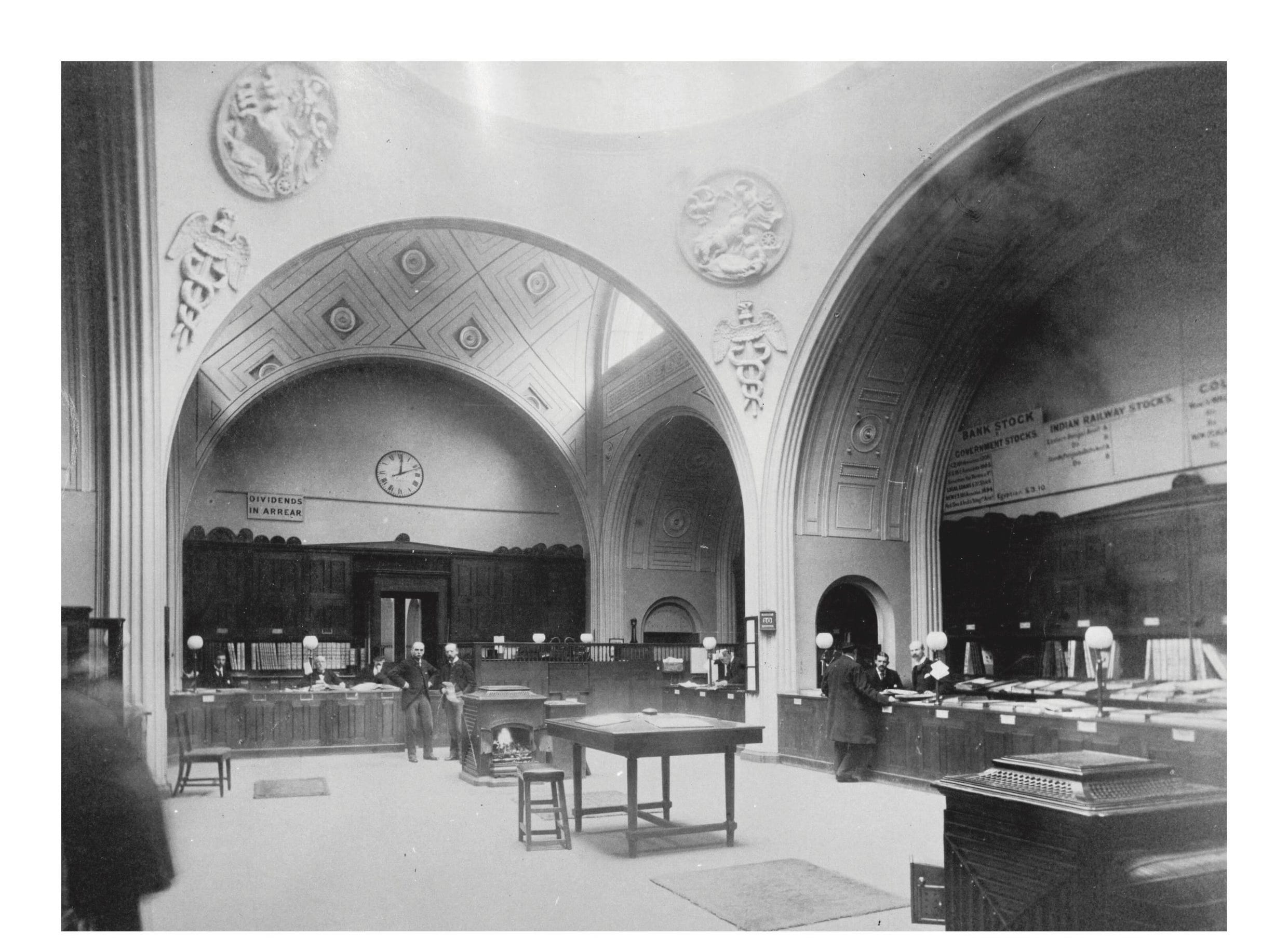
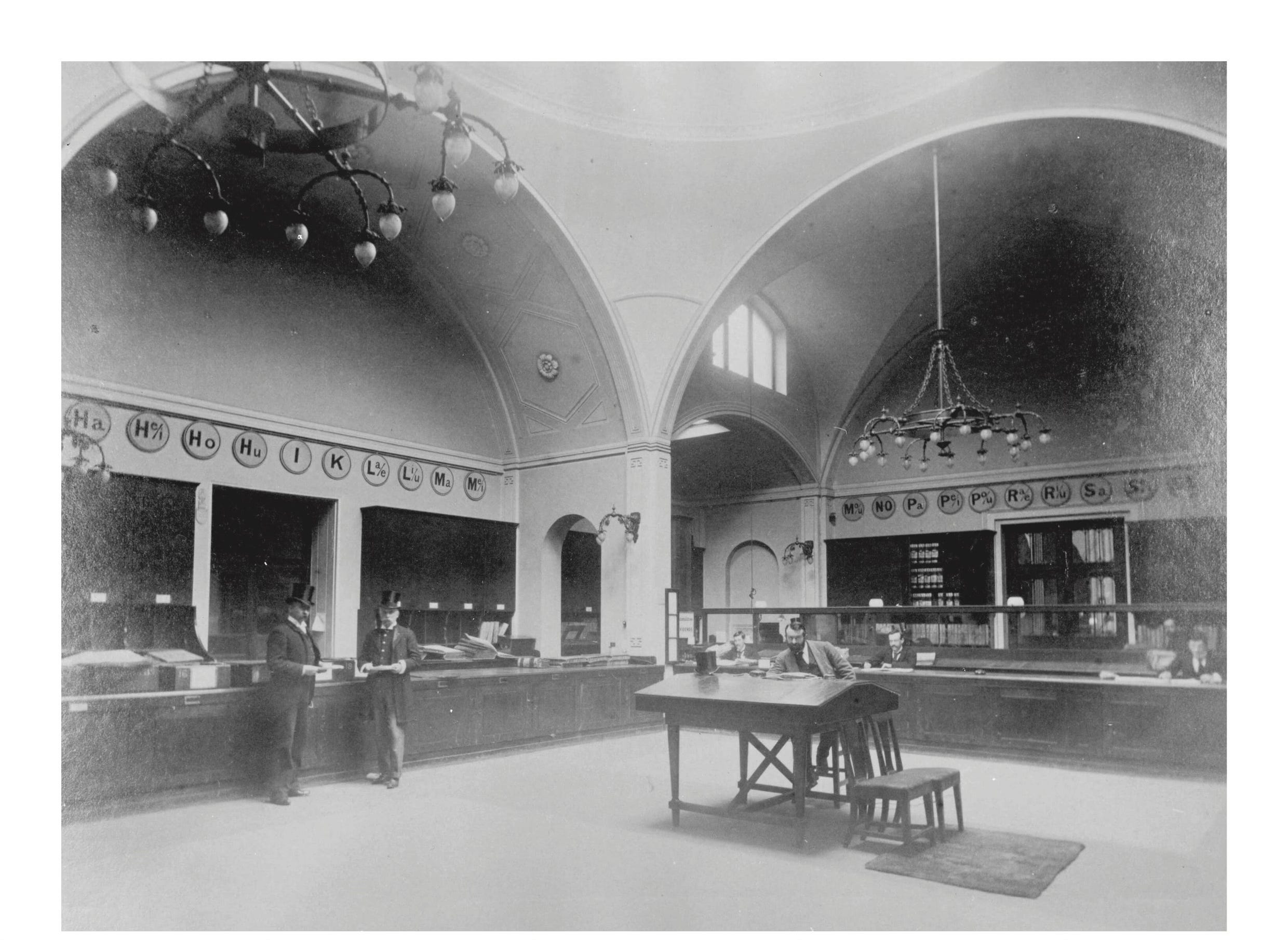
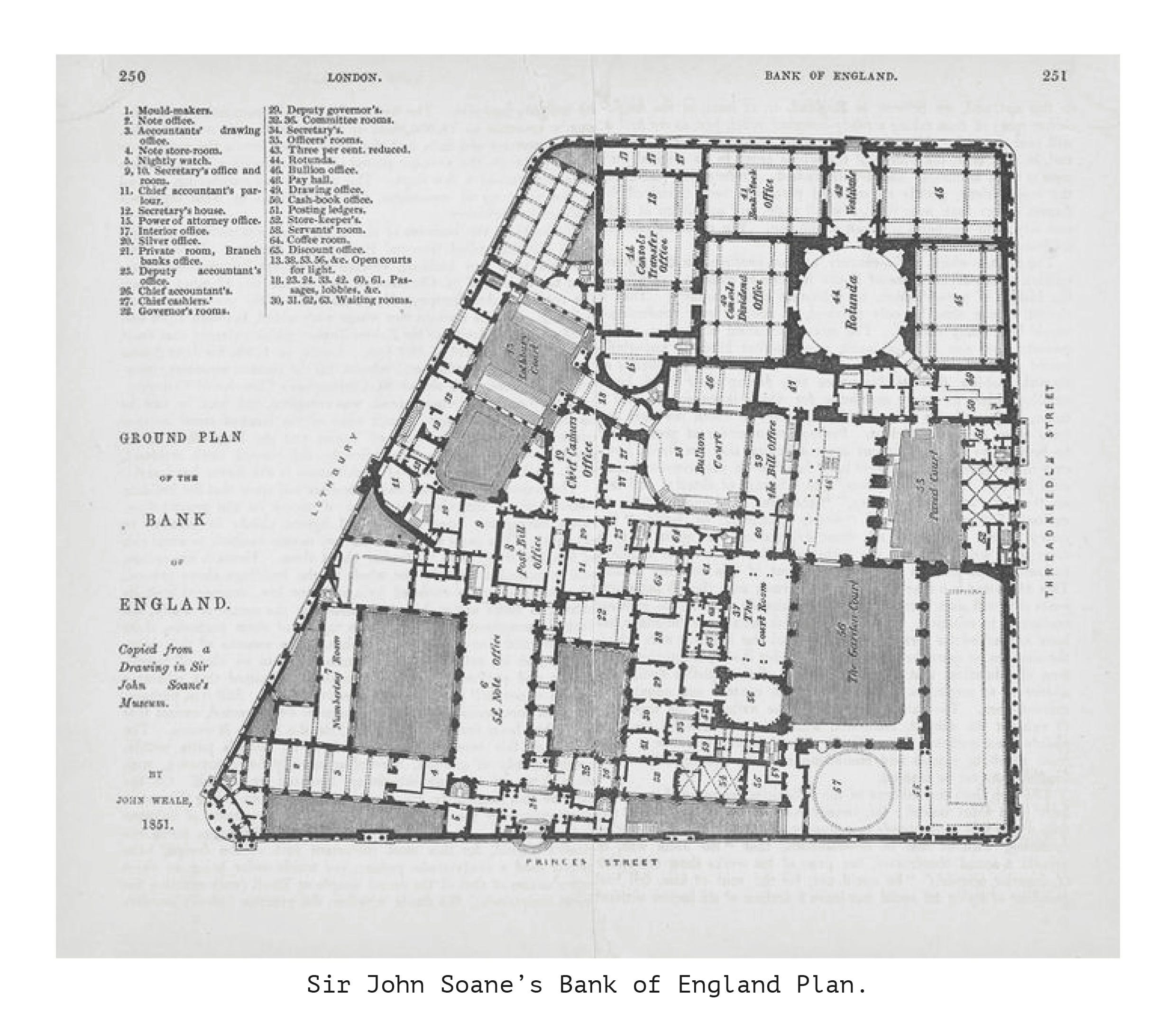
Sir John Soane (1753-1837) was appointed surveyor to the Bank of England in 1788 and, for the next 45 years, worked on a sequence of projects to extend and reconfigure the Bank. He retired from the role aged 80, having created a masterpiece of architectural form, space and light. By this time, the Bank had been enlarged to its current extent, filling an entire city block enclosed within a secure, windowless stone façade. Within this secure perimeter lay a complex plan of stately single-storey, top-lit banking halls, external courtyards, and connecting service spaces that filled the land within the perimeter walls. The plan is revered by architects as a magnificent treasure of ‘ground scraper’ or ‘poché’ planning. The plan can be read as either an architectural or a city plan; it is both. Soane’s forty-five years of effort were not directed towards delivering a ‘masterplan’ in which the outcome was determined at the outset and then implemented in phases. Instead, the process was sequential, with each stage worked out in response to current requirements, taking account of land availability and what had already been built. The plan evokes an architectural creation unfolding over time, similar to historic cities that might take many generations of continual adaptation and change to reach their current form. Soane’s creative effort could have been the work of centuries.
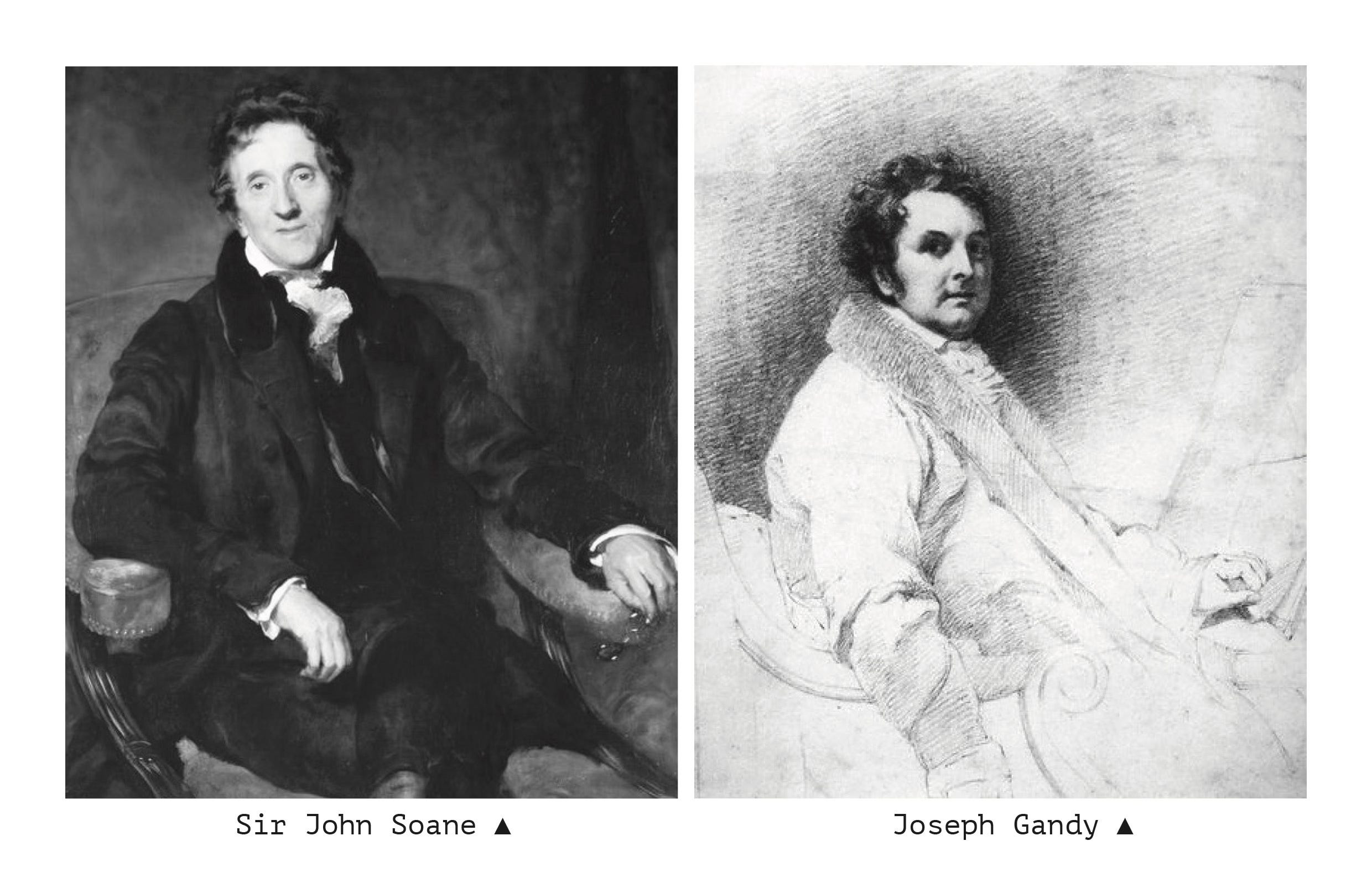
The sublime beauty of Soane’s plan is most vividly evoked in a painting by his long-time protégé and collaborator Joseph Gandy (1771-1843). The drawing is sometimes described as a ‘cut-away perspective’ in which large parts of the buildings have been removed, allowing the viewer to simultaneously understand the plan layout, building structure, and aspects of the architectural form. This may have been part of Gandy’s intent; however, the drawing also suggests the rediscovery of a great classical ruin in some remote future. This romantic conception would have flattered and appealed to gentlemen architects who had learned their craft on the Grand Tours, surveying ancient ruins of classical Rome and Greece.
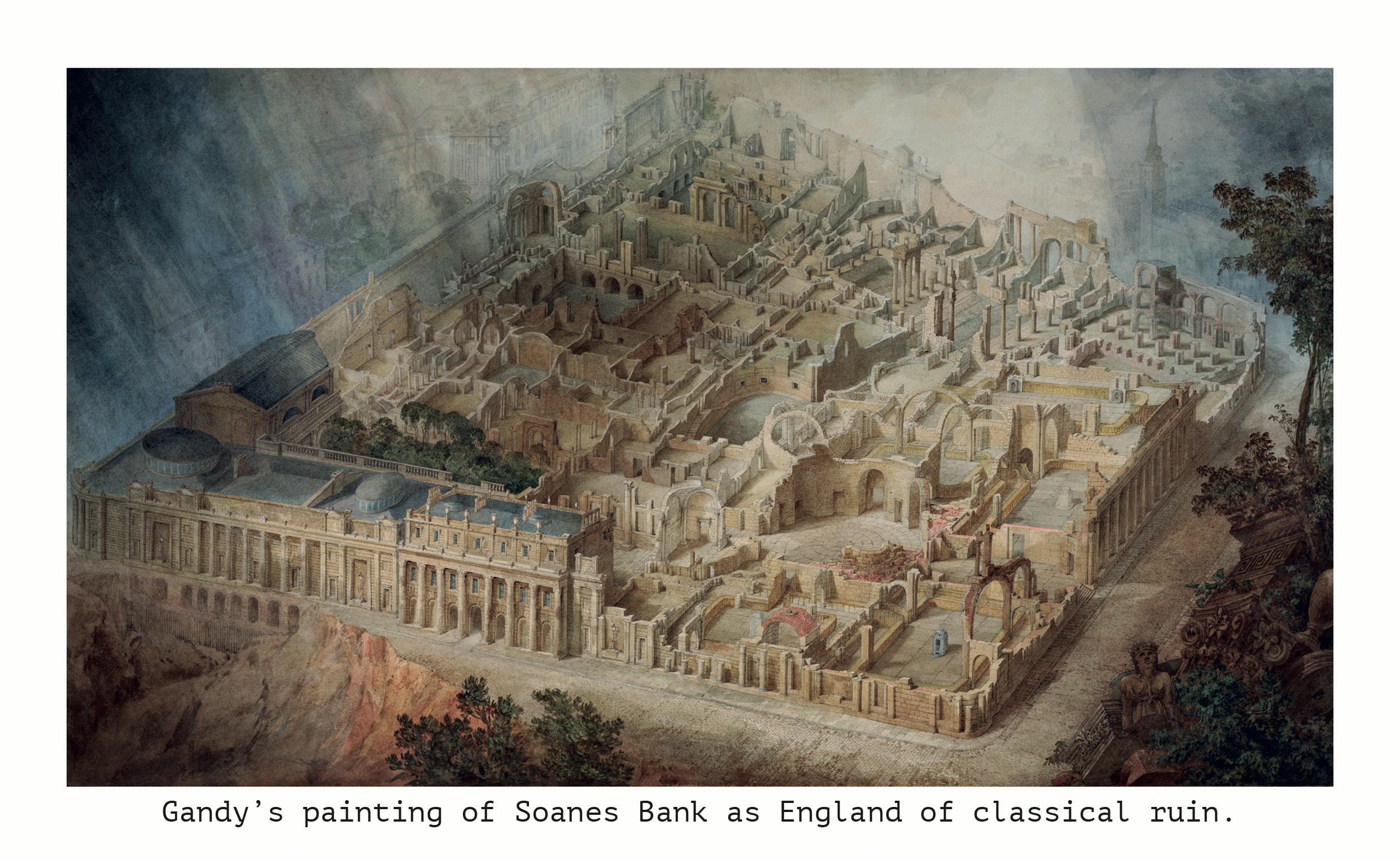
The drawing shows the surrounding city streets lightly sketched in, obscured by a fog of rain and smoke. They might be depictions of ghosts or of city memories. In the foreground, a great chasm has opened in the earth, revealing the Bank’s basement floors, as though a great flood or earthquake has destroyed the city. Only the lower courses of masonry remain of the Bank’s internal walls. Here and there, a ruined vault is still standing. At the corner of Threadneedle Street and Walbrook, a few complete buildings are shown together with a portion of the enclosing perimeter wall, revealing the height of the buildings that once covered the entire site.
Soane’s masterpiece was not destroyed by time or a great natural calamity, but by the Bank’s rather ordinary need for more space on a constrained site in the early 20th century. At that time, all banks in the City of London had to be within a short walking distance of the Bank of England. An alternative site within this constraining geography was not available. Demolition and building of both deep basements and the construction of new space above Soane’s original skyline were the only viable options.
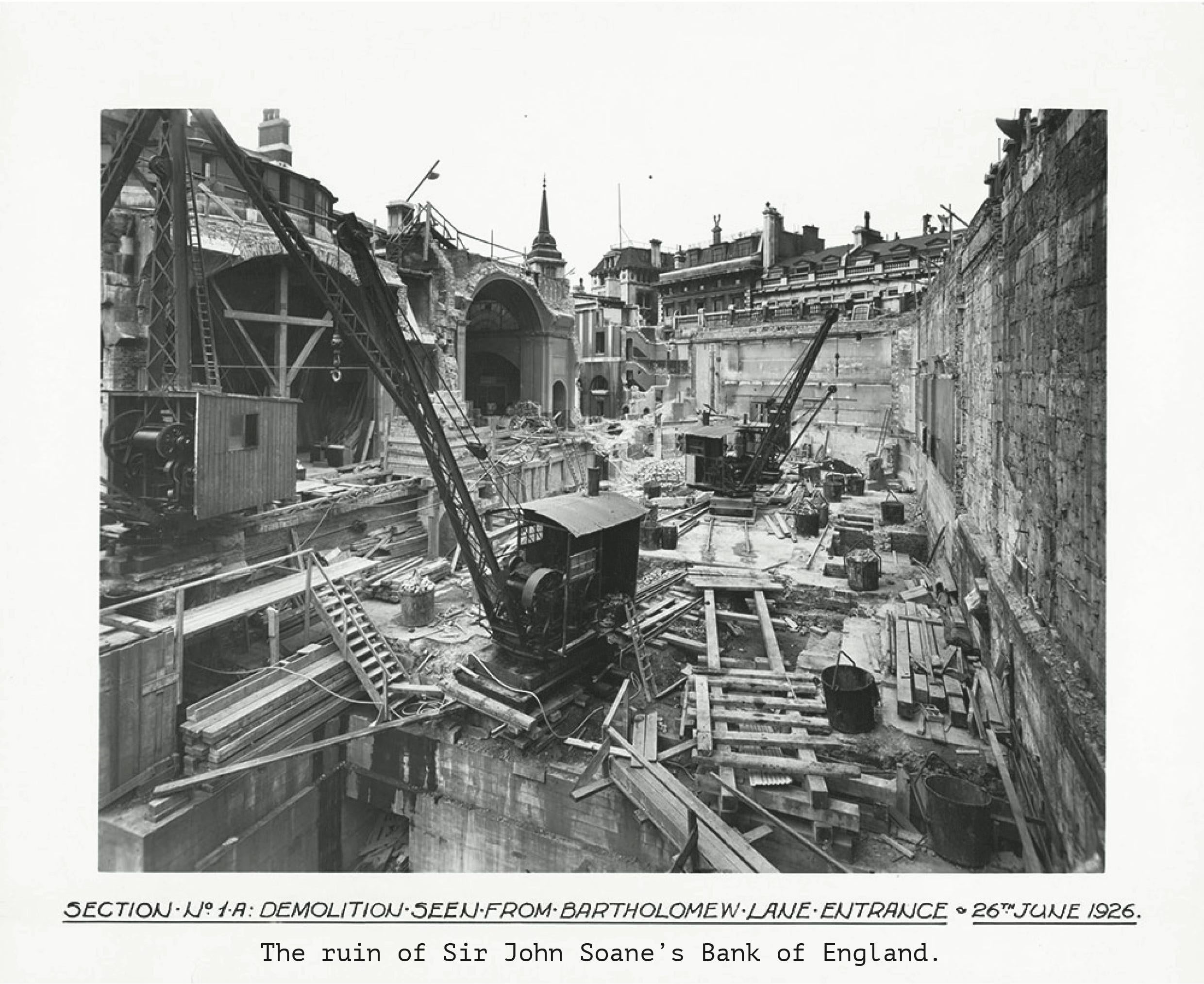
Sixty years after the fateful architectural deliberations that led to the destruction of Soane’s masterpiece, communications technology has liberated banking and many other industries from these locational constraints. However, the Bank could not know what the future held, so in 1921 Herbert Baker was appointed to design the new bank on the existing site. His design retained Soane’s perimeter wall, a few fragments of the plan, and some interior features were recreated in changed locations. A statue of Sir John Soane was added to the perimeter wall on the Lothbury elevation.
Gandy’s fantastical drawing depicts a future ruin that never existed, of a building that no longer exists. The memory of Soane’s masterpiece now lives only in imagination and art.
To read past Hoxton Chronicle posts, please subscribe to the free Substack Application and search for The Hoxton Chronicle.
No posts
Comments
Nothing yet. Say the first thing.
Sign in to join the conversation.