
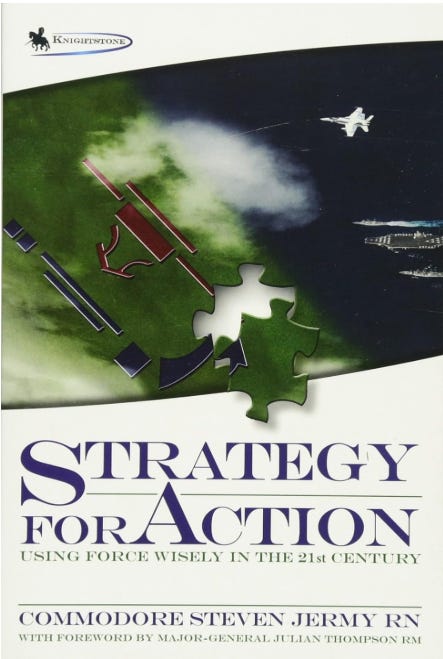
Steven Jermy opens his book with a quote from Clausewitz:
No one starts a war - or rather, no one in his senses ought to do so - without first being clear in his mind what he intends to achieve by that war and how he intends to conduct it.
I believe that the wars in Iraq and Afghanistan were not subjected to the Clausewitz test. When the relevant papers are opened to the public, I may be proved wrong.
Nevertheless, I am convinced that at the highest levels of decision making in the UK, both civil and military, there is an insufficient grasp of how to formulate strategy. The Army is the least proficient in the art. It took until the late 1980s and a former Chief of the General Staff, Field Marshal Sir Nigel Bagnall, to drag the Army’s corporate brain up from the tactical to the operational level. This is not sufficient. Competence at the operational level is not enough to win wars as the Germans, the leading operational practitioners, discovered, having lost two world wars through flawed strategic decisions.
In my day, 1980, the Royal College of Defence Studies never taught strategy. To be fair, we were straitjacketed by the Cold War which, I contend, dulled the strategic sense of many serving soldiers, sailors and airmen - soldiers especially, exercising on tactical ‘tramlines’ on the North German Plain. The outcome of the UK’s 2010 Strategic Defense and Security Review will demonstrate whether or not the Army, immersed tactically in Afghanistan, is able to raise its sights and think strategically about the defence of the UK.
The Air Force’s Strategy has always been aimed, above all, at its continuing survival; a prime example, in the inter-war years, being its advocacy of strategic bombing. To support his theory Trenchard deployed Liddel-Hart’s views on the indirect approach, including the dubious unique selling point that strategic bombing, by shortening war, would make it more humane. Steven Budiansky has commented, ‘Behind the dogma was the consideration that if Trenchard’s theory was correct, it was an unassailable case for the continuing independence of the RAF - and for a hefty chunk of the defence budget.’* I am glad that Steven Jermy has little time for Liddell-Hart as a strategist.
The Navy’s strategy of distant blockade in the First World War played a key part in the defeat of Germany. However, Fisher’s attempt at deterrence by building a huge battlefleet failed to prevent the war in the first place.
Too often the prospective strategy makers did not meet Steven Jermy’s precept:
If we want to make superior strategy, we need to start our strategy making by answering two key questions. What is the political issue at contest? And what is the desired political object? In other words, before we make a decision to fight, we must know what we will be fighting about and we must know what we want to achieve by fighting.
To formulate strategy demands an organisation. The old Defence and Overseas Policy Committee went some way to meet this. Perhaps the National Security Council (NSC) will fill the bill. The NSC could start by reading Steven Jermy’s excellent book.
Julian Thompson, 2010
* Stephen Budiansky, Air Power: The Men, Machines and Ideas that Revolutionised War, From Kitty Hawk to Gulf War II, (New York,2003) p.133.
Preparation for war is an expensive, burdensome business, yet there is one part of it that costs little - study.
Bill Slim
Flying into Kandahar Airfield on 7 May 2007 to join the West’s deployment in Afghanistan, it was almost 25 years to the day after I had entered the Total Exclusion in HMS Invincible off the Falkland Islands. Picking up my sidearm and backpack and cadging a lift on a special Forces C130 Hercules to Kabul, I felt the same sense of privilege as I had in 1982; the opportunity to be part of history. And yet this time around, there was also a sense of uncertainty, strategic uncertainty to be precise.
This time there would be few of the risks of the front line. I would be operating at the strategic level, in and around Kabul and the main NATO HQs. Although Kabul would have its odd ‘moment’, they would be as nothing compared to our operations on and around the Falklands or, for that matter, those for NATO soldiers and marines operating out in Afghanistan’s Pashtun provinces. My uncertainty was not due to the relatively small risks of Kabul, but rather a lack of clarity about where the campaign was heading. It was an uncertainty borne on what I sensed to be a lack of strategy.
But what do I mean by strategy? As he laid out the logic for a decision to wage war, General Carl Von Clausewitz, war’s greatest philosopher, exposed the essence of the answer:
No one starts a war - or rather, no one in his senses ought to do so - without first being clear in his mind what he intends to achieve by that war and how he intends to conduct it.
Strategy should answer the ‘how?’ question: How are we going to do this?’ At its starkest, strategy should explain how a state or coalition will fight a war, then guide the actions of its forces once operations begin.
Sometimes there may be little time to consider the ‘how?’ question. This was classically the case for defensive parties to conflicts in the 20th century. After Pearl Harbour, did Roosevelt have any other realistic political alternative than to respond militarily to Japan’s attack? In such circumstances, unless you have contingency plans that match the situation, your strategy will have to to be made on the hoof, at least to start off with.
But times change and the experience of the post-Cold War years suggests that events such as the great wars of national survival of the 20th century are less likely in the early 21st century. Complex armed conflicts, including those where one or more of the belligerents is not a state, appear more likely. Afghanistan and Iraq are obvious examples. Such conflicts are motivated less by threats to national survival, more by intricate political issues, such as national security. If this view is correct then, by deduction, the future will see proportionately fewer wars of necessity and proportionately more wars of choice. And in these wars of choice, there will be less excuse to begin operations without having first done the thinking.
Yet post-Cold War history suggests the West has not always done the thinking. Operations have followed paths different from those envisaged by political and military leaders. At times, our strategies have seemed unclear or faulty or both. Why has this been so?
I had started to consider this question in 2005 as a possible subject for a part-time fellowship at Oxford. I had been prompted by no more than an intuition, borne of experience of operations and war, that Western thinkers - including Western military thinkers - had lost sight of the importance of strategy Yet in the great endeavours of our time it seemed to me that strategy mattered. Superior strategy would not of itself guarantee success in an operation, but without it the prospects of success would surely be reduced.
My extended operational tour in Kabul did little to change my mind. Indeed once I had had the chance to get around the campaign, I found the problem in Afghanistan was worse than I had originally sensed. Visiting the various Regional Headquarters of NATO’s International Security Assistance Force (ISAF) in mid-2007, I asked the military planners in the Regional Command (West) and Regional Command (East) HQs the same question: “What strategy are you using for guidance and to help you shape your operational designs?” The response from the uniformly impressive, well-motivated and highly intelligent you Majors - US in the East, Italian and Spanish in the West - was essentially the same. Paraphrased: ‘There’s nothing sir. We’re just getting on with it. We’re just doing what we think is best.’ In short, notwithstanding that we were over five years into a mission that had, since October 2006, been under unified NATO command with, first, a British commander and then an American, there was no sense in these regional HQs of a strategy to guide the campaign.
Comments
Nothing yet. Say the first thing.
Sign in to join the conversation.