
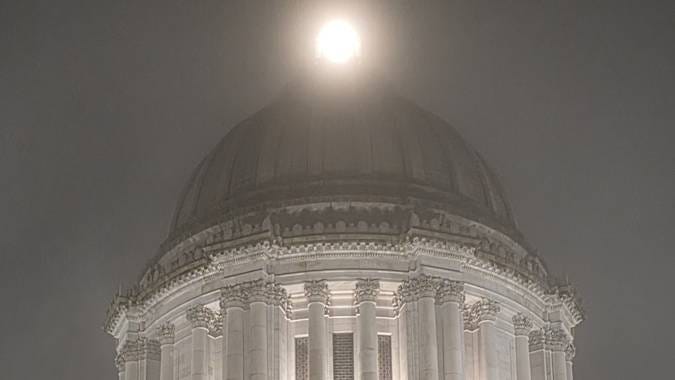
Washington State Legislative Building, Olympia — February 2026
Part 1 of 3 — Washington’s Income Tax Fight is Existential
Ok, I know that subhead sounds dramatic, but it should be. Earlier this year, the Washington legislature enacted an income tax with a $1 million deductible. There are so many things wrong with it, you couldn’t list them in anything less than book length. And since I know my audience, none of you are dying to read my treatise on it.
But let me cover the high points.
The tax is almost certainly unconstitutional, which is why Washington has been one of nine states without an income tax for nearly a century. By a combination of our constitution and 93 years of Supreme Court decisions starting with Culliton v. Chase, property includes “everything tangible and intangible subject to ownership,” and the court has rationally concluded that includes income. The state could enact a tax on income, but as property it must be uniform across all earners and capped at 1%. For obvious political reasons, that’s a proposal no one in Olympia has wanted to touch.
Enter someone with a dream. Someone who believes 93 years of court decisions and an unbroken record of voters rejecting an income tax are wrong, and who wants to overturn all of it because he prefers a progressive income tax — certainly higher than 1%, and targeting “the rich,” of course. That someone is Senate Majority Leader Jamie Pedersen, representing the 43rd district in Seattle (largely Capitol Hill, the most progressive enclave in the state). He laid the plan out in an email back in 2018, starting with capital gains income — er, excise tax (gotta draft around that pesky property thing…).
The right way to change constitutional precedent is through a constitutional amendment: two-thirds majority in both houses, then a vote of the people. With strong majorities in both chambers, they still couldn’t get there. So they used brute force instead. SB 6346 was drafted behind closed doors by the Democratic majority alone, in consultation with the Attorney General’s office, designed to do two things at once: insulate the bill from a referendum, and hand the current Supreme Court a vehicle to reverse 93 years of its own precedent.
Ok, four paragraphs of throat-clearing is probably enough. (And believe me, the above is the Cliff’s Notes version.) So why do I claim letting this stand would be existential? I mean, we already have B&O taxes, property taxes, sales taxes, capital gains “excise” taxes, real estate excise taxes, the long-term care payroll tax, the third-highest gas taxes in the country, the Climate Commitment Act surcharge, the highest estate tax in the nation (down from twice as high, yea!), paid family leave premiums, the plastic grocery bag tax, and even the highest alcohol and tobacco taxes around — to keep you from drowning your tax-induced sorrows. It’s the proverbial straw on the camel’s back.
“I don’t think we have an income problem. I think we have a spending problem.”
— Christine Gregoire, former Governor of Washington
Thank you, Governor, for stating the obvious.
Somehow, the crowd in Olympia (and King County, and Seattle) is so concerned about “affordability” they really, really, really need to levy another tax to fix the crisis. Even though all of those other taxes are exactly what made us unaffordable. It’s a simple premise they fail to acknowledge: whether a tax is aimed at a company or a person, it trickles down to come out of a resident’s wallet. Always.
And this income tax is particularly insidious. While being marketed as a “millionaire’s tax,” it’s really a tax on family farms and businesses. The pitch is that they’re just clawing back the ill-gotten gains of some nameless tech billionaire who came to Seattle and made the whole place unaffordable. But the tax applies to pass-through income — the earnings of every S-corp, partnership, LLC, and sole proprietorship in the state. That group represents 85–95% of the businesses here. Your local car dealership. Your favorite chain of family-owned Mexican restaurants. The local doctor’s office or medical clinic. That fun group of regional workout locations. Yeah, them.
Oh, and ignore the “biggest tax break for small businesses in state history” line Bob Ferguson and others are selling. They eliminated the B&O tax for microbusinesses grossing under $300,000 annually. Think about that for one second. The median household income in Seattle is $125,000. That $300,000 might pay the wage of the owner and one other employee — and that’s it. No office or storefront, no supplies, no raw materials. It basically exempts a political consultant working out of their basement or a home daycare. (No, the daycare folks actually make too much…)
And you know who won’t pay? The mobile knowledge worker who can do their job anywhere. A lot of tech founders are already packing up and leaving. But here’s the part that should make every reader stop and reread the sentence: the bill purposely leaves out public companies, which are organized as C-corps. The ones that have been villainized for years in Seattle politics — Amazon, Microsoft, Starbucks, Costco. The very companies endlessly protested and cast as evil capitalist monsters, the ones whose presence is invoked to justify the class-warfare framing that’s powering this tax, won’t owe a dime. In fact, during the same session, the legislature quietly eliminated the sales tax on software services. Isn’t there a company in Redmond that specializes in that?
But I don’t fully blame the politicians. They, like everyone, respond to incentives. That’s what every free marketeer understands. And the incentives here are unusually clear. The direct beneficiaries of this revenue flow are the public-sector unions: the Service Employees International Union (SEIU), the Washington Education Association (WEA), and the Washington Federation of State Employees (WFSE). They take their cut off the top through dues collected from state-paid employees — meaning the dues themselves are funded by your tax dollars. Those dues fund political spending. That spending elects the legislators who vote for the revenue stream that funds the dues that fund the spending. It’s a closed loop.
An income tax converts that loop from fixed to growing. Unlike sales tax or B&O, an income tax — especially a progressive one — scales automatically with the economy and with whatever new brackets the legislature adds later. Each year of growth means more dues, more political spending, more aligned legislators, and an ever-widening margin against any reform challenge. They can use that growing stream to swing elections against their political opposition indefinitely.
That’s why it’s existential. With a new, growing revenue source, the unions expand their political reach, ensure the election of legislators in lockstep with their priorities, and keep the class-warfare rhetoric loud enough to keep the rest of us on the sidelines.
If you care about Washington state, the time to engage is now. I know too many people who have already left, who are set to leave, or who have simply given up. The Democratic majority has been emboldened by years of success moving the state toward this moment. While we’ve been busy with our families, our communities, our jobs, our churches, our businesses, and our philanthropies, they’ve been slowly marching through every part of our institutions.
It’s time to say: this far, and no farther. LET’S GO WASHINGTON!
How we got here wasn’t an accident. It was engineered — and the trail goes back to 2018.
Part 2 drops Thursday.
No posts
Comments
Nothing yet. Say the first thing.
Sign in to join the conversation.