
0:00
-18:03
Okay, we’re off! Wish us luck.
The final journey, like as not, from our dear Pod to the airstrip – and it looks like it’s going to be a right bastard, at least the first few miles, across that nasty stretch of open sea.
The little RIB’s sitting a lot lower in the water than I’d like. What with the two of us, all of our food and as much in the way of personal possessions as we could cram into the dry bags.
But we’ve had to leave so much behind … Our laptops, our scuba gear, our kayaks and our whole lab and comms setup. I’m not going to pretend that doesn’t suck.
The wind, a nice, steady westerly, force five to six yesterday, has swung round to the south overnight and strengthened. Course it has.
Reckon it’s gusting gale force eight, out here in the North Passage. The cross-seas are ugly: triangular peaks popping up out of nowhere. So Maya has a lot of bailing to do. I’ve got my fist clamped round the tiller and my eye on the next wave.
Oops. Almost got swamped there. A filthy look from Maya. I’d better concentrate on the job in hand …
Phew!
Inside the Breakseas now, and we can unclench our sphincters. These nasty, icy little showers are still lashing across the bay every few minutes, stinging the few patches of bare skin left exposed by our waterproofs, but at least we’re out of that sickening swell on the beam …
Entering the channel. We’re in the lee of the high hills, and the water is flat and still at last. We can communicate without bellowing …
Except there’s nothing to say. That is, there’s lots to say, but no words to express it.
How wonderful it is, what a relief, to know that we’re not forgotten – amongst all the much bigger, more important problems that beset Tassie right now – and that there’s a plan to get us out! And how bitter it is, to abandon our little home – and the project which brought us here. We’ve achieved so little of what we planned!
I expect Maya’s thinking runs along similar lines, up there in the bow, with her face turned away. It’s going to be a long, silent trip.
Arriving at the airstrip at the end of a wearisome, dispiriting journey, we unload our gear onto the jetty, then drag the RIB up the bank and into the bushes. We’re grateful for the hand carts provided for passengers to load their baggage into. Because we still probably brought too much gear, and will have to jettison more of it here, when the plane comes to pick us up.
The keys are where Annie described – bless you, Annie! – and we set about making ourselves at home in the office.
At home? Good luck with that. It’s bleak here. The building’s impersonal and draughty after our cosy Pod. It’s damp, cold and smells of mice. The battery bank is low, but I find the diesel for the backup generator and get it running without too much swearing.
Yaay for heat and light and power. I’m starting to feel better now. On the other hand …
There’s only a microwave and an electric kettle for preparing food and hot drinks. Back in the Pod we had two gas burners and a small oven, thanks to the trusty biodigester, turning our solid waste into methane. Shit into gaseous gold, so to speak.
This place, on the other hand, just isn’t set up for habitation – no reason for it to be. There’s neither hot water nor a shower in the bathroom, for example.
Am I beginning to sound ungrateful?
Well, then. Let’s look on the positive side: there’s a good VHF transceiver, a powerful though elderly shortwave, and a nice, tall mount for the antennas.
‘Look on it as an Airbnb getaway, sweetheart! A romantic weekend away from home …’
Maya’s look says it all. I think I’ll pipe down for a bit, keep a low profile.
We find a spot to roll out our sleeping bags on the floor of the office, well away from the fierce draught that blows under the door. Then we eat a meal. For want of much else to do, we soon perform our ablutions, and bed down.
The next morning, after an uncomfortable night on the hard floor, I’m making coffee and contemplating a quick dash to the loo before I begin the first stint on radio watch. I hear the door and turn to smile at my beloved, who’s been for a walk in the half-light.
She bats me across the top of my head. Not entirely playfully, either.
‘You idiot!’
‘What?’ This harsh treatment really seems a bit uncalled for, especially this early in the morning. ‘What have I done now?’
‘Go and look.’
She points out the door imperiously, towards the creek.
‘What am I looking for?’
‘Just go. You’ll see. Down there by the creek. Through the bushes.’
I dutifully traipse down the path, rubbing my head.
I’d never really looked at the walkers’ hut before, the several times I’d flown in to prepare for our expedition. I knew it was there, alright. I just assumed it’d would be draughty and bleak, with a pong of sweaty socks or worse. Annie’s instructions were to stay at the terminal building, so that’s what I unthinkingly did, tired and sad after yesterday’s trip.
What I find when I open the door of the green-painted, corrugated-iron Nissen hut is a high, plywood-lined ceiling, a clean timber floor and a big, stone-built central fireplace. Next to the hearth, a metal pail of kindling and a small stack of tea-tree logs. In the dormitory area, comfy bunk beds with vinyl-covered mattresses. In the kitchen and dining area, a bench for food prep and a timber-topped table. Books to read. Floor-to-ceiling windows giving abundant light.
It’s not draughty at all. Or bleak. Indeed, it’s clean and welcoming and distinctly snug.
It’s less than two hundred metres from the building where we just spent a cold, uncomfortable night.
Well, aren’t I the one with shit for brains?
Apologies tendered and accepted, I offer to do a double watch at the radio in atonement for my sins. We check that the walkers’ hut is within hollering distance of the terminal. It is. Just.
With that kerfuffle over and done with, and marital harmony restored, we settle in to wait.
And wait.
And wait.
It takes less than twenty-four hours for relief to turn into psychological torture: having nothing useful to do, yet always being on tenterhooks for the call to come through.
One day turns into two, four, six. The longed-for call on one-two-six-point-seven megahertz doesn’t come.
It’s understandable. The weather’s bad – and worse: unpredictable. The pilots will have none of the usual satellite-based aids, no reliable forecast, and will be relying wholly on their own skill and judgement. They’ll come as soon as they can, and in the meantime, we must be patient.
So we take turns at tidying up the hut and the terminal and doing odd jobs around the place, and monitoring the airwaves – not just for our ride, but also for any news we can glean about the local, national and international situation, five weeks now after the catastrophe.
It’s disappointing, then, that we pick up less traffic than before at the Pod. Despite the more powerful shortwave transceiver and the better antenna. It might be the great, jagged lumps of Mount Rugby and Mount King blocking our signal to the north, Mount Counsel to the southeast. Is the Elliot Range repeater down, as well as Maatsuyker?
Or could it be that the situation in the world beyond the mountains, beyond the sea is deteriorating, rather than getting better? Are radio transmitters shutting down? Surely not so soon?
Most worrying of all: Maya can’t find Narelle. Our friend seems to have vanished from the airwaves. Has something happened to her? Has her son come at last to pick her up? Wouldn’t she have taken her precious radio set with her?
Where are you, Narelle?
On day seven at the airstrip, I’m sipping at my mid-morning mug of tea. As usual I made it, forgot it, and now it’s tarry and lukewarm. The life of an absent-minded bloke holds many such minor disappointments.
The radio crackles and scrawks, scaring the bejesus out of me.
‘Melaleuca Traffic, Cessna one-seven-two, Juliet-Alpha-Quebec, one-five miles northeast, at three-thousand-five-hundred, inbound to runway three-zero, Melaleuca.’
They’re following standard procedure, announcing their position and intentions to any other aircraft in the vicinity. Not that there’ll be any, but procedure is procedure. Then comes the first message directed at us:
‘Melaleuca Airstrip. This is Cessna one-seven-two, Juliet-Alpha-Quebec. Over.’
My hand shakes as I press the PTT button.
‘Cessna one-seven-two. Melaleuca Airstrip here. Nice to hear from you. Over.’
‘You too, mate. Mitch, yeah? Over.’
‘That’s right. Over.’
‘Baz here, co-pilot. Sitting right next to me is Cheryl, your captain for today’s flight. Got your bags packed and ready to go? Last-minute duty-frees? Ready for a quick turnaround? Over.’
‘Affirmative. Shit yeah. Come and get us, Baz and Cheryl. We’re more than ready to get out of here. Over.’
‘Nice one. ETA fifteen minutes. One-five. Request assessment local conditions. Over.’
I take a squizz out the window at the wind sock. Hmm. It’s getting blowy out there. It was dead calm an hour ago. Must be the sea breeze kicking in. Would you credit it?
‘Visibility excellent. Wind southwesterly. I estimate twenty-five knots. Gusts thirty. Over.’
A short pause.
‘Say again wind direction and speed. Over.’
‘Southwest. Sierra Whisky. Twenty-five, two-five knots gusting thirty, three-zero. Over.’
‘Okay … We’ll see how it looks when we get there. Stand by, Mitch.’
‘Melaleuca Airstrip standing by.’
Baz and Cheryl will be having some serious words about the feasibility of this undertaking, I expect. I’m about to yell for Maya – but here she is already, lugging our bags. I look into her anxious, expectant face.
‘Will they be able to land in this?’
‘I bloody well hope so. Fingers crossed, eh?’
Before long, we hear the faint drone of a motor. Then a dark speck emerges out of the cloud over Mount Norold. Here they come!
The airstrip runs northwest to southeast. So the strong, gusty breeze from the southwest is going to make landing and takeoff … interesting.
The Cessna banks over Mount Rugby and lines up for the airstrip. Nice and steady. The little aircraft comes in like it means business.
Bless you, Captain Cheryl!
Then, a few hundred metres short of the landing strip, she yaws violently. Simultaneously we’re hit by a gust of wind.
Undaunted, she steadies and keeps coming in. The wheels are no more than ten metres above the quartzite – and another sharp gust. Again, the aircraft is knocked sideways. The wings waggle and for a heart-stopping moment I think the port wing tip is going to clip one of the paperbarks.
Cheryl regains control and they climb steeply, roaring over our heads. I catch a glimpse of a face looking down at us from the starboard window. That’ll be Baz.
I run back into the building to hear what the deal is.
‘Melaleuca Airstrip. This is Cessna one-seven-two. Over.’
‘Looked a bit dicey there. Bit of a brown trouser manoeuvre. Over.’
‘Bloody oath, mate. It was Code Brown alright. We’re going around. Bear with us. Over.’
They try three more times: two from the northwest and one from the southeast. On the final attempt, it looks like they might make it, but no: they have to pull up with just metres to spare.
It’s gutting to see these brave people risking their lives for us. I’m also crapping myself at the prospect of the little plane having to do this in reverse – with a hundred and fifty more kilos on board.
‘Sorry, mate. Can’t land in this crosswind. Don’t worry. We’ll be back, soon as we get another weather window. Stay tuned. Over.’
‘No worries, Baz. Captain Cheryl, you’re a bloody legend! Stay safe and don’t take any risks on our account. Melaleuca out.’
The airstrip seems lonely as never before, after they’re gone. Maya and I stand in the forlorn little waiting room and hug in silence. There’s nothing to say.
An hour before dusk, the wind eases. I stay glued to the radio until it’s fully dark outside, but the set remains silent.
Another interminable week follows. Day after day of radio silence, though the weather is mostly mild and the wind often light. What’s going on? Our supplies are running low.
We hope that the aircraft will at least come over and drop extra supplies, even if the last attempt has spooked the pilots against attempting a landing in less than perfect conditions. But no.
I wish I’d had the presence of mind to question Baz about the situation in Hobart, but I was too elated by the plane’s imminent arrival, then too stunned by its departure without us, to pump him for information.
Then, eight days after the abortive evacuation attempt, the radio crackles to life again – and scares the living crap out of us.
‘Mayday, Mayday, Mayday. This is Cargo Ship Wickham Trader, Wickham Trader, Wickham Trader. Call sign Alpha Charlie Oscar niner-five-eight. Mayday Wickham Trader. My position three-niner degrees, five-seven minutes, four-eight Sierra. One four-four degrees, four-one minutes, four-two Echo. Under attack by pirates. Two boats alongside. Require immediate assistance. Five crew on board …’
The message cuts out.
The position puts the stricken vessel between King Island and Cape Grim – an obvious choke point for ship traffic. In other words, a lot closer to home than we’d like: just off the northwest coast of Tasmania.
‘Pirates?! For fuck’s sake!’ exclaims Maya, as we stare at each other, wide eyed.
This is surreal.
‘Why would they even do that?’ I wonder.
‘Extortion, I guess. They’ll hold the ship and its crew to ransom.’
‘Mmm but if the banking system’s down, how’s anyone gonna pay them? Who’s gonna care enough to pay them, bluntly?’
‘Maybe it’s the cargo they’re after, then. If Wickham Trader’s carrying essential supplies for King Island, for example …’
Speculation aside, it’s eloquent and terrifying testimony to the breakdown of law and order. This is Bass Strait we’re talking about, not the Malacca Strait or the Gulf of Aden. You can’t get away with that sort of brazen high-seas crime here.
And yet, here are some organised and ruthless people who clearly think they can.
‘Okay. Enough’s enough,’ says Maya, after we’ve been silent for a few minutes, digesting what we’ve just heard. ‘Time to get out of here.’
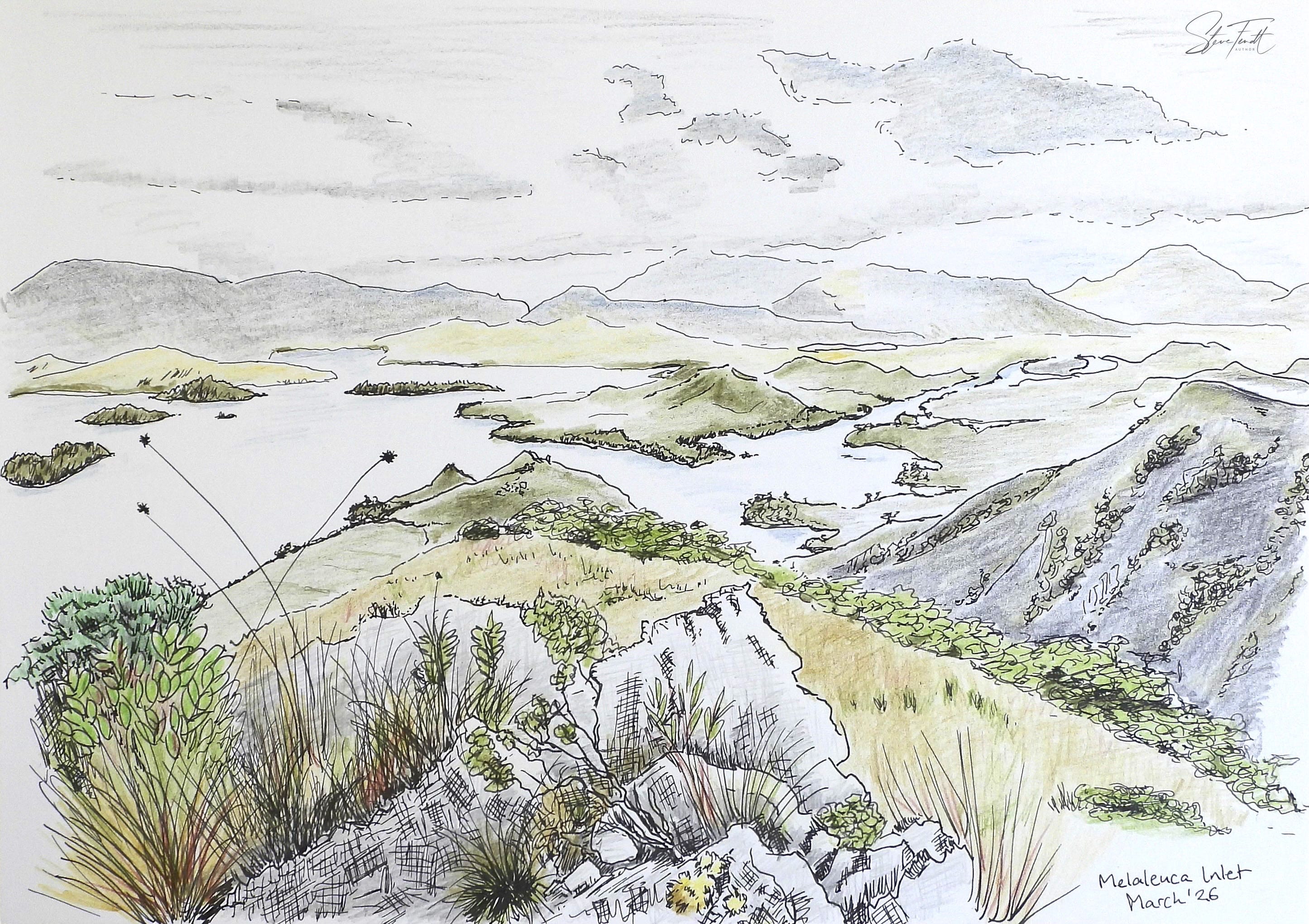
Title image ‘Melaleuca Inlet’: Pen and coloured pencil on Bristol paper. This was my view eastwards from Mount Beatty, above Claytons Corner. The summits of the hills are open moorland, dotted with white dolerite boulder outcrops. In the steep, damp gullies, rainforest trees, ferns and mosses create a still, secret world in contrast with the windswept tops and their stunted paperbarks, buttongrass and scoparia heath. With the ever-changing weather and the mosaic of sun and shade across the complex, watery landscape at my feet, the overall impression was of astonishing variety and wild beauty.
Comments
Nothing yet. Say the first thing.
Sign in to join the conversation.