
0:00
-21:36
We’re setting off from Recherche Bay just as the eastern horizon begins to lighten. We’ll stand out to sea to the southeast, heading well offshore to disguise our destination from the watchers on the headland. By the time it’s fully light, we’ve have put ten miles between us and them, and can set course for home.
Though sailing the yacht requires vigilance and occasional bursts of vigorous, not to say frantic, physical activity, we’re settling into a routine. Compared to the chug of a diesel or the muted roar of a pair of big outboards, under sail it’s wonderfully quiet on board. There’s just the occasional flap of sailcloth, the whistle of wind in the rigging and the slap and hiss of water against the hull.
As our minds unclench with the leaving of the land and its dangers, there’ll be time for conversation and for following our own private thoughts.
We should make the most of it. There’s going to be very little leisure when we get back to Poynduc. Just hard, unrelenting work, if we’re to survive beyond the eight months our supplies will buy us.
‘Did you know, there was a crackpot plan, during the Second World War, to establish a Jewish homeland in Poynduc?’ Maya wants to know.
‘Yeah, I did, as it happens. What would your grandparents have thought of that?’ Maya’s maternal grandparents were Polish Jews, refugees who lost their entire extended families in the Holocaust.
‘They’d have thought it insane. Better the desert in Palestine.’
‘Understandable. Maybe Poynduc turned out the better bet, though, in the end?’
‘Maybe.’
She sounds as if she’d like to be convinced. I’ll give it my best shot.
‘Well, by the time our fellow human beings have finished squabbling over the bones, the scraps of this civilisation, you reckon there’ll be much left? In Israel, Australia or anywhere?’
‘The way it’s looking right now? Not really, no.’
Unspoken: thoughts of our families, out there, at a distance that’s become insuperable. The other side of the world is suddenly as far away as the other end of the Milky Way.
‘So we’re better off where we’re headed. Right?’
It’s occurred to me since our abortive trip to Hobart that my fears of being ‘visited’ in Poynduc were unfounded. This lot, by which I mean the current crop of human beings on this planet, has far too many spoils to fight over in the cities and suburbs and country towns. It’ll keep them occupied for decades.
By the time there’s nothing left to scrap over, the survivors in their dystopian hell-holes will have forgotten all about the remote region of Poynduc, in the inaccessible southwest of the obscure island of Lutruwita or Tasmania. Even if a few adventurers do think of it, it’s difficult to reach, and there’s little there. We’ll have the place to ourselves for the foreseeable future, as long as we don’t do anything stupid to draw attention.
What do you think, imaginary followers? Are we doing the right thing?
I guess you’d be running for your lives or maybe even dead by now, so why am I even asking? These podcasts and video diaries I’ve narrated, these posts I’ve written in my head, they’ll never be sent.
And no offence, maybe that’s a good thing. My disgust for this ‘civilisation’ we’ve created grows daily: I want no further part of it. For eight thousand years we denuded the land, poisoned the rivers and plundered the seas, set far too many of our offspring upon the Earth. And then, eight short weeks is all it took.
Eight weeks, until it all turned to shit. It’s not exactly impressive, is it?
Our children, the sons and daughters of Maya and Mitch, will grow up resourceful and resilient. I’ve little doubt about that. We’ll do our best to plant their feet firmly on this Earth; we’ll teach them to swim and navigate its pristine waters, use its fertile soil wisely. Together we’ll discover and grow in Poynduc – a harsh land to be sure, but beautiful.
No harsher than the land my Scottish crofter ancestors farmed, in fact. And at a more human-friendly latitude: as far south of the Equator as Tuscany and Wyoming are north.
Who knows? Maybe one day my son Archie will find his way here, to his old man’s last known address. Maybe we’ll find others we can trust, and invite them to come live with us, and together we’ll nurture the tiny seed of a better society.
Utopian thinking? Naive? Shades of Moses, Noah or Joseph Smith? Shit, I hope not. Cheery Aussie pragmatism and Scottish grit, I’d prefer to think.
It’s been a good morning’s sailing in a moderate northerly, though occasional stronger gusts tumbling down the mountains are keeping us on our toes. The swell from the west is big, but regular. First Light is a well-found vessel: she responds nicely to the helm, and she’s fast, Maya tells me, for a cruising sailboat. On the way to Recherche Bay from Bruny we averaged seven knots, and often touched nine. Not bad for a novice crew.
We’re learning more about handling the boat as we make our progress westward, and settling into our roles. Maya as skipper and helmswoman, me as relief helmsman, navigator, deckhand, cook and cabin boy.
According to my navigational efforts, using knowledge and skills dredged from the depths of my memory and aided by First Light’s fancy sonar and radar, we’re midway between De Witt Island and the Mewstone now, at twelve noon.
But hello, what’s this? There’s a disturbance in the water, maybe half a mile off our port bow.
We’ve had abundant seabirds around us all morning, both coastal birds like gulls and gannets, and pelagics like albatross, petrels and prions. We’ve been tallying species as we go. Yes, old habits die hard, if at all; and we need the sense of normalcy. Five albatross species so far: mostly the misnamed shy albatross, shameless hussies of the albatross family who’ll paddle after a boat like eager, oversized chickens if there’s a feed in view, but also black-browed, Buller’s, sooty and a distant sighting of a great wandering albatross, we think.
But this particular little patch of sea is attracting a greater concentration of avian activity than anywhere else so far. Albatross, cormorants, petrels and gannets – wheeling, landing and alighting. Looks like there’s a big shoal of baitfish, maybe redfish or pilchards.
And not just birds are homing in. Now we’re being overtaken by a group of dark dorsal fins and curved backs scything through the waves: a big pod of dolphins, maybe thirty or more, hurrying to get in on the action.
A jet of water over there, where the birds are at their thickest. A whale! Through the binoculars I can see it’s a humpback and, to judge by its size, a juvenile, perhaps two or three summers old.
I’ve often seen how a solitary whale youngster is the focus of activity for other, smaller cetaceans, particularly common dolphins and pilot whales. They seem to like to hang out together.
Here comes a pack of fur seals! It’s on for young and old here. The baitfish break the surface and scatter in their desperation to escape. Poor little sods. Beneath the waves, powerful, fast tuna will be herding the prey into bait balls, driving them towards the surface, silhouetted against the light, then slashing through the spheres of quivering, silvery life. It’ll be carnage down there.
No time for sightseeing, so we have to sail on by. The abundant life of our ocean home is marvellous to see, though. It gives me hope.
I believe we’re entering an era when the apex predator by land and sea will be absent, or at any rate, much less prevalent and active. Yes, my friends, that’s us. Our calamity could create a breathing space for all the other life forms which share this planet.
Without internet banking and satellite navigation, there’ll be no global economy. That means little incentive to harvest more than we need for our own families and communities, and for local, maybe regional trade. No whales will be hunted, other than in Faroese fjords and around the ice floes of the Arctic. No krill will be harvested, and no kilometre-long nets will scour the sea beds of the continental shelves, dragging up hapless fish from the black depths, to gasp their last in the hold of a trawler. The Atlantic salmon in the Tasmanian estuaries will all be dead, the cattle in the feedlots and the pigs in their pens all slaughtered or escaped. There’ll be no industrial farming, no monocultures larger than a few hectares, no mechanised irrigation.
Ah, but.
Bushfires will rage across Australia, including our beloved Tassie, with unprecedented ferocity. And not just Australia: California, Provence and Greece, anywhere with highly flammable vegetation and drought conditions, will suffer apocalyptic mega-fires.
Tailings dams will collapse, releasing their lethal slurry into waterways, which will die overnight. Eventually the great walls of the Gordon, the Talbingo, the Garrison, the Tarbela, the Fort Peck Dam will crack and fail, unleashing devastation for thousands of square kilometres downstream. The nuclear reactors will melt down and the oil wells will spill their effluvia onto the earth and into the ocean.
The world’s going to be a big, sorry mess for a long, long time, with a great deal to grieve the loving heart of a biologist and environmentalist. You don’t just remove a keystone species like homo sapiens industrialis from a biome without major consequences – many of them far worse than the romantics and misanthropes would care to believe.
What of the survivors? What place will our descendants find in this strange new world? What kinds of society will they experiment with? Will they learn from our mistakes, or just repeat them?
‘Oi! Sheet in that bloody genoa!’
But it’s not entirely the fault of the deckhand’s daydreaming. The wind has changed. Is changing.
And that’s when things start to go, in sailing parlance, tits up.
The breeze has swung into the west and strengthened. According to the wind gauge, it’s nudging thirty knots now. Just two knots below gale force.
We’ve left it late to reduce sail, I’m told. A bit crossly, though it certainly isn’t my fault. I don’t really get how the process works yet, to be honest, but I follow instructions. Kickers and topping lifts and reefing lines and Cunninghams are involved, though they all just look like ropes to me.
As I pull cluelessly on this rope and that, I’m reminded why I quickly lost interest in sailboats, as a kid. Sailing is hard work, and mostly unrewarding.
In particular, it’s very hard to sail into the wind. It involves a lot of hurrying back and forth, back and forth, like a beagle trying to pick up the scent trail of a fox, with turns called ‘tacks’ in between, wherein you swing the bow of your boat into the wind, and hope to Christ it doesn’t stick there, but carries on through the eye of said wind, so that it ends up blowing on the opposite bow to before.
And of course, it’s Sod’s Law that wherever you need to get to is exactly where the wind is blowing from.
Now theoretically, I’m told, a good boat can sail at forty-five degrees to the wind, or thereabouts. Theory’s all very well, but when you’ve also got a three-metre swell trying to knock you right back the way you came, and you’re short-handed on a boat you’re just getting to know, forty-five becomes more like fifty, fifty-five, or sixty. Which means you’re working your arse off, covering a lot of ground, but making very little progress towards your destination. It’s a remarkably inefficient mode of travel.
Plus, your boat’s heeled over and the deck that was reassuringly horizontal before, when the wind was aft of the beam, is now uncomfortably close to vertical. When your skipper insists that this is nothing to worry about, and exactly what’s supposed to happen, you try very hard to believe her.
I’m at the chart table, which is pitching around as if it’s on the back of a rodeo mustang, with parallel rule and compasses to hand, drawing wobbly pencil lines and willing our boat to sail just a few degrees closer to the wind. It’s not much to ask, surely?
Our mission is to press westward – into this bastard wind – until we can weather jagged South West Cape. Then we hope to sail straight up that cruel coast on one tack, and arrive at the approaches to Poynduc.
The turbulent and rock-strewn approaches to Poynduc, parts of which have the dispiriting word ‘UNSURVEYED’ across them on the chart before me.
‘Rock-strewn’ ain’t the half of it. I’ve seen these rocks from inshore, and they might look small and inconsequential on this chart, but they’re big, nasty, triangular fuckers. The East Pyramids. Big Caroline. Like the teeth of a bloody great shark. Even worse are the little, sneaky ones in between, lurking just below the surface, slavering, eager to chew the bottom out of our boat.
So I would really, really like GPS to be working right now. But of course, it isn’t. As we know all too well, the satellites which the fancy chartplotter needs to triangulate our position are all offline – and chances are, they ain’t ever coming back.
Unless we’re blessed with some miraculous wind shifts, we’re going to lose the race against the approaching night. Even though right now we’ve still got five hours of daylight left.
So we’ll be making the final approach in the dark.
The fuzzy, incomplete outline of the coast on the radar screen only tells me so much, and after darkness falls, there’ll be no landmarks to take a bearing on. Once we round the Cape and head northwest, we’ll lose the powerful beam of the lighthouse on Maatsuyker.
We can’t stand off and on all night, becoming increasingly disoriented on this unlit coast. In weather that could turn from awkward to lethal any time it chooses. We’ll just have to go for it, and hope for the best.
It’s all going to depend on this little five-pointed star here on the chart. ‘Fl 5s 9M.’ A white flashing light with a period of five seconds and a range of nine miles. It’s the light beacon on Whalers Point. The one that old Clyde Clayton built and used to maintain, lugging cylinders of gas up the cliff with his bare hands.
Is it still working, now the acetylene has been replaced by a solar panel, and the light has to fend for itself from one biennial service to the next?
The last five hours have been a blur of activity.
‘Lee-HO!’ from Maya as she prepares to steer through the wind. Sheeting in the mainsail until it’s taut as a board, to let it through the eye of the wind without a jarring crash that could break the boom at the vulnerable gooseneck – the hinged junction with the mast. Maya’s pushing the boat right up into the wind – then through, as the sky and waves pivot a hundred degrees. I let the backed genoa help push the bow round, then let off the weather genoa sheet and simultaneously crank the lee winch like fury – to pull that huge triangle of sailcloth round the inner forestay and hope to Christ it doesn’t snag. Because if it does, I have to claw my way crabwise across that heaving, slippery foredeck to free it. Again.
Thanks be, the genoa’s sheeted in now – without snagging. No time to rest, though … Haul on the traveller for all I’m worth to pull the boom up to weather. The boat heels – and what was uphill before the tack is now downhill. Adjust the genoa and mainsail sheets so the sails are as aerodynamic as possible …
All as the boat bucks, the wind howls, spray and sometimes green water crashes across the foredeck. Trying to catch my breath, tug at the hood of my raincoat so that I can see, while continually adjusting and fiddling with sheets, the Cunningham and the kicker to optimise the sail’s three-dimensional geometry under Maya’s exacting direction. All with the aim of pushing the boat through the water on the optimum course.
All done for the moment? Maya nods.
Great. I take a bearing with the hand compass and claw my way down below, hand-over-hand, dripping, to mark our time, position and new course on the chart.
Our two lives have a single focus, a single purpose. To weather that damned cape. Maya’s pinched, pallid, spray-wet face above the wheel: the grim expression tells me how mine must look to her. Only mine looks probably more frightened than resolute.
Then as we close the land, the breeze falters and shifts, we encounter confused cross-seas reflected from the vertical wall of rock – and we have to adjust, adjust, adjust our course … until Maya conceeds we’re not going to make it. Not on this tack.
Lee-ho and the same exhausting ordeal over again. Standing out to sea, away, away, away from our goal.
Three times we think we’re going to make it. Three times we’re wrong. Three times thwarted, we tack back out to sea.
Now it’s our fourth go, and the light’s beginning to die.
But what’s this? The wind has backed twenty degrees, and suddenly we have plenty of sea room. If it had been like this all afternoon, we could have sailed straight here from De Witt Island – and would have been at this point three hours earlier, fresh as daisies and ready to tackle the difficult approach to Poynduc in daylight.
You really have to wonder whether someone ‘up there’ is taking the piss, don’t you?
We slip round the two-hundred-metre-high cape as smoothly as you please, with a good half mile to spare. If the wind stays like this, we’ll have a fast final leg: a beam reach with the boat not too steeply heeled, though the big swell from the west will make a bumpy ride of it.
Come on, Clyde, me old mate. Don’t let me down. Where are you?
I’m standing as upright as I dare on the weather deck, binoculars pressed to my straining eyes, peering into the gloaming, looking for Sugarloaf Rock and Hilliard Head – landmarks we need to leave well east of north, if we’re to stay out of trouble. Sugarloaf is a hundred metres of vertical rock, and Hilliard is twice that. Conspicuous, you’d have thought?
Ah, but the weather’s thick now. It looks like this latest wind shift was the warm front coming through, bringing steady rain. All landmarks ashore are obscured by shifting grey curtains of water.
Sugarloaf and the East Pyramids can only be a couple of miles off. I’ve given Maya the course three-one-five degrees magnetic to steer – northwest. It should keep us off the rocks as Poynduc opens on our starboard bow. I hope.
There!
A pin prick of light against the murky smudge of coast. Then it’s gone. There it is again – and gone! One-elephant, two-elephant, three-elephant, four-elephant, five-elephant. There! A white light flashing every five seconds.
Bring us home, Clyde, old buddy.
THE END
I hope you’ve enjoyed The Poynduc Podcast, lovely reader. I’ll be taking a break for a couple of weeks. Then we’ll embark on the next novella in the Poynduc trilogy: Children of Poynduc. Thus called because … well, you’ll see.
Wishing you fair winds and calm seas until then!
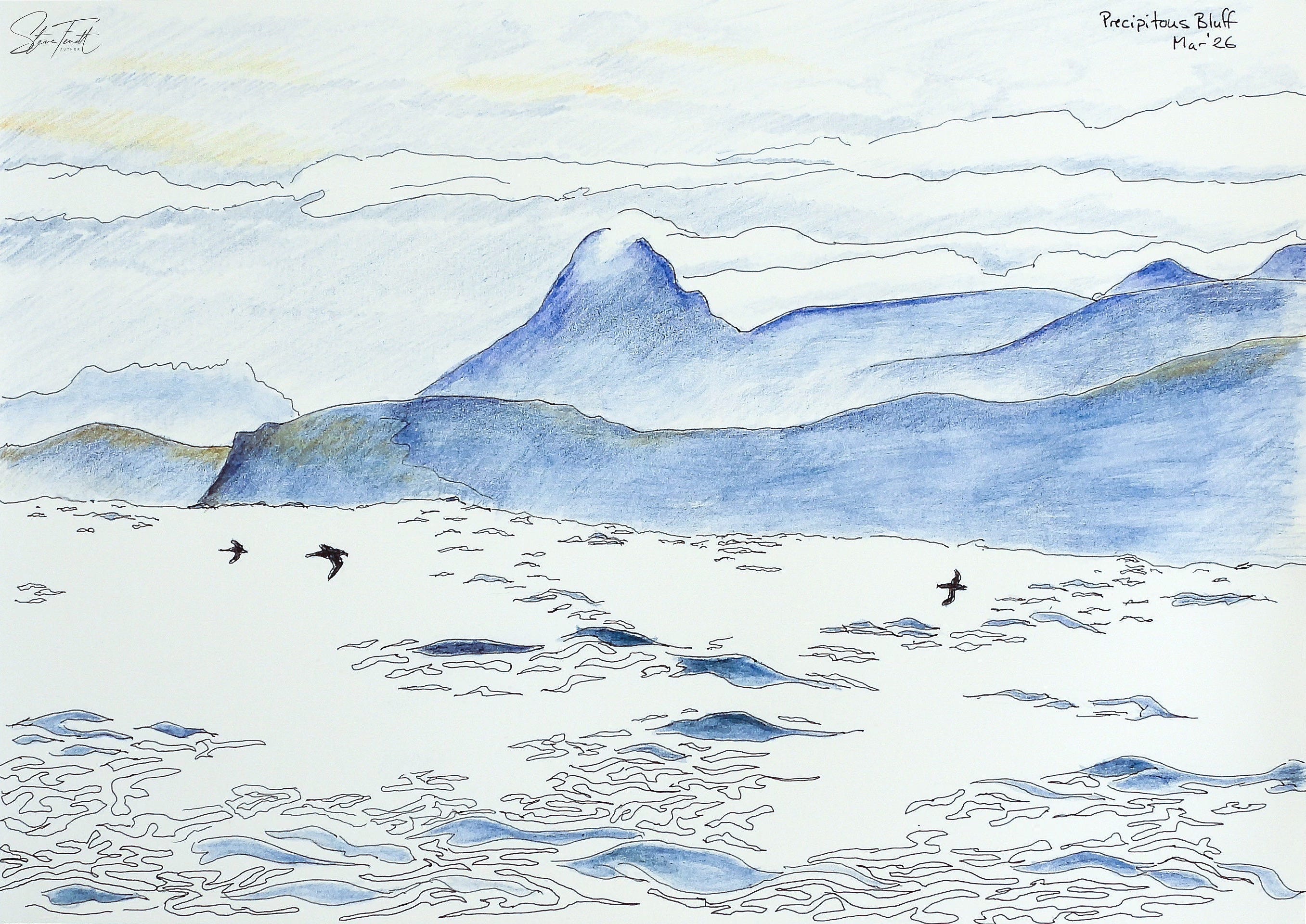
Title image ‘Precipitous Bluff’: pen and watercolour pencil on Bristol paper. Yes, it really is called that. A prosaic, if apt, name for an extraordinary geographical feature.
Comments
Nothing yet. Say the first thing.
Sign in to join the conversation.