
0:00
-18:34
North Bruny seems deserted, as far as we can see in a quick reconnoitre.
It looks as if everyone has left in one hell of a hurry, probably rushing to catch the last ferry off the island. As a result, I guess, there hasn’t been much destructive looting, just a lot of untidy packing and hasty departure, even front doors left swinging open. There are dogs barking, howling or whining: some aloof or aggressive, others ingratiating; all bewildered. Cats roam, some bold and cocksure, others shy and furtive. Cattle low in the paddocks, desperate to be milked. It breaks our hearts, but there’s nothing we can do for any of them.
Back to Dennes Point. We sit on the grass, despondently watching the pall of smoke that hangs over Hobart. We’ve invested a lot of hope in that destination – but right now, it’s looking pretty bloody unwelcoming. Over the last three days, I’ve had a growing feeling that we’re hurrying towards something we should be running away from. Now it’s a near certainty.
‘You know –’ I begin.
Maya raises her eyebrows, encouraging me to come out with whatever it is.
‘I’m kinda thinking we should grab some supplies and high-tail it back to Poynduc,’ I continue. ‘I mean, this situation, it’s just … totally fucked.’ I wave my hands helplessly. ‘Maybe we should give the world a few more months to sort itself out? Or a few years?’
Maya puts her thinking face on, frowns out to sea.
‘You’re not wrong,’ she says after a while. ‘There’s nothing for us here right now, as far as I can see, other than an awful lot of grief … and the chance of a very unpleasant death.’
I can’t suppress a shudder, thinking of our near miss, only two nights ago. Jesus, I can still hear that guy’s screams …
‘We wouldn’t be the first couple to live at Poynduc long-term …’
‘No. we wouldn’t. I tell you what though, Mitchell Davies …’
‘What?’
‘I’m not walking home – along that fucking track.’
It’s a reasonable standpoint. Though I’m thrilled to notice she said ‘home’.
‘How about sailing home, then? How’d you feel about that?’
‘A fishing boat, you mean, or a motor cruiser? Either way, we’d need a lot of fuel, and I doubt the looters will have left us much. The other looters.’
‘No. Sailing. Proper sailing. On a sailing boat. Like that one, right there.’
I point over towards the mainland, a mile distant across the Channel. There’s a little bay opposite us, and we can see a few boats there, swinging on their moorings. One in particular has been catching my eye for a while now.
Through the binoculars I can see it’s a sleek, modern, white-hulled yacht with a single, tall mast. The boat looks to be about fifteen metres long: a good size. We could stow a lot of provisions on board without weighing her down. An ocean-going vessel with a powerful rig, yet simple: one mainsail and one headsail. How hard can it be, to sail that?
As long as nothing breaks, jams or gets tangled: imagine having to be winched up that mast in a gale and a five-metre swell …
‘It’s a nice boat,’ affirms Maya, after taking the bins from me. ‘But do you have any idea how to sail it?’
As a scientist who spends a lot of time at sea, I’m comfortable around boats. I’ve got my Master V ticket. So I can legally and safely skipper a power vessel of that size: a dive boat say, or a large survey RIB.
A yacht, though? A proper yacht, with sails and everything? Not so much.
My experience of life under sail is encompassed by the two weeks of dinghy sailing school that blighted my childhood summer holiday one year. I think Ma and Da decided it’d be good for their bookish, risk-averse son. So I found myself bobbing about on the local loch in a small, pram-like vessel appropriately called an Optimist. Bellowed at by a red-faced instructor whose job was to build our characters, teach us the rudiments of sailing and keep us from drowning. In descending order of importance.
‘Well, in principle, I guess you could say …’ My voice trails off.
‘That’ll be a “no” then,’ summarises my spouse, correctly. She continues to survey the vessel. ‘I’m a bit worried about that roller genoa. Less foredeck work than a hanked-on headsail – with a novice deckhand – but more windage aloft in a big blow. Which we’ll definitely be getting plenty of, where we’re going. At least it doesn’t have one of those horrible in-mast furling mainsails. I wonder if there’s a full suit of sails? Storm jib and trysail, for instance, we’re probably going to need those …’
‘Sounds like you know what you’re talking about.’
We’ve never really discussed sailing before, I realise, proper yacht sailing, with sails and everything. It’s just never come up in conversation, in all the time we’ve spent together on the water. And I probably assumed, as a manly man, that I automatically knew more about manly sailing matters.
How embarrassing.
‘I do have a past, you know,’ she smiles, and enigmatically neglects to enlighten me further. ‘Look, I think it might suit us, but I’ll have to get on board and check it out properly.’
‘Sort of try-before-you-steal kind of thing?’
‘Uh-huh. And before we get too carried away, we need to know that the owners aren’t around, ’cause I’m not up for piracy. The boat seems to be shut up and there’s no tender on the davits or tied astern, so those are good signs.’
‘Right … So now what?’
‘We keep an eye on it today, and if there’s no comings and goings, I say we paddle across soon after dark. We slip our mooring and motor out into Storm Bay nice and quiet, then sail down the east coast of Bruny. I’m not going anywhere near the Huon estuary and those salmon pens – ever again. We’ll anchor off the old pilot station at Variety Bay, maybe? Should be quiet there, no houses overlooking the beach and usually no boats. Then we paddle ashore, to provision before dawn. Okay?’
‘Okay.’
‘If we’re going back, though, we’ll need serious provisions. Enough dry staples to last us at least a year. We can catch fish.’ She pauses to eye me sceptically. ‘And we’ll be able to grow tubers and root veg and beans and brassicas at home, but it’ll take time to get a productive garden going.’
‘True.’
‘Which reminds me: we’ll need gardening tools. And seeds! And …’
We both start to get excited about the prospect. It’s taking on more the character of an expedition, rather than running away from a grisly situation. Then a thought occurs to me.
‘Half a mo’. How are we going to get all this stuff we’re hoping to loot on board the yacht we’re hoping to steal? Is there a jetty?’
‘Good question! You’re not just a pretty face, darl.’ She pats my cheek. ‘No, I don’t remember one. So we’ll have to borrow a tender as well. Something we can tow until we no longer need it, a tinny or an inflatable.’
‘And to get the stuff we’re hoping to loot to the pilot station …’
‘Yeah, we’ll need a car. Truck. Whatever.’
First two sea kayaks, now a yacht, a tender, a road vehicle, provisions … This crime spree’s getting out of hand. Where will it end? And will we have to justify all this to someone, some day?
I’m reluctant to take a car or truck, making noise and drawing unwelcome, probably hostile, possibly armed attention. Mind you, there’s only about a thousand people on the island in winter, most of them retirees, and most of those live on South Bruny, south of the narrow, sandy isthmus of the Neck. If any of them haven’t left, we can hopefully keep out of their way.
We start to investigate the tiny township of Dennes Point. There’s nothing in driveable condition on the first few properties we enter, with a diminishing sense of trepidation as we get used to the idea of trespassing. We get briefly excited over the discovery of a Ford one-tonner in a driveway with keys in the ignition, but the fuel tank’s empty. We’ll find the same, no doubt, for every other vehicle that’s been left behind.
Then, just as we’re giving up hope, we find our ride, in the carport of a large house set back from the road. It’s an electric delivery van with ‘North Bruny Providore’ in a swirly script on both sides. It’s a boxy little thing and doesn’t look like it would do more than fifty km an hour under any circumstances; not even falling off a cliff in a stiff following wind. Not quite what I might have hoped for, then, for my very first joyriding experience. We won’t be doing any burnouts. But it’s fully charged, and it will serve the purpose.
Then we get quite excited about the big metal shed behind the house, anticipating delicious rustic fare courtesy of ‘our’ providore. But the shed’s empty. Nothing more than a few broken pallets and an empty chest freezer. Bugger.
Well, we’ve got our wheels, so let’s get on the road. We leave the kayak where it is, carefully concealed behind bushes above the beach, cast a last glance over to ‘our’ yacht – and go looting.
I never thought the collapse of civilisation, if it were to come in my lifetime, would lead to my dismantling a polycarbonate-paned, aluminium-framed greenhouse using a Phillips screwdriver a size too small for the job.
Yet here we are.
‘It’ll double our growing season,’ Maya points out as I grumble and curse. I can’t help but imagine the owners’ outrage, should they ever return: ‘The fuckers even stole our greenhouse!’
They must be keen gardeners. We find little packets of veggie seeds, neatly labelled, in a biscuit tin in the potting shed. There’s a hessian sack of potatoes, already sprouting. There’s a garden fork, a spade and a mattock: well-used tools, but clean and with their handles carefully oiled. Now I’m feeling really bad.
Back on the road. Maya makes me stop at a landscape supplies store to pick up a roll of fencing wire and some star pickets.
‘Gotta keep the local wildlife out of our veggie garden,’ she explains. ‘Otherwise we’ll be feeding the wallabies and possums and wombats and pademelons, not ourselves.’
She’s getting right into this. I never thought of my wife as a doomsday prepper. Though is it still prepping, if doomsday has already occurred?
We venture into a garage-cum-workshop, left wide open in the householders’ rush to leave, and help ourselves to a crosscut saw and other carpentry tools. The little van’s getting quite full.
And then, of course, most important of all, there’s food. We visit the general store in Alonnah. Most of their perishables are long gone – or have perished – leaving the less attractive dried goods: a tub of split peas, a big sack of rice that the mice have already started on, and some cornmeal. Vegemite.
Raiding the houses in Alonnah yields tinned goods, but the pickings are slim. This isn’t food enough to last us a year, not by any stretch. Then we strike it lucky with a big can of olive oil and several kilos of dried pasta. Shelves of home-bottled passata. Bless you, Italian homesteaders of Bruny.
Though the Alonnah pharmacy has already been looted, it’s been done in a hurried, half-arsed fashion. Probably just druggies looking for opiates. It’s still a mess, though. We sift through the wreckage of overturned shelves for wound dressings, antiseptics, antibiotics, anti-inflammatories. Anything to stock up our first aid kit.
‘You know, I’m not sure we need these,’ says Maya, looking at the packs of Trifeme she’s just picked up from the floor, then looking at me. ‘Do you think we do?’
Ever slow on the uptake, I don’t get her meaning right away. My immediate concern is that she’s saying snuggle time is cancelled forthwith and therefore we don’t need contraception.
Then, at last, I get the point.
‘Uh, no. I guess not … if you don’t think we do?’
‘Okay, then. That’s exactly what I don’t think.’ She tosses them carelessly on the counter. ‘But we do need more iodine, right?’ She starts searching busily, without meeting my gaze again.
My head is spinning with the implications of this little exchange. Giving birth at Poynduc without medical assistance. Bringing up a child there.
Well, it’s not like it hasn’t been done before. But, seriously? The timing …
I grab some packs of condoms, just in case.
Not gonna lie: we’re really getting into this looting lark. Then a thing happens that takes the fun right out of it.
Just out of Alonnah, there’s a big, white, porticoed house set back from the road behind a tall, well-tended hedge. Fancy iron gates wide open, though they look like the automatic, self-closing type. No power, I guess. We park our little electric van in the driveway, wait a minute, just in case guard dogs emerge from somewhere. All quiet, so we hop out.
The front door’s wide open.
Something’s off here. There’s just something about this place that gives me chills. I dither, but Maya’s already on the doorstep, then inside. So I follow. Through the hallway, which opens out into a huge open-plan living and dining space. The kitchen area’s opposite us. Marble island bench, a row of dark floor-to-ceiling cupboards. Swish.
Then we notice the flies. Big, black blowies. Whatever they’re interested in, it’s behind that bench. About the same time, the smell hits us. The sickly-sweet stench of death, it enters my sinuses and forces its way to the back of my throat. I can taste it.
I grab Maya by the arm, giving her a start, and whisper urgently in her ear: ‘I wanna get out of here. Now. Come on.’
My girl’s a tough cookie, but I can see by the pallor of her face that she’s crapping herself as much as I am. We back out into the hallway, glance nervously up the broad staircase, stumble out the front door and scurry to the van. Turn around in a spray of gravel and head off down the driveway as fast as our little jalopy can go.
The gates. The fucking gates are closing on us.
Maya steers for the gap. There’s a crash as we lose a wing mirror, a nasty scrape of metal on metal, then we’re out on the street.
We scream through Alonnah like there’s all the scary monsters of every horror movie we’ve ever seen on our tail, up Main Road, hang a right on two wheels, over the crest of the hill past the church. Then Maya pulls off the road, down a track into bushland, making herself drive slowly and carefully, so as not to raise a dust cloud.
After all, there’s no point in trying to outrun another vehicle in this little electric box-on-wheels, so if we’re being chased, we need to hide.
When we judge that we’re not visible from the road, but still close enough to hear an approaching vehicle, we wait. For a good half hour, we sit there and listen. Nothing passes. There’s not a sound to be heard, other than the wind in the trees and a solitary raven calling faark – faaark – faaaark.
‘What was that?’ I say at last. ‘Did someone just set a trap for us?’
‘Or we triggered the automatic sensor,’ Maya suggests. ‘Like, the gate was stuck, then when we drove in, we reset the timer and after a few minutes, the gate started to close. That’s probably all.’
Yeah, right. That’s all it was. I’ll keep telling myself that. Until one day, maybe, I’ll stop having flashbacks.
Meanwhile, we’ve got to keep our nerve long enough to get the fuck off this island and far, far away from our scary fellow human beings.
It’s in sober spirits that we resume our journey. We drive back to North Bruny across the Neck, the narrow sandy isthmus with precisely one road – a perfect place for an ambush – and down a bumpy bushland trail to the old pilot station. We create our cache of supplies in the little rocky cove, where we hope it won’t be conspicuous from sea or higher ground.
Then we make our way back to Dennes Point. The sun is sinking over the western mountains, beyond which lies home. ‘Our’ yacht seems exactly as before, just showing us her other side now the tide has turned. We take turns in napping and keeping watch. After a hectic day, it’s going to be a long and busy night.
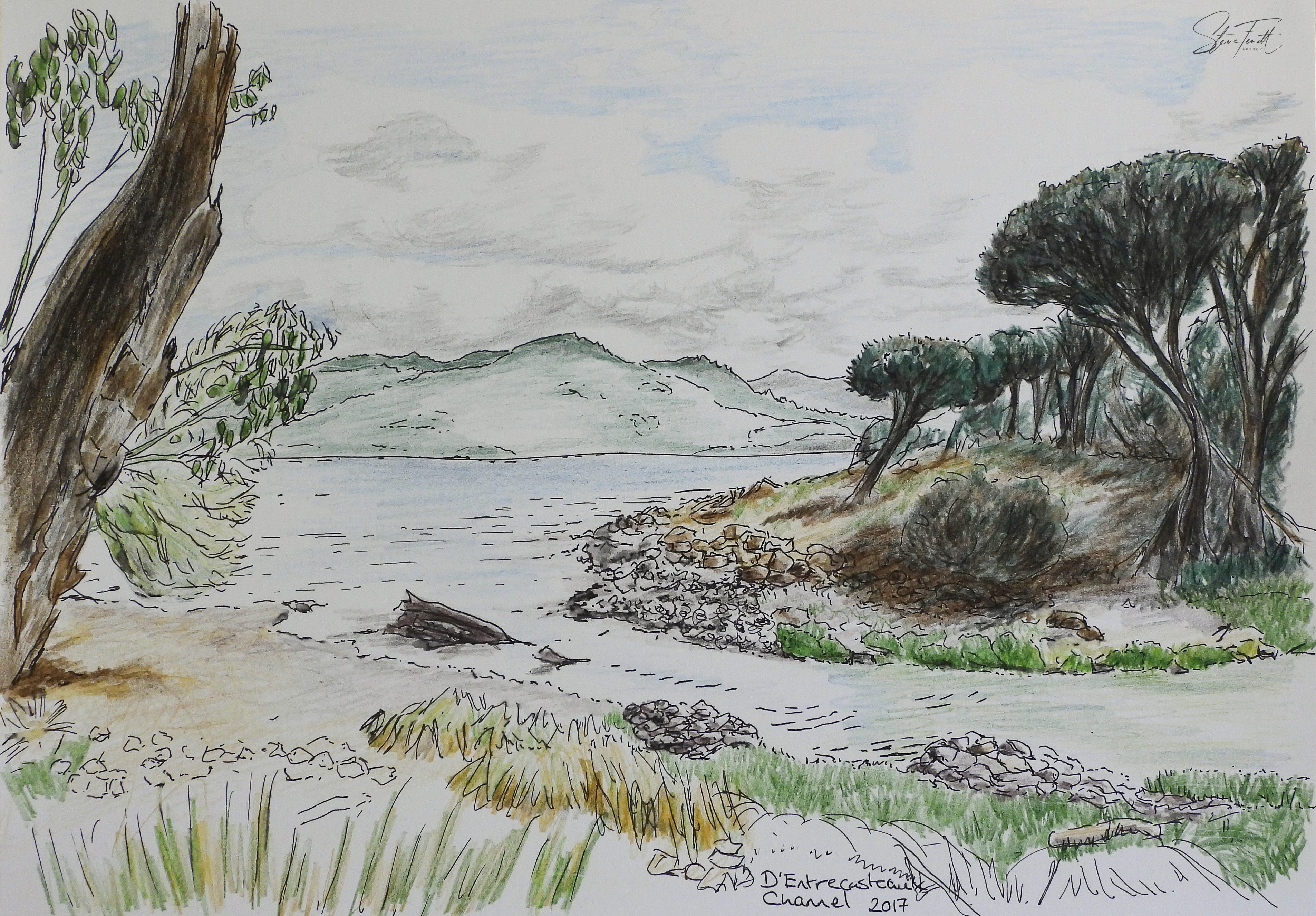
Title image ‘D’Entrecasteaux’: pen and watercolour pencil on Bristol paper. This is a view north across the D’Entrecasteaux Channel from Alonnah to the Tasmanian mainland.
Comments
Nothing yet. Say the first thing.
Sign in to join the conversation.