
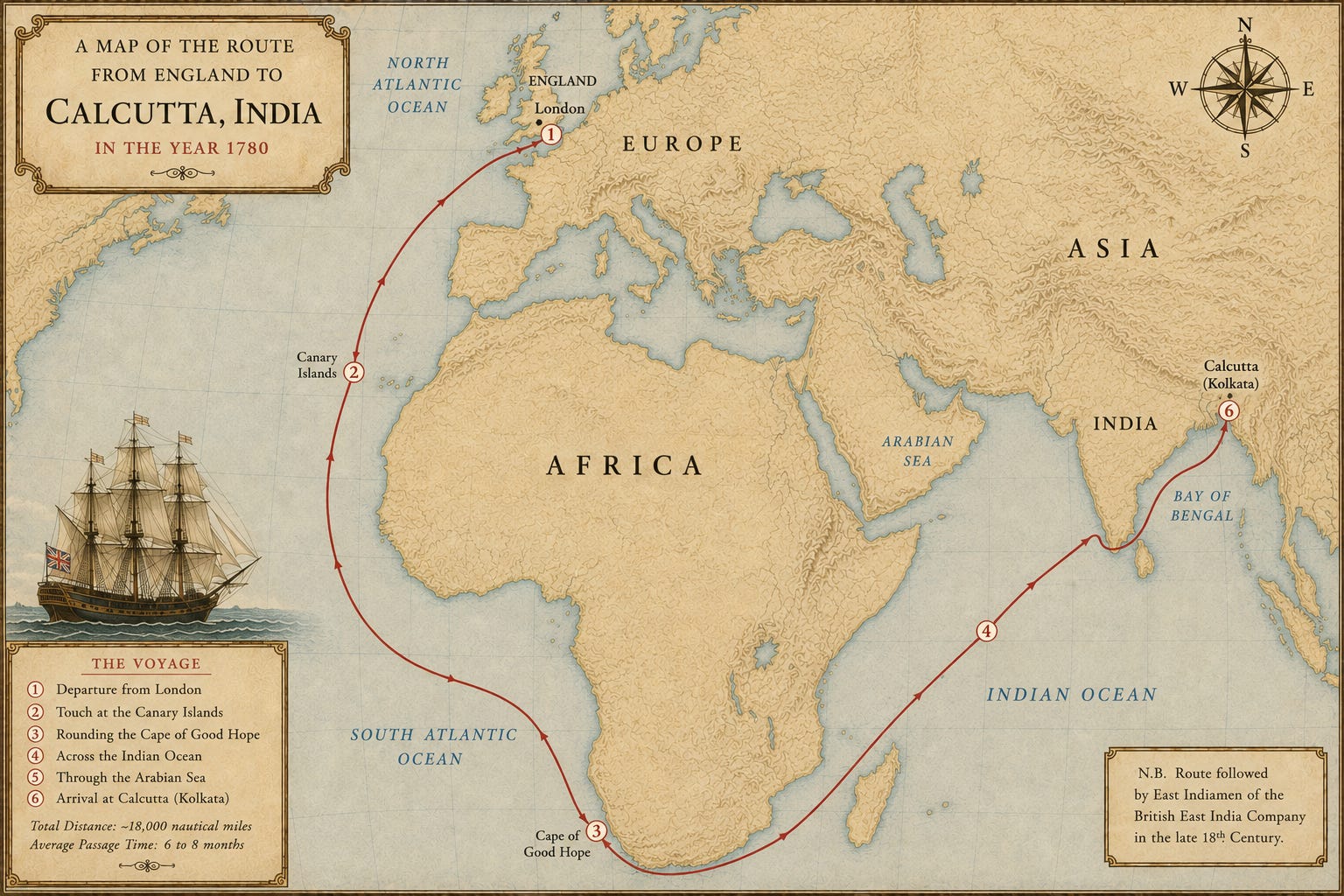
233 years ago today, William Carey was in England making last-minute preparations for a one-way trip to India. On June 13, 1793, Carey, his wife Dorothy, and their 8 year old son Felix, boarded a ship in England and finally landed in Calcutta on November 11, 1793. Imagine spending 150 days in cramped, unsanitary quarters on the open sea in the eighteenth century. This was no Carnival Cruise. No GPS navigation, no weather forecasts, no communication with the outside world, no evening entertainment. No catered meals. No swimming pools. No plumbing. No electricity. Instead, there was plenty of boredom and an abundance of misery. Why would anyone sign up for this?
William Carey was a Baptist shoemaker who took his faith seriously. He and his church affirmed the 1689 Baptist Confession of Faith (2nd London Confession) and there he learned that God is sovereign over all things, including salvation.
As God hath appointed the elect unto glory, so He hath, by the eternal and most free purpose of His will, foreordained all the means thereunto; wherefore they who are elected, being fallen in Adam, are redeemed by Christ, are effectually called unto faith in Christ, by His Spirit working in due season, are justified, adopted, sanctified, and kept by His power through faith unto salvation; neither are any other redeemed by Christ, or effectually called, justified, adopted, sanctified, and saved, but the elect only. (1689 Baptist Confession of Faith, 3:6)
Carey agreed with John Calvin that God was sovereign over all things, but in Carey’s day, an unhealthy and unbiblical hyper-Calvinism was leading many to deny human responsibility. When Carey expressed concerns for the masses of people on the planet who had not yet heard the gospel, one hyper-Calvinist responded, “when God pleases to convert the heathen, he’ll do it without consulting you or me.” In other words, since God is sovereign, we aren’t responsible to do the work of taking the gospel to the unreached. What about the Great Commission in Matthew 28:18-20 to “Go, therefore, and make disciples of all nations”? The hyper-Calvinist response was that this command was only for the original apostles. It doesn’t apply to us.
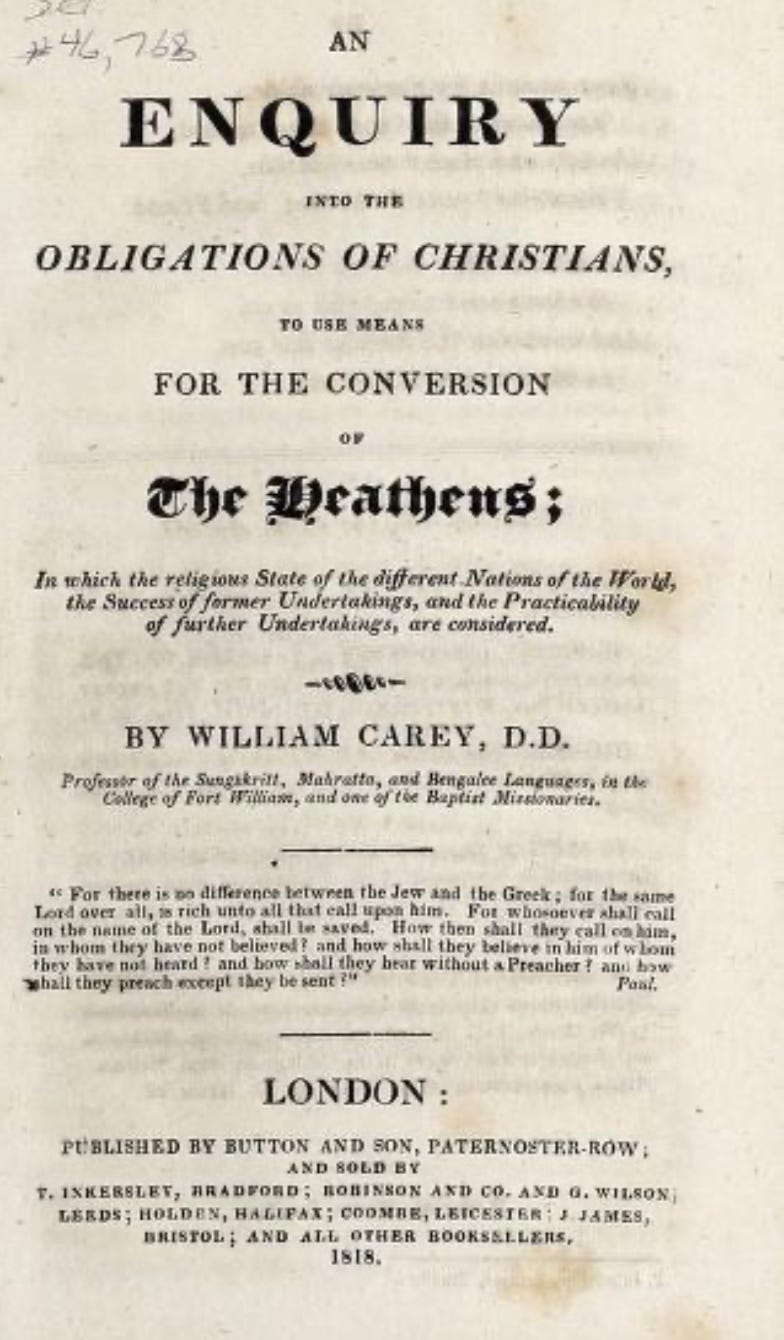
In response, Carey wrote one of the most important documents in church history: An Enquiry into the Obligations of Christians to Use Means for the Conversion of the Heathens, making the case that the Great Commission indeed applies to every generation of believers until the Lord returns. The Bible clearly teaches both God's sovereignty and man's responsibility. The God who ordains the ends also ordains the means by which he accomplishes the ends. God does what only he can do, yet he ordinarily accomplishes his purposes through the obedience of his people. We are responsible to use every available means to take the gospel to all the nations.
Obeying the Great Commission has always been expensive. The Apostle Paul, the greatest Christian missionary, was willing to do the hard work of travel and teaching, but missionaries have to eat. When necessary, he made and sold tents on the side to fill his stomach. But his time was better spent preaching the gospel, so when the church at Philippi generously provided financial support, he wrote them a thank-you letter because they “entered into partnership with me in giving and receiving” (Phil. 4:15). Their generous gift allowed him to invest more time in disciple-making than tent-making.
Carey would need substantial prayer and financial support from the church in England to travel and live in India. In 1793, he said to his friend Andrew Fuller,
“I’m going down into the mine to look for gold among the heathen nations. Would you, brother Fuller, stand at the pit of the mine and hold the rope?”
That’s what sending churches do. They hold the rope. They provide the spiritual, emotional, and financial support that missionaries need to go into those dark and hostile places on our planet where the light of the gospel does not shine or has grown dim. The work of a missionary is always difficult and often dangerous. And they cannot do that work without the sacrificial support of sending churches, those Christians that remain in the comfortable and familiar circumstances of their own culture, nation, and home.
Carey would never return to England. Over the next 41 years, he and his team established the first degree-granting college in India and, writes Kevin DeYoung, completed “six translations of the whole Bible, along with 23 New Testaments, and portions of the Bible in ten other languages. Carey himself translated the Bible into Bengali, Sanskrit, and Marathi.” The shoe-maker became a disciple-maker and changed the course of history.
But the human suffering was incalculable. Carey buried two wives and three children in India, and his third wife buried him. Missions work can be hard on a marriage and no one would nominate Carey for husband of the year. He was an imperfect man with a God-sized vision whom God chose to use despite his flaws. He and his family paid a steep price to make disciples of the nations, and that is why William Carey is remembered as “The Father of Modern Missions.”
Carey has had thousands of spiritual sons and daughters in the last two centuries who were persuaded by his Missions Manifesto, inspired by his obedience, and who have (hopefully) learned from his mistakes. It’s easy to find things to criticize about this man of remarkable achievement, but keep in mind he was a pioneer, blazing a trail for others. We can learn from his mistakes, but he had no one whose mistakes he could learn from himself.
The point is this: obeying the Great Commission has always been costly. It costs money to hold the rope, sending missionaries to unreached fields and keeping them there. And it has always cost the missionary and the missionary’s family in innumerable ways.
Yesterday I received word from a good friend of mine (and of many of you) who left his home nation years ago to advance the gospel in Ukraine. Throughout Russia’s illegal and unjust war in Ukraine, he and his family remain steadfast. He recently visited a church in Balakliya, in the Kharkiv region that had been struck by a Russian drone on May 23 (yes, in violation of international law, Russia targets churches in Ukraine). With his permission, I share the pictures he took and message he wrote:
At the time of the strike, on Saturday afternoon, the pastor and several church members were inside the church building. Thankfully, no one was injured, but they said the explosion and impact were tremendous. A fire broke out immediately, but firefighters responded and were able to put it out. The next day, Sunday, the people gathered together. With deep sorrow, but also with gratitude to the Lord that no one had been hurt and that the building had not been completely destroyed, they worshiped together. After the service, they began cleaning up and putting things in order…Balakliya was under Russian occupation for several months in 2022. During that time, the Pastor himself was detained by the FSB for two weeks and went through very painful suffering. The church had been forced to close during the occupation, but after Balakliya was liberated by the Ukrainian army, the church resumed its ministry and had been actively serving the community. Now, after this recent attack, the pastor and the church members are deeply grieved. Yet as I listened to them speak about trusting God’s plan even in the midst of this suffering, I myself was greatly encouraged. We do not know when Russia may again launch another drone attack against this church. Please pray that the Lord would protect this church.
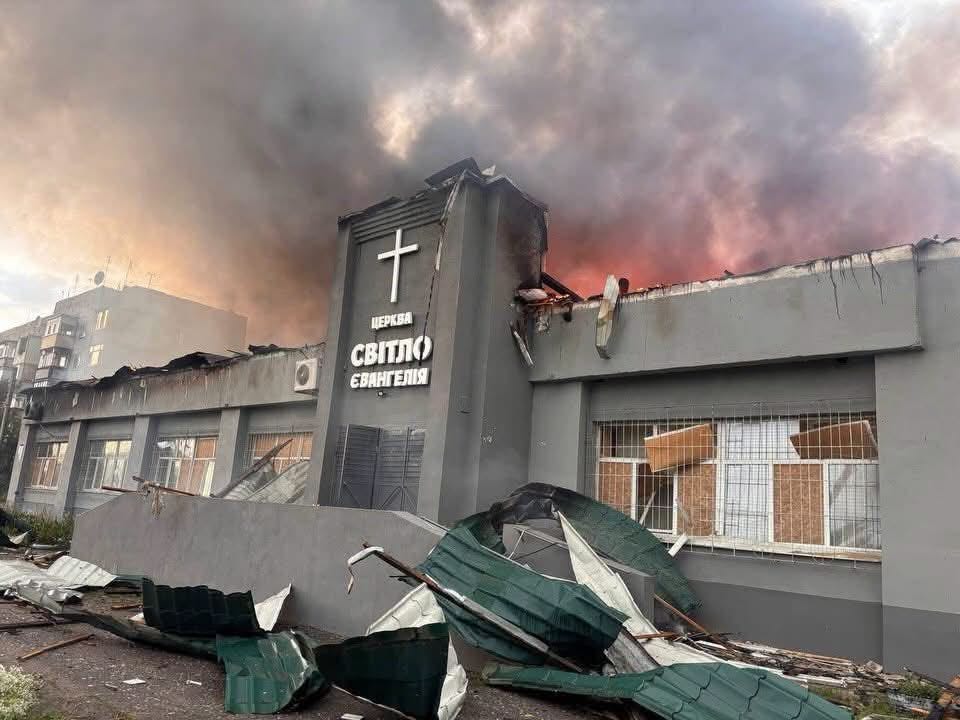
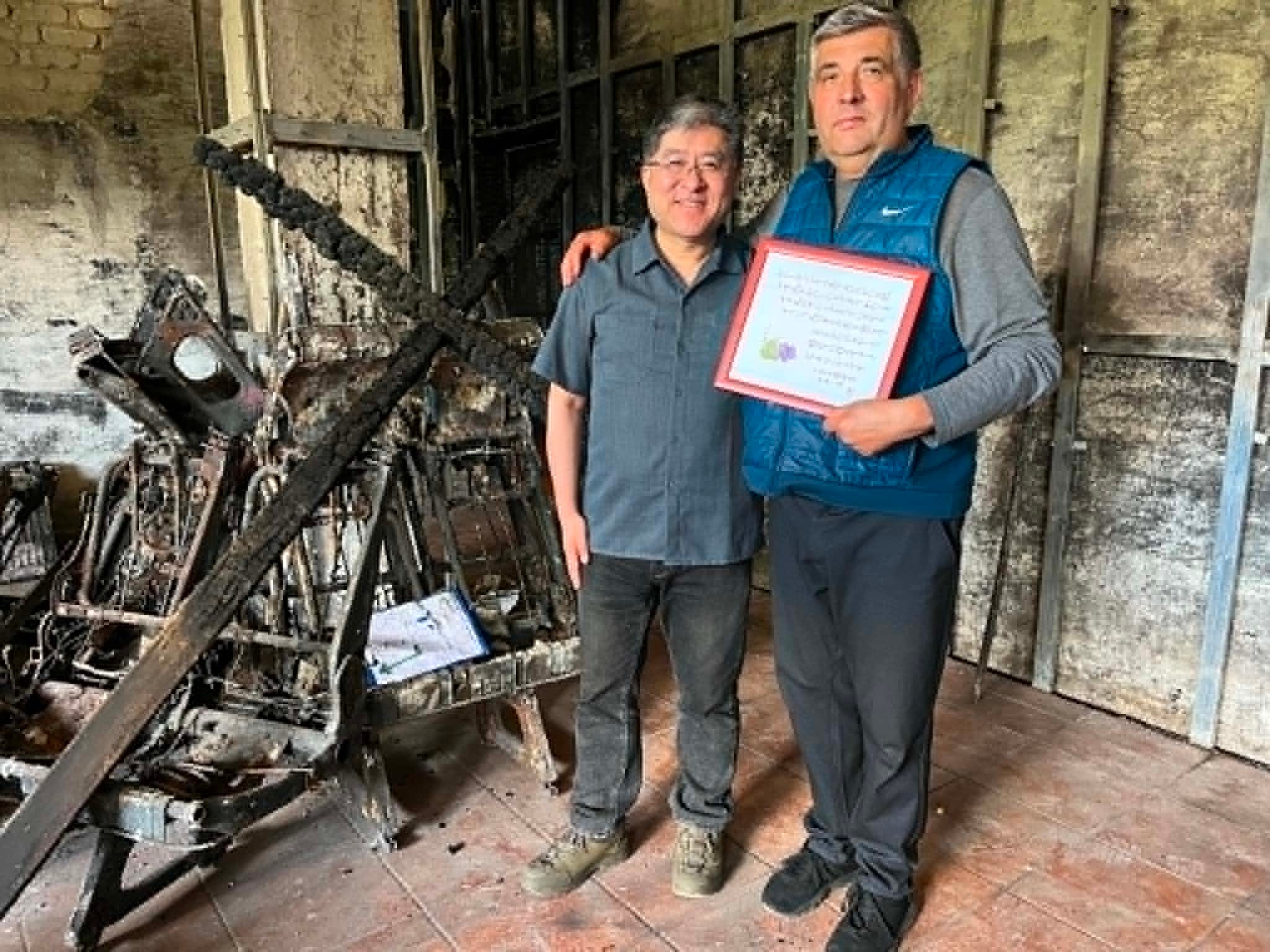
[Photos courtesy M. Funakoshi]
Why endure the trouble, hardship, and suffering that often accompany obedience to the Great Commission? We obey for two reasons. First, God commands it. That should be enough. Second, the God who ordains the ends, ordains the means by which he accomplishes the ends. If God really is in control, can he not get the gospel to people who need to hear it without us?
Well, of course he can. God can do whatever he wants. And in his wisdom, he has chosen to involve us. He has chosen to accomplish his purposes through us. That may mean enduring the misery of a slow-moving ship or dodging the danger of a fast-moving drone. It at least means that whether we send or go, we trust in a sovereign Lord who promised “I am with you always, to the end of the age” (Mt. 28:20).
This Saturday, June 13, 2026, take a few moments to remember the Carey family's departure for India 233 years ago. Pray for our missionaries. Thank God for those who hold the rope. And before complaining about how difficult it is to follow Jesus here in the United States, remember that God inexorably continues the global advance of his gospel despite slow ships and fast drones.
No posts
Comments
Nothing yet. Say the first thing.
Sign in to join the conversation.