
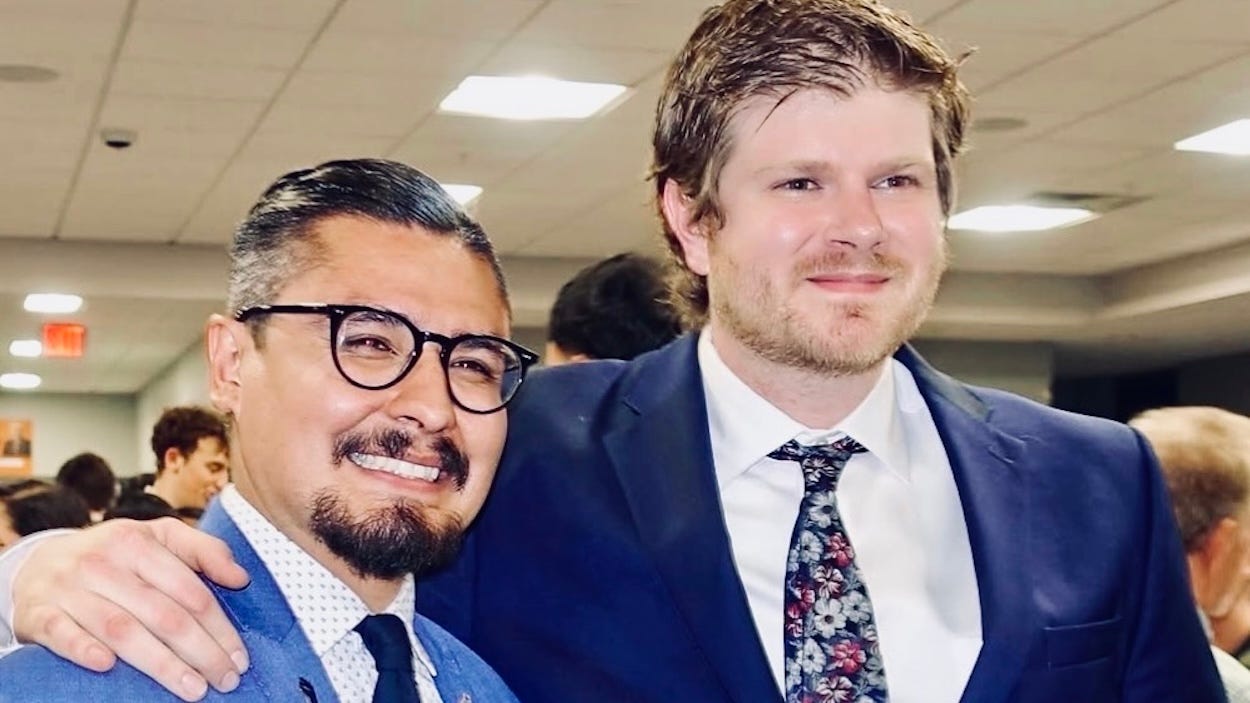
I sat down outside New Harvest Coffee Roasters with Ben Shanahan, the chief strategist and campaign manager for David Morales. David is running for Mayor of Providence against incumbent Brett Smiley in a race that is too close to call, despite the Smiley campaign’s gigantic money advantage.
Steve Ahlquist: Let’s start with who you are and what you do.
Ben Shanahan: I wear a lot of hats. Right now, in this final stretch, I’m the campaign manager, but I’m really the strategist who’s been working with David Morales for 13 months now, since July of last year.
Steve Ahlquist: That went by fast.
Ben Shanahan: Yes, indeed. Time is moving in weird ways these days.
Steve Ahlquist: For background, can you give me a little bit of your history?
Ben Shanahan: I grew up in New York. My parents and my sister still live there. I’ve been doing electoral politics work for a little bit over 10 years now- more than that, if you count the stuff that I did in high school, handing out literature for my local city councilman and whatever. I live in Philadelphia now because campaign work is seasonal, and New York is very expensive to live in if you don’t have a consistent paycheck.
Steve Ahlquist: Is Philadelphia cheaper than Providence?
Ben Shanahan: I think it might not be any more. I think it was more expensive than Providence, and now Providence has basically caught up to it. It’s very similar. I do love Philadelphia, I have to say. It’s a great city. Very happy to live there. Very proud to soon be a constituent of Chris Rabb.
Steve Ahlquist: Let’s get into this then. I saw some polling on the race released by former Mayor Jorge Elorza, which showed it was statistically too close to call.
The numbers put Mayor Smiley slightly ahead, 42% - 38%, with a 5.6% margin of error. As the strategist/campaign manager, what does that look like from the campaign’s point of view? What does it say about what needs to happen next?
Ben Shanahan: Based on their field dates, people responded to that poll on the 19th and 20th of July. Mayor Smiley released his first television ad attacking David on July 9th. Political operatives talk about saturation as the two-week mark after an ad starts running. If it’s been running for about two weeks, pretty much everyone who’s going to see it has already seen it.
Steve Ahlquist: So we weren’t quite at two weeks, but we were pretty close, right?
The Smiley campaign put a lot of money behind it. He was spending at least $45,000 a week at the beginning when he started running it. To see the race be that close, to see Mayor Smiley at 42%, David at 38%, a 5.6% margin of error, and about 20% undecided was very exciting for our campaign and for me personally. What it indicates to me is that Mayor Smiley's message is not landing with the majority of voters.
Steve Ahlquist: So he’s spending a lot to basically break even here.
Ben Shanahan: That the spending imbalance in this race was something we always knew would be the case.
Steve Ahlquist: What is that spending imbalance? Can you give me a sense of the numbers?
Ben Shanahan: It depends on how you look at it. We just had the filings come out at midnight last night. So there’s a lot of analysis still to be done.
Steve Ahlquist: So we’re a little bit early on this.
Ben Shanahan: But in terms of just the raw numbers, he spent, it looks like, about $1.6 million starting in quarter three of last year. That’s the period during which both of them were active candidates. David announced in September of last year, toward the end of quarter three. Smiley, obviously, is the incumbent and was planning to seek reelection. So he spent about $1.6 million. We spent about $400,000. So that’s a four-to-one spending advantage for him.
If you look at just the last period of time that the filing was for, so that’s July 1st until August 11th, in that six-week timeframe, he spent $820,000, and we spent about $100,000.
Steve Ahlquist: So that’s eight to one in just the last six weeks. I’m not an expert, but that seems like a lot of money to spend for someone with an incumbent’s inherent advantage to be statistically tied.
“They got the TV, we got the truth. They own the judges, and we got the proof.” - Boots Reilly
Ben Shanahan: One of the things that political strategists often get wrong is thinking of themselves as experts. The expert is the voters deciding who they want to be your mayor, legislator, congressperson, president, or governor. The expert is the person walking into the voting booth and making that decision.
What’s clear to me from that polling and the amount of money he’s spending is that he’s nervous about David’s momentum. He’s nervous about the coalition that David has built. Incumbents spend money like this against a challenger if they’re concerned about the challenger’s campaign.
Steve Ahlquist: I’ve watched Brett Smiley during his first run for mayor, while he worked as the chief of staff for Mayor Elorza and Governor Gina Raimondo, and as mayor, and I’ve never seen him lose control or say things off the cuff, like what he said about Jackie Goldman. He seems to be losing his cool. He’s generally much more reserved. I get a sense of nervousness from him as a candidate and from the campaign as a whole. That said, what do I know?
Ben Shanahan: If you look around the country right now, there’s an anti-incumbent sentiment, particularly among Democratic primary voters. And it’s not just progressive candidates or populist candidates. There was just a congressional race in Connecticut in which a candidate defeated a longtime incumbent, and I’m not even certain that the challenger who won was definitively the more progressive.
This is a hyper-local race. David has been focused on speaking to the issues here in Providence, and all politics is local. Voters want to know, “What are you going to do for me? How are you going to materially improve my life?” That’s whether you’re running for local dog catcher or President of the United States. Most of what you can see that impacts your daily life is local. It’s the potholes on your street. It’s whether or not your traffic lights work or your trash gets picked up on time.
Steve Ahlquist: It’s snow removal, or something that’s generally positive, like replacing the trash cans, but doing it in a way that doesn’t negatively impact low-impact minority communities.
Ben Shanahan: What’s relevant and what I’m sure is making any incumbent nervous, and particularly Mayor Smiley in this case, is that we have seen, over and over again, hat a massive spending advantage for an incumbent or a more establishment aligned candidate hasn’t been able to stop the wave of new people getting involved in the political process, turning out for the first time, looking at where the party is as a whole and saying, “There’s something broken if we keep losing elections to Donald Trump.”
Steve Ahlquist: Yet, I’m not seeing the Democratic establishment willing to accept that their ideas are the problem. For instance, in the AG race, we’ve got Solomon, who is running as a conservative Democrat, literally asking Republicans to disaffiliate and vote for him, because he does not want to conform to what the majority of Democrats seem to want. He wants more conservative Republicans to join the Democratic Party and shift the party’s dynamics in his favor.
I don’t think that’s a winning strategy. It seems like a way to put your head in the sand and ignore what people really want.
Ben Shanahan: I think that has something to do with the amount of money that’s being spent in these primaries as well. More and more in the information age, people have access to social media. People understand how to use Google. Now there are AI chatbots that do searches for them. People are increasingly empowered to make their own decisions. There’s also the rise of new media: the narrative is not defined solely by what one or two individual media outlets report. So money is having less and less effect in persuading people.
Steve Ahlquist: Obviously, it’s necessary to have a certain amount of money to campaign, because you’ve got to be on TV, you’ve got to have lawn signs and palm cards. You can’t just have people knocking on doors without doorhangers. What you’re saying is that an election costs, for lack of a better phrase, a populist amount of money. Like the amount of money you get from asking constituents five or ten bucks.
Ben Shanahan: Exactly. Because of the proliferation of information and the ability of individual voters and citizens to seek it out from multiple sources and reach their own conclusions, the ability to simply convince someone through repetition that you have the right answer is diminished. I don’t know that it’s trying to get Republicans to affiliate as Democrats.
Steve Ahlquist: I haven’t seen any evidence that Mayor Smiley is asking for that.
Ben Shanahan: I haven’t seen any evidence of that either. I obviously don’t know the inner workings of his campaign, but my assessment is that he’s hoping the money he’s spending will mobilize people who don’t normally vote in primary elections.
Steve Ahlquist: But there’s an emotive part of Mayor Smiley’s campaign, right? I’m going to say it bluntly: He’s trying to instill fear. He’s saying David Morales will defund the police and make you less safe. David’s a communist or a democratic socialist or whatever it is, and most people don’t know the difference between these things. It sounds like old school Red Scare tactics.
Ben Shanahan: You’re not wrong that his campaign is based on fear. As a strategist, I’ve been struck by his unwillingness to campaign on his own record. He sent at least 10 pieces of mail in quarter two of this year. Between April 1st and June 30th of 2026, he was sort of reintroducing himself to the electorate and talking about the things that he has done as mayor. That was $300,000 worth of mail that he sent.
He chose to start this quarter with an attack ad on July 9th. From everything I’ve heard and learned about Mayor Smiley, he’s an experienced political operator. As you mentioned, he was in Mayor Elorza’s administration. He was in Governor Raimundo’s administration. Before that, he was a fundraising operative. And he originally moved to Rhode Island to run a campaign for Charles Fogarty.
Steve Ahlquist: I first ran into him when he ran for mayor.
Ben Shanahan: He’s obviously an intelligent person.
Steve Ahlquist: And he can be charming. When I first met him, I thought he was okay.
Ben Shanahan: He’s very smooth. He’s shaken my hand a few times. He smiles. He’s a good politician. But also, as a politician, he knows how to read a poll, and he knows data.
Steve Ahlquist: He’s been different lately. I’ve watched him for a long time. I’ve made him mad. I’ve seen him upset with me. But I’ve never seen him lose his cool. But lately, like the stuff he said about the candidates in the Ward 5 race, or his demeanor and apparent frustration during debates...
Ben Shanahan: I think that he is well aware of certain issues that he has within the electorate, right? There’s no amount of money that he can spend that is going to make young voters favorable to his message and what he’s campaigning on. That’s part of his issue. The conventional wisdom in Providence is that the electorate skews older and East Side. And that’s true, but the average age in the city of Providence is 32.8 years, according to the last census data.
Steve Ahlquist: Younger voters tend not to vote as much.
Ben Shanahan: They do tend not to vote as much, but as we saw in New York last year, if you give them something to vote for and not just try to shame them into civic participation, and if you present a candidate who’s speaking to the issues that you care about...
We’ve heard over and over again when we’re talking to voters in Elmhurst, Mount Pleasant, the West End, Federal Hill, or Fox Point that they love the city of Providence. And I’ve fallen in love with Providence doing this campaign.
Steve Ahlquist: I’m never living anywhere else.
Ben Shanahan: I hear you. It’s an incredible place to live. The food, the culture, the weather - outside of February. You’re so close to the beach, the art that’s around town. Everything is within a drive here. It’s like a very small East Coast LA, right? It’s got tremendous history. And it’s the fifth densest metro area in the country, but the population within the city limits is only 200,000.
The “Hi neighbor!” thing that David does works so well because it’s a very neighborly city. People really know and care about each other. People love living in Providence, but what do people do when they reach their early-to-mid 30s?
Steve Ahlquist: They have kids, and they move to Barrington or Lincoln or wherever.
Ben Shanahan: And it’s not that they don’t want to raise their children in Providence. It’s because they can’t afford to have enough space. It’s 2.2 kids, a dog, and a car...
Steve Ahlquist: Right. You get an apartment while you’re single and then when you have kids and want a house, you can’t even look at a house here.
Ben Shanahan: It’s also about the schools. People want to go somewhere with more opportunities.
It’s a progressive city as well. At a minimum, this is the bluest state in the country. And it’s the urban core of the bluest in the country.
Steve Ahlquist: But we have a Democratic Party that does not reflect that. It just doesn’t.
Ben Shanahan: Look at who the senators are, right? They’ve been around a long time. They’re part of the older Democratic Party gerontocracy. The governor right now is an older guy. These people have been around a long time, and they do it a certain way. Look- if you’ve done it a long time, and you’ve gotten reelected a bunch of times, I don’t blame you for thinking that your way is the right way of doing things. But one of the first things I observed being on the ground here is how much joy and community is present in this city and how much people care about each other and want to be able to afford to continue living here.
Steve Ahlquist: The Smiley campaign could spend much more money. Eight to one is nothing compared to what he could possibly pull out.
Ben Shanahan: He’s still got about $500,000 in the bank as of the current filing. His campaign cash has finally started to go down.
Steve Ahlquist: But shouldn’t we start to see outside PACs start to advertise more heavily?
Ben Shanahan: We just saw, if you go look at the publicly available filings, Stop the Wait https://www.stopthewaitri.org/ just started spending a ton of money, not just in the mayor’s race, but in the various council and assembly races. He had an independent expenditure, the D.C.-based national PAC Victory Fund https://victoryfund.org/, hit Mailboxes last week.
So yeah, we’re going to start to see an increase, and we know that as well.
Steve Ahlquist: The Smiley campaign has asked for this money to be spent through “red boxing.” Can you talk about what that is and how that works?
Ben Shanahan: It’s fascinating. Red boxing is something that’s done pretty regularly around the country for congressional races because it’s not very tightly regulated by the Federal Elections Commission. Within Rhode Island, it’s much more tightly regulated. Red boxing is putting a dedicated page of your website telling independent groups that may be supporting you what you want them to communicate and who you want them to communicate it to.
In Rhode Island, state law explicitly says that any expenditure that republishes, in part or in full, a communication prepared by a campaign - photo, video, or text - should be considered a contribution, not an independent expenditure. They count as in-kind contributions where you don’t directly give a check to a campaign, but you’re spending money on its behalf.
Steve Ahlquist: Like renting a space for a dinner or rally.
Ben Shanahan: Exactly. The independent expenditure mailer from the Victory Fund used a photograph of Brett Smiley that they sourced from his campaign’s Instagram account, @smileyformayor. That is a direct re-publication of a campaign communication. Beyond that, if you go to his website, the way red boxes are traditionally done at the federal level, because it’s not tightly regulated and generally allowed, is that there will be a link somewhere in the header of the website that says “media.” You click on that, and there’s a red box with the messages voters need to hear.
Steve Ahlquist: That kind of thing can be useful for reporters, so I guess that’s why it’s under a “media” tab.
Ben Shanahan: Right, it’s helpful for the independent expenditures, but it’s also helpful for reporters to get a quick glance at what the campaign stands for. Brett Smiley didn’t actually have a red box around it. On his website, you have to go to the issues page, then click the public safety subheader. When you get there, then you see contrast messaging of Mayor Smiley on public safety versus David Morales on public safety, or at least, what Mayor Smiley claims David Morales’ public safety plan is.
And then there are examples of direct mail the mayor has sent: three different versions of an older Latina woman on the front, talking about how safe Mayor Smiley has made them feel, and on the back, there’s an unflattering thing said about David Morales and his approach to public safety. That is very clearly an instruction manual. And if you look at the Victory Fund mailer, it follows the same format: It doesn’t have the older woman on the front; it’s just a picture of Brett Smiley with his public safety record. On the back, there’s an unflattering picture of David Morales and some criticism of his public safety plan.
It’s very clearly an instruction manual for independent expenditures. Again, he’s spending all this money, he’s fear-mongering, and now he’s surreptitiously posting instructions for his supportive independent expenditure groups.
I think he’s scared. He’s very nervous about the campaign that David’s built, and some of that fear is because all the money in the world can’t help him with certain demographics.
Steve Ahlquist: So, wrap this up for me. What needs to happen?
Ben Shanahan: In broad strokes, we’re coming down to the last 27 days here. What’s interesting about this race and why people should be paying attention to this race is exactly what I just said about his money not being able to reach certain people. Young voters who want to build a life, start a family, and put down roots here feel like they can’t. They feel Mayor Smiley’s policies are directly opposed to their ability to do that.
Steve Ahlquist: I have three children in their 30s, and they all feel that way.
Ben Shanahan: That makes a lot of sense. When Latino voters hear about David running for mayor, they’re so excited about him. The reason for that is not just that he has a Latino name, which is part of what Mayor Smiley’s strategy of putting a bunch of older Latino women on his mailers is about... David has a documented record of showing up for the Latino community here in Providence: as a legislator, passing Cover All Kids, raising the minimum wage, and leading the passage of the bill to make lead pipe replacement free at the point of service. Those are real results that have had material impact on people’s lives.
It’s also his approach to constituent services. One of the first things I observed was David handling constituent services for people who didn’t even live in his district because he speaks Spanish, he’s relatable, and he’s accessible. When his phone rings and it’s a 401 number, he answers it every single time. He wants to know what’s going on. That builds credibility beyond the fact that he’s the son of a single immigrant mother and a lifelong renter.
He has a documented history of showing up for people in Providence. We have these two factors: Older, more traditional Democrats, people who maybe 10 years ago would have been disinclined to support a candidate like Bernie Sanders or Zohran Mamdani. They’ve been sold the bill of goods about electability, but it’s hard to keep making the case that you’re the electable side of the Democratic Party when you keep losing to an orange circus clown.
People should watch this race closely because, as far as I can tell, this has never been done in Providence, or even in Rhode Island, before.
Steve Ahlquist: I’ve never seen it.
Ben Shanahan: David beat an incumbent when he first ran. But the difference between that race and this one is that when you’re running for a part-time legislative seat that has no staff, nobody spends serious money trying to win. You can win those races just by knocking on enough doors, talking to voters, and letting them know who you are. If you have enough hustle, you can win. In this campaign, I’m incredibly proud of the hustle that he and his team have. He’s an incredible candidate. But the reason folks should be paying attention to this race is that it’s a microcosm of what is going on around Rhode Island, the region, and the country in terms of people saying, “Enough.”
Multiple groups form this coalition of people who want leaders who will actually speak to their needs. Leaders who won’t say, “I know what’s best. I alone can fix it. I understand what you’re asking for, but it’s not possible.”
Steve Ahlquist: Like rent stabilization...
Ben Shanahan: “It’s not possible.” “It’s going to ruin the market.”
Steve Ahlquist: People don’t want to hear that.
Ben Shanahan: People outside of Rhode Island should be paying attention to this race. This is the first time that something like this, at this scale, has been done here. There hasn’t been the long-term base-building that has happened in other places that has led to the results of Zohran Mamdani or Chris Rabb.
Steve Ahlquist: We’ve been trying to set that table here in Rhode Island.
Ben Shanahan: That’s what’s so exciting about this race and why folks should pay attention. I don’t know how it’s going to go. That poll from the group that Mayor Elorza works with is interesting. It reflects my read of the race. It’s a neck-and-neck race coming down to the wire, and a certain number of people are still undecided, and it’s going to come down to late breakers and turnout.
Steve Ahlquist: It’s unusual for a campaign to do an interview like this that’s o open about the nature of the race.
Ben Shanahan: There are very real structural advantages that David has that I don’t mind talking to a reporter about on the record, because I don’t think there’s any amount of money in the world that Smiley can spend that’s going to convince young families, Latinos who know about David, renters who are struggling with the skyrocketing cost of rent, and progressives who want to see a Democratic party that’s more willing to stand up and fight for what the base of the party wants to see. There’s no amount of money in the world that will convince those people that Mayor Smiley has their back.
Steve Ahlquist: It’s still unusual to have this conversation.
Ben Shanahan: Are you a basketball fan at all? Larry Bird, who I know is well-loved in this part of the world, was famous for telling his opponents exactly what he was about to do and then doing it. I forget who his opponent was, but there were three seconds on the clock, and he said, “I’m going to go here. I’m going to shoot the ball, and it’s going to go in.” And he did it, and he left 0.7 seconds on the clock. He turned to the guy and said, “Damn, I didn’t mean to leave that much time on the clock.”
This race is deeply polarized, and David’s coalition is clear. The mayor’s coalition is clear. Some undecided voters are trying to decide who they want to support. This race is going to come down to late-breaker turnout from both coalitions. Everybody knows that. The mayor is a smart guy. He’s been doing this a long time. He knows how to read a poll, and he knows exactly what I’m saying to you right now from his own research, so it’s not like we’re giving anything away.
Your readers tend to be people who are more progressive, and if they care about getting David Morales elected as mayor, if they care about a city government that’s going to take the fact that rents have gone up by 40% in six years more seriously, if they care about the quality of public schools so that people can afford to choose Providence as the place to raise their family, if they care about protecting immigrant neighbors from ICE in a city that’s 45% Latino, when we have a federal government that is totally fine with unqualified, unvetted people coming into the streets of our neighborhoods and kidnapping people...
If they care about snow removal, about a city government that actually prioritizes delivering excellent city services in every neighborhood, regardless of the neighborhood’s socioeconomic status or who lives there, and not just doing it in one part of town...
I’ve seen candidates overcome large spending disadvantages and win before. I’ve never seen this. This is a local race with an incumbent who is spending a gargantuan amount. We talked about the raw spending disadvantage. If you just look at what they call paid media: advertising, mail, those kinds of things, it’s like 30 to one against what we’re spending on paid media. He’s spending all of his money on paid media, and he has a lot more money than we do.
If you care deeply about this race and about getting David elected, we’re right there. He spent all this money against us, and he can’t put David away because David is an excellent candidate who has inspired hundreds of people.
Steve Ahlquist: You need people.
Ben Shanahan: We need people. They have money.
Steve Ahlquist: You need people committed to getting this over the finish line.
Ben Shanahan: That’s it. At all costs. We need people knocking on doors. We need people organizing their coworkers.
Steve Ahlquist: How would people get in touch with you?
Ben Shanahan: They would go to DavidMoralesPVD.com. To volunteer, go to volunteer.DavidMoralesPVD.com. If you want to sign up to knock on some doors or make phone calls with us, email us at neighbors@David Moralespvd.com. Maybe you’re somebody that doesn’t like talking to voters, but you want to help us distribute yard signs or pick up literature and move stuff around the city. You can go to DavidMoralespvd.com/donate if you want to toss us 10 or 15 bucks, whatever you can afford, to help us buy more supplies and get some of that messaging out there and make sure that we have water and snacks for the people that are out there knocking on doors all day long.
It’s now, or never, you know what I mean? David is an exceptional person. I’ve worked for a lot of candidates. He’s somebody I’m incredibly proud to have spent time with.
Steve Ahlquist: He is not a dick.
Ben Shanahan: No. In person, behind the scenes, he really gives a shit. I don’t see you too often. He really cares.
It was not an easy choice for me to take this on. I’ve got a fiancée back in Philadelphia. I have a daughter who lives with her mom, and I only get to see her every so often. I’ve had to sacrifice that for a year to be a part of this. But I deeply believe this country will only start to heal and get better when we elect leaders at every level of government who give a shit, care about the people they were elected to represent, and won’t rest until they’ve done everything they can to solve those problems. He cares deeply about this city. He cares deeply about his neighbors.
If you’re somebody who believes that those are the type of leaders we should have in government, you’ve got 27 days to help us get David across the finish line. That’s why I decided it was a good idea to sit down with you and talk about this.
Comments
Nothing yet. Say the first thing.
Sign in to join the conversation.