
In a spectacle-driven, increasingly post-literate age, where the dominant medium is an enveloping abyss of vertical shorts blazing LEDs from a palm-sized pane of glass through which one need only flick a thumb to endlessly plumb its vibrant but empty depths, writing and reading novels can feel quaint and futile. The obvious Sisyphean character of contemporary literary forays intensifies the usual insecurities that plague authors. It prompts them to reach for irony, adaptation, détournement, intertextuality, and other metafictional ploys as devices that lend gravity to their work or at least erect a spiky bulwark against would-be takedown artists. It’s been this way for a while. Even in the sepia tones of pre-9/11 America, where novels like Infinite Jest and The Corrections made us feel like maybe literature was still Important. Given our state of affairs, I admire anyone with the moxie to assemble a novel and present it as something that can meaningfully compete for cultural relevance or even attention.
The latest knight-errant in our Waste Land is a. natasha joukovsky with her novel Medium Rare. One would be forgiven for thinking that the novel might be concerned with how Jordan Peterson and Joe Rogan like their steak, but it’s really a re-telling of the Icarus myth.
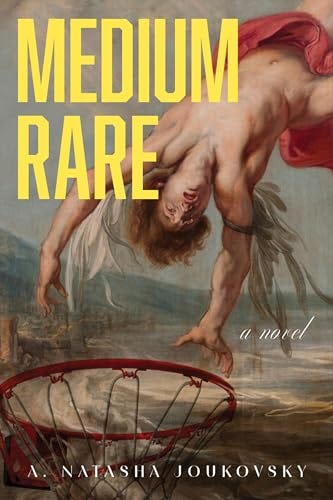
For those who have forgotten, the fullest surviving account of Icarus comes from the Roman poet Ovid in Metamorphoses (Book VIII).1After slaying the Minotaur, the great hero Theseus escapes Crete, but the master craftsman Daedalus, the designer of the Labyrinth, remains trapped there by King Minos. Unable to leave by land or sea, since Minos controls both, Daedalus resolves to escape through the air. Being an engineer extraordinaire, he skillfully fashions two pairs of wings, one for himself and one for his son, Icarus. Before taking flight, he instructs Icarus to follow a middle course. If he flies too low, the sea’s dampness will weigh down the wings. If he flies too high, the sun’s heat will melt the wax that holds the wings together.
Together, father and son rise into the sky, astonishing onlookers below who mistake them for gods. But Icarus, exhilarated by flight, abandons his father’s warnings and soars upward. The sun softens the wax, and the wings disassemble. Icarus beats his bare arms in vain and falls into the sea, crying out for his father. Daedalus, calling repeatedly for his son, finds only debris from the wings floating on the water, and he curses his art. The sea into which Icarus falls thereafter bears his name, the Icarian Sea.
The Icarus myth concerns the tradeoffs inherent to creative striving and, its frequent companion, transgression. In the words of the bard, "These violent delights have violent ends." Daedalus represents technical mastery and foresight, while Icarus embodies youthful daring that dips into recklessness. Ingenuity is most brilliant and beautiful in the young, but, when they have it, they rarely exercise it prudently. The image of melted wax and falling feathers, memorably shaped by Ovid’s poetic telling, is an enduring emblem of the dangers of excess and the fragile boundary between aspiration and ruin. These are ideas that have resonated with artists ever since. Clearly, this tension was at the forefront of Joukovsky’s mind as she crafted Medium Rare.
But before I really turn my attention to Medium Rare, it is worth disclosing that this is not my first rodeo with Joukovsky’s writing. I read and reviewed her 2021 novel, The Portrait of a Mirror, which was a modernized retelling of the Narcissus and Echo myth that followed two overlapping yuppie love triangles in an Age of Innocence sort of way and experimented some with textual formats. I also have stayed current with her periodic posts on her Substack quite useless, which provides a clear picture of her interests as a writer.2 Suffice to say, I can lay claim to a modicum of authority when it comes to understanding her style and preoccupations as a writer. My verdict? Well, I think if you've watched and enjoyed series like the White Lotus or films like The Materialist, then you will probably enjoy Joukovsky's novels. In other words, her target audience is quite similar to the subjects of her writing, affluent urbanites (or what Musa Al-Gharbi calls Symbolic Capitalists) who would like the pretense and plausible deniability of critical self-reflection and self-parody but would otherwise like a left-liberal coded permission structure for their insatiable striving and hedonic appetites.
What does threading the needle on dissonant sensibilities in Medium Rare look like? Well, Joukovsky returns to mapping the finer details of contemporary class and status dynamics among America's symbolic capitalists or professional managerial class (the PMC, the bourgeoisie, the upper middle class, or whichever your preferred term is), while pulling in elements from classical Greek myths. Sometimes these classical elements are symbols that function as guides to plot developments or foreshadowing of a kind, but other times they function as a shortcut for psychologically layering the characters. Unlike in many Greek myths, her characters have very legible and very modern psychological motivations, which she is loath to disguise, detailing them explicitly for readers. Her characters are strivers, eager to improve their position relative to others and chase more, more, and more. The skeleton key for the divining the motivations of her characters is Girardian "mimetic desire," which tracks neatly back to Icarus’ reckless aerial reveling. Instead of the allure of oneself spilling out as illicit desire for similarly modeled others (as in The Portrait of a Mirror), Medium Rare explores the simpler desire to be recognized as special, to rise above the masses, and how a little taste of specialness can be the prelude to disaster. But beyond Joukovsky's spin on Icarus, she also uses the novel as a vehicle to revel in her idiosyncratic interests: NCAA men's basketball, visual art, statistics, and real estate voyeurism.
The novel is narrated by a character named Cassandra, modeled after the ignored prophet, who recounts the rapid ascent of a moderate Republican lobbyist named Phil from a mediocre everyman to a “rare medium,” in the fortune-telling sense of the term. Phil miraculously completes a perfect NCAA March Madness bracket, wins a billion dollars for it, and then launches an all-too-brief career in the public eye, which includes exploring a career in reality TV and politics. Cassandra is enmeshed in Phil's story, like a Nick Carraway figure, first as a college friend turned work acquaintance turned close friend of Phil's wife, Raleigh. Phil's ascent incidentally pulls Cassandra into Raleigh's world of domestic tranquility and Southern hospitality, while his rapid descent pushes her right back out.3
The actual basketball in the novel faithfully follows the actual events of the 2019 tournament in which the University of Virginia (UVA) Cavaliers did indeed win after being embarrassingly upset as a 1-seed in the year prior, an inverse Icarus arc, if you will. The coverage of these games, even the March Madness scenes in general, are among the most electrifying portions of the novel and, unfortunately, comprise only its first half. So, I do feel that the second half of the novel loses steam. It is a bit shapeless, which to some extent mirrors Phil's frantic efforts to maintain relevance after his fifteen minutes of fame elapse, but it also seems like a bit of a missed opportunity. Further, the climactic scenes that trigger and then complete Phil's downfall and the rupture between Cassandra and Raleigh are rushed, even a bit melodramatic, though omitting most of the actual drama. We only see these events indirectly as readers. It’s like a Macbeth take on a wife-mistress confrontation that murders the husband’s social position, but, given that this is so heavily foreshadowed throughout the novel, the reader is expecting something a lot more like Real Housewives.
Although Joukovsky appears to understand herself as loosely working within the literary lineages of Jane Austen, George Eliot, Edith Wharton, Henry James, and F. Scott Fitzgerald, there are aspects of her novels that are distinctly Randian and Nietzschean. In fact, she perhaps presents a more realistic version of what a Randian hero(ine) could actually look like. It could perhaps be carried off a bit more trenchantly, but it definitely seems like it’s there. Her lead characters may not be able to stop the motor of the world, but they can make the scramble to the top of America’s unforgiving meritocracy look effortless and self-fulfilling all while not entirely interring their youth. Of course, there is still some vestigial moral gravity, such that characters who strive with abandon and hedonistically seize the day do eventually pay some kind of price.
Medium Rare felt like a progression for Joukovsky in terms of moving her dramatis personae from an earlier portion of young adulthood (i.e. the carefree DINK life of The Portrait of a Mirror) to a more mature portion of adulthood (i.e. adulting as a parent). That said, parenting is not immediately a compelling source of drama, so it is mostly background for the novel, serving instead as a springboard to dramatize a very Millennial version of the perennial sociopolitical friction between men and women. Phil, as a character, is ostensibly a bit of a satirical jab at the much abused "mediocre white man" who somehow manages to shirk domestic and emotional obligations and stumble and bumble his way to the top of every social hierarchy yet never develop the self-discipline to keep it in his pants.4 Phil’s Icarus arc could be understood as wish fulfillment or revenge fantasy on the part of Millennial women, a symbolic realization of what turned out to be the ill-fated vision of 2010s feminism as represented by publications like Feministing, Jezebel, or The Cut or political movements like #MeToo. However, I think this would be a bit of a slight misread. There is maybe even some subtle yet wry acceptance of male unruliness, “boys will be boys,” in the work. On the other hand, there are some palpable feminist yearnings, but certainly not bitter misandry. For instance, Cassandra's periodic maternal ambivalence is nonchalantly asserted as a kind of female rebellion against social and biological expectations and are cast as still compatible with being a loving and “good” mother. The perspective on the battle of the sexes is colored by the wisdom accrued with age and experience, but this same process creates new problems to confront, the cost that the movement of time extracts. Subsequently, Medium Rare may implicitly function as a generation- and class-defining cri de coeur for professional Millennial women, who are, perhaps, the novel’s unacknowledged Icarus figures.
Anyway, I’m happy and eager to forgive and forget some of the minor shortcomings I’ve identified because Medium Rare is an engaging and exceedingly smooth read. It doesn’t tax the attention spans of readers. It’s immersive with enough frisson of gossip, adultery, riches, and schadenfreude to stave off the incessant pull of doomscrolling or a carousel of reels. I think these are legitimate terms on which we can positively judge contemporary fiction that genuinely attempts to have an audience of readers while maintaining enough self-respect not to embrace smut or other forms of sensationalism.5
Medium Rare by A. Natasha Joukovsky will be published by Melville House on March 3rd, 2026. It is 304 pages and can be purchased at the usual places. Check it out!
To my limited knowledge, other Greek sources attest to the same basic outline with variations, and, thus, the account here is the canonical understanding of the myth.
Joukovsky intends the relationship between Raleigh and Cassandra to have significance and meaning, something for the readers to invest in. Perhaps it is because I’m the rare male reader of a book like this or because Joukovsky did more telling than showing here, but I didn’t respond in the way intended. In many ways, Cassandra warming to Raleigh is meant as personal growth and self-discovery for Cassandra, but because the warming occurs in parallel with Raleigh’s dramatic social and material ascent as Phil’s wife, it seems unlikely the relationship would have otherwise blossomed. This appears to say something incidentally cold about the possibility of relationships across very minute class and cultural differences when I think Joukovsky meant to do the opposite.
Joukovsky really missed inserting tangential allusion to Epstein island, though I’d half to double-check to ensure there wasn’t one in passing. There are many allusion and even explicit use of current events in the novel.
Maybe this set of expectations feels like a letdown for the literary striving among us (Millennials), who have been raised on participation trophies, Obama optimism, and Harry Potter universe moral logic and teleology, but these expectations are intertwined with the same process that debased cultural production and appreciation. We have to march our way back using platforms like Substack. Winning back an adult readership is important.
Comments
Nothing yet. Say the first thing.
Sign in to join the conversation.