
One autumn morning in 2005, three members of a San Francisco art and design collective called Rebar slid some coins in a parking meter—and then started unloading their truck instead of parking it. A tarp went down, then sod, then a bench, then a potted tree tall enough to throw some shade. Total materials: under $500. Total setup time: about 15 minutes. Then the group headed to a rooftop across the street to watch, nervous enough about the legality of what they’d just done that, as Rebar co-founder John Bela later put it, “we all had suits in our car in case we got arrested.” Nobody got arrested. Instead:
Within a few minutes, a man walking down Mission Street stopped, sat down on the bench, unwrapped a slice of pizza, and began to eat. Another man sat down on the edge of the potted tree, opened a newspaper, and began to read. Pretty soon, the two were chatting. Then they were laughing. … More and more people stopped by the grassy space to look at it, use it, and talk about it. “We created a social space,” said Bela. “We created an invitation for public life, for socializing in a place that was previously just used for storing cars, for storing metal boxes.”
Chapter 10 of Life After Cars, by Sarah Goodyear, Doug Gordon, and Aaron Naparstek, extends the “make water visible to fish” metaphor that’s sprinkled through the book. We are all fish swimming in carcentricity. Cars are so ubiquitous that we can’t see them, and we certainly can’t imagine life without them. How do we make people see what’s invisible?
One way is tactical urbanism experiments like the one Rebar pulled off, described and pictured above. “Tactical urbanism” is the practice of making car dependency visible by briefly and cheaply interrupting it, so people can feel what they’ve been missing. It’s also a way to shame municipalities everywhere into delivering results instead of admiring problems.
Park(ing) Day, as Rebar called their experiment, now takes place annually in cities across five continents. The grass, tree, and the bench proved, faster than even Rebar expected, that demand for some land use other than car storage had been there the whole time—waiting for a little love, a little comfort, and a few hundred bucks.
The chapter moves from Park(ing) Day through a string of examples (below) that share that theme of tactical urbanism: ordinary people, working outside any official process, demonstrating that a city’s foot-dragging over safety fixes is not always about engineering standards or budget. Often, it’s about fear, inertia, and a dogged ideological preference for process over results.
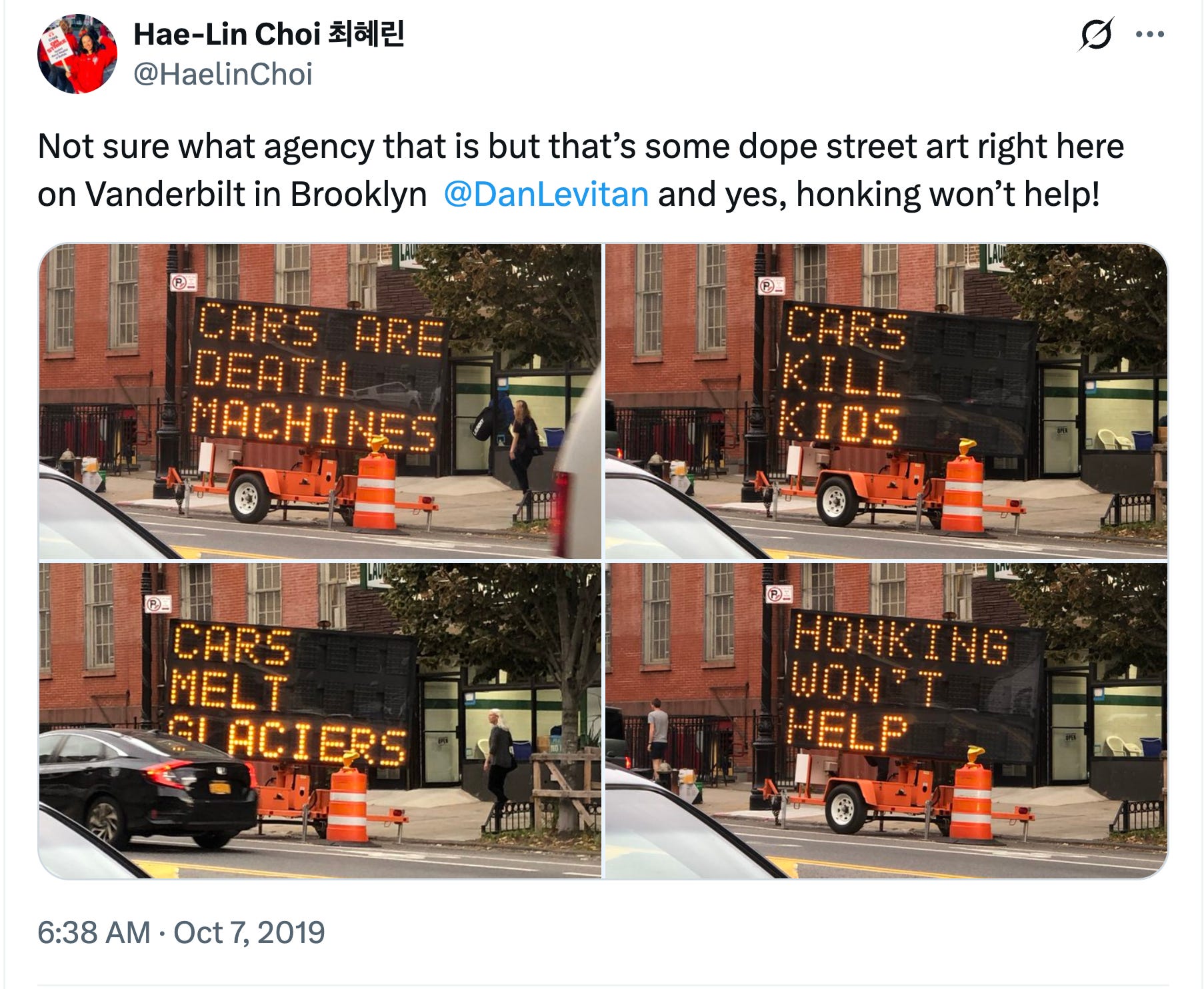
An anonymous Brooklyn activist called Bikesy hacked highway-style message boards in 2019 to flash messages like “CARS KILL KIDS” at drivers in residential neighborhoods, raising an obvious question: why was the city using expressway-grade signage on a quiet street in the first place?
Crosswalk Collective LA paints unauthorized crosswalks at intersections the city has ignored; the Los Angeles Department of Transportation sometimes tears them out within hours, only to install a sanctioned one later, once the unauthorized version has proven latent demand.
In Providence, bike commuter Jeffrey Leary lined a bike lane with 72 reflective-taped toilet plungers standing in for flex posts, and the city let them stay.
Weeks after a truck driver killed Boston cyclist Anita Kurmann on Massachusetts Avenue in 2015, cyclist Jonathan Fertig put (purchased) flower pots and (nicked) traffic cones along the bike lane, sparking copycat interventions nationwide.
The book’s authors use these examples to argue that tactical urbanism exists because frustrated citizens have learned not to wait for a kludgy, lawyer-sodden government. When official channels fail them—as they failed the cyclists on Mass. Ave. for years before Kurmann was killed—citizens take matters into their own hands. That we even needed to coin a term for “do it yourself because City Hall won’t” tells you everything about how well City Hall works.
But when amateurs take on the job that experts should be doing? That has consequences, too.
I’m not against tactical urbanism. I actually love it, because I’m so sick of how we’re slaves to endless process, and I welcome ideas to get us unstuck. But the book treats the legal and safety objections to unauthorized infrastructure as obstacles to be waved away rather than questions to be answered, and I don’t think that’s quite right. While the Park(ing) Day experiment was not risky, a crosswalk installed by amateurs sure might be. Someone could really get hurt by a poorly placed crosswalk, and the well-meaning intentions of the activists won’t be much comfort to that person or their family. Then there’s the liability question—who’s on the hook? The city? The activist? Nobody? I’d have liked to see the authors engage with that more seriously, because it made me itchy. And if it made me itchy when I’m mostly on board, it’s going to make lots of people even itchier.
Along similar lines, the book is more comfortable than I am with the Tyre Extinguishers, the anonymous collective in Britain that deflates SUV tires in wealthy neighborhoods and leaves a leaflet about emissions on the windshield. The Life authors call the tire deflation a “legal gray area” rather than vandalism. I was skeptical about that, so I looked it up, and the UK police certainly didn’t see it as a gray area. But the bigger issue for me is strategic. Deflating a stranger’s tires and calling it activism is the kind of thing that confirms every suspicion a skeptical reader already has about this movement being self-righteous and a little unserious. If the goal is to expand the coalition past people who already agree, deflating tires could backfire.
And on tone more broadly: The book and the War on Cars podcast are unapologetically anti-car. A reader who’s frustrated with the auto-centric status quo, curious about alternatives, and not yet sure where they land on any of this may put the book down before they get to the parts that would actually move them. I’m torn about whether catching more flies with honey than with vinegar works, because sometimes being spicy really works. Maybe it’s a mixed bag, winning some and losing some. And maybe it’s OK that this book sometimes made me uncomfortable?
For a book that’s ostensibly about life after cars, it is strikingly thin on public transit. If you live somewhere with real density (such as Brooklyn, where the authors live), then walking and biking can credibly replace many car trips. If you live somewhere rural or low-density—most of New Mexico, for instance—walking and biking will get you to the end of your driveway. A “life after cars” that doesn’t seriously reckon with public transit is leaving much of the country empty-handed.
A related missing piece, which I won’t belabor because I raised it earlier in this series, is land use. Car dependency isn’t just a car problem; it’s a housing and zoning problem. When the law requires big ol’ single-family lots, mandates parking, and bans anything denser than a duplex, you’ve built a place that cannot function without a car. All the bike lanes in the world can’t fix that. The book gestures at this through its parking-policy chapter, but never names land use as the central cause.
We end with Ray Bradbury’s 1951 short story “The Pedestrian,” in which a man out for an evening walk in a car-saturated future city is picked up by an autonomous police car and taken to a psychiatric facility for the crime of walking. Bradbury drew from his own life: in 1949, he was stopped by the Los Angeles Police Department on Wilshire Boulevard for walking at night with a friend. He was told to go home and not do it again. (You can listen to Bradbury himself tell the story here.) The authors use the story to lay out a choice—we can remain in a world where cars are so ubiquitous that walking is nearly criminal, or we can build toward a life after cars.
What happened to Bradbury in 1949 still happens today. Watch here to see how simply going for a walk with your young son can get you detained by police and violently thrown to the ground in the United States of America of 2024:
The conclusion then moves on to electric and autonomous vehicles, with the authors arguing that “the problem of cars can’t be solved with different cars.” Neither EVs nor AVs touch the core issues: the way cars destroy cities. From the book:
That doesn’t mean we shouldn’t pursue electrification aggressively, but we should be focusing on reducing the need for car ownership in the first place, while also electrifying public transit and delivery vehicles, rather than unquestioningly buying into yet another naive fantasy of harm-free personal motor vehicle transport as salvation.
Regarding AVs, the authors argue that, deployed in the existing built environment, AVs are more likely to entrench car dependency than to dismantle it. There are now some numbers to back up this argument. Economists Benjamin Shiller and Imke Reimers simulated a Greater Boston in which self-driving cars are widely privately owned and found that vehicle miles traveled would rise by 40% while public transit use would fall by about 10%. In a recent interview with Andrew Miller, Shiller explained why: in an AV, you can sleep, work, or watch something instead of steering. If it’s pleasanter to spend more time in your car, people will do that. They’ll tolerate longer commutes and move farther from their jobs—and sprawl and congestion will get worse.
The way out, in Shiller’s own numbers, isn’t hopeless: “I also found that with even small improvements in public transit, like increasing the speed just a little bit, you could completely offset the reduction in revenue that was attributed to self-driving vehicles,” he said.
I’ll repeat what I said in my Goodreads review: if you’re trying to explain to someone why American life feels exhausting and expensive and lonely, hand them this book. It’s a very good place to start. My mild criticisms aside, I wholeheartedly recommend this book. It’s a relentless roundup of all the ways we are so dependent on cars and an exhaustive account of the costs this has inflicted on society. I’d put it in the hands of anyone in New Mexico who’s ever wondered why the roads are so unsafe and the kids never seem to be outside anymore.
I want to end where the book ends: with encouraging readers to get active. The bolded words are their directives, and I’ve paraphrased the rest:
Learn to see cars. Sit in a park and notice you’re never out of earshot of traffic. Imagine a parking space used for something other than parking. The book pushes a small language hack here, too: call it “car storage,” not “parking,” because words can make the tradeoff more visible.
Engage with local government. Show up to the transportation board meetings about the bike lane or the road diet. Can’t show up? Send a written comment. Call your councilor. Find out who’s actually willing to take an unpopular vote and tell them you’ve got their back. Write thank-you emails when they make good decisions.
Find your people. Follow inspirational social media accounts; join a cycling, transit, or pedestrian advocacy group; join a group ride. Connecting with others who see the problem the same way keeps you from feeling like the problem is you.1
Preach to the unconverted. Their example: almost nobody, including the guy with the F-250 in his driveway, thinks Amsterdam or Paris would be improved by more cars. Another example: don’t be shy about bringing up car dependence when someone complains about gas prices.
Believe change is possible. This is something we have to keep renewing, because cynicism can creep in. The authors quote Danish architect Jan Gehl, speaking about the transformation of Copenhagen, “I think this is the most important thing: every morning when you wake up, you have to feel that your city is a little better than the day before. That is a nice feeling because it gives you hope for the generations to come.”
Previously in this series: Part I (A love affair with cars—or an abusive marriage?), Part II (Nature, bodies, neighbors: what cars cost us), and below, Part III:
A few accounts I follow on a couple of different platforms: Revélo Creative, Andy Boenau, Mark R. Brown, Sam Sklar, Peter Norton, Jon Jon Wesolowski, Angie Schmitt, Not Just Bikes, Transportation for America, and, of course, the War on Cars.
No posts
Comments
Nothing yet. Say the first thing.
Sign in to join the conversation.