
Last month, after looking through all the early statements, addresses, and homilies of Leo XIV’s young papacy, I made a prediction about a potential encyclical on artificial intelligence:
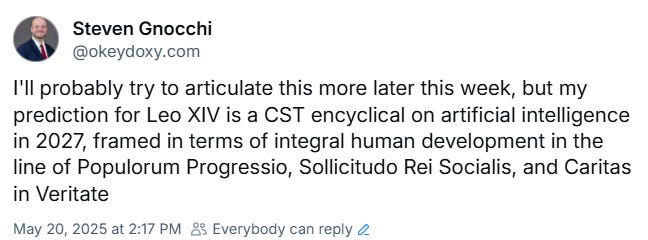
Now that I finally have a chance to come back to this, along with some conversations with colleagues, I want to (1) break out my prediction into a few pieces and (2) give my reasoning for each.
Leo XIV will write an encyclical on artificial intelligence
It will be his first encyclical
It will be a Catholic Social Teaching encyclical
It will come out in 2027, self-consciously in the encyclical line of Populorum Progressio (1967)
Confidence: High (90%)
In comments about why he took the papal name “Leo,” Leo XIV has repeatedly and specifically linked this (1) to Leo XIII’s encyclical Rerum Novarum, which was in response to the industrial revolution and its effects on workers and families, and (2) connected artificial intelligence to “another industrial revolution.” He has also ranked concerns about artificial intelligence on the same level of challenge as migration and “protection of our beloved planet Earth” (the latter of these subjects was the catalyst for Pope Francis’ encyclical Laudato Si’).
An encyclical would also bring significant attention to Catholic concerns around AI and the Church’s responses to it thus far. Indeed the Church has been actively engaging questions about ethics and AI for several years now, including the Rome Call for AI Ethics, the 2023 Minerva Dialogues, and most recently the publication of the doctrinal note Antiqua et Nova in January of this year. Jointly produced by the Dicastery for the Doctrine of the Faith and the Dicastery for Culture and Education, it’s a significant and worthwhile text that addresses a range of questions. It runs about 25 pages printed, which is short of what encyclicals tend to run in the last several decades (and it is not actually an encyclical, but rather a “note”). The text received some attention, particularly among those with active interest in AI, but it did not elicit the level of public awareness that encyclicals often do.
Confidence: Medium (50%)
Of the issues Leo has mentioned, this seems to me the one most likely to result in an encyclical in the near term. The other strong candidate in my mind on this is peace, which is another topic he has frequently emphasized, beginning with his first words on the balcony after his election.
Going back to Leo XIII (I did not look further), popes have consistently released their first encyclical within about a year of their election:
Leo XIII (1878-1903): Inscrutabili Dei Consilio, 1878
Pius X (1903-1914): E Supremi, 1903
Benedict XV (1914-1922): Ad Beatissimi Apostolorum, 1914
Pius XI (1922-1939): Ubi Arcano Dei Consilio, 1922
Pius XII (1939-1958): Summi Pontificatus (1939)
John XXIII (1958-1963): Ad Petri Cathedram, 1959
Paul VI (1963-1978): Ecclesiam Suam, 1964
John Paul II (1978-2005): Redemptor Hominis, 1979
Benedict XVI (2005-2013): Deus Caritas Est, 2005
Francis (2013-2025): Lumen Fidei, 2013
Francis is sort of a special case here. His first encyclical, Lumen Fidei, did come out in his first year, but it was really Benedict XVI’s unfinished encyclical (and conclusion to the triptych of Deus Caritas Est on love and Spe Salvi on hope). Evangelii Gaudium, which has been described as the programmatic document for Francis’ papacy, also came out in the first year and has many encyclical-like qualities, but was actually an apostolic exhortation that followed the 2012 synod of bishops on the new evangelization. Francis’ first solo encyclical, Laudato Si’, was not released until 2015.
My lower confidence on this is tied to the next two predictions, explained below.
Confidence: High (80%)
Again, Leo has explicitly tied his selection of name to Leo XIII and Rerum Novarum, which is widely seen as the encyclical that inaugurates the tradition of Catholic Social Teaching. AI is widely expected to have significant effects on labor, education, and war and peace, all of which are concerns within the ambit of Catholic Social Teaching. There are significant concerns around the impact of AI on the environment, and care for creation is one of the tenets of CST. Lastly, AI is an issue both for governments and for corporations, meaning that the concern is not simply a matter of individuals making choices but also about the larger structures of society, especially the political and economic structures.
Many, but not all, of the main texts of CST fall into one of two “lines” or “traditions,” marked largely by the year in which they are released. The larger and longer line are those texts that succeed Rerum Novarum specifically, which have been released in years ending in 1:
Quadragesimo Anno (1931), Pius XI
Mater et Magistra (1961), John XXIII
Octogesima Adveniens (1971), Paul VI (apostolic letter, not an encyclical)
Laborem Exercens (1981), John Paul II
Centesimus Annus (1991), John Paul II
These all have a clear and explicit reference point in Rerum Novarum, and this is also the line that Leo XIII has arguably most clearly appealed to when referencing artificial intelligence. There also hasn’t been a CST year 1 encyclical since 1991, so arguably we are due. However, if this hypothetical CST encyclical by Leo on AI was intended for this line, it wouldn’t be until 2031, six years from now.
Confidence: Low (30%)
The other main “line” of CST encyclicals is that following Paul VI’s Populorum Progressio from 1967. That encyclical focused especially on the idea of human development, building an argument that focused on the need for holistic or integral development of persons. This would not be limited to the economic or material conditions of development, but also the spiritual and cultural aspects as well. A key insight of it is the idea that the economy is not an end unto itself but instead must serve the flourishing of people as a whole.
This text was followed twenty years later by John Paul II’s Sollicitudo Rei Socialis in 1987. He continued this emphasis on authentic and integral development, especially in light of the challenges of the “third world” at the time. He discussed the reality of “structures of sin,” the idea that there could be institutions or structures that are themselves contrary to the will of God. Benedict XVI’s Caritas in Veritate was intended to come out in 2007 as a continuation of this line; it’s delay until 2009 was partly due to difficulties in writing and then due to the economic collapse of 2008.
It’s possible that Leo could tie a potential AI encyclical to this line of thinking, especially in terms of how AI can contribute to and/or detract from the authentic development of peoples. It would be a way to incorporate the many different issues about AI raised in Antiqua et Nova.
However, my lower confidence here comes from two things. One, that pushes a release for it back to year two of the papacy, which has not been the trend over the last century and a half.
Two, while there are these two main lines of CST texts, other CST encyclicals have not been so tied to the calendar. John XXIII’s Pacem in Terris (1963) was inspired in part by the 1962 Cuban Missile Crisis. Francis’ Laudato Si’ (2013) and Fratelli Tutti (2020), concerned with ecological devastation and the global response to COVID-19 respectively, were not tied into particular strains within CST. There’s nothing that “requires” CST texts to fall into one of those lines.
So while I am pretty confident Leo XIII will write a CST encyclical dealing with AI, I’m not as certain that it will be first or that it will be in a particular line within CST, and I definitely don’t think it can be both.
(1) The Inter Mirifica problem: the least regarded and least read of the Vatican II documents is Inter Mirifica, the Decree on the Media of Social Communications. This is not only true today, but was even true at the time of Vatican II. It was the only one of the documents where the gap between approve and reject votes narrowed over time.1
While the decree is actually much better than its detractors portray, one of its core problems is that communications technology, and technology in general, tends to develop and change so quickly that documents like this become obsolete. I think this will be even more the case with artificial intelligence. While CST texts are generally in response to contemporary issues and catalysts, the guidelines they express have a timeless and timely character to them. Threading the timeless and timely might be too difficult for artificial intelligence.
(2) AI as part of larger communications encyclical: an idea my friend and colleague Andy Staron floated to me earlier is that perhaps Leo will work on a broader encyclical on communications (or what the Catholic Church calls “social communications”). This would fit well with one of Leo’s early speeches to journalists, where he calls for a “different kind of communication,” oriented towards bringing people together, listening, and speaking the truth with charity. Here he’s building on Pope Francis’ last message for World Communications Day, which I wrote about here.
This is a good possibility, as it allows for something more comprehensive than AI but still with strong attention to AI. It also might help to avoid the Inter Mirifica problem a bit by being less tied to specific technologies. There have also been encyclicals on social communications before (Vigilanti Cura in 1936 and Miranda Prorsus in 1957), but none since Inter Mirifica.
I’ll be curious and excited to see what comes, regardless of what Leo XIV’s first encyclical turns out to be. As we are heading into summer and Leo heads off to vacation, I think we could get some news about his first encyclical after he returns.
Regardless, I’ll be happy to return here to see how I did.
May 30, 2026: here’s my follow up post in light of Pope Leo XIV’s Magnifica Humanitas:
Design, Development, and Disarmament
·
May 30
Pope Leo XIV’s first encyclical, Magnifica Humanitas, came out on Monday (but if you’re here you probably already know that). Many Catholics, theologians, and Catholic theologians stayed up very late or woke up very early for the press conference on the encyclical and then began furiously reading through the text. I probably would have done the same, bu…
According to Norman Tanner, the first vote on the schema that became Inter Mirifica was 2138 in favor to 15 against in November 1962; the November 1963 vote was 1598 in favor and 503 against. It was finally passed with “1960 in favor, 164 against, and 27 abstentions” following reluctance on the part of the Council fathers to withdraw or backtrack on the text after its strong initial support. Moreover, there was a desire to conclude at least one other text, in addition to Sacrosanctum Concilium, by the end of the second session of the Council. Norman Tanner, The Church and the World: Gaudium et Spes, Inter Mirifica (Mahwah, NJ: Paulist Press, 2005), 96-103.
Comments
Nothing yet. Say the first thing.
Sign in to join the conversation.