
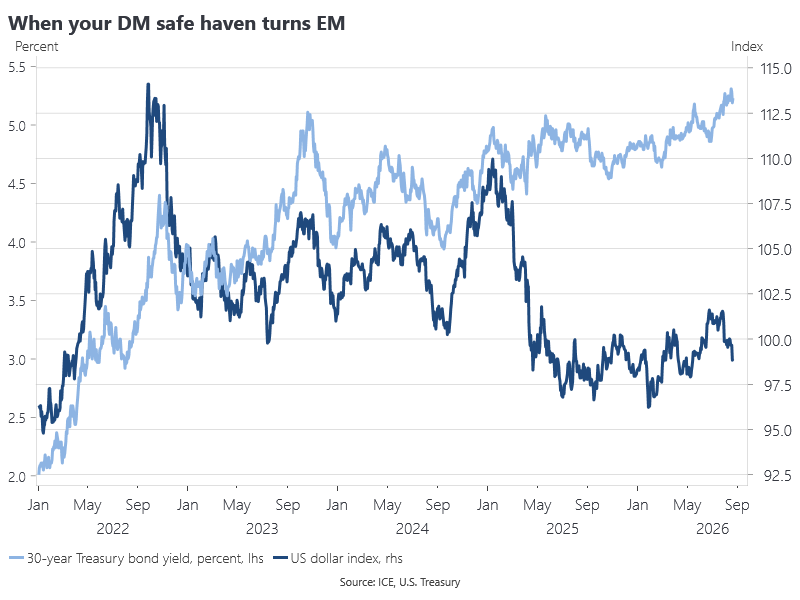
The US Treasury announced this week that it would double its long-end liquidity support buybacks, from USD 2 billion to USD 4 billion per operation in the 10-30 year sectors from 9 September through to early November. The announcement was enough to take 6 basis points off the US 10-year and 9 basis points off the US 30-year Treasury yield, the latter having reached its highest level since 2007 earlier in the week. More tellingly, the US dollar sold off and the announcement even breathed some life back into gold and BTC.
Liquidity buybacks, especially for off-the-run issues, are a perfectly normal part of Treasury debt management operations. But the doubling in liquidity support is clearly aimed at trying to put a lid on rising yields. The Treasury will finance the purchases through short-term bill issuance.
If this sounds familiar, it is because it’s precisely what Treasury Secretary Bessent accused his Democratic predecessor of doing back in 2024, based on a conspiracy theory advanced by Hudson Bay Capital’s Roubini and Miran. The claim was that the Biden administration was skewing debt issuance toward the short end to alleviate pressure on longer-term yields and juice the economy before the Presidential election. The skew was real but the suggested motivation was not. The Trump administration has not change the skew to short-end issuance.
The duration composition of debt issuance is ultimately a portfolio management issue. Increased short-end issuance makes sense if that’s where market demand is. The aim of Treasury issuance is to fund the government at least cost, while also managing interest rate, liquidity and other risks. In recommending an increase in liquidity buybacks in July this year, the Treasury Borrowing Advisory Committee (TBAC) recommended a uniform increase across the curve to avoid the operations being ‘misconstrued as weighted average maturity management,’ aka yield curve control.
Needless to say, that advice was not followed and misconstrued it was. The market interpreted it as an attempt at yield curve flattening and reacted accordingly. Following hot on the heels of the US Treasury’s joint intervention with the Japanese MoF in the yen using vehicles designed to avoid any upward pressure on US yields, markets have not surprisingly discerned a pattern of behavior.
Having decided the US Treasury is engaged in soft yield curve control, it was only natural for markets to also sell the USD, widening the wedge between the 30-year bond and DXY that has opened up post-Liberation Day 2025.
Comments
Nothing yet. Say the first thing.
Sign in to join the conversation.