
This week saw the passing of former Westpac chief economist Bill Evans. Bill was an outstanding market economist and built one of the best economics teams in the business. His calls on the direction of interest rates not only led those of his peers but would also often anticipate major turning points in the cash rate cycle. His timely 2011 call on a new RBA easing cycle marked the start of a trend that wouldn’t be reversed for more than a decade.
His views on interest rates became so influential they would significantly and persistently move market pricing. There were times when Bill arguably set the effective stance of monetary policy via the expected cash rate. Indeed, I would go so far as to argue there were times when Bill delivered more easing in monetary conditions than the RBA itself. In some ways, Bill just filled the void left by an RBA that was often unwilling or unable to articulate a coherent monetary policy strategy.
Bill’s standing was such that he could call out bad monetary policy in a way that would have seen other market economists cleaning out their desks the next day. In 2018, he was one of the first to draw attention to the RBA’s persistent failure to meet its inflation target and what he called a ‘structural fall in inflation that has not been addressed more aggressively with even lower rates due to concerns around housing markets.’
In June 2020, Bill made the case for negative interest rates, noting that the only reason it was not part of his forecast was that Governor Lowe had explicitly ruled it out. It is a good example of how he was able to balance the normative and positive aspects of calling the direction of the cash rate, perhaps the hardest aspect of being an RBA rates pundit.
That would not have been a popular position to hold. As I noted at the time, Governor Lowe told the House Economics Committee in February that year, even before the onset of the pandemic, that it would take a deeply negative cash rate to return inflation target in the near term. That only begged the question as to why the cash rate had not already been taken negative. Bill was consistent in arguing for more accommodative policy through the March-November 2020 period, even as the RBA feigned helplessness before an effective lower bound that was still not a binding constraint. Bill made much the same open economy case as I did for a QE program.
I had a respectful disagreement with Bill over his 2021 proposal to lower the inflation target and his opposition to a review of the RBA. I won’t rehash that argument here (see my contemporaneous post). Bill changed my mind on some issues though. I recall a dinner in the early 2000s with Bill, then RBA Assistant Governor Malcolm Edey and Manuel Panagiotopoulos at a Greek restaurant in Darlinghurst following Manuel’s annual Australian-Japan outlook conference, where Bill was a regular speaker. There was a debate at the time over whether the federal government should wind up the government bond market given the Commonwealth’s then-emerging negative net debt position, with gross debt outstanding approaching levels that called into question the market’s ongoing viability.
I argued that the RBA could still conduct monetary policy in the absence of a market for Commonwealth government debt. Malcolm said the RBA had looked into it and concluded that it could do it if it had to. But Bill was very insistent this was an essential piece of financial market infrastructure, including for monetary policy, a view that has been amply validated since.
If Bill could move the effective stance of monetary policy even in the absence of a move in the official cash rate, then that is surely true of the RBA itself. Indeed, the literature on the identification of monetary policy shocks suggests that central bank communication can be even more important than changes in the policy instrument. A change in the official interest rate taken in isolation is not very meaningful, a point long and well made by Scott Sumner. The policy narrative in which that decision is located is far more consequential to the expectations that determine the stance of monetary policy and its macroeconomic implications.
It is worth recalling that up until the late 1990s, the RBNZ conducted monetary policy largely through open mouth operations, albeit backed by the credible threat of changing the quantity of settlement cash. RBNZ Governor Don Brash had sufficient credibility to move market interest rates and the exchange rate through jaw-boning to effectively set overall monetary conditions. The RBNZ moved to a cash rate model from 1999 for good reasons, but it illustrates the point that changes in official interest rates are in some ways the least important aspect of monetary policy.
It is unfortunate therefore that central banks have increasingly moved away from forward guidance, since it is giving up a potentially very powerful policy instrument, increasing the burden on actual changes in official interest rates to give effect to central bank policy objectives. Kevin Warsh has famously eschewed forward guidance and RBA Governor Michele Bullock this week told the Australian Business Economists that she was very much with him on that issue.
Warsh’s unwillingness to engage in explicit forward guidance actually goes much further. He is unwilling to say much of anything other than making a mantra out of price stability, which begs the question as to how he intends to achieve it given inflation is above the Fed’s target. It turned this week’s post-FOMC press conference into an embarrassing farce. But that didn’t stop markets from reacting to the FOMC meeting. Even in the absence of a change in the Fed funds rate and with the post-meeting press conference almost entirely devoid of substantive content, we saw one of the most dramatic curve steepenings in response to an FOMC meeting in decades. Warsh might not be interested in signaling to the market, but that doesn’t mean the market isn’t taking a signal from Warsh (not to mention the three FOMC dissenters).
The curve steepening implies the Fed’s excess aggregate demand problem is expected to get worse. Warsh could address that issue without a change in the Fed funds rate, just by making different sounds with the hole in his face.
The few substantive comments Warsh did make all look like evasions. He suggested the Committee might look at other indicators besides PCE inflation, that they should look to other policies to combat inflation and that markets were tightening policy anyway. Productivity growth got a hopeful mention as well.
Warsh’s lack of public communication extends to private communication as well. According to Nick Timiraos in the WSJ:
He has said almost nothing about how the Fed reads the shocks now hitting the economy, or how policy should respond. Nor has he been more forthcoming in private: officials who sat through his first meetings came away without a clear sense of how he would approach the trade-offs ahead, according to people who have spoken with them. And where his colleagues describe a trade-off, at least in the short run, between fighting inflation and protecting jobs, Warsh denies there is one.
The lack of private comment gives the game away. The Fed chair has no ideas and doesn’t not want to be held accountable for any publicly or privately expressed view on policy that might come back to bite him. Warsh was savaged for his mistaken policy views when the first Trump administration sought to appoint him to the Fed. He does not want to give his future critics anything to work with.
He reportedly wants to do away with press conferences entirely. The financial market journalists are already calling bullshit, highlighting gross inconsistencies in his remarks. Those inconsistencies are all consistent with someone who has not thought seriously about his responsibilities and is just winging it. The lack of communication and the task forces are all intended to hide it.

Greg Ip@greg_ip
This Warsh contradiction has been nagging at me. At Sintra at the start of the month, he took comfort at the recent decline in bond yields, implying bond markets understood low inflation was on the way. Today, he took comfort at *higher* bond yields, saying they will deliver low
2:21 AM · Jul 30, 2026 · 208K Views
117 Replies · 128 Reposts · 938 Likes

Adam Ozimek@ModeledBehavior
The claim by chair Warsh that we needed all these blue ribbon panels and attempt to avoid answering questions by pointing to the panels was amateurish. I agree with his no hike, but the panels are more optics than anything and I don’t think thats a good way to earn credibility
10:27 PM · Jul 29, 2026 · 5.41K Views
7 Replies · 4 Reposts · 23 Likes
Warsh says he wants financial markets to think for themselves, but it is interesting that since QT got underway in March 2022, much of the price discovery in long-end yields takes place outside the window of FOMC meetings, reversing the pattern seen before then in which most of the secular decline in yields took place in that window. Markets are no longer looking to the Fed. The market response to this week’s FOMC meeting suggests Warsh might come to lament the judgements the market passes on Fed policy.
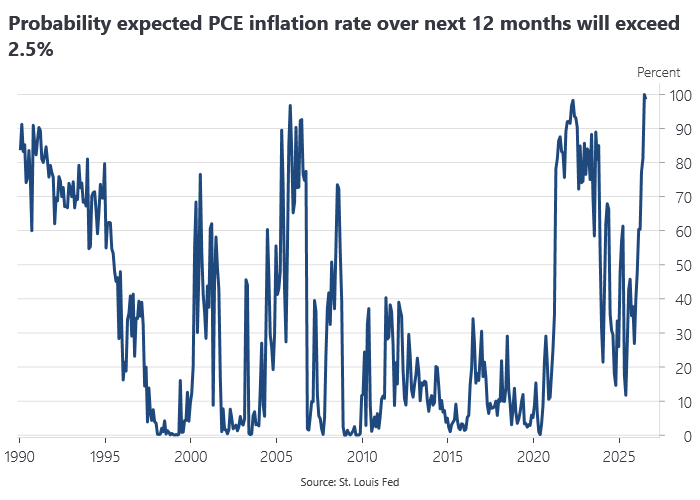
Here is a market-derived probability that expected PCE inflation over the next 12 months will exceed 2.5 percent.
Comments
Nothing yet. Say the first thing.
Sign in to join the conversation.