
In the context of the 250th anniversary of the US Declaration of Independence, JPM’s Michael Cembalest reviewed the status of US exceptionalism from a capital markets perspective. US dominance of global capital markets is a deeply entrenched structural feature of the global economy and is largely invariant to normal business cycle fluctuations. It has proven resilient to the depredations of the Trump administration, although still subject to a plausible counterfactual of even stronger US economic and market performance in the absence of those depredations.
Cembalest notes the long-run outperformance of US equities against global peers since 1900, outperformed only by Australia (’Australian exceptionalism’ was also once a thing). But US equities have underperformed peer markets since the ‘liberation day’ tariff episode.
Cembalest’s examination of relative equity market performance obscures this more recent underperformance, acknowledged only with a reference to ‘the recovery in non-US stocks in 2025.’ Tariffs are mentioned only once.
As the 250th-anniversary hook for Cembalest’s report suggests, US exceptionalism is ultimately downstream of the institutions that sustain it and those institutions, in turn, are downstream of the ideas that informed the Declaration of Independence and the Constitution. Those institutions do not change overnight, or even over a four-year presidential term, but institutions are also not self-sustaining or self-enforcing.
Cembalest notes:
The biggest medium-term concerns for investors in US assets, other than the sustainability of the US Federal debt and cyclical inflationary pressures: the increased unpredictability in the rule of law, and government defunding of science and sidelining of scientific expertise.
This is far from an exhaustive list, but fine as far as it goes.
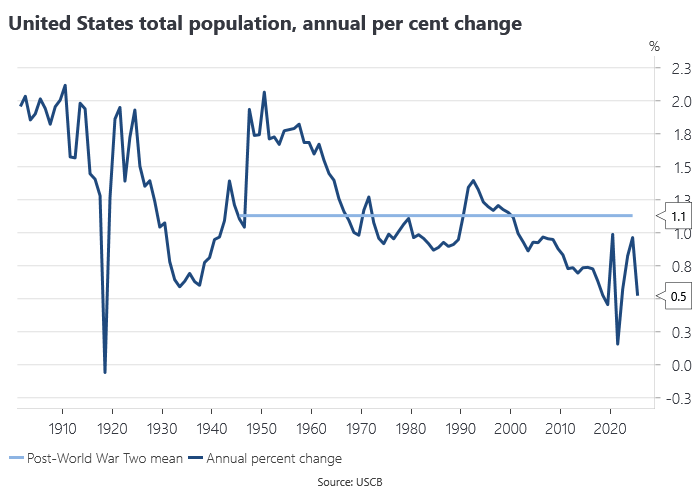
Immigration policy features prominently in his discussion of concerns relating to the rule of law, but the equally important implications of immigration for long-run trends in US demography are overlooked. As of mid-2025, US population growth was running at just 0.5% at an annual rate, less than half the post-World War Two average of 1.1% through to the end of the Biden administration. Monthly estimates of resident population were running as low as 0.2% in November last year.
Comments
Nothing yet. Say the first thing.
Sign in to join the conversation.