
In Ezekiel 8, the Lord, in a vision, shows the prophet Ezekiel vignettes of idol worship from across the city of Jerusalem: idols worshiped openly in gateways & secretly in houses, incense rising from censers, men praying to the sun. One of the vignettes is of women weeping:
“He said also unto me, Turn thee yet again, and thou shalt see greater abominations that they do. Then he brought me to the door of the gate of the Lord’s house which was toward the north; and, behold, there saw women weeping for Tammuz.”
This lament was a yearly ritual in which women would weep and cry over the death of the god Tammuz1. The lamentation took place in the nighttime between July 19th and 20th. It coincided with the first day of the Egyptian calendar, 1 Akhet 1. It also coincided with the heliacal rising of the star Sirius2, and the inundation (or flooding) of the Nile River.3
Tammuz was a shepherd-god of food and vegetation. He took care of his father Enki’s sheep.4 His name means “sprout of life,” and he was known as Duzu in Babylon and Dumuzi in Sumer5. (I will refer to him by the name Dumuzi in this rest of this post).
Dumuzi’s (Tammuz’) wife was Inanna (also known as Ishtar), who was the goddess of love, among other things.6
Inanna’s Descent Into the Underworld is a famous Sumerian myth. In modern times, the story is often called Inanna’s Descent or Ishtar’s Descent. Anciently, the poem was called From the Great Above to the Great Below, as that was the poem’s first line.
In the story, Inanna travels to the underworld and is brought before her sister, Ereshkigal (the queen of the great earth) and the seven Annunaki. In something that feels like Ghost Rider’s penance stare, Inanna is turned into a corpse by their eyes of death.
However, Inanna is not left in the underworld. Enki, her father-in-law, sends two creatures, kurgarra and kalaturra, to reanimate & return her corpse from down below.
In the 1950s and 60s, a new ending to the myth of Inanna’s descent into the underworld was published. It elaborated on Inanna’s return from the underworld, and gave us new insight into the lamentation of Tammuz. This new ending is a poem known as The Death of Dumuzi. This poem was collected and pieced together from disparate sources over many years. Here’s a chart of each of the poem’s 410 lines, and every artifact, whose text was pieced together to give us which line, of this new version of Inanna’s Descent & Dumuzi’s Death. I think the chart is a really fascinating look at how we get stories from history.
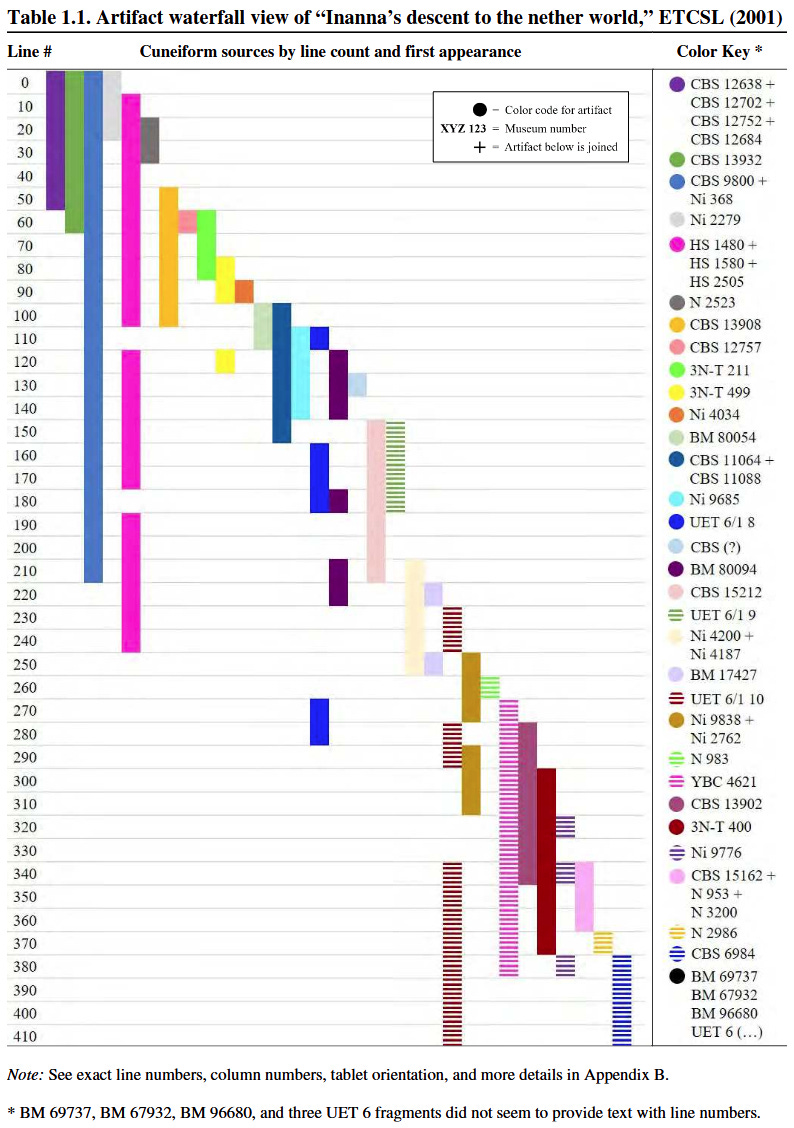
In 1934, there were eight pieces of text that formed the foundation for the reconstruction and subsequent translation of the “full” poem. In 1937, more of the story was found in ancient records at the Istanbul Museum of the Ancient Orient. In 1939 and 1940, more of the poem was found written in cuneiform in the University Museum at Philadelphia. Then, sometime in the 1950s, at the Yale Babylonian Collection, ninety-two new lines of the poem were discovered.
All of these pieces and elements of the poem were combined into what we know as Inanna’s Descent & The Death of Dumuzi in 1951 and published in Volume V of the Journal of Cuneiform Studies. Then, in 1960, Samuel Noah Kramer modified and added to the translation of those twenty-eight tablets and fragments.7
In this updated version of the poem, Inanna’s return from the underworld is not as cut and dry as it was previously presented. Inanna does not return to earth alone. She is followed by a trail of demons (known as galla). The demons insist that Inanna must either return to the underworld, or send another god in her place. Upon returning to earth, Inanna finds that her husband has become preoccupied with ruling Sumer. He sits on the throne, and wears royal robes. He is not mourning her death. Inanna decides the demons can have her husband.
When Dumuzi finds that the demons his wife brought with him from the underworld will kill him, his first reaction is to lay down in the field with his sheep and cry:
Text within this block will maintain its original spacing when published
His heart was filled with tears,
He went forth to the plain,
The shepherd--his heart was filled with tears
Dumuzi worries that his mother will have no one to care for her, and that his mother will be sad.
Text within this block will maintain its original spacing when published
Let my mother utter words of (lament).
Let my mother, Sirtur, utter words of (lament).
The fearful Dumuzi then falls asleep in this field. He has a dream. Later, his sister, Geshtinanna, interprets the dream.
Text within this block will maintain its original spacing when published
Oh, Dumuzi, your dream is not favorable which you tell me!
Rushes rise up all about you, rushes sprout all about you.
(This means) outlaws will rise up to attack you.
One reed standing all alone bows its head for you,
(This means) your mother who bore you will lower her head for you,
Dumuzi goes on the run from demons trying to kill him. He hides among the plants. Eventually he goes back to the city. He goes to his brother-in-law, his wife’s brother, who happens to be the sun-god Utu. Dumuzi begs Utu to turn him into a gazelle (or in some versions a snake) so that he can escape the demons.
Dumuzi does get turned into a gazelle. But, the demons still find him. Dumuzi prays, again, to Utu, asking to be turned into a gazelle a second time.
Then, Dumuzi arrives at the house of a woman, Belili, a wise old lady.
Text within this block will maintain its original spacing when published
Wise lady, I am not a man, I am the husband of a goddess,
Of the libated water, let me drink a little (?),
Of the flour which has been sprinkled, let me eat a little (?).
The demons find Dumuzi in the house of Belili. They chase him back to his sister’s sheepfold. They all take turns attacking him.
Text within this block will maintain its original spacing when published
The first galla enters the sheepfold,
He strikes Dumuzi on the cheek with a piercing (?) nail (?)
I first came across the story of Dumuzi in Chapter 21 of Hamlet’s Mill.8 It just so happened that, on the same day, I read Judges 4 & 5, which also includes the story of a man who is killed by a nail in the side of the head—Sisera. I thought that was interesting.
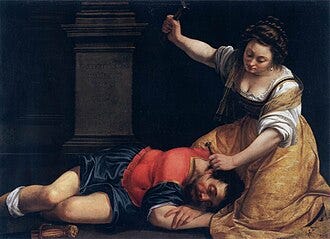
It got me wondering about the similarities between the story of Dumuzi, and the story of Sisera.
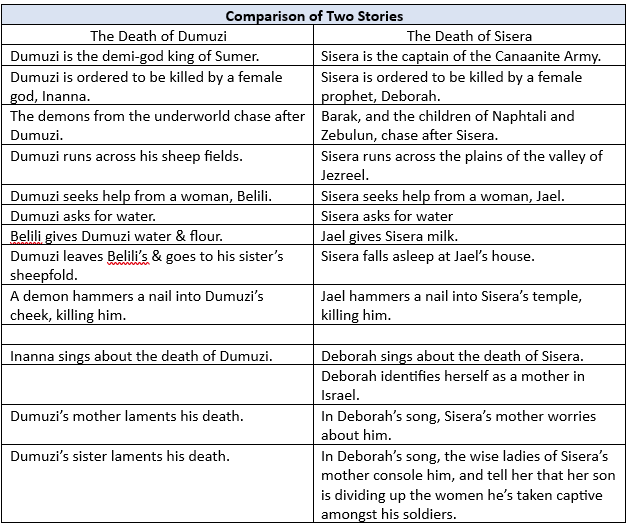
One way to look at these stories surprising similarities would be that the ancient writer of Judges was using established cultural motifs to shape his own history. The biblical writer detailing Sisera's was leaning into the well-known mythological framework of Dumuzi.
But what if it’s not merely imitation? What if this is appropriation with the intent of subversion? What if God took the story of Inanna’s Descent & The Death of Dumuzi, and intentionally structured a scenario, through commandments, that mimicked, and overshadowed, the Akkadian myth?
What if Judges is deliberately answering the Dumuzi story? What if it’s a counter-narrative?
What if God called Deborah as a prophet to specifically answer to the lament of Dumuzi? Deborah introduces herself as a mother in Israel. Was she taking the place of Inanna? Was worshipping the moon goddess Inanna becoming popular? Was attendance at the yearly festival of the Weeping of Women up? What if God had Jael kill Sisera with a nail in the side of the head to prove a point?
What if God had Deborah write a poem / song commenting on Sisera’s mother’s reaction, because that’s what happened in the Dumuzi lament? What if the presentation of Sisera’s mother, waiting at the window for her son to return, is mocking Dumuzi's mother, the goddess Sirtur? It’s an ironic takedown. In the same way that Elijah mocked the priests of Baal for not being able to call down fire to consume their sacrifice. It’s a subversive piece of female poetry.
What if God commands people to live their lives in a way that they become signs? He did it with Hosea & Gomer—one of my favorite stories from the entire Bible. What if God uses our actions to overwrite local myths? What if our literal lives are sermons?
There seems to be some more elements of this idea in the rest of Judges.
There is the story of Abimelech in Judges 9. At the end of that chapter, Abimelech is attacking a tower, and is almost killed by a woman when she throws a millstone from the top of the tower onto his head. Abimelech begs his armor bearer to kill him with his sword, before he bleeds out from the millstone damage to his head. Is this because Abimelech didn’t want to become another Sisera? Did he not want to be turned into a type? Or a sign?
There’s the story of Jephthah and his daughter in Judges 11. In this chapter, Jephthah sacrifices his daughter:
And it came to pass at the end of two months, that [Jephthah’s daughter] returned unto her father, who did with her according to his vow which he had vowed: and she knew no man. And it was a custom in Israel. That the daughters of Israel went yearly to lament the daughter of Jephthah the Gileadite four days in a year.
This feels a lot like the custom of the women weeping for Tammuz.
Which also happened to be the name of the fourth month of the Hebrew religious calendar.
An interesting note: Sirius, before the birth of Christ, was red in color. It is white to modern astronomers. No one is sure why exactly. But there are theories.
For this reason, Sirius was the most important star to the ancient Egyptians.
Noah Kramer, History Begins at Sumer, p.95
https://www.blueletterbible.org/lexicon/h8542/kjv/wlc/0-1/
Noah Kramer, The Sumerians, p.153.
Noah Kramer, The Sumerians, p. 156-160.
It’s a really interesting book that takes comparative mythology and attempts to correlate it to astronomical patterns. Chapter 21, “The Great Pan is Dead,” is a collection of myths that all relate to the star Sirius.
Comments
Nothing yet. Say the first thing.
Sign in to join the conversation.